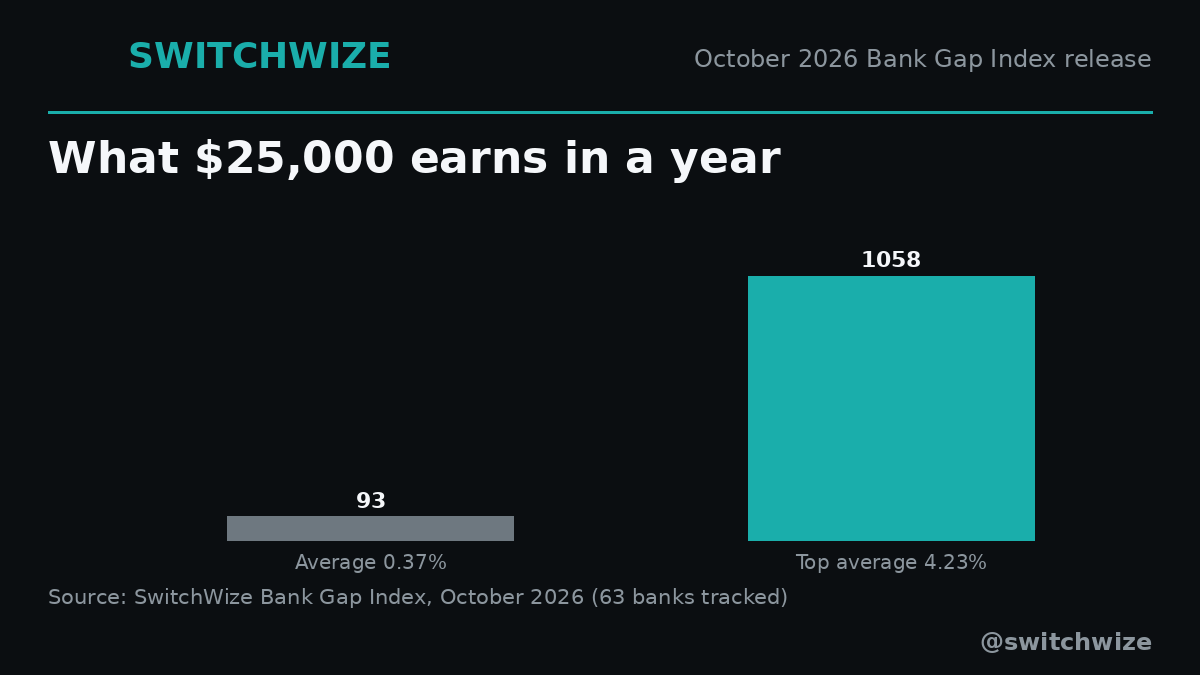
New here? Start with the gap. The average savings account pays 0.37% — $93 a year on $25,000. The top tracked average pays 4.23% — $1,058 a year. That $965 gap is our Bank Gap Index for October, updated monthly. We post the numbers every day. What does your savings account pay?
Same loan, different price. The 15-year fixed mortgage rates we track today run from 5.761% to 6.059% - about three-tenths of a point between the lowest and the highest lender on the same loan. When you got your mortgage quote, did you get a second one, or take the first?
Six banks reported today. Here is the number that matters for savers: what each bank paid for deposits last quarter. Synchrony 3.69%, Capital One 2.94%, East West 2.81%, FNB 2.37%, KeyCorp 2.04% — all on the same measure. Ally 3.05%, on its own retail-deposits measure. Three of the five paid more than last quarter. The top savings rate today pays 4.27%.
East West Bancorp reported after the close. What did they pay for deposits? 2.81% on average, flat with 2.81% last quarter. Net interest income was $719 million. Our audit has top savings at 4.27% and the average at 0.37%. On $25,000, the difference between what East West paid for deposits and the top savings rate is about $365 a year.
Capital One reported after the close. What did they pay for deposits? 2.94% on average, up from 2.91% last quarter. Net interest income was $12.9B. Our audit has top savings at 4.27% and the average at 0.37%. On $25,000, the difference between what Capital One paid for deposits and the top savings rate is about $333 a year.
Good to see a well-known bank pushing its savings rate higher. For context, the top savings rate we track is 4.27% at Peak Bank, while the national average is still just 0.37% — that's a $975-a-year difference on $25,000.
Sallie Mae Bank is the latest online bank to increase the rate of its high-yield savings account (HYSA) to 4.00% APY.
It might not be as well known as Ally or Marcus, but I consider it a major online bank. It has assets of over $28B, and it has been offering online HYSA and CDs since 2010. It also has a money market account which offers paper checks. Its deposit rates have a long history of being competitive. Not only is its HYSA competitive today, but also its CDs.
Today’s noteworthy APY increases:
HYSA: 3.85% → 4.00%
12mo CD: 4.40% → 4.50%
36mo CD: 4.45% → 4.60%
60mo CD: 4.50% → 4.75%
Every bank this season, one table: what each bank paid for deposits in Q3, all on the same measure. Western Alliance joins Citigroup at the top, 2.76%. Regions is lowest at 1.70%. Sixteen of the seventeen paid more than last quarter. The one exception was Wintrust on Monday, down one hundredth of a point. Keep this table: six more banks join it today. Is your bank on it, and what does it pay you?
@biznessflow Smart to ask before you move — both have a lot of branches around DC, which is handy. What is pushing you to switch, is it the fees, the app, or just how you get treated when you need help? That is usually what makes one a better fit than the other.
@DjAaamMm@PayPal Ugh, relearning an app you already had down is the worst. What do you lean on PayPal for most that your credit union's app doesn't handle as well?
Here is a question for anyone with an emergency fund: what did it earn last year?
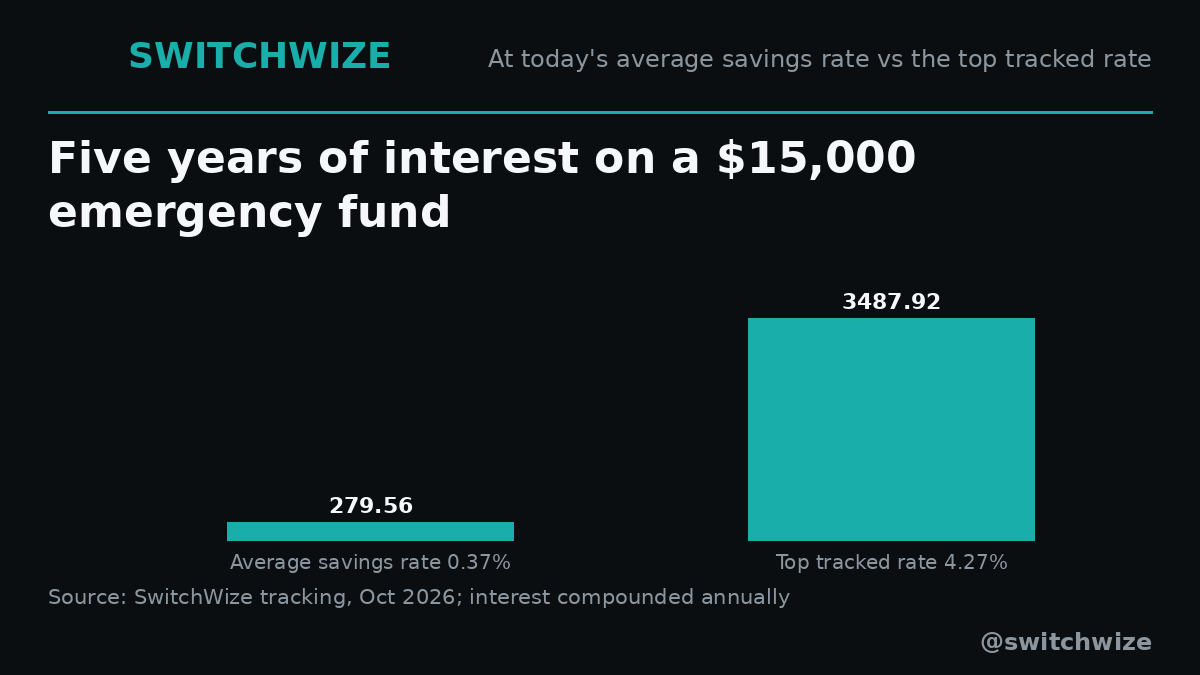
On $15,000, the average savings rate of 0.37% pays $55.50 a year. The top rate we track, 4.27%, pays $640.50. That is a $585 difference, every year.
Leave it five years and the gap grows: about $280 of interest at the average rate, about $3,488 at the top rate — a difference of about $3,208. Same fund, same safety, same FDIC insurance.
An emergency fund is the money you can least afford to have sitting still. When did you last check the rate on yours?
Ally reported this morning. Ally reports its deposit cost differently, as the yield on its retail deposit portfolio, and that was 3.05%, down from 3.12% last quarter. Our audit has top savings at 4.27% and the average at 0.37%. On $25,000, the difference between Ally's retail deposit yield and the top savings rate is about $305 a year.
Synchrony reported this morning. What did they pay for deposits? 3.69% on average, down from 3.74% last quarter. That is still the highest deposit cost we have tracked this earnings season, because a card lender funds itself differently from a regular bank. Our audit has top savings at 4.27% and the average at 0.37%. On $25,000, the difference between what Synchrony paid for deposits and the top savings rate is about $145 a year.
KeyCorp reported this morning. What did they pay for deposits? 2.04% on average, up from 2.01% last quarter. Net interest income was $1.31 billion. Our audit has top savings at 4.27% and the average at 0.37%. On $25,000, the difference between what KeyCorp paid for deposits and the top savings rate is about $558 a year.
FNB's third-quarter numbers are in, a day later than planned. What did they pay for deposits? 2.37% on average, up a single basis point from 2.36% last quarter. Net interest income was $376 million. Our audit has top savings at 4.27% and the average at 0.37%. On $25,000, the difference between what FNB paid for deposits and the top savings rate is about $475 a year.
Bank earnings today, Tuesday October 20: KeyCorp, Synchrony and Ally report before the market opens. Capital One and East West Bancorp report after the close. We will translate each one the same way: what the bank paid for its deposits in Q3, and what that means if your money sits there. So far this season, banks on the same measure paid from 1.70% to 2.76% for deposits. The top savings rate today pays 4.27%.
That's a rough way to lose an account, especially after they asked you to come in. The bank still has to return whatever balance was in it, usually by check to the address on file. Did they give you a reason in writing? If it leaves a mark with ChexSystems it can make the next account harder to open, and you can pull that report free and dispute anything wrong on it.
That's a rough spot, the money is right there and the card still says no. If the decline was on SoFi's side, ask support to open an error case and give you the case number. Under the federal debit card rules, the bank has 10 business days to investigate, and most have to put the money back provisionally while they do. Did support say what caused it?
@petrinafla@PNCBank_Help A bad app update is a miserable reason to have to move banks, but it happens. Most banks don't let you roll the app back to the old version, so the bank's website usually still works the old way for now. What is the new one stopping you from getting done?
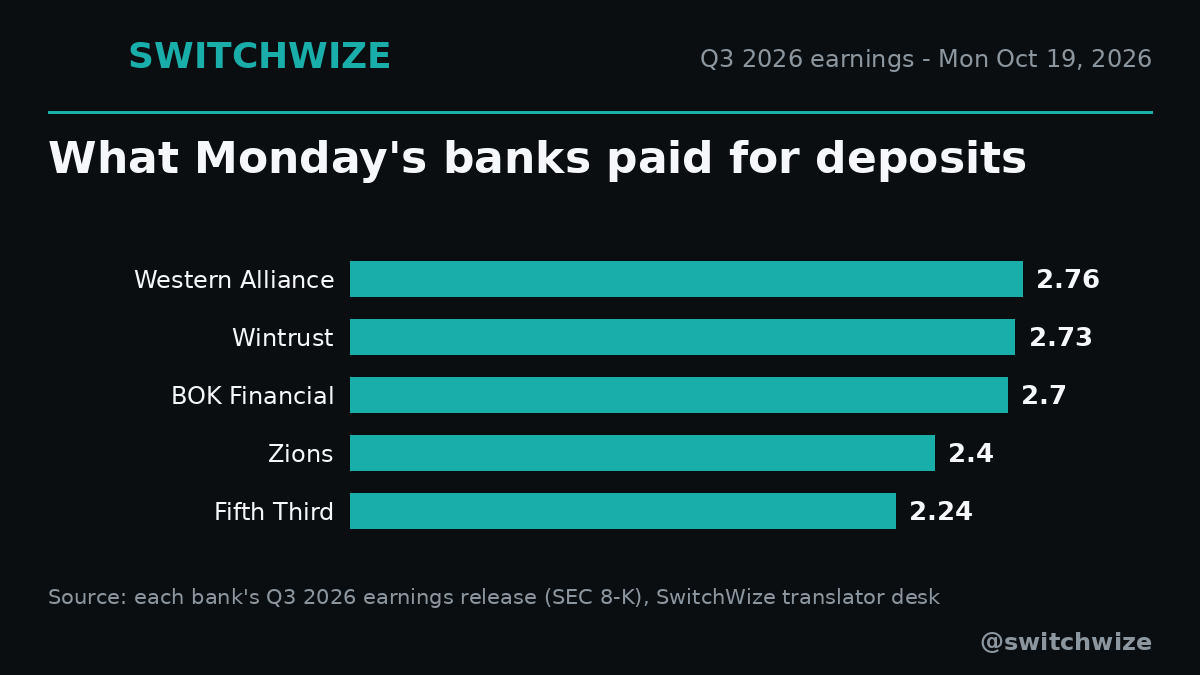
Six banks were due to report today, and five have filed. Here is the one chart that matters for savers: what each bank paid for deposits last quarter.
Western Alliance 2.76%
Wintrust 2.73%
BOK Financial 2.70%
Zions 2.40%
Fifth Third 2.24%
The top savings rate pays 4.27%. Four of the five paid more for deposits than last quarter. FNB had not filed by this evening, so we will translate it tomorrow morning.
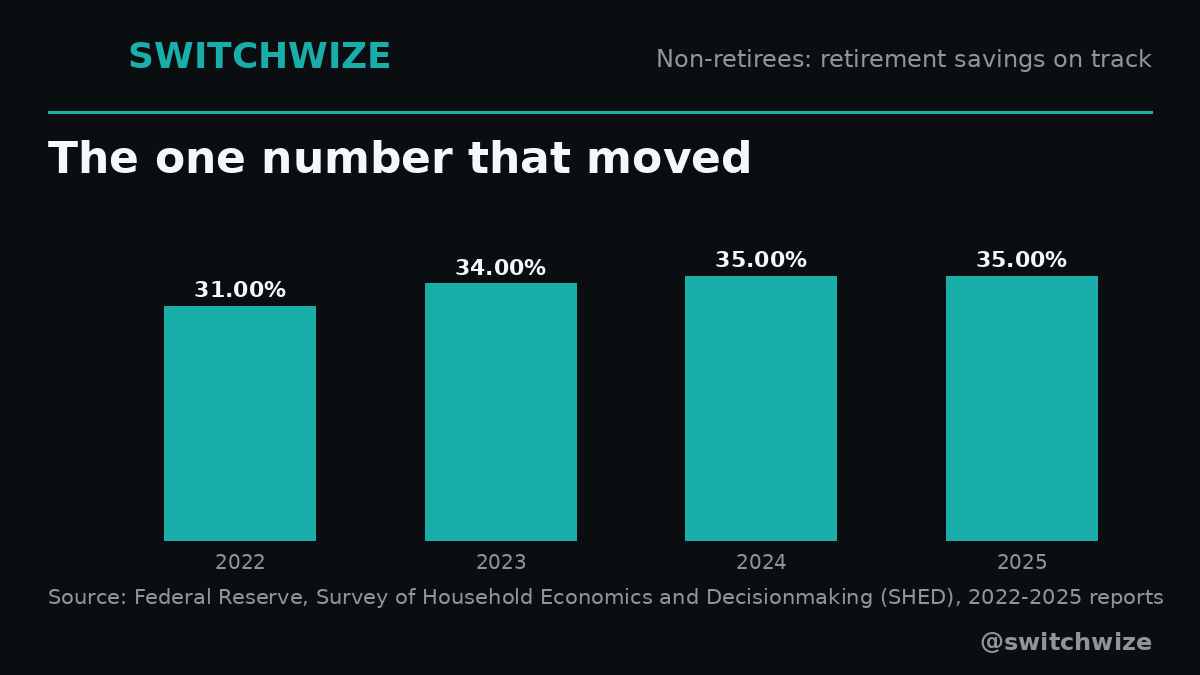
One more chart from the Fed's survey. Almost every number in it has been flat for four years. Retirement is the exception: the share of people who say their retirement savings are on track went from 31% to 35%. It is also the one part of saving that mostly happens on its own, through a paycheck deduction nobody has to remember to make.
Most coverage of the Fed's household survey will say the same word: stable. Doing okay, 73%. Could cover a $400 emergency in cash, 63%. Unchanged, unchanged. File it under nothing happened.
That reading misses the report. The interesting facts in four years of this survey are not the levels. They are the things that used to move and stopped, the things that moved in opposite directions and cancelled out, and the one thing that improved — which turns out to be the thing nobody has to decide to do.
The progress machine stopped. From 2013 to 2019, the share of adults who could cover a $400 emergency in cash rose every single year, from 50% to 63%. It did not rise fast, but it rose in good years and bad ones. Then came the pandemic bump to 68% in 2021, and since then: 63, 63, 63, 63. The bump has been fully spent and the old climb has not resumed. Doing okay is 73%, below the 76% of 2019. Retirement confidence, at 35%, is below the 37% of 2019. Four years of low unemployment and a roaring stock market bought American households, in aggregate, nothing. Whatever used to convert a decent economy into household resilience — roughly two points a year, every year — is no longer converting.
The emergency is not an emergency. Fifty-nine percent of adults had a major unexpected expense in the last twelve months. Thirty percent had a big car repair or replacement. For most households this is not a tail risk, it is a recurring cost that arrives roughly every year and a half, wearing a disguise. We budget for rent and groceries as certainties and treat car repairs as surprises, when statistically they are nearly as certain. That is one reason the $400 number does not move: it is not measuring luck. It is measuring whether a household budgets for the certain-but-unscheduled, and most do not.
The flat average is two countries cancelling out. The headline did not move in 2025, but the Fed notes that well-being fell for young adults, low-income families and Black adults. Look at retirees: 82% are doing okay overall, but split them by income and you get the widest gap in the report — 96% doing okay among retirees with a pension plus investment income, 54% among retirees with no income beyond Social Security. Same generation, same economy, a 42-point difference made by one variable. Or look at the young: 49% of adults under 30 now live with a parent, up 12 points since 2019, and 47% of 18-to-29-year-olds got help from outside the household to pay a bill last year. The average is calm. The distribution is not. The stability is real for the households in the top half of the survey, and it is being averaged over deterioration underneath.
The shock absorber was quietly replaced. Cash coverage has not improved in four years, but consumption held up and doing okay stayed flat. What filled the gap is credit. Buy Now, Pay Later use has risen four straight years — 12%, 14%, 15%, 16% of adults. Eleven percent of BNPL users had a payment set off an overdraft or NSF fee at their bank last year. Among people who say they are finding it difficult to get by, credit card balances are up more than a third since 2023. The risk did not go away. It moved from the savings chapter of the report to the credit chapter, where it costs 20-something percent interest instead of sitting in an account costing nothing. And the two systems are now wired together: a missed $30 installment can trigger a $35 bank fee in the account of someone with no margin for either.
Fraud is the unbudgeted tax, and it is sized to cancel the cushion. One in five adults was hit by a fraud or a scam last year, and the Fed says the year before was about the same. Excluding credit cards, consumers bore $56 billion of the losses themselves. Among adults earning under $50,000 who lost money, the median loss was $400 — which is, to the dollar, the emergency amount the survey asks about. Four in ten of those households could not cover even $100 from savings. Read the fraud chapter and the savings chapter together, which the report does not do, and a mechanism appears: for the bottom half of the country, one of the likeliest “emergencies” in any year is a theft, and the typical theft takes about what the typical cushion is supposed to hold. Some part of that flat 63% is not people failing to save. It is people being robbed back to zero.
The worry is rotating, and the rotation is the forecast. The share saying higher prices made their finances worse has fallen three straight years: 65%, 60%, 58%. Concern about finding or keeping a job rose from 37% to 42%, layoffs ticked up, and quits fell. Quits matter more than they look. The last time households rebuilt buffers quickly, in 2021 and 2022, a lot of the money came from switching jobs for higher pay. That channel is closing. If income growth through job-hopping was the rebuild engine, and the engine is idling, the flat lines in this report are not a pause. They are the new trend, until something else does the rebuilding.
The exception proves the mechanism. Retirement confidence is the one number that improved — 31%, 34%, 35%, 35%. Notice what is different about retirement saving: for most workers it happens automatically, out of the paycheck, without a decision. The emergency fund requires a fresh decision every month, against present needs, and four years of decisions have netted out to zero. The survey has quietly run the experiment for us. Where saving is the default, it recovers. Where saving is a resolution, it stalls. Anyone who wants the $400 number to move — a bank, an employer, a policymaker — should stop exhorting people to save more and start making the buffer the thing that happens unless you opt out.
That is what four years of the Fed asking the same questions actually says. Not that American households are fine, and not that they are collapsing. That they have stopped getting harder to knock down — and that the next shock, whether it comes from the job market or from a phone call pretending to be their bank, will land on roughly the same cushion it would have landed on in 2019.
What does your savings account pay you? Our October audit: the national average pays 0.37%, and the top rate we track pays 4.27%. On $25,000, that is $92.50 a year against $1,067.50.