Ungloved, the new 1X hand looks beautiful.
25 DoF, tendon-driven, force-controlled, tactile sensing, IP68 sealed, ±0.2mm positioning accuracy.
1X has already described NEO as being built in America’s most vertically integrated humanoid robot factory, and that strategy shows up here too; every hand is built end-to-end in-house, from tendon materials and 1X Motors to soft polymers, skin and tactile sensing.
They have stated hundreds have already come off the line, with capacity for 10,000 hands this year.
Introducing NEO’s 25 Degrees of Freedom, tendon-driven hands — nearing or surpassing human-level dexterity, strength, speed, and reliability.
For seventy years, robotics worked around the hand problem. The humanoid bet is the reverse: it lives or dies at the fingertips.
Today, we’re launching GPT-Live-1.
This model can listen, speak, reason, and hand off complex work all at once, without ever breaking the conversation.
Most people will see GPT-Live-1 as a better voice model. To me, the exciting part is much bigger: it’s an early glimpse of what it feels like when superintelligence becomes ambient and effortless to interact with.
It’s the beginning of a new interface to intelligence.
And we are still very, very early.
The approach here is exactly right. Pairing builders with domain experts, and grounding the work in the company’s real knowledge, systems, and workflow context.
Most AI initiatives don't stall for a lack of ambition or model capability, but because the people building the tools or workflows are too far removed from the friction of the actual work.
The breakthrough happens when you combine technical builders, domain experts, and the scattered knowledge, workarounds, context behind the workflow itself.
You can’t redesign the future if you’re too far removed from the friction of the present.
We're opening the waitlist for our Monetization Gateway, which will allow you to charge for any web page, dataset, API, or MCP tool behind Cloudflare. The charges will settle in stablecoins over the x402 open protocol. https://t.co/pvICtEIixj
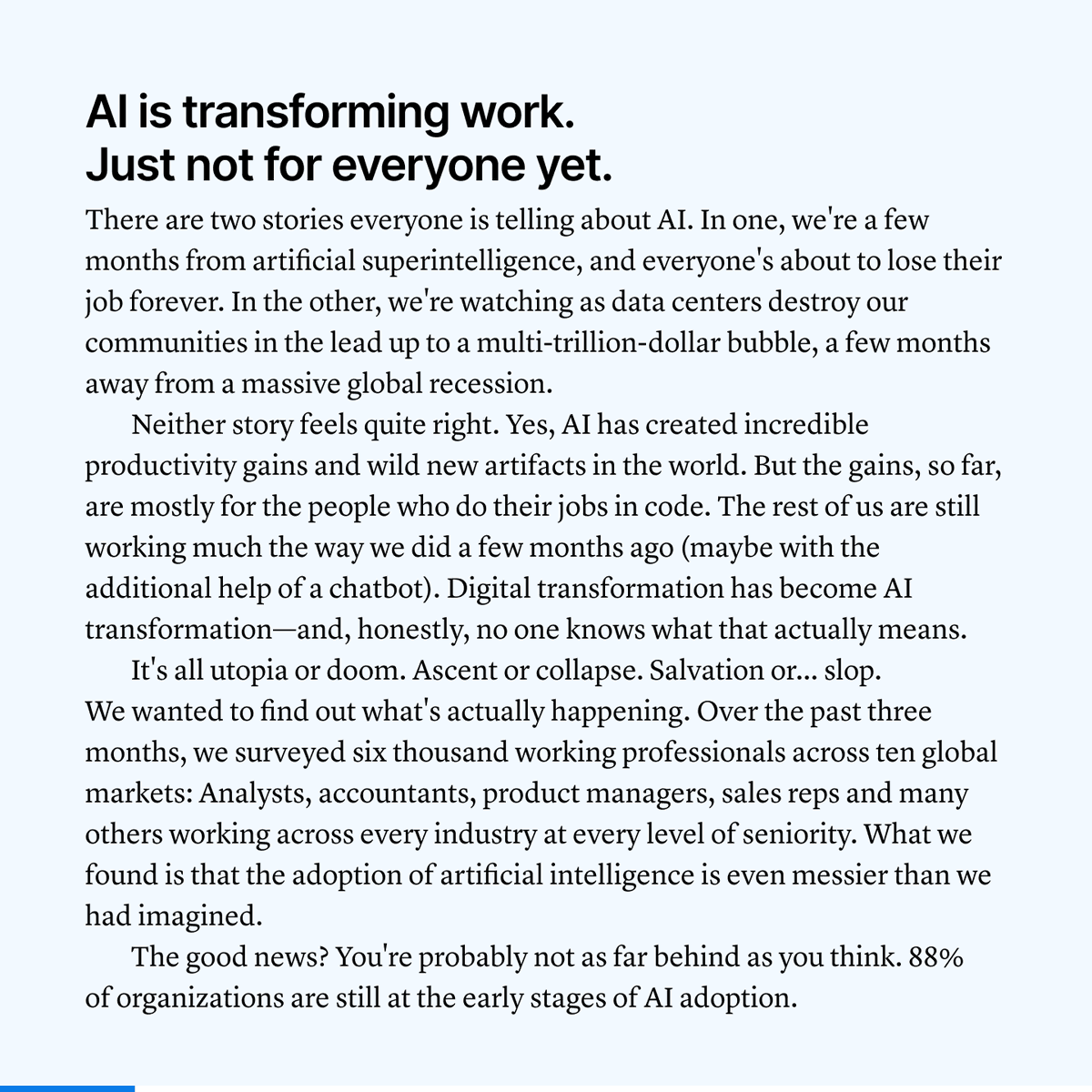
AI is moving fast. Most companies aren't.
The loudest stories come from the edges - autonomous agents, massive job losses, whole industries about to flip. Read enough of these stories and it feels like you’re behind and everyone else is way ahead.
This didn’t feel quite right to us. So we surveyed 6,000 professionals across 10 markets to map where AI at work actually is. Here's what we found 🧵
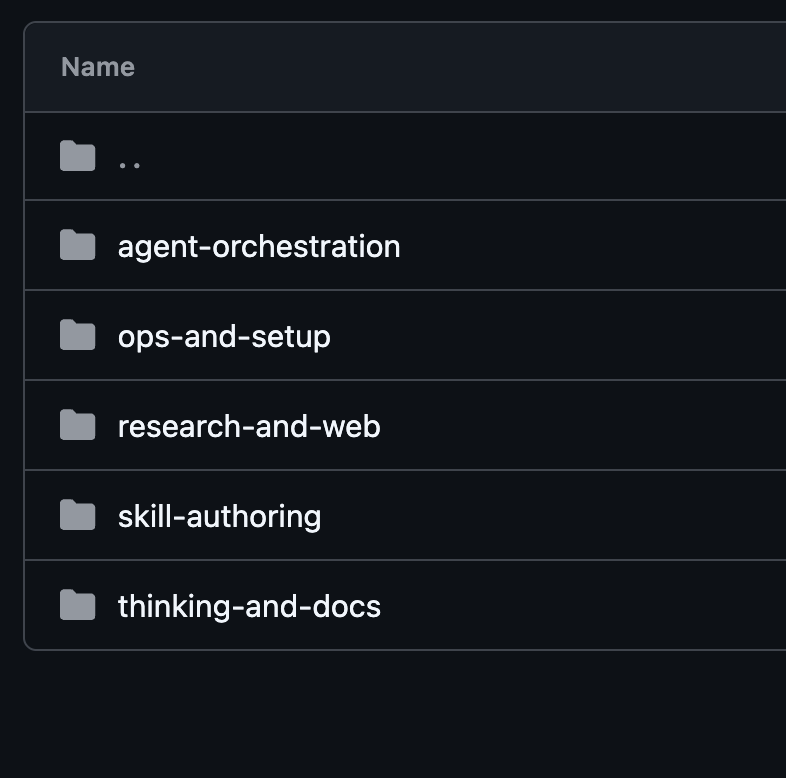
im releasing all my agent skills to the public
this is hundreds of hours of trial & error
every single global .agents skill i have
go grab it. it's free.
Our thoughts on the importance of AI sovereignty.
1. Your AI sovereignty dictates your institution’s future. Sovereignty is the precondition for choice. Relinquishing sovereignty transfers the future choices of your institution to others, who are likely to exploit it for their gain and your loss.
2. Data retention is your treasure. Transfer it at your own peril. Your ability to win is dictated by your ability to recognize and use your unique edges, and you keep winning by compounding the underlying data to generate new insights. Transferring that data hands over access to your pre-existing winning plays and yields the means of production for new ones.
3. Tokenmaxxing hijacks your value orientation and decreases your institutional fortitude and intelligence. The pursuit of high token usage incentivizes disposable scripts over robust software — with the addictive feeling of false progress. There is a reason why those selling tokens refuse to charge based on value.
4. Controlling your weights is controlling your fate. Weights are the distilled form of hard-won, accumulated institutional knowledge. If you let others control your weights, you are allowing them to migrate the alpha of your business to theirs.
5. There is no contradiction between sovereignty and alpha. The architecture that maximally preserves sovereignty is one that enables institutions to own their tribal knowledge, and to compound it as alpha.
6. Politicizing the technical issues involving sovereignty is what your adversary wants. Techno-politicization is the wellspring of false sovereignty. Techno-politicization drives decisions that seem to reduce dependency, but ultimately limit agency — especially on the battlefield in the West.
7. Real expertise is existential. Allowing politics or favoritism to determine your technical decisions rewards whoever is best at politics, not whoever is right. Listen to those closest to the problems, not those speaking most compellingly about them.
8. Learn from institutions that are winning or that have consistently delivered. Institutions facing existential threats do not have the luxury of making technical decisions based on political preferences.
9. Only listen to institutions, countries, and people who have a proven record of being right. A track record of correctness is the best and only signal for future correctness. Judging something as right or wrong based on who you like is exceedingly misguided.
The Midjourney scanner is revolutionary. There’s a bullish case that exceeds the most optimistic takes.
I was at the unveiling and used the scanner myself. I personally want to experiment with a weekly whole body Midjourney scan to add to my 1.5 billion data points and let my AI and doctors start connecting the dots.
Most of the early commentary has focused on the wrong questions: “is it as good as MRI?” and “what about false positives?” These are legitimate concerns, but they miss the bigger shift.
The more important question is: what does fast, low cost, safe whole body imaging unlock?
Let’s start with measurement.
A speedometer tells you how fast you are going. A fuel/battery gauge tells you when to stop. A thermostat tells you what to wear. The stock price tells you how much money you’ve made or lost. We measure what we care about.
Except, oddly, for our bodies, which are among the least measured things in our lives. Most people have more data on their favorite sports team, bank account, and social media performance than their body. The future will think we were crazy for this.
The first law of medicine is to do no harm. Our current system has harm baked into it.
+ an undiagnosed condition progressing silently is harm
+ a doctor who can’t easily get a patient screened preventively is harm
+ having no baseline to compare against when something shows up is harm
Our preventive net is narrow and inconsistent. Late stage diagnoses that could have been caught earlier remain common. Midjourney’s technology won’t eliminate that overnight, but it points toward a future where routine wholebody baselines become normal rather than exceptional.
Midjourney can help flip harm-by-default into a new expectation for our health infrastructure: almost no one will ever again be blindsided by a late-stage, life-threatening diagnosis that could have been caught earlier reasonably and cost-effectively.
Some examples of what earlier structural visibility enables:
+ breast cancer caught while localized has a ~99% five year survival rate. Once it has spread distantly, that drops to around 32%.
+ an abdominal aortic aneurysm kills more than 8 in 10 people when it ruptures. A single ultrasound finds the aorta in 99 percent of people, and screening cuts aneurysm deaths by a third to a half.
Midjourney’s technology will not do it all on its own. Its full angle, water immersion approach works around bone rather than seeing through it, and routes bowel gas to image the full abdominal cross section. Yet two real limits remain: air filled lungs stay a blind spot even here, and the brain is out of reach behind the skull, beyond the torso and legs this scanner covers.
That is fine, and they may improve these areas over time. Midjourney doesn’t need to do it all in order for it to be one of the biggest things to hit medicine in a long time.
Let’s look at where specifically Midjourney may be useful to each of us. We’ll start with where we get data today:
1) Blood draws tell us what is happening chemically.
2) Wearables tell us how the body is functioning.
3) Imaging tells us what is happening structurally.
The third layer, soft tissue, is the one we have never been able to access easily. MRI is great, but it is expensive, intimidating, and slow.
Midjourney's technology excels with soft tissue. Here are three places it could be game changing. There are many more.
1. Metabolic health - fatty liver is one of the earliest structural signs of metabolic dysfunction. It’s strongly linked to insulin resistance, type 2 diabetes, and cardiovascular risk. Being able to track visceral fat, muscle fat infiltration, and liver fat over time could give a much clearer picture than blood markers alone. Over 88% of Americans are metabolically unhealthy.
2. Endocrine tissue - the same metabolic patterns often cluster with thyroid issues, PCOS, and hypogonadism. Ultrasound can directly image the thyroid and ovarian structures. Fat tissue itself is an endocrine organ, so tracking it structurally adds another useful data layer.
3. Soft tissue + multiomics - new proteomic aging clocks can already predict risk for many chronic diseases from blood proteins. These molecular models could become significantly more powerful when combined with actual structural imaging data. The two are complementary, not competitive.
The real advantage: baseline + longitudinal tracking
The biggest unlock isn’t a single scan. It’s having a baseline followed by regular follow-ups. A one off scan in a moment of concern turns every finding into a potential crisis. Without context, you have no idea whether something is new, stable, or changing. With baseline + repeated measurement, the question changes from “what is this?” to “is this changing?” Most incidental findings stay stable. The dangerous ones tend to grow or evolve. Trajectory is often more informative than any single image or timepoint.This is why false positives become more manageable with frequent, low-friction imaging.
Midjourney has a difficult road ahead. Building robust, clinically validated medical hardware and software is extremely hard. Regulatory, technical, and adoption challenges shouldn’t be understated. Also, David is doing this for the right reasons and he’s well positioned financially to push through the difficulty.
On the horizon
We are moving quickly into a future where we will have continuous biological measurement. It will be all around us, a lot of it invisible and autonomous. Measurement will be in our gyms, beds, homes, clothing, offices, cars, glasses, and wearables. It will also be inside of us, in tissue and circulating in our blood vessels. This moves us from managing crises to preventing them. But this future will not just show up. We need bold builders like David and his team, willing to do the hard work.
Let me explain why an AI art company just built a full-body medical scanner, because almost everyone is reading this as a random pivot.
Ultrasonic CT works by firing sound through your body and recording the ripples that scatter back. Half a million emitters the size of a grain of sand, surrounding you in water, each one listening. What comes back is noise. Reconstructing a clean 3D image of muscle and tissue from that scattered acoustic mess is an inverse problem, and it is brutally hard. The hardware is the easy part. Butterfly Network already makes the chips. The reconstruction is where every previous attempt stalled.
That reconstruction is the exact problem Midjourney spent years getting good at. Turning ambiguous input into a coherent image is what they do. They aimed it at sound waves instead of text prompts.
This is why the scan takes 60 seconds while a full-body MRI takes 60 to 90 minutes. Close to 100x faster, no radiation, no magnets, resolution down to a fraction of a millimeter.
Then read the part most people skipped. The scans happen at a spa. Hot tubs, cold plunges, and a machine that quietly images your whole body while you relax. The scan is a side effect. You barely notice it.
Run it forward. The plan is 50,000 machines doing a billion scans every month. Midjourney has no investors and no quarterly hardware margin to chase. The payoff was never the scan fee.
A billion monthly full-body scans is the largest longitudinal map of human anatomy ever assembled. Every model trained on it gets sharper, and every sharper model makes the next scan worth more. This was always an image company. They just found a kind of image nobody else could generate.
Introducing the Open Knowledge Format (OKF), an open specification that formalizes the LLM-wiki pattern into a portable, interoperable format.
AI is only as smart as the context we give it. As we build more advanced, agentic AI systems, they need accurate metadata and context to be useful. But in most organizations, that context is locked inside fragmented data catalogs, isolated wikis, scattered code comments, or the minds of senior engineers. Every time a new AI agent is built, teams are forced to solve the exact same context-assembly problem from scratch.
To solve this, we've announced OKF, a vendor-neutral, open specification that formalizes the "LLM-wiki pattern" into a portable, interoperable format. It provides a standardized way to represent the enterprise knowledge that modern AI systems rely on.
— Just markdown: readable in any editor, renderable on GitHub, indexable by any search tool
— Just files: shippable as a tarball, hostable in any git repo, mountable on any filesystem
— Just YAML frontmatter: for the small set of structured fields that need to be queryable: type, title, description, resource, tags, and timestamp
We’ve also shipped reference implementations to help you hit the ground running, including an enrichment agent for BigQuery, a static HTML visualizer, and live sample bundles on @github → https://t.co/ilhAMCrcTc
➕ Knowledge Catalog can now natively ingest OKF!
Stop reinventing data models and building bespoke integrations for every new AI tool. Here's more about how OKF works → https://t.co/FR4kJRsgEH
Announcing Artificial Analysis Intelligence Index v4.1: a shift toward agentic workloads, featuring upgraded benchmarks and new per-task metrics
The Artificial Analysis Intelligence Index is our synthesis metric for assessing model intelligence and tracking AI progress. v4.1 marks a broader shift toward agentic workloads, with three main changes:
Updated and reweighted evaluations toward agentic tasks:
1. We upgraded three evaluations, removed one, and reweighted the Intelligence Index:
➤ Upgraded Terminal-Bench Hard to Terminal-Bench 2.1 and τ²-Bench Telecom to τ³-Bench Banking. Both move to newer, more robust task sets with harder, more realistic agentic scenarios that better separate frontier models
➤ Upgraded GDPval-AA to GDPval-AA v2. The upgrade re-baselines Elo to human performance at 1000, introduces a rotating panel of frontier-model judges, and raises the turn limit from 100 to 250 for longer-horizon agent trajectories
➤ Removed IFBench due to saturation. The benchmark no longer distinguishes frontier models sufficiently, so we have removed it from the Intelligence Index. We will continue to run it and publish results on new model releases
2. Cost per Task, Time per Task, and Tokens per Task:
Three new per-task metrics, reported for every model and based on the Intelligence Index. We take the total cost, total time, and total output tokens for a model to run the Intelligence Index and divide by the number of tasks across its evaluations, giving the average cost, time, and output tokens to complete a single Intelligence Index task
3. Cached input token reporting:
We now report cached input tokens and their impact on cost, including the cost to run the Intelligence Index, to better reflect the real cost of running each model
Key Results:
➤ Leading models: Claude Fable 5 (with Opus 4.8 fallback, 60) leads the Artificial Analysis Intelligence Index v4.1 by four points but is currently unavailable, leaving Claude Opus 4.8 (max, 56) as the most intelligent available model, ahead of GPT-5.5 (xhigh, 55) ➤ Open weights leading models: Among open weights models, DeepSeek V4 Pro (max, 44) and MiniMax M3 (44) lead, followed by Kimi K2.6 (43) and MiMo-V2.5-Pro (42)
➤Cost per Task: Claude Opus 4.8 (max) is the most expensive available model at $1.78 per task, with Claude Fable 5 the highest overall at $3.25. GPT-5.5 (xhigh) scores within a point of Opus 4.8 on the Intelligence Index at $0.99 per task. DeepSeek V4 Pro (max) stands out on the Intelligence vs Cost per Task chart at $0.04 per task, with other leading proprietary models costing 20x to 45x more
➤Time per Task: time per task (inference decode time) ranges from 1.5 minutes for Grok 4.3 (high) to 13.5 for Claude Sonnet 4.6 (max), a roughly 9x spread. Claude Opus 4.8 (max) completes a task in 6.4 minutes and GPT-5.5 (xhigh) in 3.7, while Gemini 3.1 Pro Preview stands out on the Intelligence vs Time per Task chart at 1.6 minutes for a score of 46
You are a taker, not a maker. All you’ve done your whole life is take from the makers of the world.
The zero-sum mindset you have is at the root of so much evil. Once you realize that civilization is not zero-sum and that it is about making far more than one consumes, then it becomes obvious that the path to prosperity for all is just let the makers make.
Regarding Tesla, the reality is that I have been given nothing.
However, if I lead Tesla to become the most valuable company in the world by far and it stays that way for 5 years, shareholders voted to award me 12% of what is built. Anyone who wants to come along for the ride can buy Tesla stock.
If Tesla “merely” becomes a $1.999 trillion dollar company, I get nothing. This is a great deal for shareholders, which is why they voted so overwhelmingly to approve this, for which I am immensely grateful.
And they did so by a margin far more than you won your political seat.