@levikov This is manufactured identity that can be bought. The next level is encapsulating emergent identity. That’s the trillion dollar product. iykyk
The person who figures out how to sell identity to people who hate themselves is going to be worth more than every info product guru on earth combined and nobody is framing the opportunity correctly…
Every purchase over $50 is an identity purchase. Nobody buys a $200 skincare routine because they ran the clinical data. They buy it because they want to be the type of person who has a $200 skincare routine. The product is proof of who they're becoming
This applies to everything. A trading course isn't education. It's a costume change. The buyer wakes up Monday morning and they're "a trader" now. A fitness program isn't a workout plan. It's permission to call yourself disciplined. A paid community isn't access to information. It's a membership card to an identity they couldn't get into before
The markets printing the hardest right now all exploit this at the core:
Carnivore diet stuff converts 4-5x higher than generic fitness. Not because the product is better. Because the buyer's identity is welded to the philosophy. Returning the product means abandoning who they decided to be. The psychology won't let them
Looksmaxxing went from incel niche to mainstream in 18 months because it gave young men an identity framework. You're not buying jawline gum. You're buying entry into a transformation arc where you're the protagonist
"Clean living" products aimed at women 35-55 charge 3-5x more than identical products without the belief layer. Because buying "organic" isn't a product decision. It's a statement about what kind of mother you are
The deeper play nobody's running yet: most identity products are selling TO an existing identity. "You're a trader, here's trader stuff." That's level one
Level two is CREATING the identity and then selling everything inside it. You don't sell a course about making money online. You create an archetype, build an entire worldview around it, and then everything from the $47 ebook to the $5,000 mastermind is just gear for playing that character
Every religion understood this. Every luxury brand understands this. Every political movement understands this. The info product industry is still selling features and benefits like it's 2014
the products with the lowest refund rates on earth are the ones where returning the product means killing a version of yourself. build that and you never have to "sell" again
something to think about
Terminal keeps getting better.
Last week, we shipped:
- Detailed X community metadata in Trenches (age coloring, following & followers)
- Time correlated funding labels in Holders tab
- X profile description translations
- Increased trading wallet groups limit to 20
- Instant candle loading while scrolling through charts
- Refreshed portfolio UI
- And much more!
Make the switch.
7/ This is probably the cleanest product takeaway in the whole dashboard:
Cashback launches are much more likely to clear early activity thresholds:
- Traded at least once
- Reached 5+ traders
- Reached 10+ SOL volume
But that advantage doesn’t carry through to higher 7-day migration rates.
So cashback seems better at creating activity, not necessarily graduation.
6/ Here’s the twist that surprised me the most:
Higher trading activity does not translate into better token outcomes.
Cashback launches do not show consistently higher 7-day AMM migration rates overall.
But among the tokens that do migrate, cashback launches seem to reach AMM faster in the upper tail.
That’s a very different story than simply saying “cashback makes tokens succeed.”
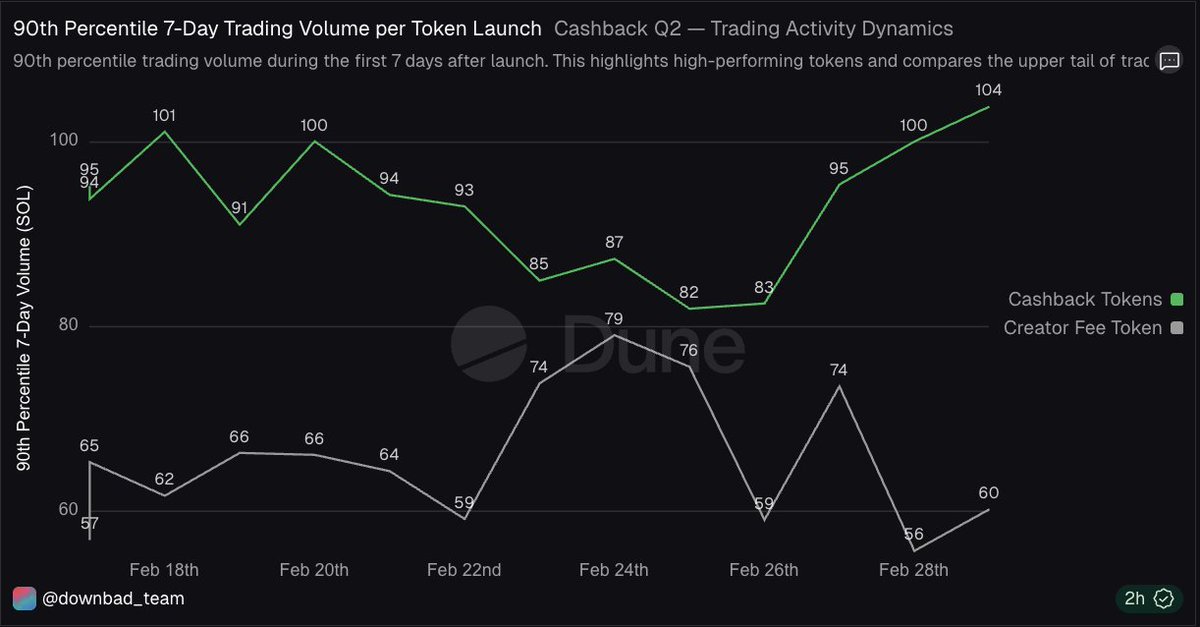
5/ The activity signal gets even stronger when you look deeper.
Cashback launches aren’t just higher on average.
They also look stronger in the upper tail.
That means the effect isn’t only coming from weak noise at the bottom, the higher-performing launches also appear more active under cashback.
4/ This also isn’t some niche corner case either.
Cashback usage appears pretty persistent after launch. Roughly in the high-20s to low-30s % of daily launches.
So this mechanic is not marginal.
It’s become a meaningful part of @Pumpfun's launch behavior.
3/ So I measured trading intensity.
Average trading volume per token launched:
Non-cashback tokens → ~33 SOL
Cashback tokens → ~51 SOL
That’s a ~54% increase.
So yes, Cashback launches generate much higher average 7-day trading volume per token than creator-fee launches.
So this isn’t just a “more cashback tokens exist” story.
The average cashback launch itself appears to trade harder.
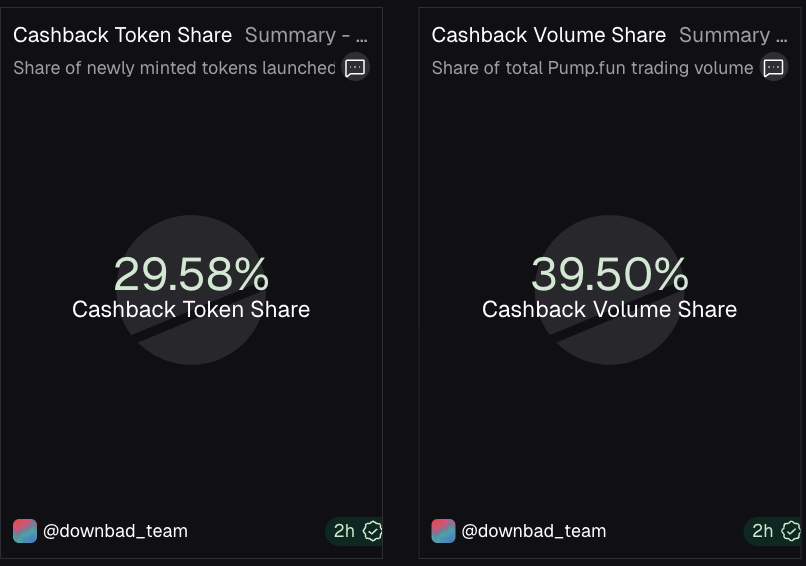
2/ First big signal:
Cashback tokens make up only ~30% of launches…
…but account for ~40% of 7-day trading volume.
That is an imbalance.
Something about cashback is clearly amplifying trading activity far beyond its share of launches.
1/ Back with an update on my analysis on @Pumpfun's Cashback Incentive.
After analyzing the data…
They might NOT be doing what most people think.
I dug into the on-chain data behind @Pumpfun cashback tokens.
The results surprised me 👇
@a1lon9@Schoen_xyz@absolquant Yeah @a1lon9 I agree I found the same when I analyzed the onchain data. Cashback fees have been great for volume but it’s a different story when it comes to token survival…
2/ First big signal:
Cashback tokens make up only ~30% of launches…
…but account for ~40% of 7-day trading volume.
That is an imbalance.
Something about cashback is clearly amplifying trading activity far beyond its share of launches.
9/ Here is the full dashboard for you to check out: https://t.co/ut22Qx8ZcD
Would especially love pushback on 2 questions:
1. Is cashback mainly increasing repeat trader intensity rather than broad participation?
2. Is the goal of cashback to improve launch activity rather than graduation quality?
If so, the data may actually be saying the mechanic is working exactly as intended.
Any feedback or thoughts would also be appreciated. Tagging some folks who may be interested.
@a1lon9@json1444@RainsRevenge@Va3Ko@Adam_Tehc
1/ Back with an update on my analysis on @Pumpfun's Cashback Incentive.
After analyzing the data…
They might NOT be doing what most people think.
I dug into the on-chain data behind @Pumpfun cashback tokens.
The results surprised me 👇
8/ Important caveat:
This is still observational, not causal.
The dashboard also shows signs of creator selection:
future cashback creators already looked stronger pre-launch.
But even with that bias check, the within-creator switcher comparison still leans toward stronger cashback performance.
So we can fairly state:
Cashback likely boosts trading behavior
while creator quality still explains part of the edge.
Curious if the @Pumpfun team sees the same thing internally.