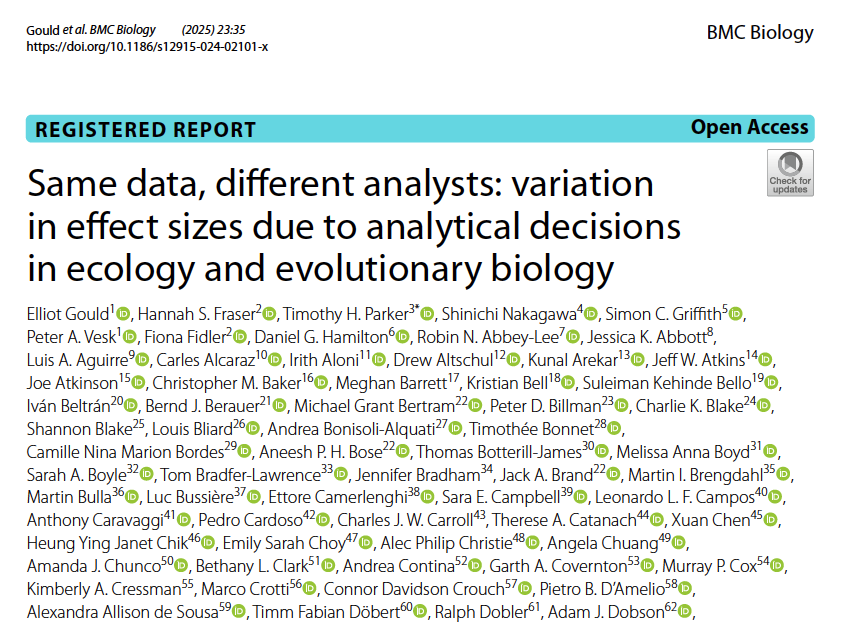
The first many-analysts study in ecology is finally published! 🥳🙌
300+ coauthors and 5+ years, this was a massive effort by @Elliot_Gould_@HannahSFraser@TimParker88 and co.
Open access 👉 https://t.co/aA8QFN3bDs
Lilian Marchand, student in Bonsai, will defend his PhD this afternoon, on methods for precise gene-level RNA isoform reconstruction with long reads (Méthodes pour la reconstruction du répertoire des transcrits d’un gène à partir de données RNA-seq de 3ème génération)
Our study on methods to detect subgenomic RNAs (sgRNA) is now out. This is work from Thomas Baudeau (from @CamilleMrcht and @m_salson Mikaël Salson's groups), who visited my group last summer. https://t.co/7cd9XQXThh 1/5
Mikaël Salson @m_salson obtained his HDR yesterday, with a defense entitled Méthodes sans alignement et indexation
pour l'analyse de données nucléiques massive (alignment free methods for massive nucleic sequences analysis).
Recent alignment methods aim to reduce reference bias, where reads with non-ref alleles fail to align correctly. However, there's a lack of methods for analyzing reference bias. Here we present biastools, which measures and categorizes reference bias. 1/
https://t.co/Xcp1AoKkob
A remaining hurdle for long-read sequencing is scalability and cost. Here, we developed a single flowcell ONT protocol + push-button pipeline that generates state-of-the-art small and structural variant calls and scales to 1000s of genomes: https://t.co/SNCQkvoKlY
Wonderful #Seqbim2022 in Bordeaux, thanks to the organizers!
By the way, did I mention that Lille will host the GDR BIM days in November 2023, that will be joint with #Seqbim23 ?
Recently, I wrote a bunch of Zotero tutorials that went (mildly) viral on #AcademicTwitter.
Thought I'd put them all together so folks can find them easily.
So, here goes 👇
Zotero 101: A meta-thread 🧵
Retweet to share it with your friends/colleagues.
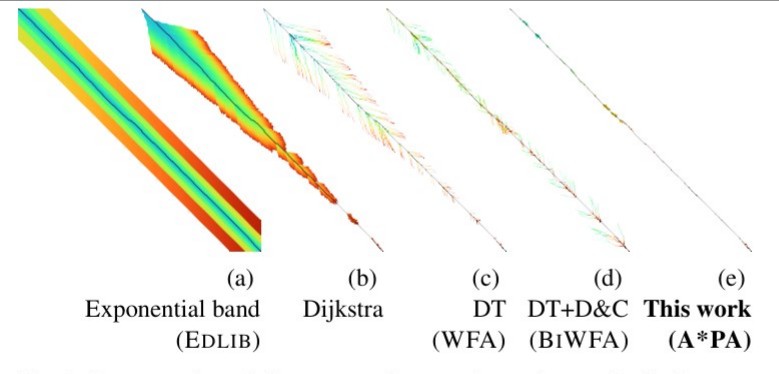
@curious_coding and I extended the seed heuristic to exact alignment of long (Mbps) erroneous (≤15%) sequences.
The empyrical near-linear runtime makes our aligner A*PA 250x faster than Edlib and WFA on synthetic data, and looks promising on human data.
https://t.co/YmqdAOml32
Comparison of calling pipelines for whole genome sequencing: an empirical study demonstrating the importance of mapping and alignment https://t.co/xW9AkuSSoH #biorxiv_bioinfo