Just received my PhD diploma from ETH Zurich for opening the topic of A* for optimal sequence alignment.
My thesis argues that A* is natural for alignment by being heuristically fast and provably optimal. I feel lucky to poke such a fundamental problem yet I have no clue why this wasn't done 40y ago.
https://t.co/MVj6JNa0Ty
In addition to my coworkers, I am thankful to the external defense committee which appreciated my work and vouched with their reputation:
@veli_makinen, who gave me careful feedback and future directions,
@pashadag, whose papers influenced me from the beginning of my PhD.
Just received my PhD diploma from ETH Zurich for opening the topic of A* for optimal sequence alignment.
My thesis argues that A* is natural for alignment by being heuristically fast and provably optimal. I feel lucky to poke such a fundamental problem yet I have no clue why this wasn't done 40y ago.
https://t.co/MVj6JNa0Ty
I dedicate this thesis to my high school teachers:
Svilen Rusev, who introduced me to science, and
@BiserkaYovcheva, who equipped me to research it.
I am also grateful to my advisor @mvechev for insisting on provable algorithms, my co-advisor @gxr for insisting on practicality, my coauthors Beni Bichsel, @HarunMustafa416, @akkah21, @curious_coding, and all the countless folks who supported me on my first steps to a childhood dream of science.❤️
@pebope1 All code is public and FOSS:
https://t.co/dbDuGZqvPC - prototype read aligner to pangenome graphs
https://t.co/zc3rZpnJJU - fastest global aligner for long seqs
https://t.co/yuLWjDDHTV - minimalistic repo for global alignment for learning and experimentation
SVs are not yet well handled because:
1) for targeted A* search, the seed heuristic has to compensate for each indel letter, so you need potential of 10k seeds for 10kbp indel,
2) edit distance is not really a suitable metric when edits are dependent. one usual approach is to add affine (WiP).
@SilasKieser Relevant bioinformatical tasks are read alignment, genetic and genomic comparison, and everything that uses these. Note that most of the currently used algorithms are not optimal so the main benefit compared to them will be not speed but accuracy.
A* looks natural for optimal alignment. Previously scaled near-linearly seq.length. Now also scales with error rate.
The LACK of seed matches holds more information than their presence. Don't ignore it :")
@peshotrie and I just finished our paper on exact global alignment using A*.
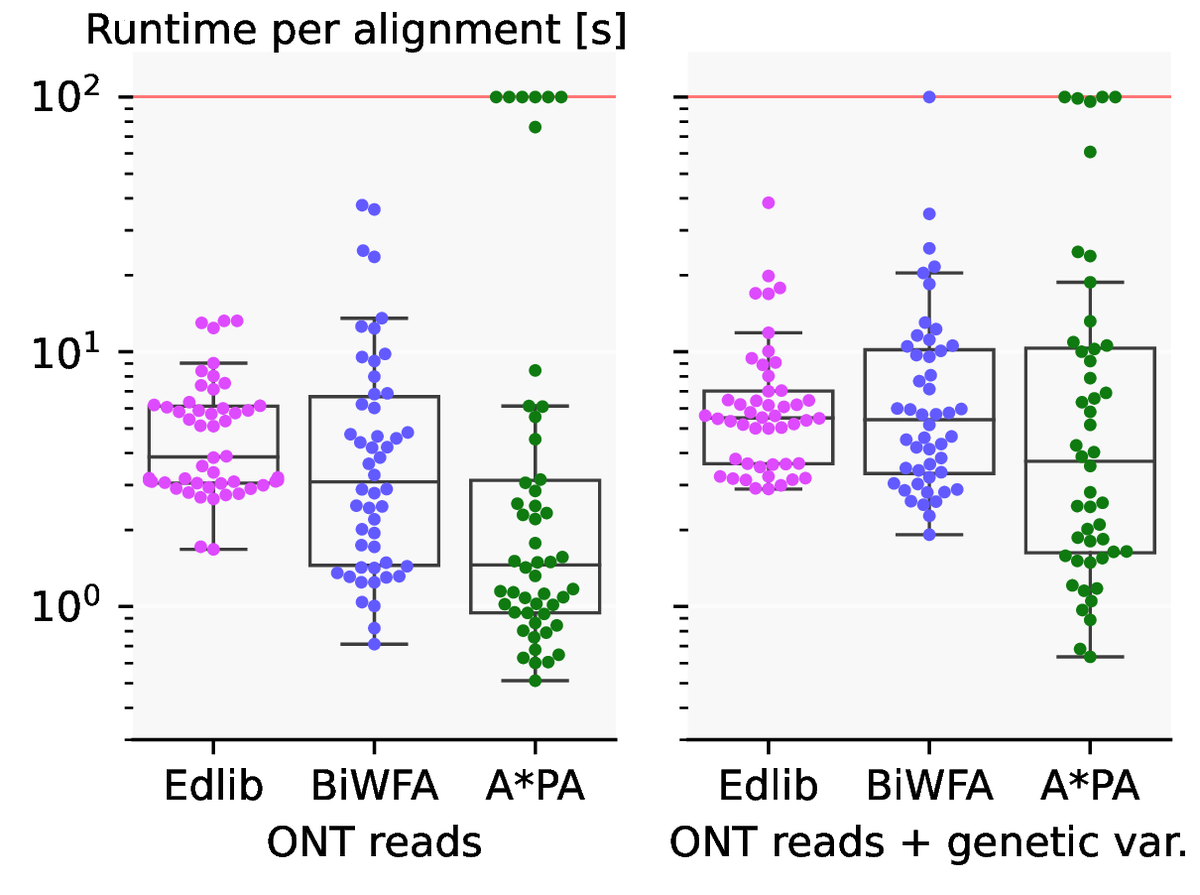
A*PA is now faster than both Edlib and BiWFA when aligning noisy long reads 🎉
We do this using the 'gap-chaining seed heuristic'. 1/6
https://t.co/bk25O7eygx
@estherbianc that's quite interesting! can we conclude that market participation expands the perceived group for the in-group preference? https://t.co/UmkbheNuQL
@t_brekalo @curious_coding hey Tvrtko, thanks for the interest! would be great to connect A*PA to C/C++! nevertheless, mind the limitations of our algorithm: in particular, the current implementation is slower than Edlib for short sequences (<1kbp) and A LOT slower for distance seqs (>15% errors).