1/ This new paper https://t.co/lh2yxJCZbH deals with the "nearest neighbor" (NN) and "causal modeling" (CM) interpretations of counterfactuals.
I have remarked on several occasions that the
former suffers from a fundamental problem of "representation". So, if there is a clash
Our project, Learning from Videos is designed to build AI that automatically learns audio, textual & visual representations from publicly available videos on Facebook. Learn how this will improve AI-powered products — starting with Reels’ recommendations: https://t.co/iVyo788873
Using #normalizingflows for #GravitationalWaves population analysis! https://t.co/cvwV4Wci8M
[Left]: using normalizing flow for the likelihood. [Right]: using analytic likelihood. But you can make normalizing flow likelihood from training data w/o analytical assumptions
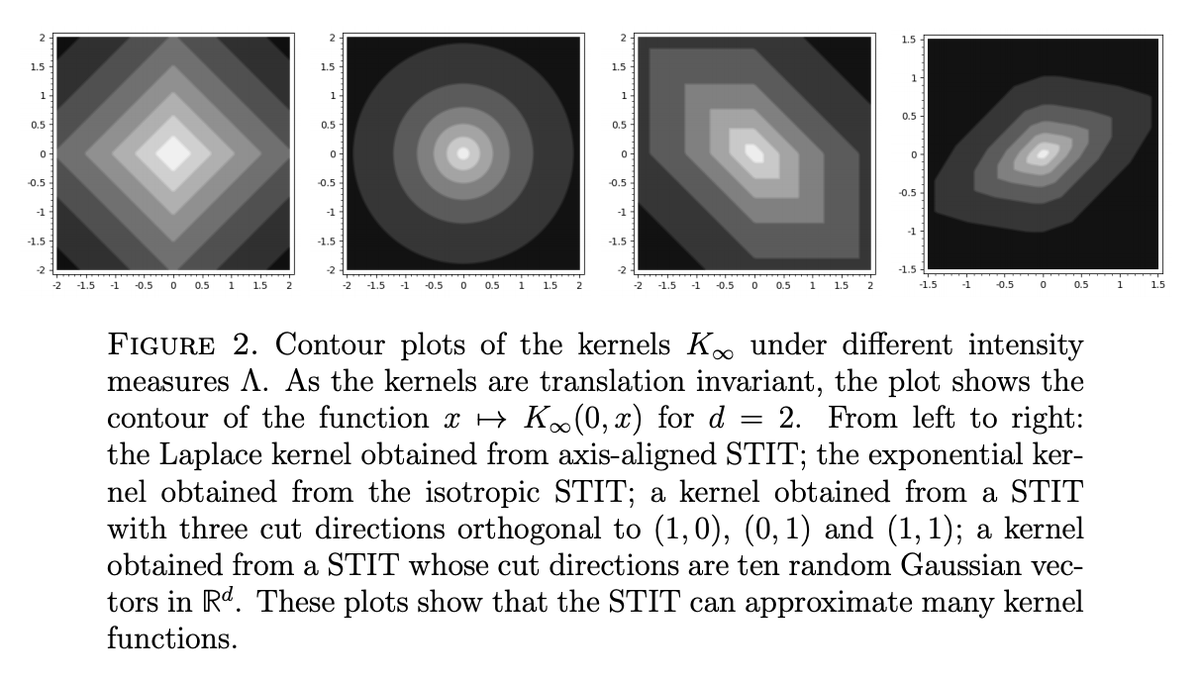
In "Mondrian Kernel", we showed the Mondrian process can approximate the Laplace kernel. Using the Mondrian process <> STIT connection, O'Reilly and Tran have now uncovered whole classes of kernels that can be approximate by stochastic geometries. Beauty! https://t.co/xVDHpZycte
-2007, The Road to Quantum Artificial Intelligence https://t.co/dN6qUbNtpr
-2015, Quantum algorithms: an overview https://t.co/dOtt6F0Edg
-2018, Machine learning & artificial intelligence in the quantum domain: a review of recent progress(download not pdf) https://t.co/575YmY33iq
Some folks still seem confused about what deep learning is. Here is a definition:
DL is constructing networks of parameterized functional modules & training them from examples using gradient-based optimization.... https://t.co/jmHpWZOMH8
We've just open-sourced the code for Stacked Capsule Autoencoders (NeurIPS '19): https://t.co/tP5FSq6dqC
joint work with @sabour_sara, @yeewhye and @geoffreyhinton
DiffTaichi: Differentiable Programming for Physical Simulation
“Using our differentiable programs, neural network controllers are typically optimized within only tens of iterations.”
When we have good priors about the world, it makes sense to use them!
https://t.co/8bSDbBz7Ga
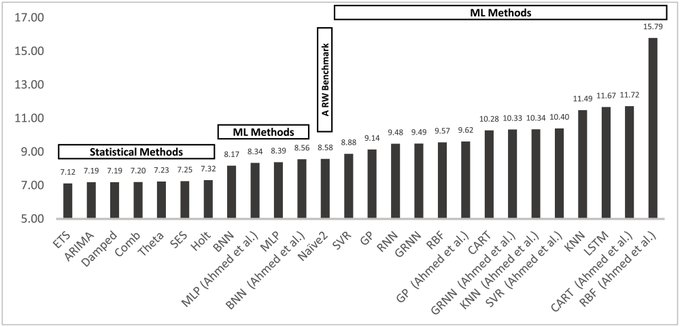
The https://t.co/S3BpRgtxUW paper with its finding that the worse Stat forecasting method was more accurate than the best of the ML ones has passed the 100,000 mark of views/downloads. None of those who have read/downloaded it has challenged its finding. We are still waiting!
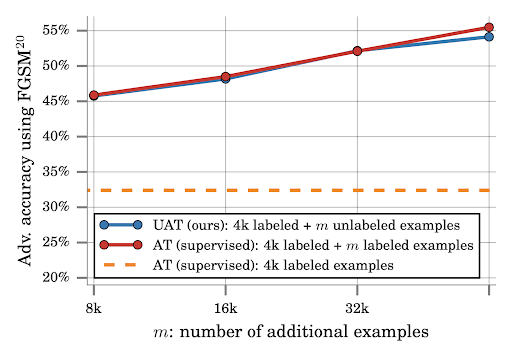
"Are labels required for improving adversarial robustness?" TL;DR: no!
With only 10% of CIFAR10 labels, UAT has almost no drop in robust accuracy. With additional unlabeled data, UAT obtains SOTA robust accuracy.
Paper: https://t.co/3HF362CcEK
Code: https://t.co/kApBTF1nJj
Thrilled to be able to share what I've been working on for the last year - solving the fundamental equations of quantum mechanics with deep learning!
https://t.co/pzp0Xhsxbu
In our new blog post, we review how brains replay experiences to strengthen memories, and how researchers use the same principle to train better AI systems:
https://t.co/SMdKq6hYzX
Can we scale gradient-based meta-learning? In Warped Gradient Descent, we meta-learn a geometry over the joint task parameter distribution. We can learn optimisers for RNNs and against catastrophic forgetting. W/ A. Rusu, @rpascanu, H. Yin, @RaiaHadsell. 👉https://t.co/WZq2nQq15c
Project Euphonia is a speech-to-text transcription model for those with atypical speech. In a new @interspeech2019 paper, learn how researchers are collaborating with the #ALS community to develop Euphonia for those with ALS or other speech impairments. https://t.co/mSHSINm88a
GENESIS is the first fully probabilistic model for unsupervised image segmentation with amortized inference, developed by @martinengelcke, @IngmarPosner, O. Parker-Jones and myself: https://t.co/ZTMAqJJN9U
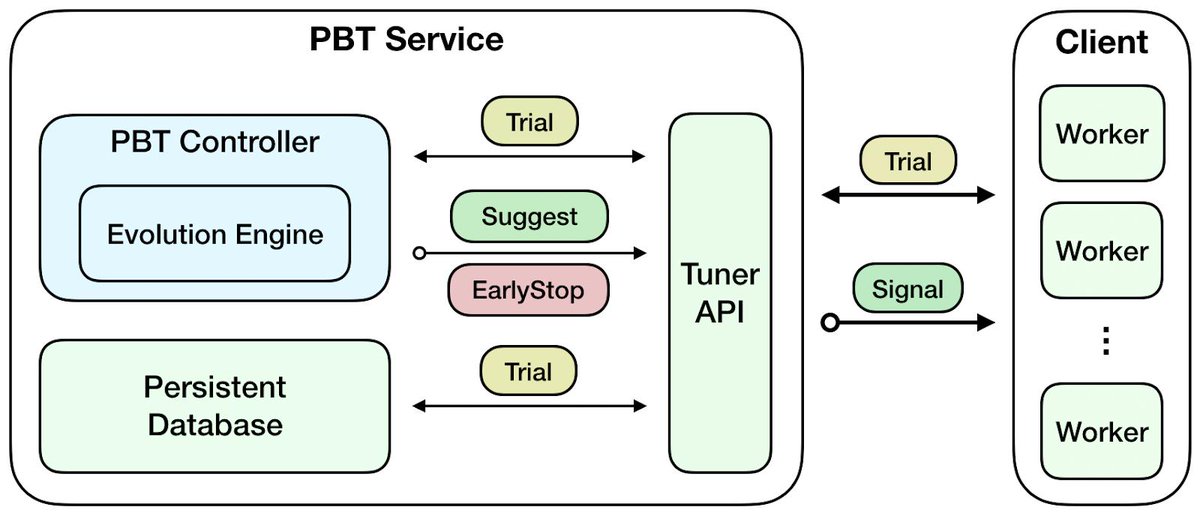
We recently developed a unified service system that allows Population Based Training to be scaled to diverse machine learning applications within Alphabet. We'll be presenting this paper at @kdd_news, August 2019 in Anchorage, Alaska! https://t.co/FjoGxBTO5p







![cosmo_shirley's tweet photo. Using #normalizingflows for #GravitationalWaves population analysis! https://t.co/cvwV4Wci8M
[Left]: using normalizing flow for the likelihood. [Right]: using analytic likelihood. But you can make normalizing flow likelihood from training data w/o analytical assumptions https://t.co/Z7rHgnnrPq](https://pbs.twimg.com/media/ERokoruWkAEtHR8.jpg)