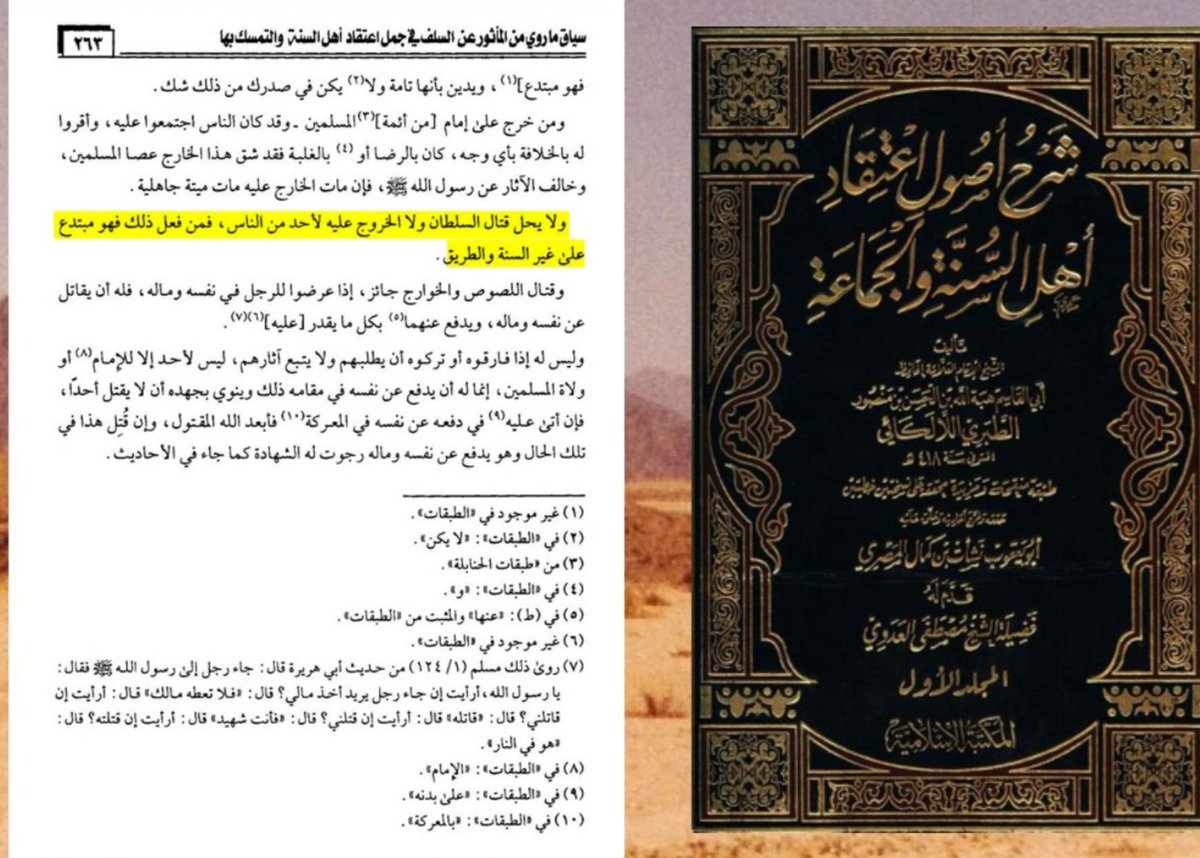
Imam Aḥmad Ibn Ḥanbal رحمه الله said:
"It is not permissible to fight the ruler, nor is it permissible for anyone among the people to rebel against him. Therefore, whoever does that is an innovator, upon other than the Sunnah and the correct path."
Sharḥ Uṣūl I‘tiqād Ahl al-Sunnah wal-Jamā‘ah (1/263)
https://t.co/Brqkgi0Yoz
*WHAT IS THE MEANING OF Al-WALA' WAL-BARA (LOYALTY AND DISAVOWAL) IN ISLAM?*
Shaykh Ibn Bazz said:
Al-Wala' wal-Bara' means: loving the believers and taking them as allies, and hating the disbelievers, opposing them, and disavowing them and their religion. This is Al-Wala' wal-Bara', as Allah Almighty says in Surah Al-Mumtahanah:
"There has already been for you an excellent pattern in Abraham and those with him, when they said to their people, 'Indeed, we are disassociated from you and from whatever you worship other than Allah. We have denied you, and there has appeared between us and you animosity and hatred forever until you believe in Allah alone.'"
(Surah Al-Mumtahanah: 4)
However, hating them and opposing them does not mean that you wrong them, aggress against them if they are not actively warring against you, or make them close friends.
Rather, it means that you hate them in your heart and regard them as enemies, and they should not be close friends to you. But you must not harm them, injure them, or wrong them. If they greet you with peace, you return their greeting, advise them, and direct them toward goodness, as Allah, the Almighty and Majestic, says:
"And do not argue with the People of the Scripture except in a way that is best, except for those who commit injustice among them..."
(Surah Al-Ankabut: 46)
The People of the Scripture are the Jews and the Christians, and similarly other disbelievers who have a pledge of security, a treaty, or Dhimmah (protection). However, whoever among them acts unjustly shall be compensated according to his injustice.
Otherwise, what is prescribed for a believer is to debate in a manner that is best with both Muslims and disbelievers—while hating them [their disbelief] for the sake of Allah—according to the noble verse mentioned above, and the statement of Allah, Exalted is He:
"Invite to the way of your Lord with wisdom and good instruction, and argue with them in a way that is best." (Surah An-Nahl: 125)
So he must not aggress against them or wrong them. Rather, he should teach them and guide them toward the truth, hoping Allah will guide them through him to the right path. There is also no harm in giving them charity and acting kindly toward them, due to the statement of Allah, the Almighty and Majestic:
"Allah does not forbid you from those who do not fight you because of religion and do not expel you from your homes - from being righteous toward them and acting justly toward them.
Indeed, Allah loves those who act justly."
(Surah Al-Mumtahanah: 8)
And as established in the two Authentic books (Sahih al-Bukhari and Sahih Muslim) from the Prophet ﷺ, Asma' bint Abi Bakr (may Allah be pleased with them both) was commanded to maintain relations with her mother while her mother was still a disbeliever, during the truce between the Prophet ﷺ and the people of Mecca at Al-Hudaybiyyah.]
Etiquettes in memorising Ḥadīth
Khaṭīb al-Baghdādī said:
The student should not burden himself with what he is unable to bear. Rather, he should limit himself to that which is small and manageable for him, whose memorisation he can firmly establish and which he can master:
On the authority of Shuʿbah, he said: “I used to come to Qatādah and ask him about two ḥadīths, so he would narrate them to me, then say: ‘Shall I give you more?’ I would say: ‘No,’ until I memorised them and mastered them.”
az-Zuhrī said: “Whoever seeks knowledge all at once, it will escape him all at once. Rather, knowledge is acquired one ḥadīth and two ḥadīths [at a time].”
[al-Jāmiʿ li-Akhlāq ar-Rāwī wa-Ādāb as-Sāmiʿ by Khaṭīb al-Baghdādī p. 354-356]





![Azmatul51794319's tweet photo. *WHAT IS THE MEANING OF Al-WALA' WAL-BARA (LOYALTY AND DISAVOWAL) IN ISLAM?*
Shaykh Ibn Bazz said:
Al-Wala' wal-Bara' means: loving the believers and taking them as allies, and hating the disbelievers, opposing them, and disavowing them and their religion. This is Al-Wala' wal-Bara', as Allah Almighty says in Surah Al-Mumtahanah:
"There has already been for you an excellent pattern in Abraham and those with him, when they said to their people, 'Indeed, we are disassociated from you and from whatever you worship other than Allah. We have denied you, and there has appeared between us and you animosity and hatred forever until you believe in Allah alone.'"
(Surah Al-Mumtahanah: 4)
However, hating them and opposing them does not mean that you wrong them, aggress against them if they are not actively warring against you, or make them close friends.
Rather, it means that you hate them in your heart and regard them as enemies, and they should not be close friends to you. But you must not harm them, injure them, or wrong them. If they greet you with peace, you return their greeting, advise them, and direct them toward goodness, as Allah, the Almighty and Majestic, says:
"And do not argue with the People of the Scripture except in a way that is best, except for those who commit injustice among them..."
(Surah Al-Ankabut: 46)
The People of the Scripture are the Jews and the Christians, and similarly other disbelievers who have a pledge of security, a treaty, or Dhimmah (protection). However, whoever among them acts unjustly shall be compensated according to his injustice.
Otherwise, what is prescribed for a believer is to debate in a manner that is best with both Muslims and disbelievers—while hating them [their disbelief] for the sake of Allah—according to the noble verse mentioned above, and the statement of Allah, Exalted is He:
"Invite to the way of your Lord with wisdom and good instruction, and argue with them in a way that is best." (Surah An-Nahl: 125)
So he must not aggress against them or wrong them. Rather, he should teach them and guide them toward the truth, hoping Allah will guide them through him to the right path. There is also no harm in giving them charity and acting kindly toward them, due to the statement of Allah, the Almighty and Majestic:
"Allah does not forbid you from those who do not fight you because of religion and do not expel you from your homes - from being righteous toward them and acting justly toward them.
Indeed, Allah loves those who act justly."
(Surah Al-Mumtahanah: 8)
And as established in the two Authentic books (Sahih al-Bukhari and Sahih Muslim) from the Prophet ﷺ, Asma' bint Abi Bakr (may Allah be pleased with them both) was commanded to maintain relations with her mother while her mother was still a disbeliever, during the truce between the Prophet ﷺ and the people of Mecca at Al-Hudaybiyyah.]](https://pbs.twimg.com/media/HTyhN-ibIAA30VL.jpg)
![Azmatul51794319's tweet photo. *WHAT IS THE MEANING OF Al-WALA' WAL-BARA (LOYALTY AND DISAVOWAL) IN ISLAM?*
Shaykh Ibn Bazz said:
Al-Wala' wal-Bara' means: loving the believers and taking them as allies, and hating the disbelievers, opposing them, and disavowing them and their religion. This is Al-Wala' wal-Bara', as Allah Almighty says in Surah Al-Mumtahanah:
"There has already been for you an excellent pattern in Abraham and those with him, when they said to their people, 'Indeed, we are disassociated from you and from whatever you worship other than Allah. We have denied you, and there has appeared between us and you animosity and hatred forever until you believe in Allah alone.'"
(Surah Al-Mumtahanah: 4)
However, hating them and opposing them does not mean that you wrong them, aggress against them if they are not actively warring against you, or make them close friends.
Rather, it means that you hate them in your heart and regard them as enemies, and they should not be close friends to you. But you must not harm them, injure them, or wrong them. If they greet you with peace, you return their greeting, advise them, and direct them toward goodness, as Allah, the Almighty and Majestic, says:
"And do not argue with the People of the Scripture except in a way that is best, except for those who commit injustice among them..."
(Surah Al-Ankabut: 46)
The People of the Scripture are the Jews and the Christians, and similarly other disbelievers who have a pledge of security, a treaty, or Dhimmah (protection). However, whoever among them acts unjustly shall be compensated according to his injustice.
Otherwise, what is prescribed for a believer is to debate in a manner that is best with both Muslims and disbelievers—while hating them [their disbelief] for the sake of Allah—according to the noble verse mentioned above, and the statement of Allah, Exalted is He:
"Invite to the way of your Lord with wisdom and good instruction, and argue with them in a way that is best." (Surah An-Nahl: 125)
So he must not aggress against them or wrong them. Rather, he should teach them and guide them toward the truth, hoping Allah will guide them through him to the right path. There is also no harm in giving them charity and acting kindly toward them, due to the statement of Allah, the Almighty and Majestic:
"Allah does not forbid you from those who do not fight you because of religion and do not expel you from your homes - from being righteous toward them and acting justly toward them.
Indeed, Allah loves those who act justly."
(Surah Al-Mumtahanah: 8)
And as established in the two Authentic books (Sahih al-Bukhari and Sahih Muslim) from the Prophet ﷺ, Asma' bint Abi Bakr (may Allah be pleased with them both) was commanded to maintain relations with her mother while her mother was still a disbeliever, during the truce between the Prophet ﷺ and the people of Mecca at Al-Hudaybiyyah.]](https://pbs.twimg.com/media/HTyhNSBaYAAloS8.jpg)









![Azmatul51794319's tweet photo. *WHAT IS THE MEANING OF Al-WALA' WAL-BARA (LOYALTY AND DISAVOWAL) IN ISLAM?*
Shaykh Ibn Bazz said:
Al-Wala' wal-Bara' means: loving the believers and taking them as allies, and hating the disbelievers, opposing them, and disavowing them and their religion. This is Al-Wala' wal-Bara', as Allah Almighty says in Surah Al-Mumtahanah:
"There has already been for you an excellent pattern in Abraham and those with him, when they said to their people, 'Indeed, we are disassociated from you and from whatever you worship other than Allah. We have denied you, and there has appeared between us and you animosity and hatred forever until you believe in Allah alone.'"
(Surah Al-Mumtahanah: 4)
However, hating them and opposing them does not mean that you wrong them, aggress against them if they are not actively warring against you, or make them close friends.
Rather, it means that you hate them in your heart and regard them as enemies, and they should not be close friends to you. But you must not harm them, injure them, or wrong them. If they greet you with peace, you return their greeting, advise them, and direct them toward goodness, as Allah, the Almighty and Majestic, says:
"And do not argue with the People of the Scripture except in a way that is best, except for those who commit injustice among them..."
(Surah Al-Ankabut: 46)
The People of the Scripture are the Jews and the Christians, and similarly other disbelievers who have a pledge of security, a treaty, or Dhimmah (protection). However, whoever among them acts unjustly shall be compensated according to his injustice.
Otherwise, what is prescribed for a believer is to debate in a manner that is best with both Muslims and disbelievers—while hating them [their disbelief] for the sake of Allah—according to the noble verse mentioned above, and the statement of Allah, Exalted is He:
"Invite to the way of your Lord with wisdom and good instruction, and argue with them in a way that is best." (Surah An-Nahl: 125)
So he must not aggress against them or wrong them. Rather, he should teach them and guide them toward the truth, hoping Allah will guide them through him to the right path. There is also no harm in giving them charity and acting kindly toward them, due to the statement of Allah, the Almighty and Majestic:
"Allah does not forbid you from those who do not fight you because of religion and do not expel you from your homes - from being righteous toward them and acting justly toward them.
Indeed, Allah loves those who act justly."
(Surah Al-Mumtahanah: 8)
And as established in the two Authentic books (Sahih al-Bukhari and Sahih Muslim) from the Prophet ﷺ, Asma' bint Abi Bakr (may Allah be pleased with them both) was commanded to maintain relations with her mother while her mother was still a disbeliever, during the truce between the Prophet ﷺ and the people of Mecca at Al-Hudaybiyyah.]](https://pbs.twimg.com/media/HTyhOeLaAAAns6q.jpg)

![ibn_Abidin_'s tweet photo. Etiquettes in memorising Ḥadīth
Khaṭīb al-Baghdādī said:
The student should not burden himself with what he is unable to bear. Rather, he should limit himself to that which is small and manageable for him, whose memorisation he can firmly establish and which he can master:
On the authority of Shuʿbah, he said: “I used to come to Qatādah and ask him about two ḥadīths, so he would narrate them to me, then say: ‘Shall I give you more?’ I would say: ‘No,’ until I memorised them and mastered them.”
az-Zuhrī said: “Whoever seeks knowledge all at once, it will escape him all at once. Rather, knowledge is acquired one ḥadīth and two ḥadīths [at a time].”
[al-Jāmiʿ li-Akhlāq ar-Rāwī wa-Ādāb as-Sāmiʿ by Khaṭīb al-Baghdādī p. 354-356]](https://pbs.twimg.com/media/HT5Rf4mWUAA4VcY.jpg)