I recall being very surprised to find out that a recommendation letter and advisor’s name are VERY important in faculty hiring.
I had assumed it should be research interests (their diversity and depth), prior experience/papers and research vision (which is most important!). But no, recommendations turned out to shape who’s invited to campus interviews.
Ever since, I’ve been questioning this approach.
Is it appropriate to give recommendations so much weight, given all the inequity and bias this approach has?
Many people will say: “Yes, it helps us decide on a candidate quickly”.
However, now looking from the PI’s side, I am still inclined to think that no, it’s not worth it.
♦️ Major PROS:
1. Decisions can be made fast when you have too many applications.
2. Using the letter, you can learn about their personality, passions, trustworthiness, etc. This is by far the biggest reason why so many committees use references. They also can call the advisor directly.
♦️ Major CONS:
1. Recommendations can have a lot of fluff. ‘Amazingly unique’ candidates turn out to be below average during interviews.
2. The advisor’s NAME on that letter has a huge effect. This limits career opportunities for those excellent candidates who were not lucky enough to have “that big name writing a 2-page reference” for them.
3. Strong students may receive bad recommendations because their advisor was unhappy about something small (or simply toxic). There are many stories of students whose careers were destroyed by supervisors via bad recommendations.
4. Many advisors don’t know how to write strong letters. When poorly written, a recommendation letter devaluates a strong candidate.
♦️ Ethical issues with recommendations:
1. Recommendations promote elitism.
“You are not from a famous advisor’s group..? Sorry, you don’t belong here.”
2. Recommendation can be used to indirectly control students and postdocs:
“You don’t want to spend 15 hours a day on your research? But then how can I write a good recommendation letter for you?”
3. Recommendations can be used to cut opportunities for students (it's rare though):
“This student is so good… I don’t want him to go to my competitor’s group and transfer my lab’s expertise there. A dull reference will save me.”
4. Students don’t report their advisors’ inappropriate behavior because they need good recommendation letters from them.
📍 My current view is:
Recommendations are useful when they are accurate.
But advisor’s bias, lack of experience, lack of interest and sometimes even retaliation - it all negatively impacts the outcome.
I think it all comes down to:
“Do I want to hire fast, or do I want to hire fairly?”
___
A physicist spent 12 days supervising Claude Code as it built a piece of cosmology software.
It's the cleanest demonstration I've seen of the difference between intellect and intelligence.
The agent was brilliant at the cognitive work. Transcribing equations, debugging, optimizing against the test suite.
At one point it found a correction factor that fixed every test.
The number was physically meaningless. It worked at the single setting they checked and would've been wrong at every other one. Correct prediction, zero explanatory value.
The agent was clueless. The physicist was not.
When the physicist finally asked "does this number correspond to anything in the actual theory?", the agent answered correctly in seconds.
It could reason. It just couldn't transcend its own frame.
That's the difference. Intellect operates on the content. Intelligence operates on the context while it simultaneously generates the frame.
Agents will transcend intellect and become intelligent when they can generate their own frame of reference.
Who knows how long that will take?
People who don't follow cancer research often ask me why we haven't cured cancer. That perception masks a wonderful reality: We make amazing, stepwise progress every year, and the result is that many people live much longer today than they would have previously.
Right now we're in the thick of the annual meeting of the American Society of Clinical Oncology, the biggest research meeting on new cancer medicines, and this morning a bunch of really important studies dropped. I'm going to review them here.
This first image is the result for daraxonrasib, a treatment for pancreatic cancer that is generating consdirable excitement. The green line is the probability of living for patients who got the new drug; the gray one is the chemo control group.
If you follow cancer drugs, a chart like this will make your breath hitch a little. I'm going to review these and some other data here.
Hi All,
I recently completed teaching a first-level ML course from a probabilistic framework. I was asked by many to share my classwork. I put it out here (in the first reply). This may be of use to a few.
1. Just got off a call with @UnSubtleDesi. I couldn't be happier for her and both of us couldn't help but discuss the harrowing days of post poll violence in West Bengal in 2021. So I am going to share what happened five years ago just so ppl know what happened. #WestBengal2026.
AI is moving from "How do I use this model?" to "How do I architect this system?"
I just finished teaching the Mathematical Foundations of ML for NPTEL. I did it the old-school way: Chalk, talk, and rigorous derivations. No slides, no shortcuts.
If you want to move past the wrappers and understand the actual math behind generative models and optimization, this is for you. We build the foundation from the ground up so you can lead the next wave of agentic AI.
Stop being a model-user. Become an AI Architect. This is your starting point. Course link is in the first reply.
@manas_muduli You left Institute of Physics, Bhubaneswar. It is one of premier research under DAE, Government of India. And also institute dedicated to only theoretical and experimental physics research. And many of their alumni are well established scientist worldwide.
Listen, as a doctor, I see patients every day looking for a "magic pill" for insulin resistance. The truth?? Evidence-based medicine shows it’s actually reversible, but it requires a clinical blueprint not just willpower.
Here’s how we actually move the needle in 2026:
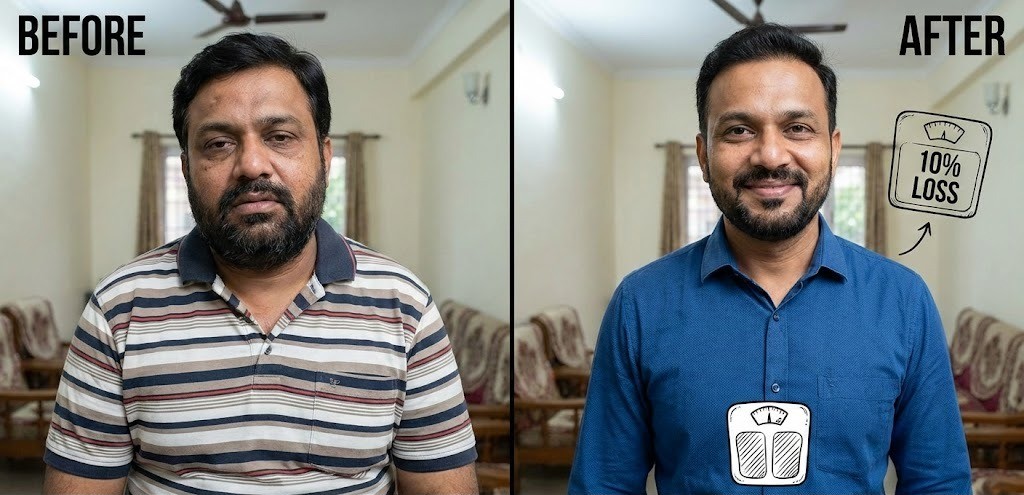
1️⃣The 10% Tipping Point: Losing just 10% of your body weight is the metabolic "reset" button. It clears ectopic fat from your liver and pancreas, which can drop your HOMA-IR (insulin resistance score) by a staggering 65%!!
2️⃣Muscle is a Glucose Sink: You need to lift. Resistance training triggers GLUT4 translocation.....this lets your muscles suck up glucose without needing a ton of insulin. More muscle = a bigger metabolic sink.
3️⃣The Protein Priority: High-leucine protein (lean meats, legumes) is critical. It protects your muscle mass while you lose fat. Don't fall into the "skinny fat" trap where you lose weight but your metabolism actually slows down.
4️⃣Watch the Saturated Fats: It’s not just about carbs. High saturated fat can actually "clog" the insulin signaling pathway in your cells. Swap the butter for fiber-rich whole foods to keep the pipes clean.
5️⃣The GLP-1 Revolution: If lifestyle isn't enough, GLP-1 and GIP/GLP-1 dual agonists are game-changers. They don't just mask blood sugar; they help reverse the underlying pathology by targeting the brain-gut-pancreas axis.
⚠️ Clinical Disclaimer: While GLP-1 agonists are highly effective, they are serious medications. They must only be used under a doctor’s supervision after a formal prescription and a thorough metabolic workup to monitor for side effects like pancreatitis or gallbladder issues.
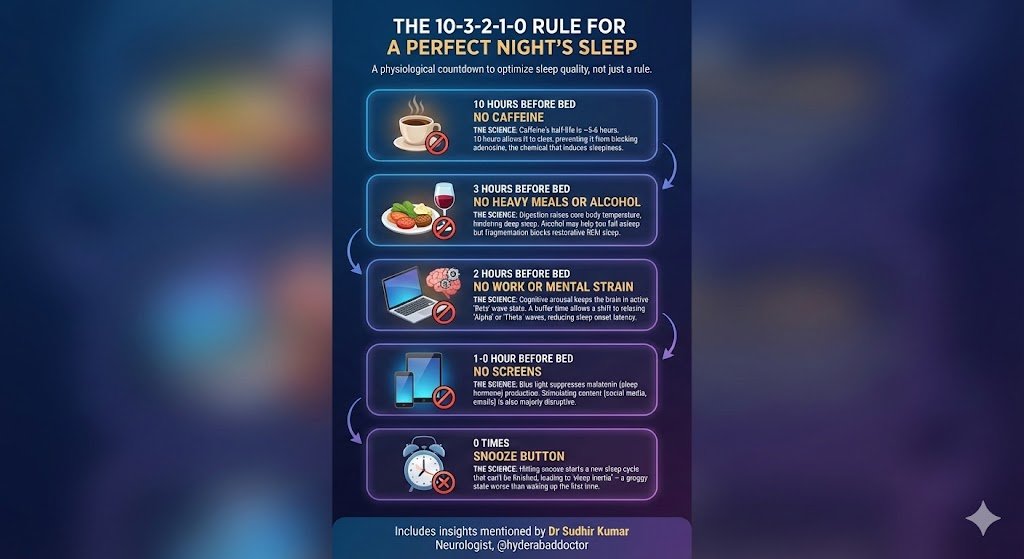
The "10-3-2-1-0" Rule for the Perfect Night’s Sleep.
If you wake up feeling like your brain never truly "turned off," your bedtime routine is likely starting too late.
Sleep is NOT an on/off switch; it is a landing sequence.
✅To protect your neurons and ensure deep, restorative sleep, follow this countdown:
🔸10 Hours Before Bed: No More Caffeine
It takes about 10 hours for caffeine to be fully cleared from your bloodstream. Even if you "can sleep" after a late coffee, the quality of your deep sleep is compromised.
🔸3 Hours Before Bed: No More Food or Alcohol
Digestion and alcohol both interfere with your sleep cycles. Alcohol might help you fall asleep, but it destroys your REM cycle, leaving you groggy the next day.
🔸2 Hours Before Bed: No More Work
Give your brain a "buffer zone." Stop answering emails and solving problems. Your prefrontal cortex needs time to shift from "active mode" to "rest mode."
🔸1 Hour Before Bed: No More Blue Light
Blue light from phones and tablets suppresses melatonin production. Put the screens away. Read a physical book or listen to a podcast instead.
🔸0: The Number of Times You Hit Snooze
When you hit snooze, you go back into a sleep cycle you can't finish. This "sleep inertia" makes you feel more tired than if you had just gotten up.
✅The Result?
By following this countdown, you align your habits with your body’s natural circadian rhythm.
Better sleep = better focus, faster processing, and long-term neuroprotection.
Which of these is the hardest for you to follow? For me, it's usually the "1-hour screen" rule!
Let’s discuss below. 👇
Dr Sudhir Kumar
@hyderabaddoctor
#SleepHygiene #BrainHealth #Neurology #HealthTips #Performance
(Disclaimer: The information provided is general in nature, and may not be applicable to all. Discuss with your physician for personalized advice).
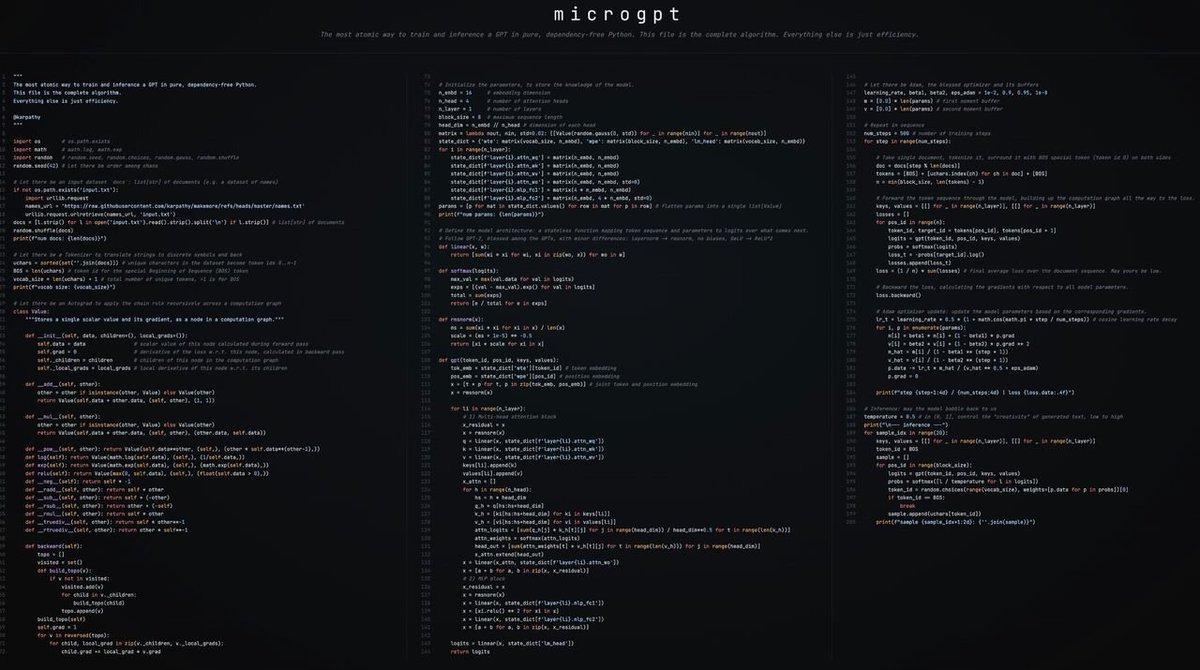
Most beautiful code I have seen shared in public recently.
Built by Andrej Karpathy - single file of 200 lines of pure Python with no dependencies that trains and inferences a GPT. This is how it should be taught to everyone trying to get into learning LLMs.
This might be the cleanest, most elegant public code drop in AI this year.
Karpathy's new "art project": microgpt (https://t.co/itMLfmOu5l)
→ Single Python file (~200 lines)
→ No PyTorch, no NumPy, no external libraries at all
→ Full working GPT: data loading → character tokenizer → tiny autograd engine → GPT-2-style transformer → Adam optimizer → training loop → inference/sampling
It's the bare-metal essence of what makes large language models tick - everything else (CUDA kernels, distributed training, mixed precision, flash attention, massive datasets…) is optimization & engineering around this core.
Perfect starting point for anyone trying to truly understand LLMs instead of just calling APIs.
Highly recommend reading + running it. Changes how you see "AI is just matrix multiplies + softmax" from abstract → concrete.
Intermittent Fasting: Are you skipping the wrong meal?
Most people think Intermittent Fasting (IF) is just about how long you fast. New data from BMJ Medicine and other landmark trials suggest when you eat is just as important.
If you are skipping breakfast and eating late, you might be fighting your own biology.
1. The Circadian Rhythm Rule
Our bodies are hard-wired to process nutrients during daylight. Our insulin sensitivity is at its peak in the morning and lowest at night. By eating late, you are forcing your body to handle fuel when it’s trying to go into "repair mode."
2. Why Breakfast is more important than Dinner
Studies on Early Time-Restricted Eating (eTRE) show that a window starting earlier in the day (e.g., 8 AM or 10 AM) is significantly more effective than a late window.
The Result: Better blood sugar control, improved insulin sensitivity, and lower blood pressure compared to late-day eating.
3. The "Melatonin Conflict"
As night falls, your brain releases melatonin. Melatonin tells your pancreas to slow down insulin production. If you eat a heavy meal at 9 PM, your blood sugar stays elevated longer because your "insulin factory" has already clocked out for the night.
4. Skipping Dinner = Better Sleep & Metabolism
"Skipping dinner is better than skipping breakfast."
By ending your eating window by 4 PM or 6 PM, you allow your body to enter a deep state of autophagy (cellular cleanup) and fat-burning while you sleep.
✅The Golden Rule:
Follow the sun. Eat like a King in the morning, a Prince at noon, and a Pauper (or nothing at all) in the evening.
Stop chasing the clock. Start aligning with your biology.
Dr Sudhir Kumar
@hyderabaddoctor
#IntermittentFasting #HealthTips #Longevity #MetabolicHealth #BMJMedicine #WeightLossJourney
Abdominal obesity is not cosmetic.
It indicates poor metabolic health. It is linked to inflammation, and it increases risk of stroke & heart attack.
If you have a “belly,” this thread may reduce your risk of diabetes, stroke & heart attack. 🧵👇
I am personally lucky to know Nathaniel Craig and his fantastic research team at UCSB. I also spent 5+ years of my career personally in this field and my MS degree was in theoretical particle physics. It takes years and years to learn this kind of amplitude calculus and field theory, and the fact that it can be now handled by AI now blows my mind. Cannot wait to see @OpenAI for dark matter theories and neutrino physics. Knowing which particle interactions are viable under chosen conditions helps experimentalists to fine tune expensive high energy lab equipment for the right range of parameters and saves lots of money and time for academics. Congrats @kevinweil and science team 🤗
GPT-5.2 derived a new result in theoretical physics.
We’re releasing the result in a preprint with researchers from @the_IAS, @VanderbiltU, @Cambridge_Uni, and @Harvard. It shows that a gluon interaction many physicists expected would not occur can arise under specific conditions.
https://t.co/EAZhKWacsG
@flipkartsupport Again you are playing a trick by redirecting to some chatbots to resolve the issues despite giving all the details in the message @jagograhakjago@_Kalyan_K@flipkartsupport. I have tried the multiple times what you have suggested in the message