قناة DW الألمانية أنتجت وثائقي عن المهاجرين في ضواحي باريس، وركزت فيه على مجموعتين عايشين في نفس المنطقة.
من جهة، فيه حوالي ٧٠ ألف فرنسي من أصول صينية. في أوبرفيلييه، بضواحي باريس الشمالية، بنوا أكبر مركز لبيع الملابس بالجملة في أوروبا. حياتهم بسيطة يقومون بدري ويشتغلون لين وقت متأخر، يديرون ورش صغيرة، ويمسكون محلاتهم، ويوصلون البضايع. يرجعون يحطون اللي يكسبونه في تجارتهم، وإذا ضاقت عليهم، يدبرون أمورهم ويحاولون يتجاوزونها بنفسهم. غالبا هادين وبعيدين عن الأضواء، ونادر يطلبون إعانات خاصة من الحكومة، وما ينزلون الشوارع عشان يثيرون الفوضى. ومع مرور السنين، زاد عدد العوايل اللي اشترت بيوت وكبرت تجارتها.
وعلى الجهة الثانية، جاليات المهاجرين من شمال أفريقيا، ساكنين في نفس الحي. اندماجهم الاقتصادي في المنطقة ما تقدم كثير. لكن الوثائقي رصد تغير خفي في طريقة التفكير و هي نظرة بدأت تنتشر بهدوء تعتبر اللي يعتمد على نفسه نوع من التهديد.
بحسب اللي رصده الفيلم، بعض اللي واجهوا صعوبة في الاندماج يميلون يشوفون أنفسهم ضحايا، ويحسون إن المجتمع مدين لهم بالكثير. بس يوم يلتفتون ويشوفون الصينيين اللي جنبهم، تتغير نظرتهم. وبدل ما يتعلمون منهم التجارة، يتعاملون معهم كمنافسين.
طيب، من وين جاي هالعداء؟ أوضح نقطة صدام هي إن الصينيين كل ما نجحوا أكثر، صار التمسك برواية المظلومية أصعب. الكل هنا جاي من برا، ويواجه نفس صعوبات الغربة. وحتى الصينيين يوم جوا، كثير منهم ما كانوا يتكلمون فرنسي، ولا عندهم علاقات في البلد. فإذا فيه شخص يقدر يكد ١٢ ساعة وزيادة في اليوم، ويرتب حياته شوي شوي، يصير صعب تردد عبارة (إحنا متعثرين لأن الدنيا ظالمة) واحد يصدقك
اللي يبني نفسه بجهده وبدون ضجة، غالبا يضايق اللي تعود يلوم الظروف والعالم ويعيش في عقليه الضحيه.
وفيه اختلاف ثاني عميق في فهم الثروة. كثير من اللي يطالبون بالإعانات يشوفون الثروة كأنها كيكة حجمها ثابت، تقاسموها الناس وخلاص. ما يشوفون كيف قامت محلات الجملة هذي، وكيف أصحابها شالوا البضايع بأيديهم، كرتون ورا كرتون. كل اللي يشوفونه إن ربح المحلات الصينية جاي على حسابهم.
وزد على هذا إن الصينيين متعودين على الصبر وتفويت المشاكل. إذا صار خلاف، عادي يختارون يعدون الموضوع عشان يحافظون على الهدوء. ومع هالخلل في التفكير، تتحول المسألة بسرعة إلى مشاكل أمنية. سطو، وترصد، واعتداءات في الشوارع، تتكرر ضد هالناس اللي كل اللي يبونه يعيشون بهدوء ويسترزقون.
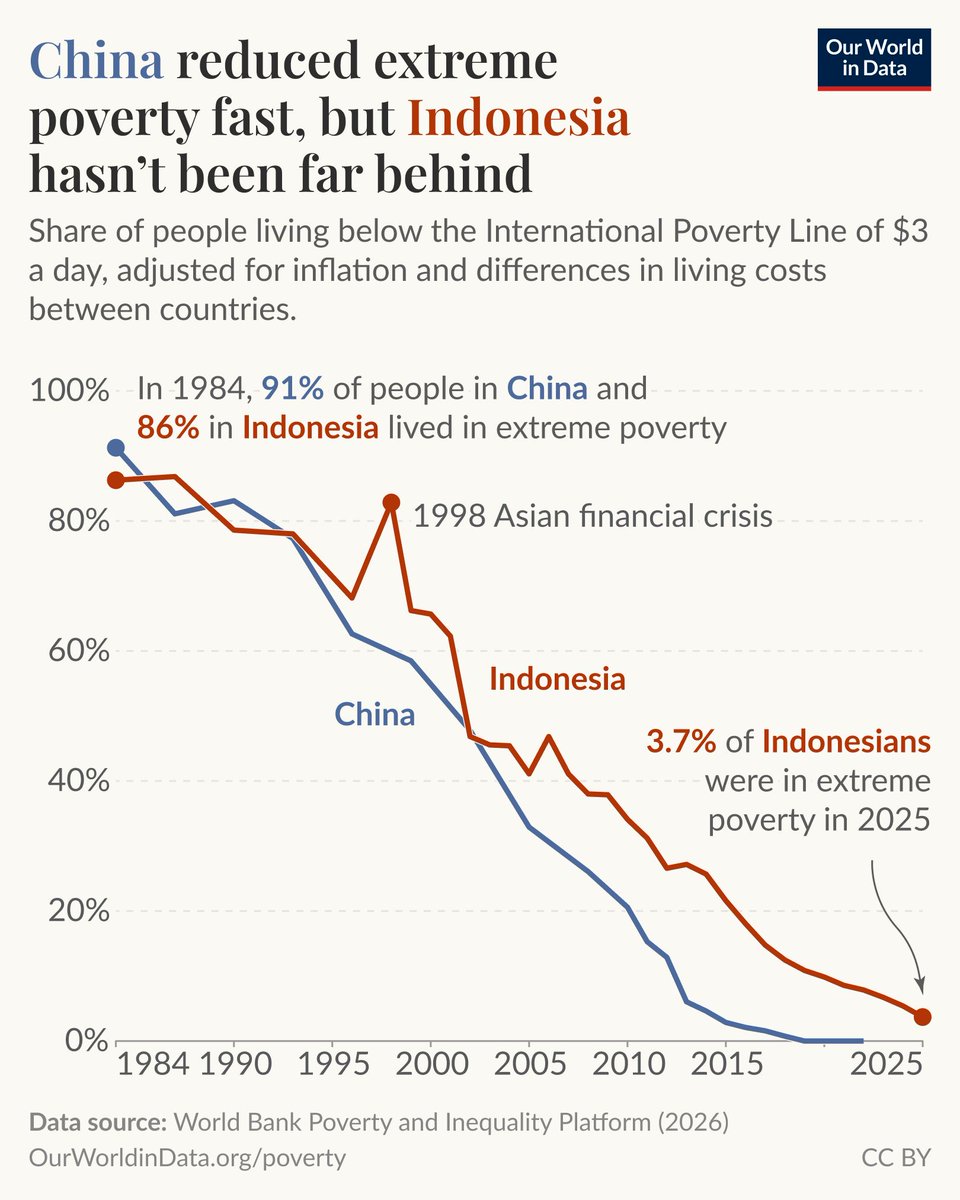
You've read a lot about how much China reduced extreme poverty but without much international recognition Indonesia hasn’t been far behind the Chinese! Respect.
The biggest, and stupidest, myth in European politics, particularly popular in France, is that Europe suffers the consequences of "austerity" and "neoliberalism". In the biggest 5 countries in Europe, more than half of the population makes its income from the state, less than half from the private sector. This is what makes the problem of reducing the welfare state so impossible: more than half of the voters are net recipients. No surprise that Italy's budget has not been balanced in 100 years, France's in 50 years (ooh la la, l'austérité!!):
-France: 30 million from the state versus 21m private sector workers. State spending is 57% of GDP, taxes more than half the economy. The budget hasn't been balanced in the lifetime of most French (since 1974).
- Germany: 35 million adults from the state, versus 34 million from the private sector. 10% of the population is registered as severely disabled. Public spending is over half of GDP. Germany has had a continuous budget deficit since 2019.
-Italy: 23 million from the state, versus 20.5 million private-sector workers. Public spending is 51% of GDP. Italy has had a budget deficit every year since 1925, for 100 years.
- Spain more people get their income from the state since 2024: 18.21 million from the public sector versus 17.9 million people working in the private sector. Since 2025, Spain also had more government employees than self-employed workers (autónomos) for the first time in history. State spending is at 45%, budget has not been balanced since 2007.
- UK: 54% of households now receive more in state benefits than they pay in taxes. State spending is 44.5% of GDP, taxes (40%) are at their highest since 1950, the budget hasn't been balanced since 2001, and 1 in 5 new cars is paid by the government through a bizarre state disability scheme (Motability).
“Instead of the promised productivity increase via the bailout reforms, the Greek economy experienced the opposite: a sharp drop in labor productivity and a significant redistribution of employment toward low-productivity sectors.”
In England there are very clear differences in subjects high school students choose for their final years. It’s exactly as cliche as you think… Source: https://t.co/DC1JJAB0fM
This article indirectly describes one of the more important consequences of our current, distorted form of globalization, even if it isn't commented upon enough. Automation will help Japanese and Korean shipbuilders compete with Chinese shipbuilders only if wages don't rise in line with productivity.
In a system in which nations "win" at manufacturing mainly by suppressing unit labor costs, every country that wants a large manufacturing sector is under pressure either to suppress household income (including by reducing transfers) or to raise productivity without allowing a commensurate rise in wages.
This is the kind of world Keynes warned about, in which countries try to expand production while suppressing demand.
But while a few individual countries can get away with beggar-thy-neighbor growth policies, the world itself cannot do so. If too many countries try to suppress wages, or expand productivity while suppressing the accompanying wage growth, the only way to keep demand and supply balanced globally is with surging debt.
It is of course a good thing if businesses and governments around the world invest to expand productivity growth, but it is not a good thing if workers' wages don't rise in line with the growth in productivity. There's no point in making more stuff if people can't afford to buy it.
This is why Joan Robinson warned that the inevitable result of beggar-thy-neighbor policies, once deficit countries are no longer able politically to bear the costs, is a breakdown in trade. Rising debt and suppressed wages can only go on for so long.
https://t.co/492d6AVD5K via @ft
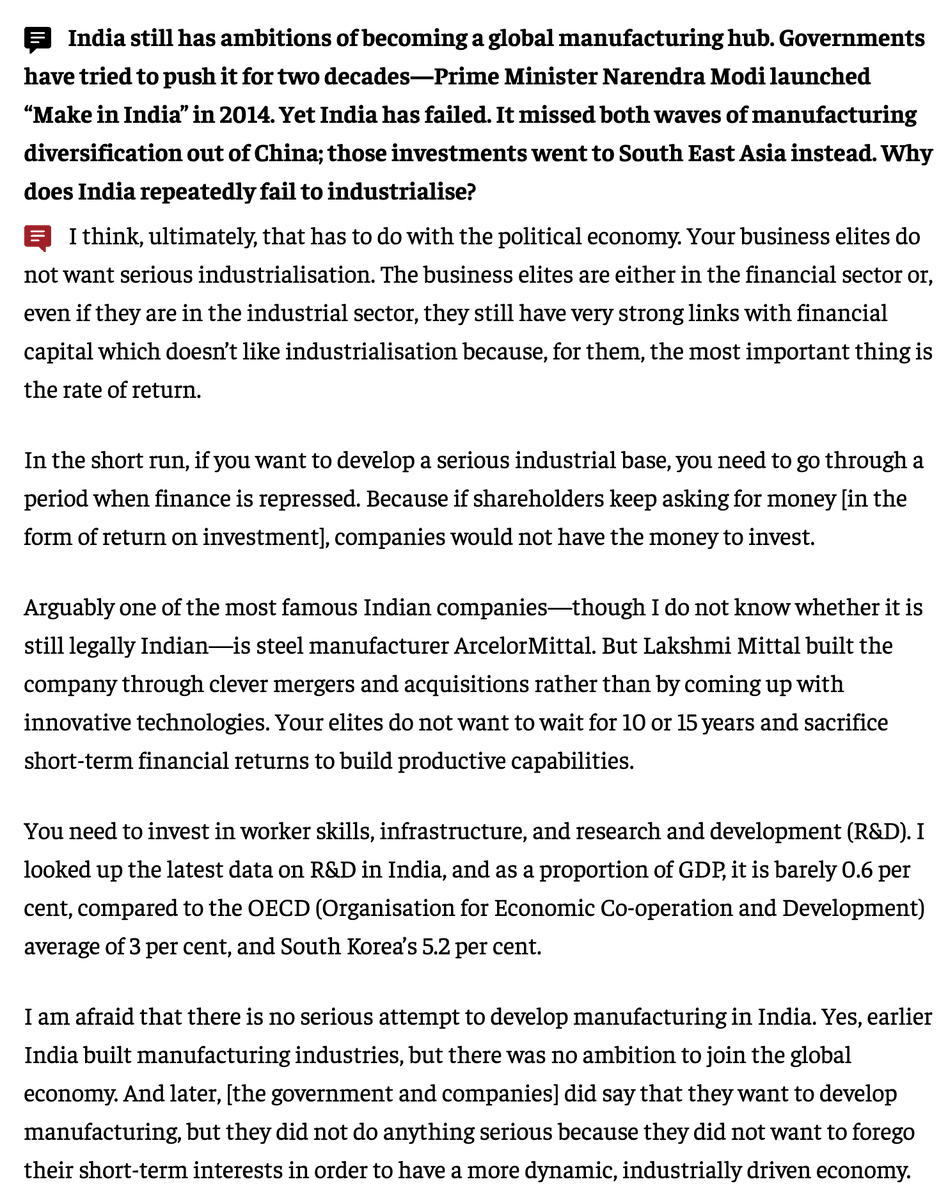
Why has India failed to industrialize?
Ha-Joon Chang argues that it’s because India’s business and financial elites oppose industrialization — and that it won’t happen unless their power is curbed.
Lee Kuan Yew on China
Q: Will China become a democracy?
"No, China is not going to become a liberal democracy; if it did, it would collapse. Of that I am quite sure, and the Chinese intelligentsia also understands that. If you believe that there is going to be a revolution of some sort in China for democracy, you are wrong. Where are the students of Tiananmen now? They are irrelevant. The Chinese people want a revived China. Can it be a parliamentary democracy? This is a possibility in the villages and small towns.
The Chinese fear chaos and will always err on the side of caution. It will be a long evolutionary process, but it is possible to contemplate such changes. Transportation and communications have become so much faster and cheaper. The Chinese people will be exposed to other systems and cultures and know other societies through travel, through the Internet and through smart phones. One thing is for sure: the present system will not remain unchanged for the next 50 years.
To achieve the modernization of China, her communist leaders are prepared to try every method, except for democracy with one person and one vote in a multiparty system. Their two main reasons are their belief that the Communist Party of China must have a monopoly on power to ensure stability and their deep fear of instability in a multiparty free-for-all, which would lead to a loss of control by the center over the provinces. To ask China to become a democracy, when in its 5,000 years of recorded history it never counted heads — all rulers ruled by right of being the emperor; if you disagree, you chop off heads, not count heads."
Q: The relationship between the United States and China has now become the most important geopolitical issue of this century. How do the two sides engage with one another?
"From the Chinese side, in a very pragmatic, almost cold blooded and clinical fashion. On the American side, there’s been some vacillation. First China is a strategic adversary, then China is a strategic partner, then China is a stakeholder, and then China is not carrying its weight."
Q: What impact is China’s rise having on its neighbors in Asia?
"China’s strategy for Southeast Asia is fairly simple: China tells the region, 'Come grow with me.' At the same time, China’s leaders want to convey the impression that China’s rise is inevitable and that countries will need to decide if they want to be China’s friend or foe. China is also willing to calibrate its engagement to get what it wants or express its displeasure"
Q: Will they be able to create the domestic demand that’s necessary as they find exports reduced?
"Slowly. But in the meantime they’re keeping the economy by an enormous expenditure on infrastructure in the west — high-speed roads, high-speed railways, airports, telephone lines, bringing water from the south up to the north where it’s arid and dry, huge, enormous, mammoth projects. That keeps it going. "
Q: How will China’s behavior toward other countries change if China becomes the dominant Asian power?
"At the core of their mind-set is their world before colonization and the exploitation and humiliation that brought. In Chinese, China means Middle Kingdom, recalling a world in which they were dominant in the region.
The concern of America is what kind of world they will face when China is able to contest their pre-eminence. Many medium and small countries in Asia are also concerned. They are uneasy that China may want to resume the imperial status it had in earlier centuries and have misgivings about being treated as vassal states having to send tribute to China as they used to in past centuries.
The Chinese tell us that countries big or small are equal; [that they] are not a hegemon. But when we do something they do not like, they say you have made 1.3 billion people unhappy. So please know your place
"
Q: What is China’s strategy for becoming No. 1?
"The Chinese have concluded that their best strategy is to build a strong and prosperous future, and use their huge and increasingly highly skilled and educated workers to outsell and outbuild all others. The Chinese have calculated that they need 30 to 50 years of peace and quiet to catch up, build up their system, and change it from the communist system to the market system.
I believe the Chinese leadership has learned that if you compete with America in armaments, you will lose. You will bankrupt yourself. So, keep your head down, and smile for 40 or 50 years."
Q: What are the major hurdles in executing that strategy?
"There will be enormous stresses because of the size of the country and the intractable nature of the problems: the poor infrastructure, the weak institutions, the wrong systems that they have installed. Straight-line extrapolations from [China’s] remarkable record are not realistic. China has more handicaps going forward and more obstacles to overcome than most observers recognize. Chief among these are their problems of governance: the absence of the rule of law, which in today’s China is closer to the rule of the emperor; a huge country in which little emperors across a vast expanse exercise great local influence; cultural habits that limit imagination and creativity, rewarding conformity; a language that is exceedingly difficult for foreigners to learn sufficiently to embrace China and be embraced by its society; and severe constraints on its ability to attract and assimilate talent from other [countries].
China will inevitably catch up to the U.S. in absolute GDP. But its creativity may never match America’s because its culture does not permit a free exchange and contest of ideas. How else to explain how a country with four times as many people as America — and presumably four times as many talented people — does not come up with technological breakthroughs?"
Q: How should one assess Xi Jinping?
"He has had a tougher life than [his predecessor] Hu Jintao. His father was rusticated, and so was he. He took it in stride, and worked his way up. It has not been smooth sailing for him. His life experiences must have hardened him. He is reserved — not in the sense that he will not talk to you, but in the sense that he will not betray his likes and dislikes. There is always a pleasant smile on his face, whether or not you have said something that annoyed him. He has iron in his soul, more than Hu Jintao, who ascended the ranks without experiencing the trials and tribulations that Xi endured. He is a person with enormous emotional stability who does not allow his personal misfortunes or sufferings to affect his judgment. He is impressive."
Apple just silently killed 9 paid apps with one free update.
iOS 27 dropped September 22.
Most people saw a new design and moved on.
A developer who tracks App Store data broke down the feature list and told me:
“Apple just made $372/year in subscriptions completely pointless. The features are already on your phone. Nobody will find them.”
Here’s every feature — and the app it replaces 🧵
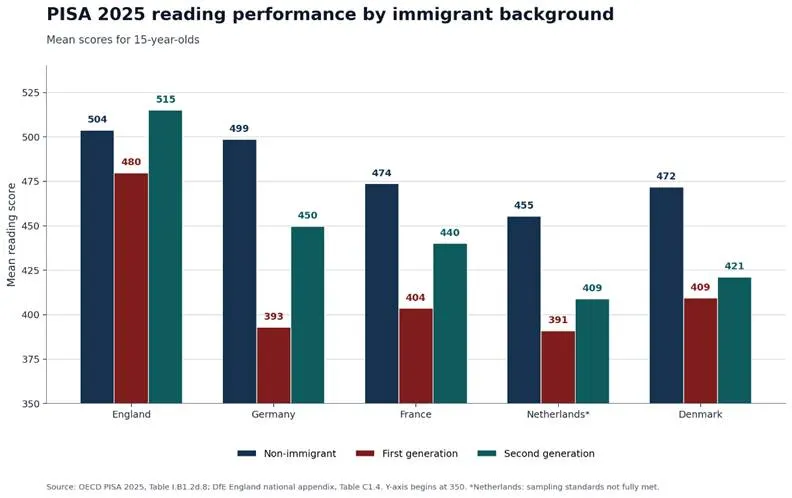
The difference between the performance of immigrants in England + W Europe is staggering. (20 pts equals a year of learning.)
I look at this in detail in the post - it can't be explained away by language or relative advantage. There is a policy factor.
Xijing Research Institute dean Zhao Jian: "For years, the conventional wisdom was that China’s economy was held hostage by its real estate sector. Today, Beijing faces a new, equally perilous predicament: an economy dangerously overreliant on exports. The core issue is not that Chinese manufacturing is too competitive, but that this advantage is essentially subsidized by the severe compression of domestic consumption and labor costs. Rebalancing is no longer optional; it is urgent."
Interesting Caixing article. I wouldn't say this is the policymaking consensus yet, but the speed with which similar views have been spreading in public suggests that we may be nearing a turning point in the narrative.
https://t.co/Q2eSxcONum
People keep saying Trump term II is the most corrupt administration ever, so I built a model to find out if it was true.
I took the UN's definition of corruption, turned it into eight criteria and 100 points, and scored the leaders history remembers for looting their countries: Marcos, Suharto, Mobutu, Abacha, Obiang, Putin.
Then I put every president since Eisenhower on the same scale, both parties, with every exoneration counted right alongside the convictions.
Nixon scored 41 and no other American President scored over a 25.
Trump's second term scored a 91, which ties him with Suharto and Mobutu and puts him above Marcos and Abacha.
So he is not only the most corrupt president in American history. At this pace he finishes his term level with the most corrupt rulers of the last hundred years.
PSA: don't come in my comments arguing about the results if you haven't read the full article, because ignorance is a choice.
Full article is up now on my Substack (link in bio) and it's free.
China is fundamentally like everywhere in Asia, a K shaped maxxed economy,
Anything with dollar exposure/export exposure is fine, those elites are living better than ever,
The local wage economy
and domestic economy are a funk though, because Asians just don’t spend or are too indebted , the local governments don’t do much to strengthen their stock markets, and the economies are dominated by pretty unprofessional family run companies that also pretty much are nepotistic and resistant to professional management.
The smartest thing you can do as a young ambitious Asian is to export max and tech max via your own business,
The domestic economies are finished as a real wealth building route.
And I say this as someone who loves Asia by the way, but I am always blunt about the realities of situations.
REMINDER: They need a credible off ramp from the hyper scaling narrative they’ve been selling for months. Safety concerns are an obvious way to justify the incoming pivot. They also justify taking the whole thing into a closed “Manhattan project” type setting at the government’s expense. This justifies the incoming lockdown.
As I predicted in August the scale narrative had run its course due to kimi. Hyper scaling wasn’t about genuine demand expectations. It was about winning the ai race by outspending and bankrupting your competitors. Kimi made that pointless.
This is no doubt the asymmetric information Bessent has been alluding to for weeks. There’s going to be a helluva lot of liquidity freed by this move. It’s all going to go flooding into USTs. Happy D day bond guys.
👇
1/2
Michael Froman: "Perhaps the most significant, if implicit, subsidy is Chinese manufacturing firms’ access to Beijing’s state-directed financial system, which channels vast credit to prioritized sectors, enabling Chinese firms to expand without the same concern for profit and return as their international peers."
This helps show why rebalancing is so difficult. Raising interest rates and cutting off financing to unprofitable producers would set off a self-reinforcing process in which a large number of producers would have to close down facilities and fire workers which, in turn, would reduce domestic demand further.
https://t.co/dq6jtEwkt9 via @ForeignAffairs
ispanyollar dünyanın yarısını yönettiler, nasıl oldu da ing ve fransanın gerisine düştüler diye sormak çok haklı bi soru
1787 yılında, abdulhamitin madride gönderdiği ilk resmi osmanlı elçisi ahmet vasıf efendinin İspanya sefaretnamesini okumak gerekir bunu anlamak için, çünkü dönemi bizim dilimizde, bizim dünyamızda anlatan bi insan. vasıf efendi, dışarıdan bakıldığında ihtişamlı görünen bu imparatorluğun içten içe nasıl çürüdüğünü bizzat yerinde görmüş ve adeta bi iktisatçı gibi satır satır teşhis etmiştir
vasıf efendi, amerikadan gemilerle gelen külçe külçe altın ve gümüşün ispanyol ekonomisini nasıl tembelleştirdiğini açıkça anlatır. ispanyolların kendi memleketlerinde fabrika açmak, zanaat geliştirmek yerine ihtiyaç duydukları her şeyi ingiltere ve fransadan hazır satın aldıklarını yazar. yani sömürgelerden gelen o devasa servet ispanyada kalıcı bir sanayi yaratmamış, yalnızca rakiplerinin sanayi devrimini finanse eden bi nakit akışına dönüşmüştür hatta o kadar çok altın gelmiş ki avrupada altın enflasyonu olmuştur
sefaretnamede dikkat çeken en vurucu gözlemlerden biri halkın ve soyluların iş ahlakıdır :D vasıf efendi, sokaklarda cebinde tek kuruşu olmayan ama asilzade olduğu için ticaret yapmayı, tezgah başına geçmeyi ya da fiziki çalışmayı onuruna yediremeyen binlerce insan olduğunu aktarır. hatta halkın tembel ve miskin olduğunu yazmıştır. üretim ve zanaat aşağılık bir meşgale görüldüğü için ekonomi tamamen dışa bağımlı hale gelmiştir
vasıf efendi granada sokaklarını gezerken hayran kaldığı sulama kanallarını, tarım arazilerini ve şehir mimarisini uzun uzun anlatır, ama sonra acı bi gerçeği vurgular, bu toprakların asıl üretici gücü, zanaatkarı ve mühendisi olan müslümanlar ve yahudiler zorla sürgün edilmiştir. nşitelikli insan sermayesi ülkeden temizlenince geriye işlenmeyen verimli topraklar ve atıl kalmış bir ekonomi kalmıştır
ülkedeki kiliselerin, manastırların ve ruhban sınıfının büyüklüğüne değinen vasıf, hiçbir şey üretmeyip sadece hazineden ve halktan beslenen devasa bir kitlenin varlığına dikkat çeker. en zengin toprakların ve sermayenin bu kurumlarda bloke edilmesi, üretim sermayesini tamamen kilitlemiştir.
hatta hatıratlarından hatırladığım en komik ve vahim olaylardan biri, yine vasıf efendinin anılarında asıl şok yaşadığı kraliyet olayı da budur, padişahın kral üçüncü carlos için gönderdiği resmi hediyeleri teslim ettikten sonra kraliyet ailesinin diğer üyelerinin özellikle veliaht prens veliahtın eşi maria luisa ve kralın diğer çocuklarının "Padişah bize niye ayrı hediye göndermedi?" diyerek açıkça tavır koyup elçilik heyetinden yüzsüzce pay talep etmesidir.
osmanlı protokolünde devletlerarası hediyeler yalnızca hükümdara takdim edilirken, ispanyol saray hanedanının sanki sıradan bi miras kavgası verir gibi padişahın krala getirdiği samur kürkleri, kıymetli kumaşları ve mücevherleri aralarında paylaşmaya kalkışması, yetmeyip vasıf efendinin kendi yanında getirdiği şahsi eşya ve paraları da kraliyet üyelerine dağıtmak zorunda bırakılması karşısında sefir çileden çıkmış ve koca bir hanedanın yabancı bir elçinin hediyelerine böylesine arsızca tamah etmesini sarayın ahlaki sefaleti ve tükenmişliği olarak not düşmüştür.
pasifikten atlantike kadar uzanan o haritayı savunmanın bedelini, ispanyanın tersanelerini ve askeri yapısını incelerken, bu kadar geniş bi coğrafyada kale ve donanma tutmanın getirdiği muazzam lojistik masrafların sömürgelerden gelen parayı misliyle eritip tükettiğini anılarında söyler, madrid sarayını mimari olarak son derece haşmetli ve debdebeli bulsa da, içerideki kraliyet ailesi ve görevlilerin yabancı bir elçinin hediyelerine bile göz dikecek kadar asalak, dedikoducu, kuralcı ve ahlaken çürümüş bi dünya içinde yaşadığını anlatırç. sokakları ise taş döşemelerine rağmen pis kokuların sindiği, çöplerin saçıldığı ve asıl mesleği olmayan, pelerinlerine sarınıp köşe başlarında aylaklık yapan gururlu ama sefil hidalgo kalabalıklarıyla dolu tekinsiz bi çelişkiler şehri olarak tasvir eder
okumak isteyenler için çok eğlenceli bi hatırat:
https://t.co/3bFcWFQWUN
Many people cite GDP to show off which country is "the richest" or use GDP per capita to show off who is more productive. I find it more interesting to look at what people end up OWNING and what they CAN BUY for that money.
As long as you calculate everything in US$ and don't adjust for purchasing power it doesn't mean anything. Yes, US salaries are often double that of Japan, but then real estate or even food prices are easily 3-5 times as high. So here's the top 30 of MEDIAN* NET WEALTH per adult ADJUSTED FOR PURCHASING POWER.
The US being way down is not surprising considering that people are notoriously indebted all the time, and buy everything on credit, but it also shows how litte their already small savings can get them.
*Median is more realistic than average here, because in the US the high number of billionaires would actually skew the results upwards, not reflecting reality very well.
Part three of a 3-part series on the China version of the Asian growth model. All three parts are a good explanation of where China's development stands today and why rebalancing has proven so difficult.
https://t.co/28j7SABcla