Having traded markets for nearly a decade, I still get asked the same question over and over:
“How do I become a trader?”
And my answer never changes:
Don’t.
Seriously, just DCA into the S&P 500 $SPY every two weeks, close the app, and go live your life.
Because what most people see on FinX isn’t the reality of this game. This isn’t a side hustle and it’s not a casual skill you pick up on weekends.
It’s a full-blown obsession.
But...if you want to become a trader...and if you want even a chance at surviving in this arena, you have to live it, breathe it, and eat it…Every. Single. Day.
You’re constantly processing:
• What’s the next trade
• Which narratives are emerging
• Who’s breaking out vs who’s lagging
• How sentiment is shifting day to day
• Macro, rates, geopolitics
• What bonds are doing at 6am…or midnight
• Indicators across multiple timeframes
And that’s just scratching the surface.
It never shuts off. Not when you wake up, not when you go to bed.
Your brain never shuts off; it’s constantly running simulations. Hell, I’m dreaming in numbers at this point.
And here’s the truth no one wants to hear: You have to be a little insane to choose this path.
Years of pain, emotional swings, and getting humbled over and over and over again.
You don’t come in and start winning. You survive first.
You blow up ideas. You question yourself. You hit points where most people would quit.
You’ll find yourself in some very dark mental places and you’ll have to claw your way out on your own, because at the end of the day, this path is a lonely one…get used to it.
But that’s where real risk management is born. That’s where discipline is built.
And if you’re not thinking about markets at a borderline obsessive level…If you’re not wired this way…You’re not making it. Not long term.
It took me over 5 years to become consistently profitable, but I knew how obsessed I was. Quitting was never an option...not until I made it.
FinX has turned into a highlight reel, with everything optimized for instant gratification and almost no real emotion or honest testimonials. So tonight, I’m sharing the raw truth…what my mind is actually processing every single day of an everyday trader.
And one more thing, albeit I already mentioned it, get comfortable being alone.
Don’t expect to explain your life to “normal” people…they won’t get it.
Most will assume you’re never going to make it anyway.
Most traders walk into the charts like the market is supposed to move for them.
But the truth hits hard: the market doesn’t care about your bias, your setup, or your feelings.
Some days it trends like a rocket.
Some days it moves like wet cement.
And if you force trades in the wrong environment, the market will tax you for your impatience.
The real skill:
- Read the environment
- Match your aggression to the conditions
- Know when the market is giving… and when it’s taking
A sniper doesn’t fire at every shadow.
A trader shouldn’t either.
When the market is dead, your best trade is not trading.
When the market wakes up, that’s when you strike.
Adapt or get eaten — that’s the rule.
Scaling up exposes weaknesses you didn’t know you had.
A trading system rarely breaks at small size — it breaks when exposure increases.
If you’re thinking about trading bigger, read this first.
https://t.co/UXIrEmC8OH
Polish 26 year old guitar master Marcin Patrzałek respond to those who have made public comments claiming that his music is fake.
He made this video in a tutorial form showing how he manages to play so extraordinarily well in response. And yes, it's all played on one guitar.
It is with profound sadness that we share the passing of Bobby Weir. We send him off the way he sent so many of us on our way: with a farewell that isn’t an ending, but a blessing. A reward for a life worth livin'. https://t.co/2qdBbh80v1
📸 Chloe Weir
Casinos ban certain strategies to protect their edge. There are interesting parallels between how casinos manage risk and how traders can think about probability.
Most traders approach markets without a statistical framework. They pick directions, chase setups, and hope they’re right more often than wrong.
Casinos operate differently. They rely on probability and statistics to maintain consistent advantages over thousands of transactions.
Looking at how casinos manage risk offers useful educational comparisons to options trading. Here are a few concepts that I think stand out:
#1: The Martingale approach is based on scaling position size after losses.
Casinos restrict this model with table limits. The mechanics are simple:
- Bet $10 and lose → next bet is $20
- Lose again → next bet is $40
- Continue scaling until a win
The model is designed so a win could offset earlier losses, but this assumes unlimited capital... something neither casinos nor traders have. Table limits exist to prevent this approach from being feasible.
While markets don’t impose table limits, traders still face natural constraints like capital, volatility, and risk tolerance.
#2: Card counting estimates when probabilities shift.
The MIT Blackjack team used card counting to identify when the deck statistically favored the player. Casinos eventually restricted this behavior.
In options trading, probability estimates appear directly in the options chain. Traders can evaluate different strikes and expirations using those estimates — similar in spirit to how card counters evaluated deck composition, though market dynamics are far more complex.
#3: Small statistical advantages become meaningful over large samples.
Casinos profit from a small percentage edge across thousands of transactions.
In options trading, probability estimates help traders structure defined-risk positions. Higher-probability trades typically offer smaller potential returns, while lower-probability setups may offer asymmetric outcomes. Nothing is guaranteed, and performance varies, but sample size and position sizing matter.
#4: Structural rules shape what strategies are viable.
Casino table limits prevent infinite scaling. This constraint defines which betting strategies remain possible.
Markets operate with different structural rules. Traders adjust position size based on available capital and risk management preferences. Understanding these differences helps clarify which concepts translate across environments... and which don’t.
The bottom line?
Casinos operate on statistical edges and disciplined probability management. Markets offer probability-based frameworks too, though outcomes remain uncertain. Recognizing how different environments manage risk can offer helpful context for thinking about trading in a probability-informed way.
Educational only. Not investment advice. All trading involves risk.
Trading can turn you into a better person.
Patient and disciplined, for starters. But it also makes you focused, accountable and driven, yet humble.
Often, the ‘spark’ that creates or enhances these qualities is flared from the moment you start approaching trading with a professional mindset.
You realise you’re in it for the long haul, and act accordingly. You commit to the markets.
And you start working harder than you believed possible. 🧵
I learned this lesson the hard way:
The market wants you to think & act like everyone else
What do I mean?
The large players who control the stock market want you to make predictable moves so they can capitalize on it. Every trade you make has someone on the other side. They are selling when you are buying. They are buying when you are selling
The process is simple. These large players create something that will stir emotions in the traders they are targeting. A headline, a technical setup, etc. Then.... they wait for the traders to get emotional & act on that emotion
Those traders have fallen into the trap
Imagine you live in a small town with a small store. Every time you visit the store they are always out of oranges, and you're tired of it. You start a rumor around town that the oranges are causing a dangerous sickness. Next time you go to the store, they have plenty of oranges for you to buy
Now imagine you live in that same small town, but you're the guy trying to sell those oranges. You wait for the nasty rumor to die down & buy an ad in the local paper that explains all the health benefits of eating one orange per day. Your oranges start flying off the shelves again
This is the type of push & pull we see happen all the time in the market. The average Joe is incredibly easy to predict, and the large players take advantage of it whenever they can
Remember all the tariff headlines in early 2025? They made the average Joe TERRIFIED. Lots of market participants panic sold their shares after seeing the negative headlines & red market
Vinny the value investor saw those headlines & liquidated his long term portfolio. Who did he end up selling his shares to? The investment company who owns the media platform that Vinny uses for his news. The same people who were spreading the fear were scooping up shares being sold due to that fear
Who profited from that environment? The traders who were able to examine the situation without emotion. The traders who understood that when everyone is scared, that's typically when the whales are getting ready to start buying
The market wants you to think & act like everyone else
It wants you to get scared every time you see a bad headline paired with some selling. It wants you to run to your computer to click the buy button every time you see good news and a green candle
It's your job to learn the traps that the market sets. It's your job to understand how the current environment is impacting the masses. It's your job to avoid the impulsive emotions that the average Joe cannot
Every blown account I've analyzed starts the same way.
Overtrading.
Not the day you overtrade - but what you do after.
Here's the pattern that destroys accounts (and how I finally broke it):
Disaster
the dramatic drawdown, the painful reversal of fortune, the failed strategies and idea, is not the exception. it is the natural, inevitable friction of any high-stakes venture.
Every one of us will face moments when the fundamentals we trust are questioned, and the bottom line is bleeding.
The vast majority of the world operates under the delusion that absolute, seamless success is the expected norm.
They are unprepared for the depth of the valley, only perceived by those who try something worthwhile.
Our true value, our competitive advantage, is not established during the bull run. It is revealed entirely by how we act in those dire moments.
It is the disciplined response to a crisis, not the reaction to a windfall, that defines us as leaders and shapes our enterprise.
Long-term, compounding success is never a stroke of luck. It is forged in Perseverance. It is built on the strength of our Adaptation and our Action through the most grueling part of the journey: the daily, painful requirement of showing up without capitulating.
In the dark of the market correction, in the despair of the valley of failure, when the environment is hostile and the data is grim, we execute. We maintain the systems, we trust the process, and we refuse to let go.
This resolute execution, year after year, in the face of inevitable challenge, is the only true path to enduring wealth and legacy.
Understand the path will take everything and march on. I will walk the path with you, until we dine in heaven once more.
You'll get periods you can't win enough, you'll get periods where you doubt you ever had it.
Over 13 years.
Max consecutive wins: 29
Max consecutive loss: 13
Felt like the king, felt like the dumbest person on earth.
Markets will make sure to test you like you have never been before and not feel any emotions doing so.
Hang in there.
First mushroom trip data is out: my brain activity.
Dose: 5 g dried Psilocybe cubensis (B+ strain)
Containing 24.9 mg psilocybin
Psilocybin longevity experiment.
What we see in the brain:
+ brain activity data mirror my subjective experience
+ strong decrease in my brain’s control center (prefrontal + premotor cortex)
+ strong increase in sensory, auditory and speech integration
+ higher entropic brain patterns: open, flexible, less predictable, exploratory
+ brain network patterns resembling a youthful state vs aged and rigid
Matching what I reported experiencing:
+ “felt like my consciousness was dialed up to 10/10.”
+ “I felt hyper aware and hyper alive.”
+ “I experienced sense of touch with awe.”
+ “my mind was insatiably curious and wanted to deploy its sensors into the world and discover all things.”
+ “My brain wanted to stare, study and marvel.”
+ “The flavor exploded in my mouth.”
+ “...restored my perception to youthful levels, returning them to factory settings and dissolving my aged numbness.”
Why this could matter for longevity:
+ In people aged 65-85, higher happiness was linked to a 22% reduced risk of all-cause mortality over 15 years.
+ A meta-analysis showed that optimism correlated with a 35% decrease in heart attacks and a 16% decrease in all-cause mortality.
+ Having a strong purpose in life is associated with a 17% reduction in both heart attacks and all-cause mortality.
+ In psychedelic medicine, treating depression with ketamine has been shown to reverse biological age by up to 3 years.
Together, these findings suggest a plausible mechanism by which psychedelics, including psilocybin, can prolong both health and lifespan by improving mental well-being and rewiring the brain to a more positive, creative, and curious state.
My team and I hypothesized that neuroplasticity, the loosening of rigid inhibitory patterns that makes the brain more flexible, creative, and relaxed, and even the subjective psychedelic state itself may be as meaningful for longevity as methylation shifts, senescence reversal, or telomere biology.
What’s happening mechanistically
Earlier work shows that psilocin (the active metabolite of psilocybin) acts primarily as an agonist at 5-HT₂A serotonin receptors in the cortex. These receptors are especially dense in high-level association and sensory regions, as mapped in a high-resolution PET/MRI atlas of the human serotonin system.
When these receptors are activated, brain imaging studies show an induced state of desynchronization, entropy, and neuroplasticity. This process erodes the rigid brain hierarchy and default mode networks in favor of a brain-wide spontaneous, creative, curious, and child-like state.
Kernel Flow data shows the same pattern:
The recorded timepoints included:
+ baseline: directly before session start (not shown)
+ timepoint 1: 4 hrs after dose (acute phase effects).
+ timepoint 2: end of the day, before bedtime.
+ timepoint 3: the following morning.
I continue to measure my brain daily.
Image notes
+ The three maps show changes vs. baseline (not absolute activity)
+ Red = increased connectivity, blue = decreased connectivity vs. my baseline.
+ The left reference map shows the 5-HT₂A receptor distribution from PET, the main psilocybin target.
Time Point 1 - 3 hrs post dose
+ Reduced connectivity in the prefrontal and premotor cortex, correlating with acute brain desynchronization.
+ Increased connectivity and hyperintegration between the primary motor and sensory cortex regions.
+ Enhanced connectivity in the auditory and speech areas of the cortex.
+ Inhibited connectivity in the medial prefrontal and posterior zones, areas associated with the Default Mode Network (DMN).
Subjective experience:
+ Enhanced sensory vividness and bodily presence: The brain's top-down hierarchy, originating in the pre-frontal cortex, was attenuated. This reduced predictive filtering, leading to a flood of bottom-up sensory information and heightened bodily perception (e.g., a fascination with water and light dynamics in a jar, a restored, primal joy of touch and sensation).
+ Peak neuroplasticity and cortical entropy: A peak in cortical entropy and neuroplasticity contributed to a feeling of hyperawareness (e.g., heightened sensory perception, feeling "at one with existence," hyper-aware and hyper-alive).
+ Deeper appreciation of music and uninhibited movement and expression: Sharpened auditory senses and reduced top-down inhibition allowed music to be enjoyed on a profound level. Concomitant functional connectivity in speech-motor and auditory-motor integration areas facilitated uninhibited expression through both speech and movement (a restored, uninhibited, child-like joy of music).
+ Note: Full ego dissolution was not experienced, which may necessitate a higher dose to achieve more advanced desynchronization of the prefrontal and parietal cortices.
Time point 2 - 5 hrs post dose, end of trip
+ Intensified sensory and motor hyperconnectivity.
+ Continued increased connectivity in auditory and speech centers, with a relative restoration of connectivity to the speech understanding area.
+ Partial re-emergence of the prefrontal parietal coupling, while prefrontal context remains partially inhibited.
+ Partial re-emergence of connectivity in areas related to the default mode network.
Subjective Experience
+ High-order brain networks begin to restabilize, alongside persisting sensory, motor, auditory, and speech hyperconnectivity, suggesting neuroplasticity in action.
+ The narrative shifts from pure sensation and experience to meaning generation, accompanied by deep philosophical reflection (e.g., reconsidering the meaning of life and one's relationship with mortality in the time of AI, and pondering the future of human evolution).
Time point 3 - next morning (afterglow)
+ Persistence: Patterns from the acute phase continue, including general prefrontal cortex inhibition, ongoing neuronal plasticity, and heightened senses.
+ Intensified connectivity: Increased connectivity is noted in the speech generation area and the somatic sensory association area.
+ DMN inhibition: The default mode network remains inhibited.
Subjective Experience:
+ "Afterglow" effect: Characterized by continued sharpened senses, calm clarity, emotional openness, and low inhibitions. For instance, I felt more comfortable expressing uninhibited, self-deprecating humor (i.e. my post making fun of myself about the insane lengths I go for my Don’t Die experiment)
+ Integration of experience learnings: The heightened activity in the somatic sensory association area aligns with the process of integrating and "making sense" of the raw sensory experience of both the self and the external world.
+ Enhanced creativity: The intensified connectivity in the speech generation area contributed to the uninhibited bout of creative writing I undertook to report my experience.
$NQ and $ES_F closed below their FVGs after failing to make new highs with $YM, confirming a SELL SIGNAL ⚠️
$SPX is now positioned in its 3rd wave down 🔻 with a primary target at 6550🎯, where major confluence aligns:
• Weekly FVG support
• 1st-wave equality
• Overshot 4-year trendline
Overall, momentum has shifted firmly to the downside. Looking lower against the SMT high at 6870 (invalidation)
All 3 indices formed a bullish Daily FVG, now key support at ES 6830–6772 | SPX 6807–6730🟢
If it holds, $SPX can extend toward 7000–7050 (W5 of Wave 3).
But several bearish divergences are forming — including one at the $NDX PDH — and a Daily close below #ES 6772 | $SPX 6730 would confirm a sell signal ⚠️, suggesting W5 is complete and the next wave down is beginning.
Due to the momentum in the Dow, price may use that FVG as support to make a new high, but without NDX and/or SPX -> forming a more significant bearish SMT divergence, which would give an even strong sell signal if that FVG is inverted.
$SPY $RTY_F $NDX $NQ_F $YM
Plan vs react. Inevitably my best trades are via planning where I have a thesis and levels. Worst case and best case. This way we can take emotion out of the process and just execute. You can’t function efficiently without confidence. If you have a well thought out plan of action it creates confidence. When you react to price without any forethought it’s much harder to manage a trade.
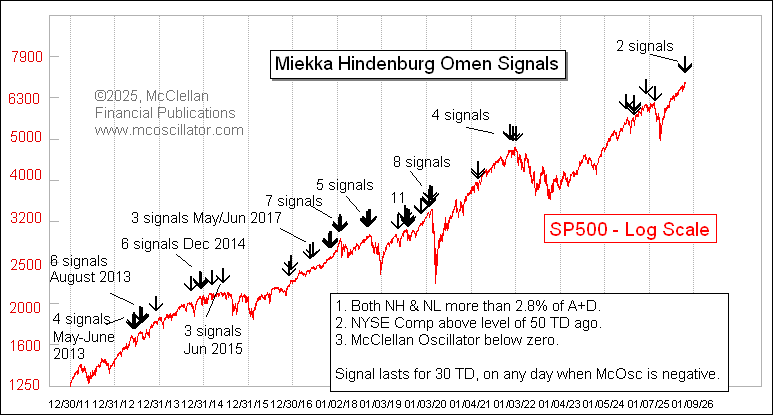
The NYSE on Oct. 30 saw 93 New Highs, and 131 New Lows, both above the 77 threshold (2.8% of A+D) to get another Hindenburg Omen signal. This makes 2 so far, with one yesterday. They tend to matter more when we see a cluster of them.