The AI ponzi scheme goes like this:
Everyone is generating all these long ass docs and then passing them off for others to read
Then the person receiving is like, wtf this is way too long, and hands that into an AI to read and summarize
Then they are generating a long ass response back
and this cycle goes like that forever. and we call this work now 😅
The token lords watch this from their towers nodding and grinning.
My 30+ observations on the greatest opportunities in AI agents right now:
And some ideas that are keeping me up at night.
1. The new buyer on the internet is an AI agent. Imagine billions of new customers showing up with money to spend but they only shop via MCP. That's what's happening. No MCP server means you're invisible to the fastest growing buyer on the internet.
2. Every franchise system in America (30,000+) needs an agent layer and none of them have one. One founder per franchise vertical. That's 30,000 businesses waiting.
3. Everyone said "distribution is the only moat" a year ago. Now I'd add that the only moat is distribution plus memory. The company that has your audience AND your agent's accumulated context is impossible to leave.
4. Consumer mobile is more interesting than it's been since 2012. Apps can finally DO things for you instead of showing you things. The next wave of $100M apps are being built right now.
5. The most interesting startup nobody has built is an agent marketplace where you rent access to someone else's trained agent. A recruiter spent 6 months training a sourcing agent on healthcare hiring. That agent is worth renting to every other healthcare recruiter on earth. The agent itself becomes the product.
6. A sorta strange phenomenon that's happening right now is agents are developing preferences. Give the same agent the same task 100 times and it starts developing patterns in how it approaches it. Nobody is studying this yet. But the agents that develop good patterns are worth more than the ones that don't. That's a new kind of asset.
7. Dead internet theory is about to become dead SaaS theory. Half the apps you use will quietly replace their support team, their onboarding team, and their content team with agents. You won't notice for months. Then you'll realize you haven't talked to a human at that company in a year.
8. The most valuable data in the world right now is sitting in the support tickets of small or mid tier SaaS companies. Every ticket is a customer telling you exactly what to build next. Mine this.
9. The most interesting pricing problem nobody has solved is how do you price a product when your costs change every time OpenAI or Anthropic updates their model pricing? Your margins can swing 40% overnight based on a decision made in San Francisco. The company that builds dynamic pricing infrastructure for agent-based businesses solves a problem every AI company has.
10. The best AI products feel like they're reading your mind. The worst ones feel like filling out a form with extra steps.
11. An interesting arbitrage I've noticed lately is hiring a human VA for $20/hour to supervise an AI agent that does $200/hour work. The human just checks the output.
12. The managed AI agent business is becoming the new agency model. $5k/month per client. You build it, run it, maintain it. The client gets a digital employee they never have to think about. This will be a $50 B+ category.
13. The first "shadow agent" scandals are about to drop. Employees running personal agents on company infrastructure without telling anyone. Using company API keys. Agents accessing internal docs. IT departments have little visibility into this right now. Lots of opportunity to build companies here. Definitely a painkiller not a vitamin type of business.
14. Right now there are probably millions of agents running on autopilot that their creators forgot about. Still burning tokens. Still sending emails. Still scraping websites. Still costing money. The "find and kill your zombie agents" tool is a product that writes itself.
15. Companies are starting to hire based on someone's agent portfolio instead of their resume. "Show me 3 agents you built that are running right now." It's REALLY early but it's starting.
16. Your Slack archive is a product. Every company's internal Slack has thousands of messages explaining how they actually do things. The company that lets you point an agent at your Slack history and auto-generate SOPs and agents from it will be enormous.
17. We're watching the cost of intelligence fall faster than the cost of distribution. Which means distribution is now the expensive thing.
18. The most underrated asset a human can have in 2026: the ability to sit in a room with another human, make eye contact, and have a real conversation. As AI handles more of the transactional stuff, the humans who can do the relational stuff become disproportionately valuable. The soft skills people used to dismiss as fluffy are becoming the hard skills. The hard skills people spent decades acquiring are becoming the soft ones.
19. There are MANY huge companies to be built around the fact that most people's agents are running on their personal laptops which they also use to browse the internet, check email, and download random files. The attack surface is enormous. One compromised Chrome extension and your agent's API keys, customer data, and workflows are exposed.
20. There's a new type of burnout forming that doesn't have a name. It's not from working too hard. It's from context switching between human work and agent work 50 times a day. Reviewing agent output, correcting it, approving it, reviewing again. The mental load of supervising agents is different from the mental load of doing the work yourself. Some founders are telling me they were less tired when they did everything manually because at least the cognitive pattern was consistent.
21. The cheapest form of market research: search "[your industry] spreadsheet template" on Google. Whatever people are tracking manually is your product.
22. Half the YC companies pivoted within 8 weeks of demo day. Not because they failed. Because agents let them test 5 ideas in the time it used to take to test one. The concept of "committing to an idea" is dissolving. Serial pivoting is becoming the default because 1) AI lets you move fast 2) the world is moving fast.
23. The loneliest job in tech right now is being the only person at your company who understands what the agents are doing. You can't explain it to your boss. You can't hand it off to a colleague. If you leave, everything breaks. You've become a single point of failure for an entire automated system. That person needs a title, a team, and a backup plan. Most companies haven't figured this out yet.
24. Your browser history is the most valuable training data you own and you're giving it away for free. Every site you visit, every product you research, every competitor you study, every pricing page you screenshot. That behavioral data, structured and fed to an agent, would make it understand your business better than any onboarding call. The company that lets you turn your browser history into agent context builds something nobody can replicate.
25. Everyone is building AI wrappers. Nobody is building AI unwrappers. The tool that takes an AI-generated document and tells you which parts a human wrote and which parts were generated.
26. Stripe just became the most important company in the agent economy and they barely had to do anything. Every agent that sells something needs Stripe. Every agent that buys something needs Stripe. They're the payment rail for the entire agentic internet by default.
27. The most undervalued API in the world right now is the US Postal Service address verification API. It's practically free. Every local business lead gen agent needs it. Every real estate agent needs it. Every direct mail agent needs it. Boring government infrastructure is quietly becoming the backbone of agent-native businesses.
28. The concept of "business hours" is for humans. Your agent closed a deal in Tokyo at 3am, processed the payment, sent the onboarding email, and updated the CRM before your alarm went off.
29. What happens when agents start recommending other agents? Your research agent finds that a competitor's sales agent is better and suggests you switch. Agent referral networks are forming organically. The first agent affiliate program is probably 6 months away.
30. Cal dotcom closed their source code. That's the canary. When open source companies start closing up, it means agents were cloning their product too easily. Every open source company is quietly asking the same question right now.
31. "AI for pet groomers" sounds like a joke and that's exactly why it will work. 150,000 of them in America. Zero tech. All scheduling by phone or IG DMs. The joke ideas always win.
32. The thing that will seem most obvious in hindsight: we spent 2025-2026 arguing about which model is best while the entire value was in the orchestration layer. The model is the CPU. Nobody buys a computer based on the CPU anymore. They buy it based on what they can do with it. Makes so much sense in hindsight. What else will be obvious in hindsight?
I'll share more notes soon.
I can't sleep with all that's going on. Maybe you too.
What an incredible time to be building.
The economics for AI are clearly complicated. But the crux is the following (assuming a frontier lab with LLMs, not diffusion):
- if you account for the previous training run, they look great
- if you account for the current training run, they look terrible
- the current training run isn't in COGs (obviously)
- but we all know models only have 3-6months of relevancy
.... so ... either capital keeps chasing growth one training run ahead of what's currently being used. Or the market will have to rationalize the disconnect.
Many database systems include compilers, meaning that your SQL query is turned into machine code.
PostgreSQL has a just-in-time compiler for queries. It is not alone, a system like ClickHouse does too.
Even the good old sqlite translates queries into its own byte code for efficient execution.
Database system engineers often claim that database engines are the most badass software you can build. And they have a point.
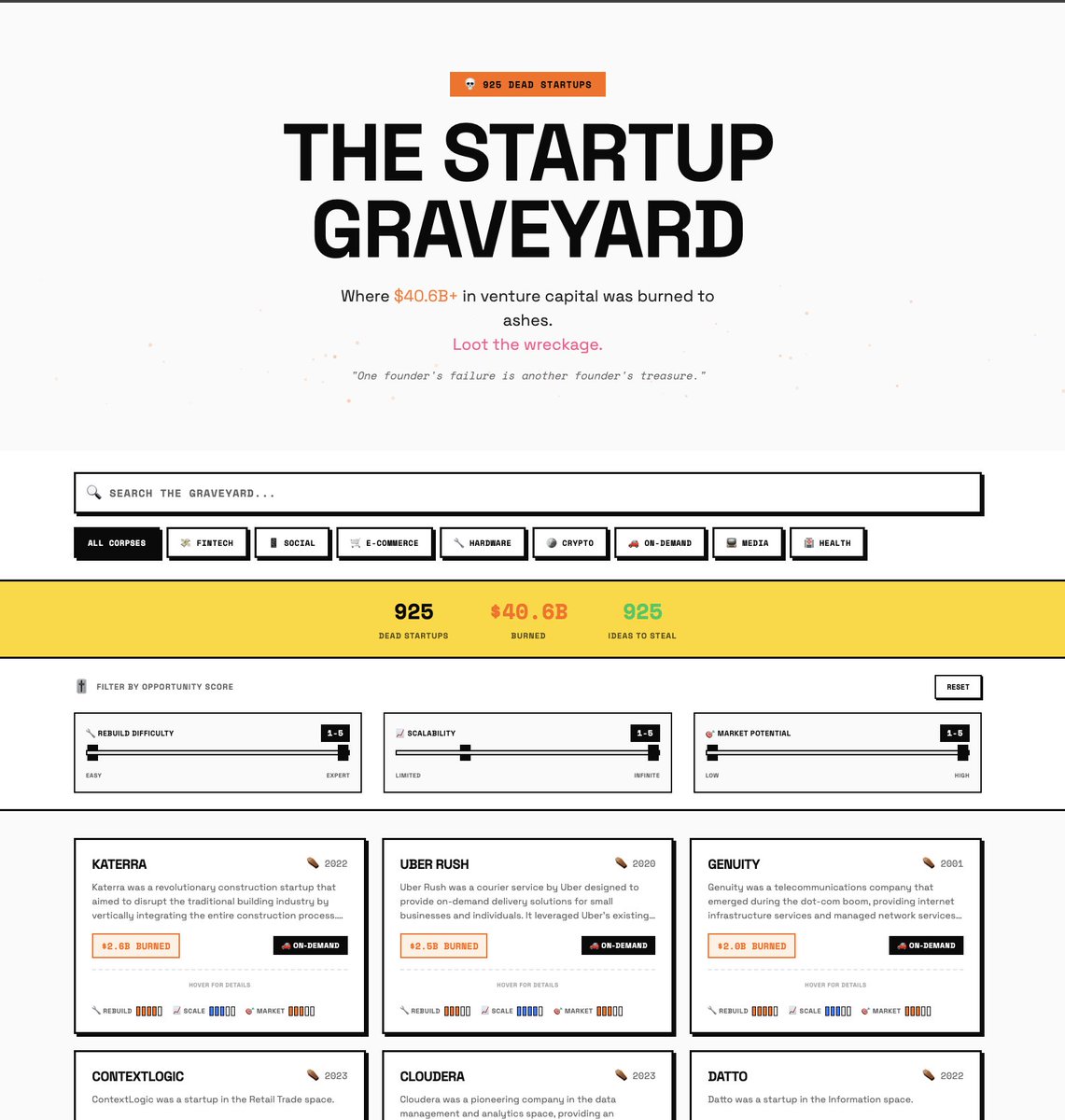
Someone curated 925 failed VC-backed startups, broke down why they failed, and how to make it work with today’s tech -
https://t.co/NFUhrhe7P2
Cool fr🙌
If you want to be a top-tier backend engineer in 2026, here’s the path I’d recommend - in roughly the order I’d take it:
1. Data Structures & Algorithms (properly)
Not for LeetCode tricks, but to build real intuition: caches, queues, heaps, indexes, bloom filters, rate limiters. You should be able to implement the basics without panic.
2. Operating Systems fundamentals
Processes vs threads, memory management, virtual memory, syscalls, file descriptors, scheduling. Backend performance issues are often OS issues in disguise.
3. Networking & Distributed Systems basics
TCP vs UDP, HTTP/1.1 vs HTTP/2 vs HTTP/3, DNS, load balancing, retries, timeouts, backpressure. If you don’t understand networks, you don’t understand backends.
4. Databases (deep, not wide)
Pick one SQL database (Postgres) and go deep:
indexes, query planners, MVCC, isolation levels, WAL, replication.
Then learn why NoSQL exists, not just when to use it.
5. Consistency, Transactions & Failure Models
CAP, consensus (Raft/Paxos at a conceptual level), idempotency, exactly-once vs at-least-once, saga patterns. This is where many “senior” engineers fall apart.
6. A systems language (Go or Rust)
Go: concurrency, networking, cloud-native systems
Rust: safety, performance, correctness
Most modern infra and backend platforms are written in one of these.
7. Concurrency & Parallelism (in practice)
Thread pools, async runtimes, event loops, actor models, work queues.
Learn how things break under load, not just how they work on paper.
8. Observability & Production Debugging
Metrics, logs, traces, SLOs, alerting, profiling.
Learn to debug memory leaks, latency spikes, and cascading failures at 3am.
9. Cloud & Infrastructure fundamentals
Containers, Kubernetes basics, autoscaling, service discovery, CI/CD.
You don’t need to be a DevOps expert, but you must understand the platform your code runs on.
10. Security fundamentals
AuthN vs AuthZ, TLS, secrets management, common attack vectors, threat modeling. Backend engineers are security engineers whether they like it or not.
The pattern here is simple:
Easy backend jobs are over. CRUD alone won’t cut it.
Strong fundamentals let you move fast, reason under pressure, and design systems that survive reality - not just pass interviews.
There are no shortcuts anymore.
But if you build these skills seriously, even if you stumble, you’ll come out dangerously competent.
If you are a dev stuck at $0 MRR,
I will pay you $500 to Code or Vibe code something in public.
Make sure:
- You should have a working SaaS product
- You can read/understand code
- Knows about a little bit of databases/Supabase/Auth
- Knows VibeCoding Tools
- Much better if you are good at coding
- UI/UX is important, you can use any AI tools/Magic MCP server.
- You can spend about 100 hours on building the product.
What will you get:
- $500
- This gives you some exposure on socials
- Mention of your existing SaaS product to my 40K audience.
- Fun to build in public
Just reply with your SaaS product and DM me that you are interested.
Others, Please RT or Reply for reach.
Quant Resources Series: 1/n
Do not learn C++ by solving DSA problems, instead learn it for Quant Finance. Follow this roadmap (resources are also included) by Quasar Chunawala.
https://t.co/CwLEwD65Bx
He has done a great job compiling the C++ for Quant roadmap and resources.
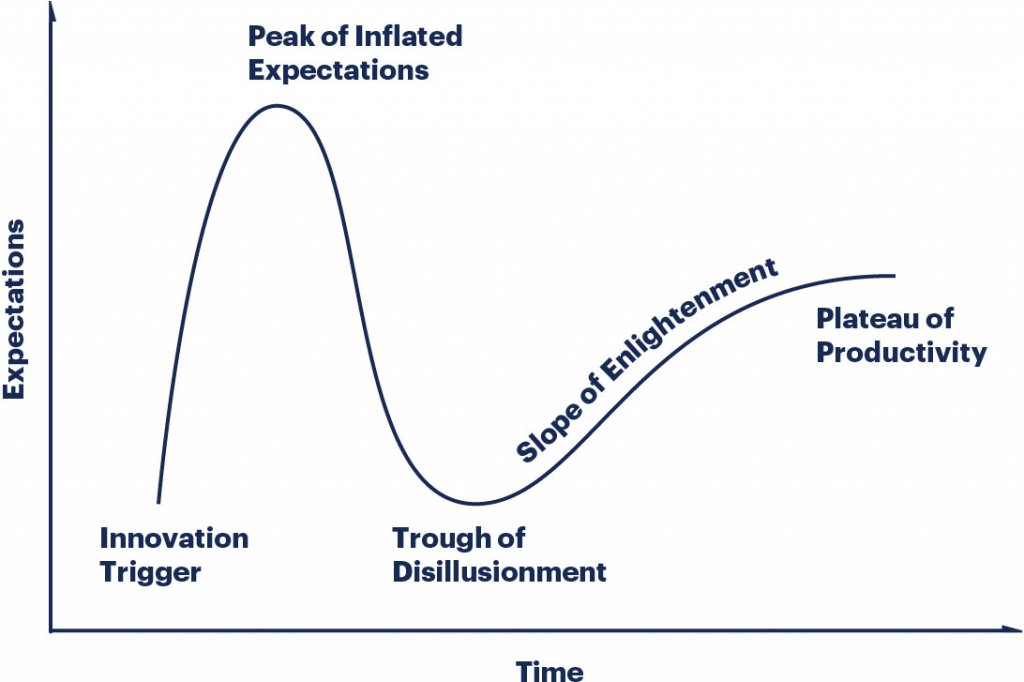
# Getting Rich off Hype Cycles
Yes, I know you're in tech for the love of it. But when a generational paradigm shift comes along, only a fool would let go the chance to amass wealth along the way. I guess this means I've always been a fool.
I'm not really playing this one but here's what I know about hype cycles.
A lot of you are seeing a paradigm shift play out in real time for the first time. I say in real time because the speed of this one is astonishing. The last paradigm shift we had was mobile and it took ages. Hardware needed to roll out across the globe and it came in two waves - pre iPhone and post. Many of y'all were around at the time. If you missed the bus that time don't worry. A lot of people never made any money off the Internet either. But this time can be different. Please God, let this time be different.
And paradigm shifts are birthed in solitude (DARPA anyone?) but at some point they make perfect sense to everyone for the first time and so is born the hype cycle.
So, there's the AI ship - steaming away from the harbor. If you jump on a speedboat and undertake some daring stunts you can still catch it. But you will have to move fast. If not, you could drive 200 miles to the next port and catch it there in three days (maybe). After that there are no more chances and all the good cabins will already be taken.
Wait. Why are you hesitating? Even though all of you can see the huge ass steamer pulling away from the dock, many are still asking - is this real? Or some of you shrugging your shoulders and saying nah, they'll be back soon, it's only a short cruise. My brother in Christ, that steamer is provisioned for deep blue water and is going far far beyond the horizon. How can you tell? - you ask.
I can tell because this shit is on my TV. Noida news anchors are discussing Deepseek.
"Ok", you say, "but I mean it's too late already". No it isn't. The steamer has just left the dock. This is a paradigm shift happening in front of our eyes and I know it's a lot to take in. But for perspective I can share that in 2001 many thought that it's over for the Internet. There was the hype and then the dotcom bust and everyone thought “that's it. now we carry on with life as usual.”
What people didn't understand is that these new paradigms can't take over immediately. They cling to the surface for a while and then they go deep into the foundations of society. The internet is everywhere now. It is almost impossible to escape it. When it came to India in 1995, it was slow, expensive and only available in a few areas. By 2015 (conveniently rounding to around the time of Jio), it had arrived everywhere. In 20 years it took over India. Mobiles took even less time. AI is going to take even less time.
And yes, everyone is going to have AI in their pocket. And all software will be rewritten for AI. I was at the Peak XV hackathon the other week and it struck me that everything is going to be rewritten for agents. I saw someone demo ‘parental controls but with agents’ and the penny dropped. WE ARE SO EARLY.
Now this is how hype cycles work - there's a lot of enthusiasm at first. The technologists and engineers see something amazing and they keep experimenting with new products. At some point the finance bros hear about it.
Your Indian middle class brain probably cannot comprehend this but there's a section of society whose main problem is what to do with all the money they have. If there's even the hint of a story there, the finance bros hype it to their HNI clients. They know that all these people need is the right story (Internet, mobile, BRICS, Argentina, Bitcoin even fucking APIs) and they start hyping it. The money starts flowing in, raising valuations across the board. At some point the bill comes due (ie fund cycle has to close but there's no greater fools left in the private markets) and everything goes to shit. And it looks like the end of the world.
But remember this - booms and busts will come and go but the march of civilisation is inexorable. Your job is to survive in a manner that allows you to extract value from this. And the progress of AI is inexorable.
If the AI doesn't end up enslaving us all, this is going to be amazing. Full sci-fi world coming up. I can't believe this is the same planet I was born on. If someone told me aliens are selectively unlocking the tech tree I might even believe them.
## Actionable Advice.
So, actionable advice
- we're still way early. We haven't seen the first AI valuation crash yet. You must jump in now if you want to still be amongst the early movers. If you're in ML/DL and you're working at some enterprise then you're not even in the game. You will have to find some startup that's growing and jump in.
- Everything is going to get faster and cheaper - there is a lot of money to be made if inference can be faster and cheaper. Faster, cheaper, better cameras powered instagram and all the chinese dance bar apps. There is always money in getting stuff into the hands of the proletariat. Especially stuff that makes them look good. Or smart. Or allows them to be lazy.
- Whatever you can think of as the limits of this, raise them by two orders of magnitude - anyone remember '640k should be enough for anyone'? that was Bill Gates. TCP/IP started with a few dozen machines and now there are trillions, when the Internet was supposed to be 'just a fad'
- Take risk, wherever you can find it
- being a founder is amazing. It means you will capture more of the value. however, you get far fewer shots at this than everyone else. you can't just turn your company off and go do something else without upsetting investors. they want to see you die for your (their) startup. So don't get too hung up on whether you're a founder or a founding member. If you can get past Series A with 2% equity or more you should be fine.
- take as much equity as you possibly can. If you're young and single take only survival money and turn the rest into equity. I feel a little bad giving this advice because in a hype cycle you will also get grifters and ethical morons who will steal your ESOPs from you and that's a whole other game. Hopefully governance gets better on this front.
I know your Indian middle class upbringing is screaming at you to find safe haven, but if you have any risk taking ability whatsoever, then go for it. Go into debt if you have to, to quote that terrible meme.
- the well capitalised will do better - if you see a company with excellent traction and good funding, go for it. It doesn't matter what part of the AI stack it's on.
- the deeply skilled will do better - when the paradigm shifts, being able to operate in the new paradigm separates the winners from the losers. For how long did people who just know php make a good living? A much better living than those who didn’t (on average?) That’s the power of being able to operate in the new paradigm. You should probably be spending your weekends learning ML / GenAI / fine tuning / LORA etc.
- play the long game
- find your tribe. Y'all going to be navigating this together. Some of y'all going to hurt yourselves. When you do, you should have someone to give you cover. When you do well, make sure others do well as well. Team up with other engineers and also sales and marketing, business types and so on. Winning big here is going to be a team sport. Don't be a hero.
- we're still so early. until death all defeat is psychological, so don't optimise for the short term. There's going to be a lot of money made (and lost) along the way. Your job is to stay in the game.
- there are other ways to get rich in the hype cycle than IPO. There will be a tonne of acquisitions, so even if your company doesn't make it, for the next few years it will be enough to be a good acquisition target. There are two ways to create this - by building a kickass team and by creating IP. In the hype cycle, even acquihires can generate meaningful wealth.
- read some science fiction. If you don't know what the Kardashev scale is, now's a good time to start reading sci-fi. The danger in the hype cycle is not having a picture of the new world being born. If you can draw a picture of the future, then you'll be more agressive in pursuing your ideas. There are going to be plenty of ideas that tackle the surface structure problems - layering AI onto a non-AI world. Wrappers. However, there are AI-native ideas also waiting to be born. If you can spot these early, you increase your chances of winning.
- go where money is being made
- I remember talking once to a GP in a fund. He made his millions running a 35 person email management software company in Connecticut. But he was close to where the action was and where the wallets were so he could see a need and fill it. The US will always make more millionaires than we will in India, but it's 2025 and hopefully getting access to those customers and dollars is still possible. In any case, there are a million opportunities if only one knows how to look.
FDs are safe when the market is returning 13%. When the market is returning 40% they're the very opposite of safe. We're at the start of a paradigm shift, a secular change in the way work is done, business is done and life is lived. Pay attention to the signs. And go catch that boat.
MIT just solved humanity's biggest weakness:
In 2025 the average attention span lasts no longer than 12 seconds.
But fortunately scientists discovered a 3-step method that fixes this.
Here's the protocol to rewire your brain:
Vertical AI Agents
@snowmaker
At a recent event, a founder asked Sam Altman "If you were 24 and starting a startup today, what would you build?" His answer: A vertical AI agent.
The difference between Tsinghua University and IIT is the difference between Deepseek and Krutrim.
Deepseek is a world beating LLM while Krutrim is vaporware. Chinese STEM schools pursue real science while IIT directors talk about gaumutra. It manifests on students.
we live in a paradox.
everything has meaning but as soon as we try to give it a meaning it becomes meaningless. imagine trying to capture a reflection in water - the moment we reach for it, our touch disturbs the surface and the image dissolves.
maybe meaning isn't something we assign, but something we witness in moments of stillness.
it exists in the spaces between our desperate attempts to define it… in the wordless understanding of a sunset, in the indescribable feeling of being alive. the more tightly we try to hold onto meaning, to pin it down with words and explanations, the more it slips through our fingers like sand.
i think true meaning is found not in our explanations, but in our acceptance that everything simple is.
I hated it when someone asked, ‘What are you building?’ and I couldn’t answer fluently.
So I memorized this sheet and just repeat it every time. Do wonders.
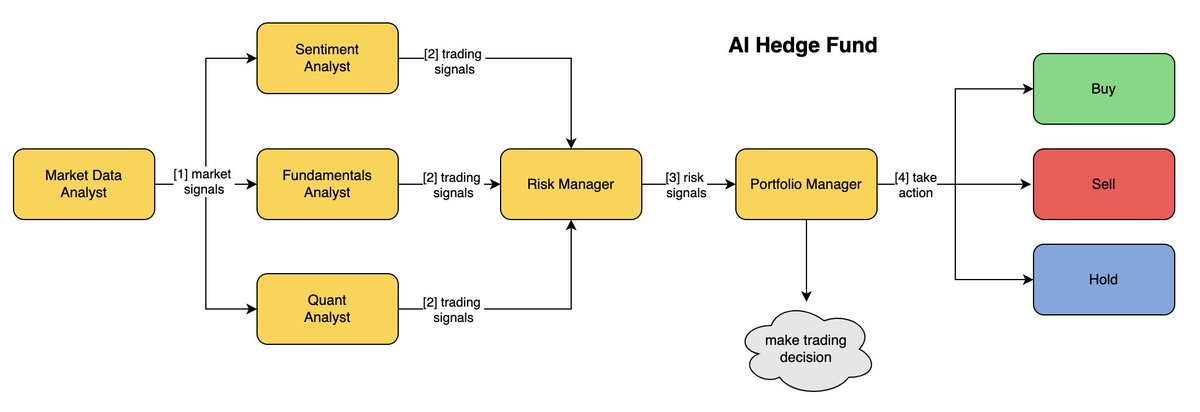
I’ve been building a real-world AI hedge fund.
It's open source so you can learn + build too.
The hedge fund has 6 agents:
1 • market data agent
2 • quant agent
3 • fundamentals agent
4 • sentiment agent
5 • risk manager agent
6 • portoflio manager agent
The hedge fund is powered by @langchain
You can run all of my code below.
No prior coding experience is required.
All of the agents show their reasoning so you can see how they work.
1 • Market Data Agent: gathers market data like stock prices, fundamentals, etc.
2 • Quant Agent: calculates signals like MACD, RSI, Bollinger Bands, etc.
3 • Fundamentals Agent: analyzes profitability, growth, financial health, and valuation.
4 • Sentiment Agent: looks at insider trades to determine insider sentiment.
5 • Risk Manager: determines risk metrics like volatility, drawdown, and more.
6 • Portfolio Manager: makes final trading decisions and generates orders.
This is just the start.
There are a ton of cool features that we can add.
Let me know if you have any suggestions.