We'll be spending a lot more time trying to understand the outputs of language models. A few thoughts, tips & tricks:
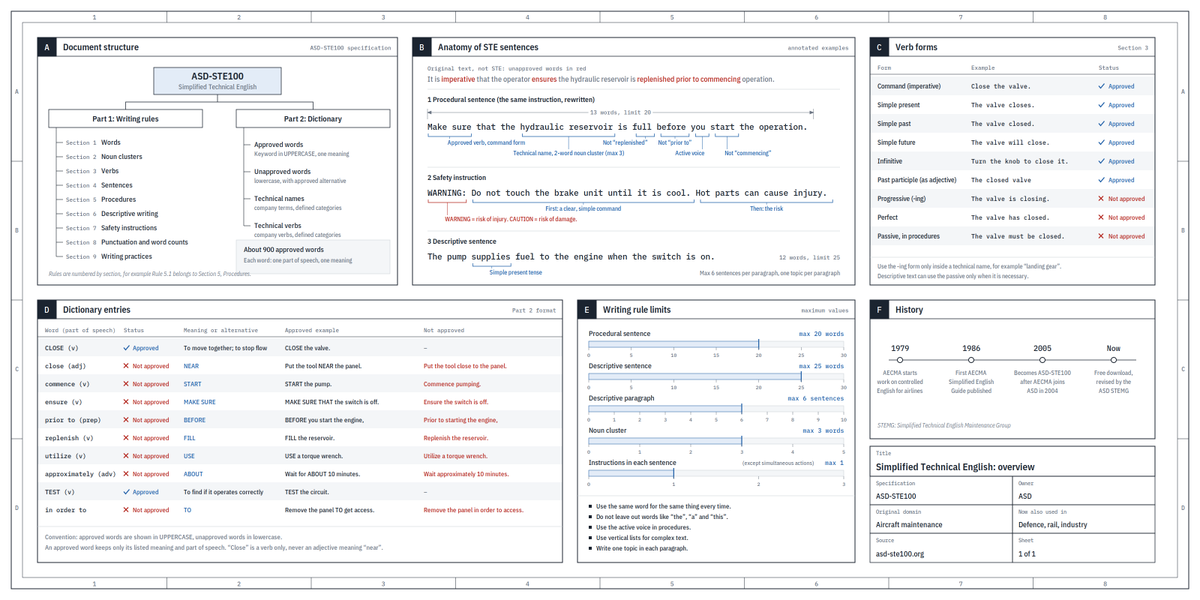
Writing. Something I've had success with: Ask your LLM to explain something in ASD-STE100, it's a controlled language specification originally developed for aerospace maintenance documentation. LLMs well-versed in this language and it comes with heavy constraints on clean writing style that I often find a lot more readable. Sometimes I've tried to soften it a bit e.g. ask for "80% of the way to ASD-STE100" because the spec is quite stringent. But even better:
Diagrams / images. Instead of writing, ask your LLM to create a diagram. These can be a lot easier to process, parse, and understand. But even better:
Web pages. Ask for output "in HTML" to get a beautiful, interactive webpage. LLMs are getting really good at frontend and can create beautiful experiences, animations, etc. But even better:
Explainer videos. The output format I am most bullish on is fully custom / bespoke explainer videos generated on any arbitrary topic. Experiment with things like "Create a 3b1b style video explainer on X. Use my ElevenLabs API key for audio narration". (you'd need an API key for the latter or you can ask your LLM to find you decent free alternatives that use your local compute). This is actually starting to work!
In summary:
- As LLMs get better, they will do more and more of the legwork autonomously, and a lot more of our work will rise up the abstractions into oversight and understanding.
- Luckily, LLMs can help here too because as intelligence and code are increasingly abundant, you can ask for large, custom, discardable software artifacts (e.g. web apps, video explainers) that would have never made sense to create before. Push the boundaries here and you'll be surprised.
I get these messages on a daily basis, where students have realized that Ayurveda is a pseudoscience and there is no job satisfaction in practicing it. Here are some pointers on how you get out of the matrix.
1. Start with a reality check.
India’s Ayurveda BAMS degree will never gain mainstream, let alone global, recognition. Betting your future on it is risky.
✅Here are some options that can be useful👇
2. Master of Public Health (MPH).
Most MPH programmes explicitly list AYUSH degrees (including BAMS) as eligible. Two years of epidemiology, biostatistics and health-policy training positions you for district‐level public-health posts, NGO programme leadership, or global-health fellowships...work that is 100 % evidence-driven.
3. Clinical-research & pharmacovigilance diplomas.
Post-graduate certificates (6–12 months) train you to run trials, monitor drug safety and manage data for CROs, pharma companies and teaching hospitals. Providers such as Cliniminds accept BAMS graduates and have solid placement histories for roles like CRA or Drug-Safety Associate.
4. Health informatics & data analytics.
A one-year PG Diploma in Health Informatics (online or blended) is open to any graduate, so you can jump straight into EMR implementation, hospital analytics or AI-based disease-prediction projects where outcomes, not ancient theory, matter.
5. Evidence-based nutrition & dietetics.
MSc Clinical Nutrition programmes explicitly list BAMS among accepted degrees. The coursework covers biochemistry, nutrition and medical diet therapy, enabling you to become a registered clinical dietitian who writes hospital diets grounded in RCTs, not those doshas or prakriti nonsense.
6. Medical writing & scientific communication.
If you enjoy clear thinking and sharper prose than dusty Sanskrit slokas, short certificates in medical writing welcome BAMS holders. You’ll produce clinical-trial protocols, systematic-review manuscripts and CME modules...work that’s remote-friendly and evidence audited.
7. Medical coding & health-information management.
Three-month coding courses train life-science grads (BAMS included) to translate diagnoses into ICD-10 and CPT codes for insurers and health-tech firms. It’s desk-based, quality-controlled, and pays better than most entry-level Ayurvedic jobs.
8. Hospital / healthcare administration (MBA-HC, MHA).
BAMS counts as a qualifying bachelor’s degree for most MBA-Healthcare and MHA programmes (cut-off ≈50 % aggregate). Graduates oversee operations, quality and strategy in multi-specialty hospitals, keeping budgets, infection rates and patient outcomes in line, and not wasting time balancing vata-pitta.
9. Regulatory affairs & drug-policy roles.
PG Diplomas in Regulatory Affairs accept BAMS grads and lead to careers ensuring drugs, devices and clinical data meet FDA/EMA norms...exactly the interface where rigorous science and law converge.
10. Community & NGO health work.
Even without further degrees, a BAMS + MPH combo is prized by non-profits for maternal-child-health, TB/HIV programmes, and health-systems research. You deliver real impact where guidelines are written in Lancet figures, not ancient palm-leaf scripts.
11. Health-tech & startup ecosystem.
Coding or data-science certificates plus your anatomy-physiology base lets you join digital-health product teams. This include building apps, clinical-decision-support tools or AI symptom checkers that are validated in peer-reviewed studies.
12. If you truly want to practise modern medicine. There is still no shortcut: you’d have to enrol in a recognised MBBS (India or abroad) and restart the medical track.
Summary: drop the pseudoscience baggage, pick a track above, and double-down on skills that are measurable, audited and globally transferable. The community, and your future self, will thank you.
AI holds great promise in medicine, but awareness is key, according to Dr @taranraix, data scientist and AI/ML Engineer in the healthcare space. Taran lost his father to liver cancer and wants to help people stay informed about liver health.
Read more: https://t.co/aqxeAqhndE
A red flag in someone's conversation: if the person (particularly an employee on a salary) transforms hierarchy into ownership by saying "my team", "my lab", "my analysts", "my department", etc., rather than "our" team, lab, analysts, etc.
Why hallucinations cannot be solved in LLMs? An LLM is a neural network no different in principle from any other neural network. Imagine you train a neural network as a binary classifier. How much effort is needed to make this binary classifier highly accurate on both classes? Given that you understand the meaning of each class and assuming that unlabeled examples are easily available, you can sit and label as many examples as needed to achieve the needed level of accuracy for each class.
Now think of an LLM as a classifier. It's a multiclass classifier with an infinite number of classes. We call a hallucination a situation when the predicted class is different from the true class. The unlabeled data for each class is not easily available. And even if it were, you need an infinite number of labelers to make sure the accuracy for each of an infinity of classes is high enough. This is obviously infeasible.
In Olympic shooting, they use equipment like:
> A lens to avoid blur
> A lens for better precision
> ear protectors for noise
Then a Turkish guy (Dikeç) came and won a silver medal with just a pair of GLASSES.