We'll be spending a lot more time trying to understand the outputs of language models. A few thoughts, tips & tricks:
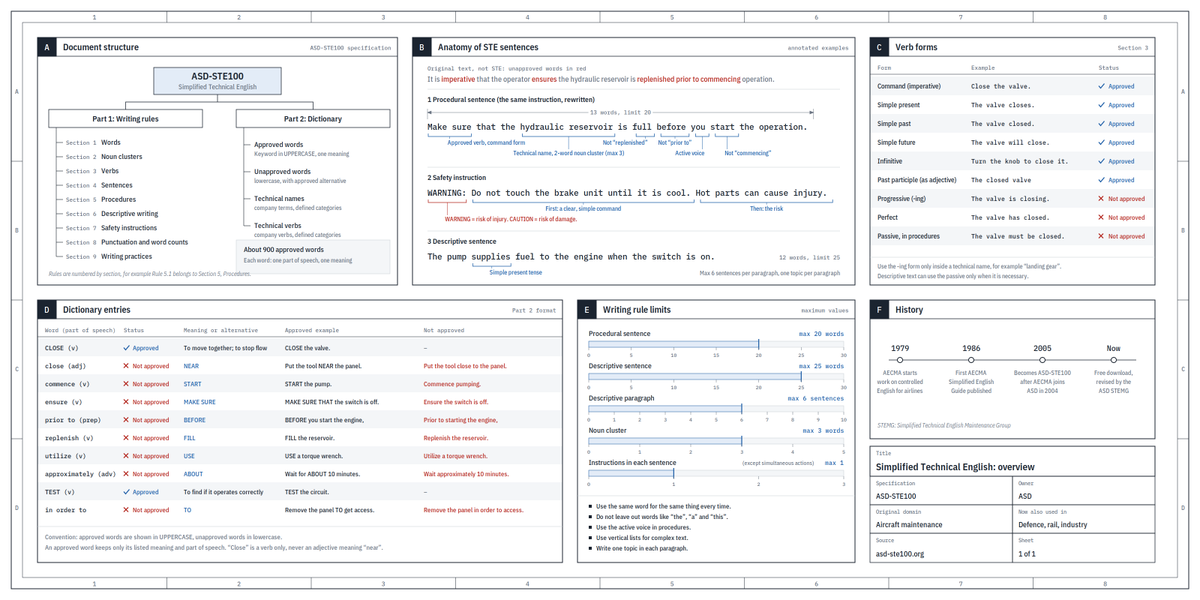
Writing. Something I've had success with: Ask your LLM to explain something in ASD-STE100, it's a controlled language specification originally developed for aerospace maintenance documentation. LLMs well-versed in this language and it comes with heavy constraints on clean writing style that I often find a lot more readable. Sometimes I've tried to soften it a bit e.g. ask for "80% of the way to ASD-STE100" because the spec is quite stringent. But even better:
Diagrams / images. Instead of writing, ask your LLM to create a diagram. These can be a lot easier to process, parse, and understand. But even better:
Web pages. Ask for output "in HTML" to get a beautiful, interactive webpage. LLMs are getting really good at frontend and can create beautiful experiences, animations, etc. But even better:
Explainer videos. The output format I am most bullish on is fully custom / bespoke explainer videos generated on any arbitrary topic. Experiment with things like "Create a 3b1b style video explainer on X. Use my ElevenLabs API key for audio narration". (you'd need an API key for the latter or you can ask your LLM to find you decent free alternatives that use your local compute). This is actually starting to work!
In summary:
- As LLMs get better, they will do more and more of the legwork autonomously, and a lot more of our work will rise up the abstractions into oversight and understanding.
- Luckily, LLMs can help here too because as intelligence and code are increasingly abundant, you can ask for large, custom, discardable software artifacts (e.g. web apps, video explainers) that would have never made sense to create before. Push the boundaries here and you'll be surprised.
Command and Control Center of SDAL's #Bhargavastra vehicle-mounted, multi-layered counter-swarm drone system with Data pattern's #phantom Hunter 2 ADFCR
From Prototype to Qualification-Aware Hardware: Lessons from NASA’s SmallSat Structures, Mechanisms, Materials, and Additive Manufacturing Survey https://t.co/7zOWoVlKQn
Check out my latest article: Building the Future of Autonomous Drone Navigation: A Deep Dive into Our Visual Odometry System
Centimeter-level precision and 120 FPS performance https://t.co/y4NslaCIHS via @LinkedIn
When the Twin Towers came down, JD Vance enlisted in the Marine Corps, gung-ho to exact justice on America’s enemies. Subsequently he came to believe the Forever Wars were a mistake. This is who I want by Trump’s side: an American patriot, with the courage to fight America’s wars but the wisdom to know when to avoid them. God bless JD, God bless Trump, and God bless the USA.
I agree with Andrew Ng. #AI poses no more risk than #mathematics and #physics. Are we going to outlaw or regulate science? AI will serve humanity in more ways than we can imagine. https://t.co/jSpfXbqyLW
Professor Canziani makes complex and dry topics the most engaging and fun to learn during his lectures. I am a big fan, and I highly recommend anyone interested in deep learning to flow and watch his video lectures.
#deeplearning#ai#nyu https://t.co/Hi8g812w8Q
I am excited to announce the completion of the Generative Adversarial Networks (GANs) Specialization offered by https://t.co/vAqJSrDP09 on Coursera. This course was taught by Sharon Zhou, PhD, a CS faculty member at Stanford Univer…https://t.co/ZMAYcpHRdl https://t.co/GwHW1CF7Nj
It was a great experience to be part of this team. World-class talent with data-driven execution!
#machinelearning#deeplearning#ai # #data # https://t.co/TzCq5fwClo
It is time to increase support for Ukraine more than ever. No country belongs in NATO if it supports Russia.
#stopwarinukraine#supportukraine https://t.co/DNoe7ROfGq