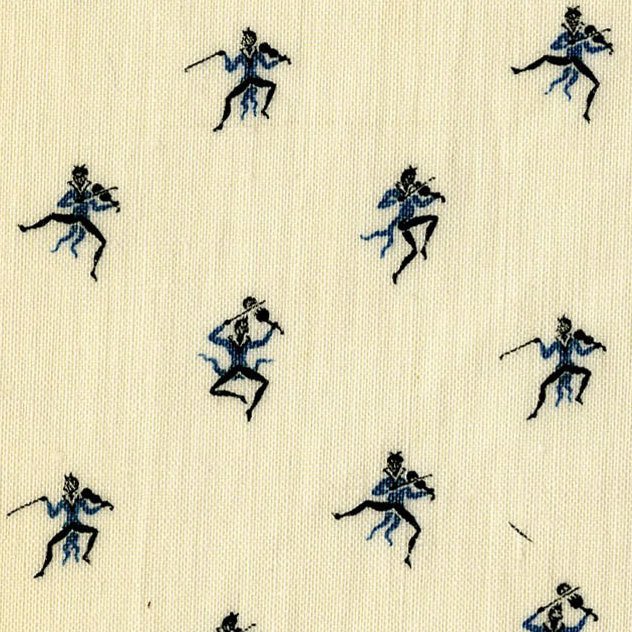
A printed cotton fabric sample featuring a fiddling and dancing devil motif. Date: 1881. Collection: Zane Collection, The Design Center at Thomas Jefferson University, Philadelphia.
This design is an example of the witty fabric prints known as 'conversationals,' which were fashionable in the late 19th century.
In European and North American folklore, the fiddle and the devil are an inseparable duo. For centuries, the church branded the fiddle as the 'Devil's Instrument,' arguing that it lured people into raucous village revelries and 'sinful' dances.
This imagery took on various forms in folk narratives. I'd like to touch upon three of them.
The first is the theme of the 'devil teaching the fiddle.' According to legend, those aspiring to become master musicians would meet the devil at desolate crossroads at midnight, selling their souls in exchange for extraordinary talent.
The second is the curse of the 'endless dance.' Folktales say the devil would disguise himself and sneak into village festivals. He'd play a melody so magical and rousing on his fiddle that people would lose their willpower, forced to dance madly until they collapsed from exhaustion.
The third common narrative is the 'musical duel.' Mortals challenging the devil to a fiddling contest was a staple of these stories. Rumors that the legendary violin virtuoso Niccolò Paganini had sold his soul to the devil for his superhuman talent were among the most widespread beliefs of the era.
Had @Ada_Palmer back on – this time to talk about Machiavelli, perhaps the most misunderstood thinker of all time.
Machiavelli cut his teeth as a high-level diplomat for Florence, a position from which he got to closely observe the most important rulers in Europe at the time, including the ones who were on the path to destroying his dearly beloved Florence.
In 1513 the Medici retook control of Florence and, wrongly suspecting Machiavelli of participating in a coup attempt, fired, tortured, and exiled him.
Machiavelli could have fled his exile and worked for any number of different principalities that would have been eager to make use of his talents.
Instead, he decided to rot in the countryside and compile his career's lessons about power, politics, and human nature into a book he dedicated to the very man whose new regime had tortured and exiled him, Lorenzo di Piero de' Medici.
But at least the Medici were in a position to use his insights to defend Florence. Machiavelli the patriot did not want any other hands to touch this book, because those hands, armed with these lessons, might pose an existential danger to Florence.
The closest modern analogy, at least as Machiavelli would have seen it, would be Szilard's letter warning FDR about the possibility of a nuclear fission bomb.
What were those insights? And how were they inspired by Machiavelli's dangerous diplomatic missions all across Europe, and his extensive reading of antiquity? Watch this episode with Ada Palmer to find out!
00:00:00 – How Florence bargained with Cesare Borgia for survival
00:15:08 – Machiavelli’s analytical innovations
00:23:58 – Why popes became warlords
00:36:13 – Why the common people demanded nepotism
00:47:57 – Cesare Borgia brought terror to rulers and justice to the people
00:57:55 – Art as a proxy for war
01:06:41 – Florence, a city famous in hell
01:15:57 – The Prince was a job application to Machiavelli’s torturers
01:41:39 – During the Renaissance, original ideas had to be couched in antiquity
01:50:44 – Why copyright began with the Inquisition
02:02:12 – Machiavelli wasn’t Machiavellian
Look up Dwarkesh Podcast on Spotify, Apple Podcasts, YouTube, etc.