Here it is, “America Is the Poem,” the poem I composed for @realDonaldTrump's second presidential inauguration. I recorded the audio of myself reading the poem and the brilliant @realsashastone created the video. Feel free to share it. God bless America!
🧵🚨 1. Everyone should know the story of Roscoe Filburn, a farmer from Ohio who found himself in the crosshairs of one of the most absurd federal overreaches in history. It’s a tale of government control over the most basic of American freedoms—growing your own wheat.
If you are looking for a break from all the problems of this world? Follow this amazing account @CarlBovisNature. His photography of birds are beautiful and always interesting.
As it's Friday, I'm asking all my followers to please retweet (and comment) on this post if you see it, to help my bird account be seen! 🙏😀
To make it worth sharing, here's the moment a Swallow zooms out of a hole in a shed door! 😍
Thank you very much! 😊♥️
During the civil war, there was a soldier who lost both, his brother and his dad to death on the same day.
He wanted to see the president and plead his case. He was given a pass to do so.
He went to the White House but was told by the guard on duty, “You can’t see the president, young man! Don’t you know there’s a war going on? The president is a very busy man!
Now go away, son! Get back out there on the battle lines where you belong!”
So the young soldier left, very disheartened, and sat down on a little park bench not far from the White House when a little boy came up to him.
The kid said, “Soldier, you look unhappy. What’s wrong?”
The soldier looked at the little boy and began to spill his heart to him.
He told of his father and his brother being killed in the war, and of the desperate situation at home.
He explained that his mother and sister had no one to help them with the farm.
The little boy listened and said,
“I can help you, soldier.” He took the soldier by the hand and led him back to the front gate of the White House.
Apparently, the guard didn’t notice them, because they weren’t stopped. They walked straight to the front door of the White House and walked right in.
After they got inside, they walked right past generals and high-ranking officials, and no one said a word.
The soldier couldn’t understand this. Why didn’t anyone try to stop them?
They reached the oval office where the president was working and the little boy didn’t even knock on the door. He just walked right in and led the soldier in with him.
There behind the desk was Abraham Lincoln and his Secretary of State, looking over battle plans that were laid out on his desk.
The president looked at the boy and then at the soldier and said, “Good afternoon, Todd. Can you introduce me to your friend?”
Todd Lincoln, the son of the president, said, “Daddy, this soldier needs to talk to you.”
The soldier pled his case before Mr. Lincoln, and right then and there he received the exemption that he desired. -Jon Hathorn
My Dear Friends,
This is exactly how prayers work.
No matter what you need today, Jesus will take you by the hand and walk you up to the throne of God and say, "Father, this person needs your help. They need to talk to you."
The Son of God made a way for you. You now have direct access to the Father through his Son. Your prayers were purchased at a price.
Pray for your children, pray for your family, pray for our country and pray for Donald Trump!!
#614clinton 🙌
I heard my campaign video is going viral! Could everyone do me a favor?
Please like, retweet, and share this post to help spread my message!
@realDonaldTrump and I will win Virginia with your help.
Suddenly after three years, a number of angry former Trump appointees—some on the prompt of potential or real book promotions, or in anger about firings, or their own legal exposure—are replaying all the supposedly atrocious things Trump said in private to them between 2017-21. If, in fact, they are accurate, then by all means they were certainly atrocious things to have said even in private—and should never have been spoken by a president. But what is mysterious about their outrage are three other considerations that we hear nothing about from such now quite public critics:
1) Is there not a difference between atrocious bluster in private and public, methodical weaponization and destruction of our institutions?
Can such critics at least say they deplore the weaponization of the FBI (e.g., the contracting of old Twitter to suppress the news, the admitted lying under oath of its interim director Andrew McCabe, the convenient “amnesia” on 245 occasions of James Comey while under oath, and the bureau’s current fixation with parents at school board meetings, traditional Catholics and pro-life activists)?
Or the corruption of our intelligence officials who were knee-deep in the fraud of “51 former intelligence authorities" who willingly lied, on the prompt of the current secretary of state, about a laptop—deliberately so to influence a presidential debate and election?
Or the entire collusion hoax that was hatched by the Clinton campaign, with help from the FBI, DOJ, and CIA?
Or consider two of our top intelligence officials who lied admittedly under oath, such as Brennan and Clapper? Does not all that pose a danger to democracy?
Or the politicalization of the DOJ that was ready to exempt, save a brave dissenting judge, Hunter Biden and by extension the Biden clan from real legal jeopardy. Was it not wrong in 2020 for retired 4-stars officers to attack in venomous terms and publicly their commander-in-chief? If not so, why then is there a statute at all in the uniform code of military justice prohibiting just that?
2) As far as “dangers to the democracy”, cannot some at least cite the radical changes in voting laws done in key states in 2020 under the guise of Covid, or the infusion of $419 million by Mark Zuckerberg to appropriate the work of registrars and voting officials in key states?
Or the “cabal” and “conspiracy” to ensure the Biden 2020 victory as boasted about in stunning detail by liberal Time writer Molly Ball?
Who tried to cancel student loans without a vote of congress, or drained a great deal of the strategic petroleum reserve solely to boost approval before the midterms?
Or the 2016 leftwing effort to pressure the electors not to vote according to their constitutional responsibilities and instead throw the election to Clinton?
Can't they at least cite the 120-days of looting, riot, arson, attacks on law enforcement, and deaths that were largely exempt from punishment—violence that included an attempt to storm the White House grounds to get at a president, and the torching of a police precinct, federal courthouse, and iconic DC church?
Or cannot they deplore the 2015-17 macabre threats to Trump’s person by celebrities (beheading, shooting, stabbing, incineration, blowing up, etc.)?
What actually had Trump done in his first moments in office when DC rioters went berserk during the inauguration and Madonna screamed about blowing up the White House?
What had he done in his first few days that prompted ex-Pentagon lawyer Rosa Brooks to write in Foreign Policy (“3 Ways to Get Rid of President Trump Before 2020”) an outline of how to destroy his presidency before it started by either the 25th Amendment, impeachment—or a military coup (cf. also the later August 2020 pre-election letter of retired officers Nagl and Yingling, calling on Gen. Milley to intervene following the election with the 82nd Airborne to remove Trump from office).
What had he done in his first few months in office in earn 58 House members voting to impeach him?
3) Who injured the country and the lives of its people more, the 4-years of Donald Trump or the 2.5 years of Joe Biden?
Who engineered the exempt crossing of 8-million illegal entrants that will have repercussions for decades? Who has been largely silent about nearly 100,000 annual fentanyl deaths and the direct role of an open border in them?
Who engineered the disastrous and deadly flight from Kabul, timed for the narcissistic public stunt of a cheap 20th-anniversary triumph celebration of 9/11—according to The Washington Post?
Who called the accidental killing of 10 civilians during the Kabul mess a “righteous strike”, or phoned his PLA counterpart to warn about his own commander in chief, or unlawfully hijacked the chain of command?
Who spiked fuel prices, interest rates, and inflation that have caused untold misery to millions of Americans?
Who is silent about the destruction of the criminal code in our major cities that has helped unleash an unprecedented crime wave?
That list of current catastrophes that go unnoticed could be expanded.
So yes, if these recent accusations about crude and cruel Trump private conversations are true, then let us all deplore what Donald Trump said in private to his closest aides and appointees.
But let us also consider that those who voice these expressions of outrage seem to stay silent about the concrete damage to our institutions and country that was neither rhetorical nor spontaneous—but all too real and planned.
https://t.co/gQagiUDiTH
I arrived at the address and honked the horn. After waiting a few minutes I honked again. Since this was going to be my last ride of my shift I thought about just driving away, but instead I put the car in park and walked up to the door and knocked.. 'Just a minute', answered a frail, elderly voice. I could hear something being dragged across the floor.
After a long pause, the door opened. A small woman in her 90's stood before me. She was wearing a print dress and a pillbox hat with a veil pinned on it, like somebody out of a 1940's movie.
By her side was a small nylon suitcase. The apartment looked as if no one had lived in it for years. All the furniture was covered with sheets.
There were no clocks on the walls, no knickknacks or utensils on the counters. In the corner was a cardboard box filled with photos and glassware.
'Would you carry my bag out to the car?' she said. I took the suitcase to the cab, then returned to assist the woman.
She took my arm and we walked slowly toward the curb.
She kept thanking me for my kindness. 'It's nothing', I told her.. 'I just try to treat my passengers the way I would want my mother to be treated.'
'Oh, you're such a good boy,’ she said. When we got in the cab, she gave me an address and then asked, 'Could you drive
through downtown?'
'It's not the shortest way,' I answered quickly..
'Oh, I don't mind,' she said. 'I'm in no hurry. I'm on my way to a hospice.’
I looked in the rear-view mirror. Her eyes were glistening. 'I don't have any family left,' she continued in a soft voice.. ‘The doctor says I don't have very long.' I quietly reached over and shut off the meter.
'What route would you like me to take?' I asked.
For the next two hours, we drove through the city. She showed me the building where she had once worked as an elevator operator.
We drove through the neighborhood where she and her husband had lived when they were newlyweds. She had me pull up in front of a furniture warehouse that had once been a ballroom where she had gone dancing as a girl.
Sometimes she'd ask me to slow in front of a particular building or corner and would sit staring into the darkness, saying nothing.
As the first hint of sun was creasing the horizon, she suddenly said, 'I'm tired. Let's go now'.
We drove in silence to the address she had given me. It was a low building, like a small convalescent home, with a driveway that passed under a portico.
Two orderlies came out to the cab as soon as we pulled up. They were solicitous and intent, watching her every move.
They must have been expecting her.
I opened the trunk and took the small suitcase to the door. The woman was already seated in a wheelchair.
'How much do I owe you?' She asked, reaching into her purse.
'Nothing,' I said.
'You have to make a living,' she answered.
'There are other passengers,' I responded.
Almost without thinking, I bent and gave her a hug. She held onto me tightly.
'You gave an old woman a little moment of joy,' she said. 'Thank you.'
I squeezed her hand, and then walked into the dim morning light.. Behind me, a door shut. It was the sound of the closing of a life..
I didn't pick up any more passengers that shift. I drove aimlessly lost in thought. For the rest of that day,I could hardly talk. What if that woman had gotten an angry driver, or one who was impatient to end his shift? What if I had refused to take the run, or had honked once, then driven away?
On a quick review, I don't think that I have done anything more important in my life.
We're conditioned to think that our lives revolve around great moments.
But great moments often catch us unaware-beautifully wrapped in what others may consider a small one.
PEOPLE MAY NOT REMEMBER EXACTLY WHAT YOU DID, OR WHAT YOU SAID ~BUT~ THEY WILL ALWAYS REMEMBER HOW YOU MADE THEM FEEL.
🙏🏼🥰✝️
Many people want to "Move On" from Covid, and I get it - I do too.
The thing is, We can't. There's no going back. We learned some things about Ordinary People, and we must discuss it.
Some people were scared, and some people were not. Those who were scared were willing to do to terrible things to those who were not.
Ordinary people called for the health insurance of other ordinary people to be canceled.
Ordinary people silenced some of the most highly trained and qualified physicians in the world, and other ordinary people championed the censorship.
Ordinary people were glad other ordinary people could not eat inside with them.
Ordinary people eagerly explained to other ordinary people that their child would not be receiving a life saving transplant due to their vaccination status.
Ordinary people cheered as Doctors, Nurses, Respiratory Therapists, Radiologists, and many other Healthcare Workers were fired, when they were called hero's months before.
Ordinary people cheered as blue color state employees were fired, when they were called "Essential" months before.
Ordinary people were angry when The Supreme Court stepped in and saved the jobs of many unvaccinated workers in the private sector.
Ordinary people shunned family members, and un-friended life long friends.
Ordinary people were un-invited from trips and kicked out of groups, clubs, and communities.
Ordinary people kept ordinary student athletes from competing due to vaccination status.
Probably the worst of all, ordinary people were coerced into injecting themselves with an unknown substance, that they didn't want, all under false pretenses, many of which had terrible or deadly reactions.
The list goes on an on, and so do the crimes against humanity.
Ordinary people became monsters, all because of fear.
Are you ordinary?
Do you live in fear?
Did you become a monster?
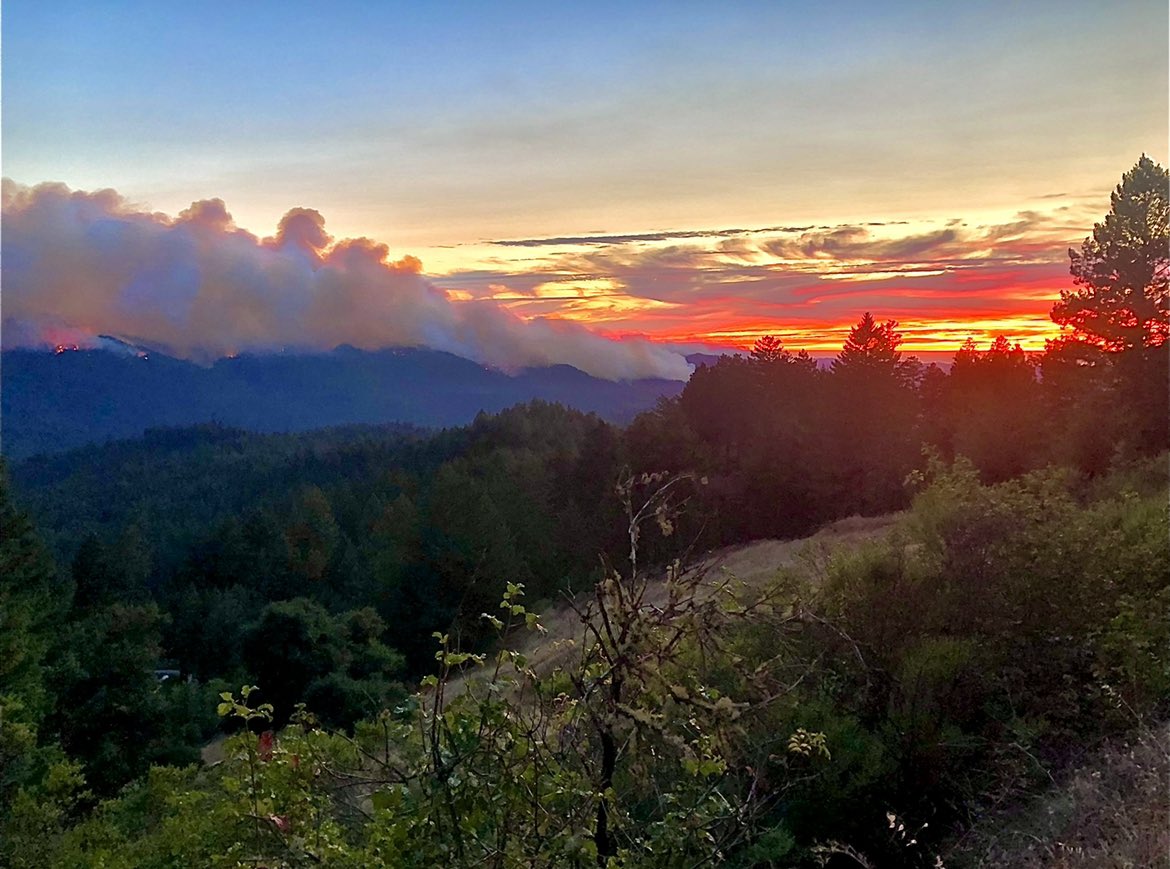
Photo: CZU Lightning Complex fires. Long Ridge Open Space Preserve. La Honda California. August 18, 2020. 8:15 PM.
In the last interview of his life (1996), astronomer Carl Sagan warned of the dangers that come when citizens cannot ask skeptical scientific questions of those in authority. Watch and ask: was he right?
So to sum it up:
1. US bans gain-of-function research.
2. Rogue bureaucrats fund it abroad instead.
3. Lab leak occurs. Global pandemic ensues.
4. Scientific leaders lie about it and label dissenters as racists.
Want to create a crisis of trust in science? That’ll do it.
First they overlook evil. Then they permit evil. Then they legalize evil. Then they promote evil. Then they celebrate evil. Then they persecute those who still call it evil.
• If you're wrong, admit it.
• If you're confused, ask questions.
• If you're stuck, seek for help.
• If you make mistake, learn from it.
• If you learn something, teach others.