We partnered with @FireworksAI_HQ to train open-source models for legal. Here's what we found:
1) Hybrid legal agents can beat frontier models on quality and cost by routing selectively to a frontier advisor.
We tested a hybrid setup where GLM 5.1 served as the primary worker, routing tasks to Opus 4.7 as an advisor when needed.
GLM invoked Opus sparingly, just 0.83 times per task on average.
The hybrid setup beat Opus on both quality and cost: 18% all-pass vs 14%, at $368 vs $954 across the same 100 tasks.
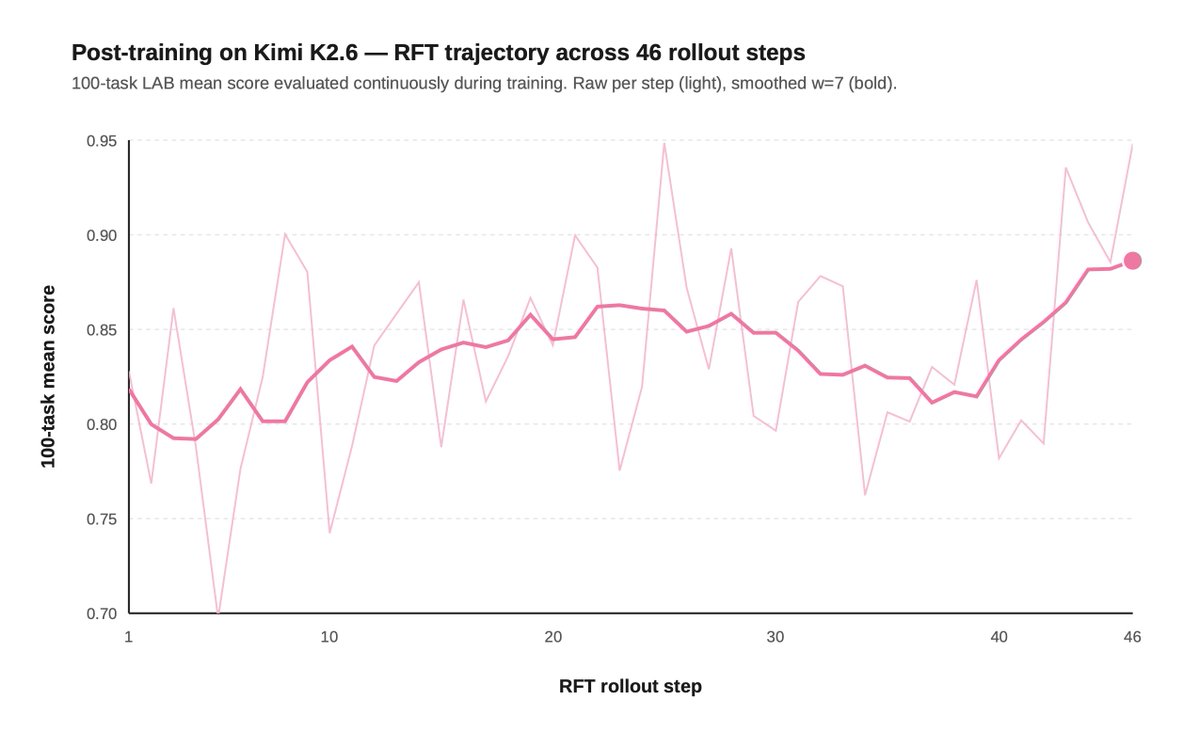
2) Post-training can push open models to frontier-level legal performance.
On a 100-task slice of our Legal Agent Benchmark (LAB), SFT moved Kimi 2.6's all-pass rate from 11% to 15%, beating Opus' 14%.
But the cost gap was even more striking: $84 vs $954 across the same 100 tasks, or ~11x cheaper.
We're excited to continue working with @FireworksAI_HQ on the next generation of open-source legal agents.
OpenAI and Anthropic are effectively telling the market they can't solve every problem with a generic AI coworker.
You don't pour billions into massive forward-deployed joint ventures if you think the next model release is going to take care of it.
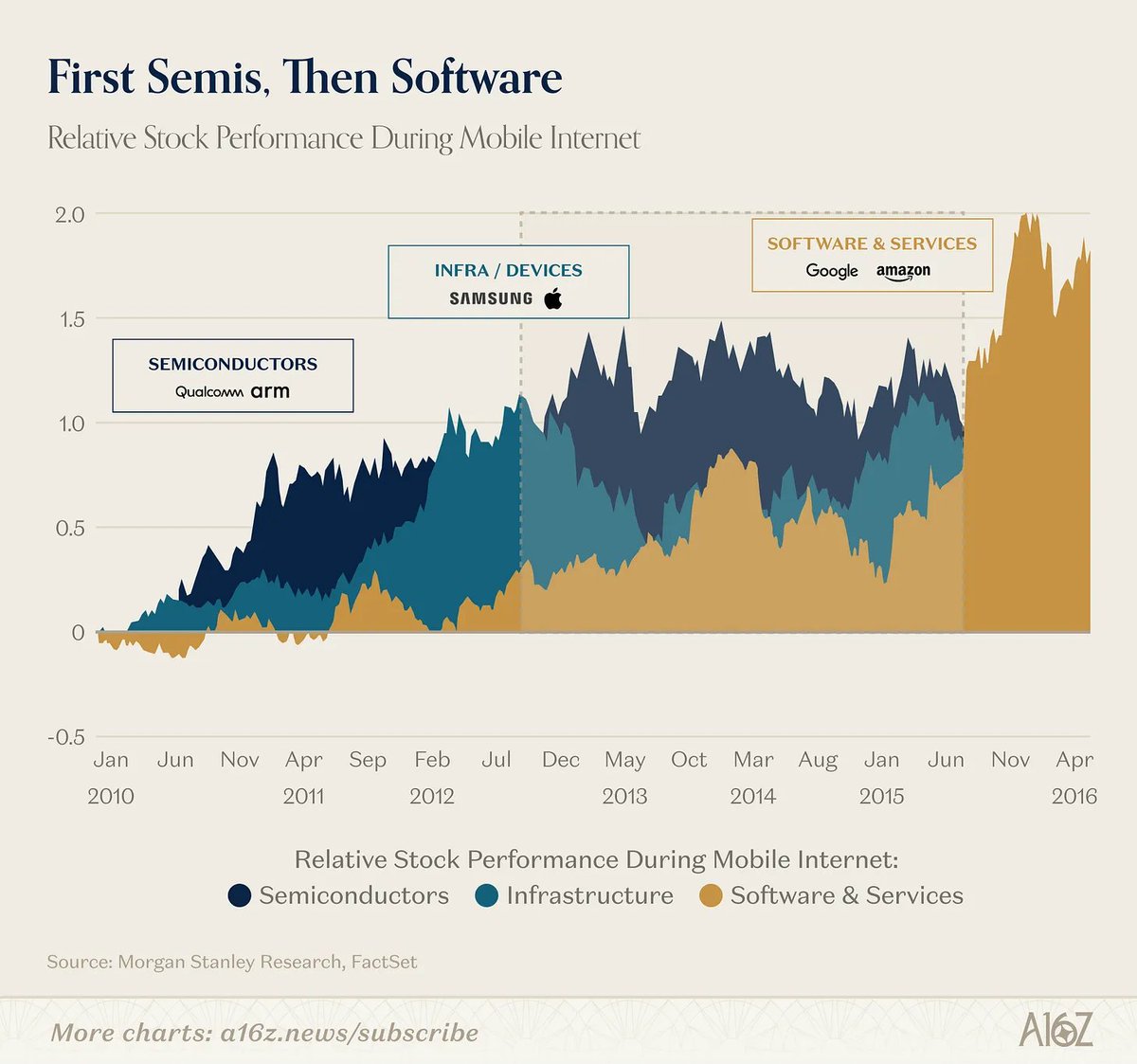
In the cloud supercycle, semis led and software followed (and you didn't need Qualcomm or ARM to tell you the value was migrating up the stack).
In AI, the infra layer itself is telling us the application layer is a separate, massive opportunity they can't fully capture.
a16z's @joeschmidtiv on why the app layer isn't dead: https://t.co/84QN5Mj9T3
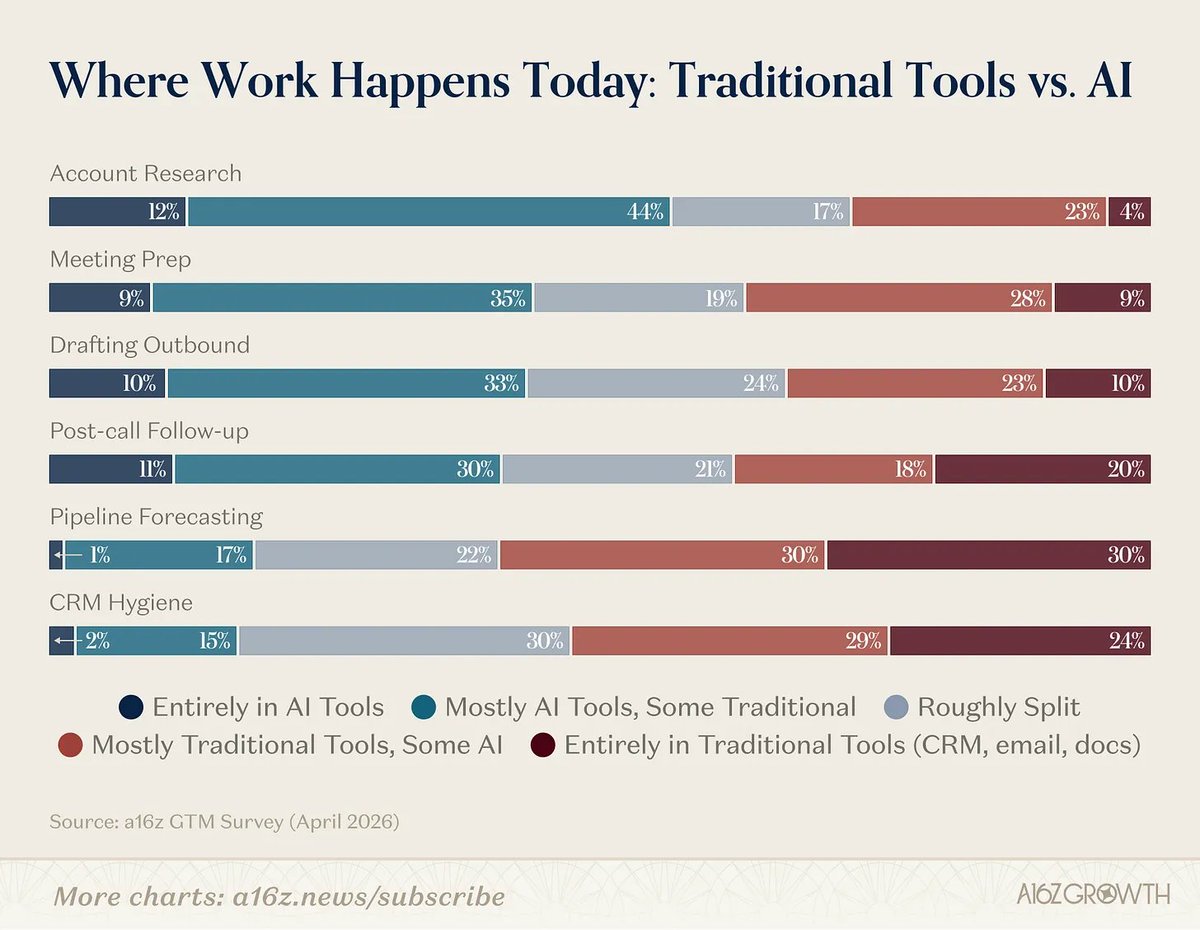
From "System of Record" to "System of Intelligence"
In the next decade, you want to own the system of intelligence that pulls from the system of record, becomes the user’s one-stop shop for gaining context and taking action, and turns the SoR into something that’s primarily consumed at the API layer.
The reasoning layer that sits above the database is where a new generation of companies is being built, and it’s where the majority of the next decade’s enterprise value of GTM software will end up.
Full piece from a16z's Gio Ahern, Steph Zhang, and Alex Immerman: https://t.co/2udG6l6SSx
People at major AI labs (using internal models) 3-4 months ahead of startup silicon valley engineers
SV founders/eng 3-6 months ahead of NY
NY founders/eng 6-12 months ahead of rest of world
Most people have no idea how fast AI shifting as 1-2 years behind SOTA
"The future is here, just not equally distributed" - Robert Heinlein
Memory..
I was born in ‘71 and don’t have much to help remember the years before iPhones arrived in ‘07.
My kids have endless photos and text conversations.
Now we’re recording everything at work.
It’s clear where this trend is heading.
As a car guy that has previously owned a Tesla S Plaid and 2 Model X’s.. I’m wishing Tesla would release a new premium car. I’d love to have a luxury daily with self driving. @elonmusk
If you read this and don’t understand why it’s happening it’s an opportunity to reset your understanding of how the real world works.
The real world will need a ton of help actually getting agents going in the enterprise. Companies have legacy tech stacks they need to modernize, data in tons of fragmented tools, knowledge that isn’t captured or digitized, and change management needed to actually utilize agents effectively. And they have to do all this while still running their business day-to-day, unlike startups.
This is why there is so much opportunity for companies (software or services) to actually deploy agents in specific domains and workflows. This remains a big opportunity for both existing services providers but also tons of new startups as well. Every new technology wave produces a new era of consulting firms that can deliver on that technology.
It’s also why the FDE model is going to be alive and well for a long time because companies will want to have their vendor actually help drive the change management and implementation for their new workflows.
The people aren’t going away. Far from it.
AI apps = ~50% of value for new $5B+ private companies.
Not models. Not infrastructure. Applications.
The value is moving up the stack — and the winners aren't selling AI. They're selling work.
If you’re operating in software today, Anthropic’s incredible growth is obvious:
- It writes our code
- We embed it in our products
- We all use it for business
- All our portfolio companies and our investment team
- The value is clear
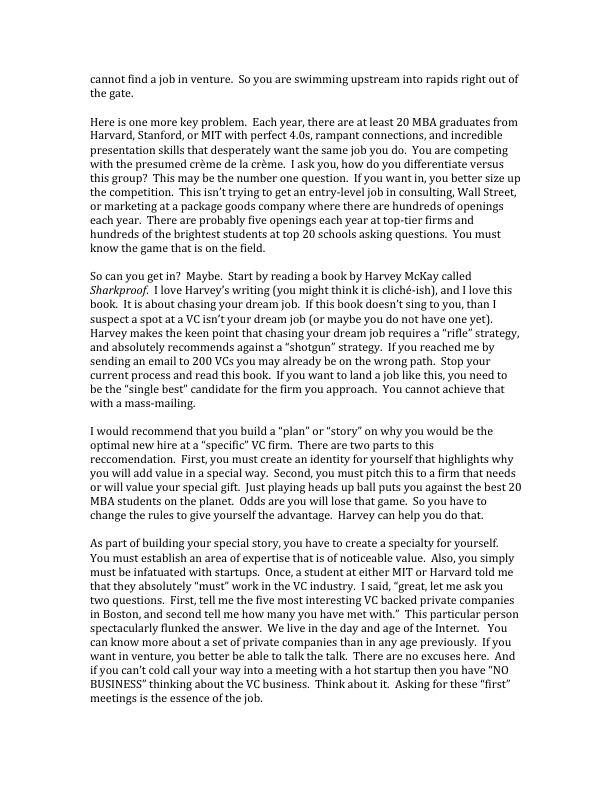
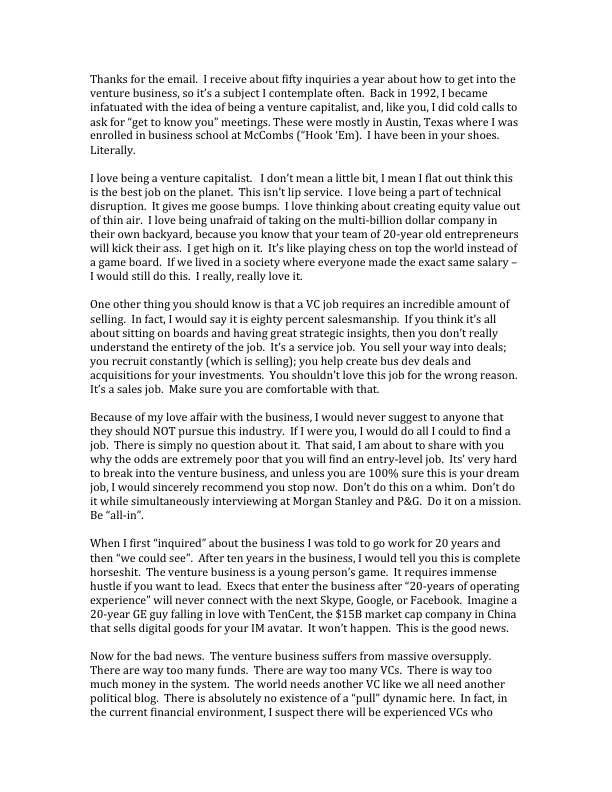
"So You Want to be a VC"
Im enjoying this week in Boston visiting students promoting my new book - Runnin Down a Dream. Not surprisingly, many ask me about trying to break into venture capital. I wrote a letter answering this question 15 years ago. I would send it out when people inquired. I'm making it public for the first time - with zero modifications.
1) I think it holds up well
2) make sure and read my new book also
3) I probably can't help with followups (as suggested in the letter)
Hope you find it useful. Good luck!
Marc Andreessen says don’t ever do diamonds in the rough. Only do diamonds.
"This is actually an investor ego thing, I think, which is you basically say, 'Wow, I'm the investor that's gonna go find the thing that nobody else knows about... I'm going to go do the thing nobody else can think of.'"
"The general pattern is... if it's got merit to be investable for venture, there are a lot of really smart and hungry VCs out there, and they are working extremely hard to sniff these things out, and it's their full-time job, and it's all they do."
"I think it's really unusual to have the diamond in the rough, and usually if it's the diamond in the rough, it usually means two things... a company that's offside in some fundamental reason, it's in the wrong place, or it's structured wrong."
"There's a reason why it's a diamond in the rough that actually ends up becoming a big problem."
@pmarca with @HarryStebbings
In our operations and portfolio today:
70-100% AI-generated code, mostly up from almost none at the beginning of Q4-25.
Includes large and complex product environments.
There is no excuse to be at levels lower than this other than deciding to fall behind.
The U.S. is facing a maritime crisis most don't see coming. Two-thirds of global trade moves by sea, yet America's shipbuilding capacity has been eroding for decades.
This is why we're proud to join @Saronic's Series D as they rebuild U.S. maritime power from the ground up.
Learn more on why we invested 👉 https://t.co/AIhW5ij0nB
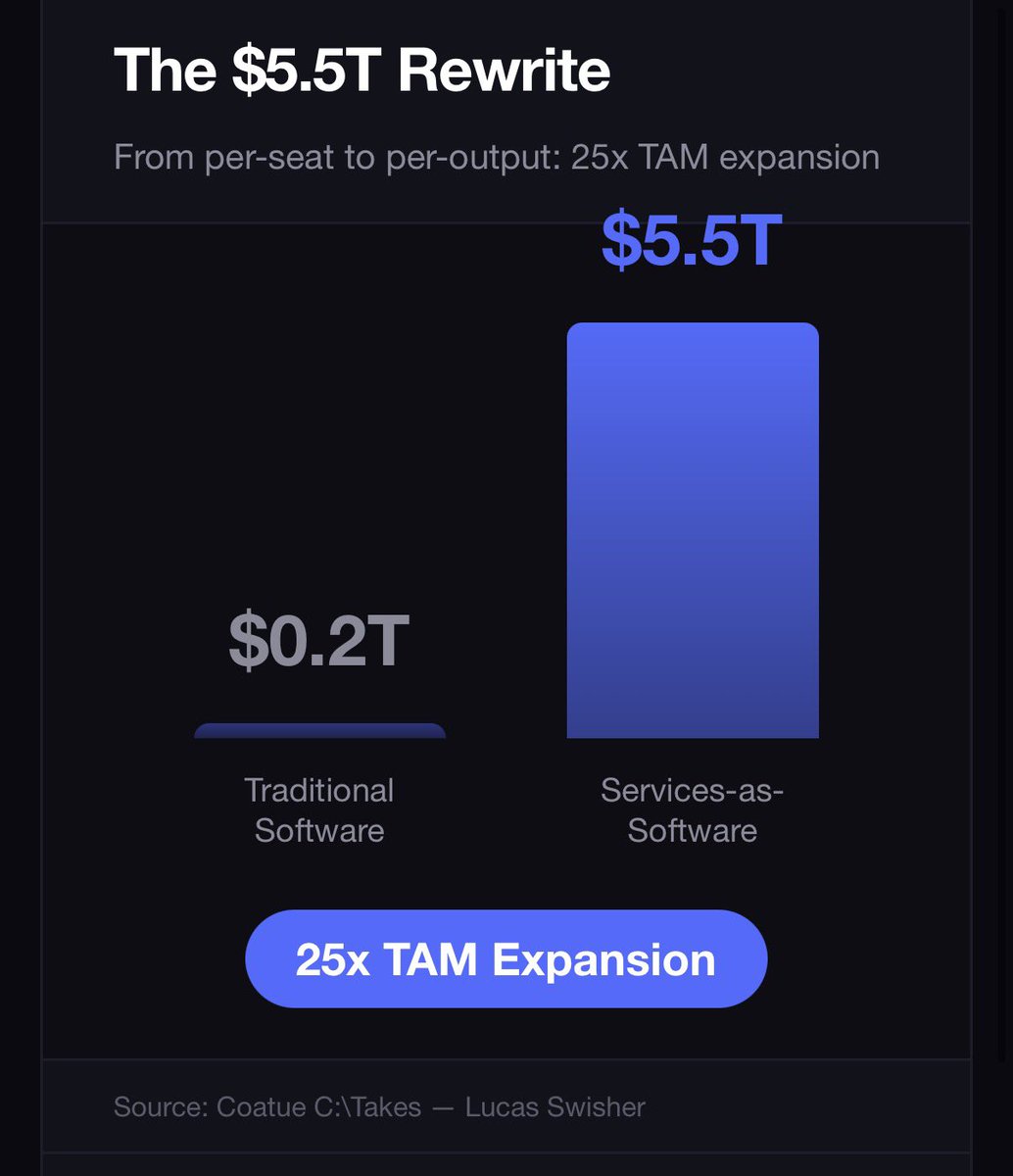
Coatue just put a number on what we’ve been seeing at seed for 3 years.
Software = $0.2T market.
Services-as-software = $5.5T.
25x.
The shift is from selling tools (per-seat) to selling work (per-output).
This is why the best vertical AI companies don’t compete with software incumbents.
They’re compete with expensive service providers, BPOs and high turnover labor.
A $2K/month AI agent replacing an $80K/year agency is the new business model.
Interesting thing about YC’s 2026 batch…
There are no blue collar builders.
Shocker.
Everyone is funding vertical AI agents in the trades but not built by the trades.