The first AI persona you’ll actually want to meet face-to-face.
Most AI personas stare blankly while you talk. Emma reacts while you’re still speaking.
After 18 months of research at @nuance_ai, this is Emma, built on Nuplex, our full-duplex audiovisual foundation model.
@paulg I wondered if a load of closing parentheses would tokenize poorly, but they don't!
(Not that this would have been material relative to the gain from abstraction anyway)
The Dispossessed by Ursula Le Guin has an exploration of this that I enjoyed, which I think broadly aligns with your definition that there are "certain lines you shouldn't cross".
Essentially, it says that time is simultaneously sequential and cyclical, in that one state proceeds the last according to action, and that past states are a part of the current state. To be a moral agent, you must strive to move towards better states (or you would deny others improvement), but you must do it in a way that does not cause harm, because that harm becomes part of the state that you arrive in.
It was a fun book, the scene where the protagonist explores those ideas is the bit that brought it together for me.
I've gone through a similar transition in my thirties too and I attribute it to two things.
Firstly, I place more importance on my day to day lived experience than I used to. Happiness is a thing that can only be experienced "now", and I most often experience it while doing beautiful work in beautiful places with people I love. Beauty matters!
Secondly, I now see more of the world as subjective or relative than I used to. Even areas that eventually prove absolute present as subjective while we search for answers. Because of this, I have come to believe that much of life comes down to exercising judgement and discernment, and this is the domain of aesthetics.
When I was in my early 20s I ranked aesthetics last on the list of philosophical pursuits, and I now place it right at the top, and might even argue that most of philosophy is just an application of aesthetics.
@pitdesi@davidu This is my theory too. When I lived in the UK I had 4.6 or something in Uber, and after a couple of years in the US it has gradually climbed up to 4.95 or so.
And no my behavior in Ubers has not changed in that time. If anything, it became worse.
@JaredSleeper There's something delightfully ironic about a software investor building this stuff for themselves. Very cool though and I agree with your conclusion!
Every day I'll be sharing an agent my customers actually use in their business, and show how well the agent does using Claude vs an open model.
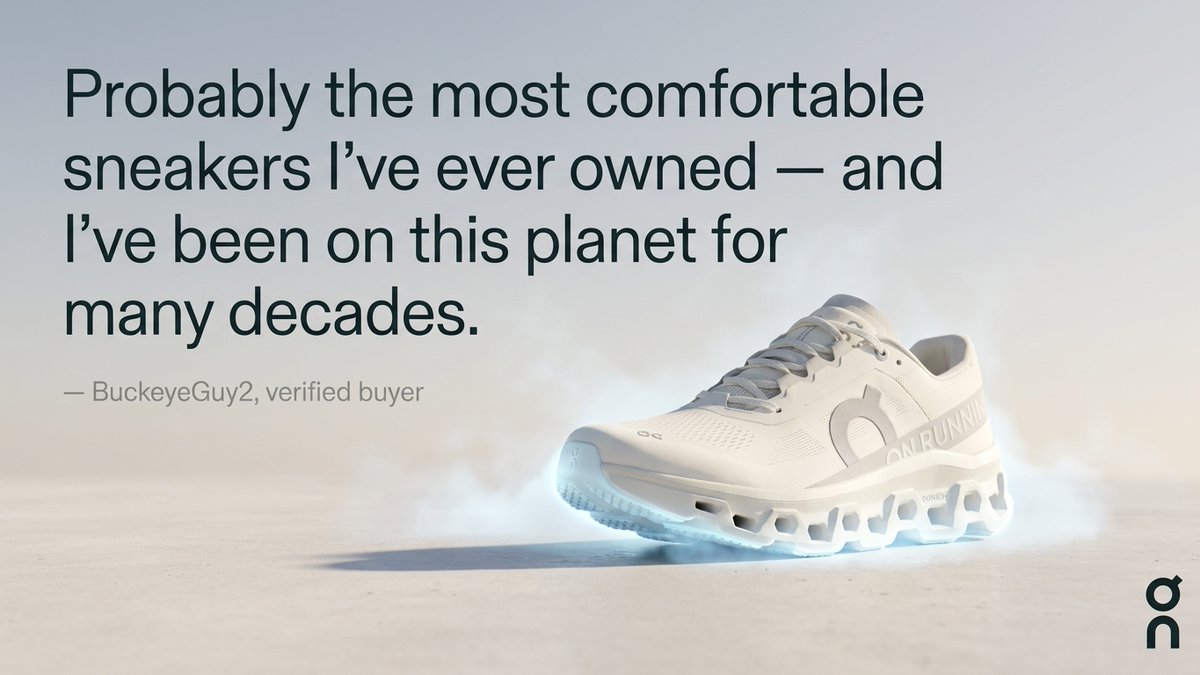
Today: Two popular models (Kimi K2.6 and Mistral Large) against Claude Sonnet - which can make the best testimonial ad for On shoes?
TL;DR Mistral continues to impress me greatly.
The agent is very simple - it looks for google reviews of the product, finds the best testimonial, analyzes the imagery on the site, and then uses a Nano Banana tool (keeps it even) with reference data to create an advertisement.
No order this time, you decide which one won.
Mistral Large 3
Cost: ~$0.03
Quality: 4.5/5
Notes: This did a great job of creating cool imagery, and copying a lot of the close up shots of the shoes. I liked it because it’s the best quality per dollar. You could very cheaply make assets for every single review, if you wanted to. The downside is - even though it found a ton of reviews, it didn’t actually take a verbatim from there, but instead decided to use the On tagline from the site.
Claude Sonnet 4.6
Cost: ~$0.15
Quality: 3/5
Notes: It found an actual verbatim, but the font is weird, and it picked a quote that was far too long to put on a testimonial. I wasn’t that impressed with how it did, and it cost a ton more than Mistral did. Still, it kept up with some of the imagery that On uses (folks using the shoes) which was good.
Kimi K2.6
Cost: ~$0.07
Quality: 4/5
Notes: This one is actually my favorite, but it doesn’t actually look like any advertisement for On that I was able to find. It used an actual verbatim, and made the imagery look super interesting. All of them are fairly cringe (a real designer would do far better than this), but this is the closest to something that maybe I would put on a slide.
Every day for a while, I'll be posting two agents that my customers use. One will be an OSS model, one will be Claude (or other frontier model). Will share cost, performance, and output quality. Sharing the agent and outputs below;
For today, I'm mixing a prompt that our VC customers use to gauge founding team and adding some flavor around GTM so that sales teams can use it.
I had it research the founding team at Modal Labs, and deliver a document that benchmarks the leadership team on their technical acumen, background, and GTM connectedness. Document for each is below.
I used Claude, Mistral, and Minimax:
1st Place: Mistral Large 3:
Cost: ~0.03 cents (1/6th the cost of Claude)
Quality: 4.5/5
Length: 7 Pages
Overall, Mistral is the clear winner - it not only produced a beautiful document that was easy to read with tables and well thought out sections, but it wrote more data and the sections were better laid out (basic info, detailed info, takeaway). The analysis was arguably also better.
2nd Place: Claude Sonnet 4.5:
Cost: ~$0.20
Quality: 3.5/5
Length: 6 pages
Overall, Claude ended up being fairly good at following the prompts. It didn't do the best job of formatting the document, but it DID fill out all the sections and gave detailed depth. It didn't complete the doc so points off for that.
3rd Place: Minimax 2.5
Cost: ~$0.02
Quality: 1.5/5
Length: 3 pages
Overall, not as good. Basically just summarized their linkedin profiles, and didn't really do any analysis.
Sharing the agent and the docs below!
SUPER excited to announce our latest launch, which is focused on solving a problem every single one of our customers has: prompting and creating agents.
So today we're launching Coco - an agent creator inside Cotera to help you build repeatable, scalable agents for work.
Just tell Coco what you want your agent to do, and it builds it for you. It finds the tools, you put in your creds, and that's it.
Connect it to any of our hundreds of integrations, then run it however you need:
⚡ On a trigger: on a regular schedule
💬 One time: chat with the agent on demand
🔁 In a loop: run up to 100 in parallel
🗄️ Via dataset: run it on every row in your data warehouse or CSV
Watch the full walkthrough and join our Slack community :)
ANNOUNCEMENT: Every day for a while, I'll be posting two agents that my customers use. One will be an OSS model, one will be Claude (or other frontier model). Will share cost, performance, and output quality
Why? Everyone on twitter/LI is still so surprised at what Claude can do that they don't realize just how close behind the open source models are.
For the first detailed breakdown, I've created a basic AI agent that does deep research on an individual (link in comments).
It takes a name and a company, and finds their linkedin, company linkedin, and X account and goes through and reads the info it can find. It then outputs a large briefing document on the individual. My first victim is @JaredSleeper
I ran this agent on Claude Sonnet and Mistral 3 Large. The outputs are as follows:
MISTRAL:
Length: 44 pages
Cost: $0.048
The formatting came out a bit botched, but WOW was it detailed. It wrote a ton of very, very detailed information, and didn't just summarize his background. It was a very very thorough piece of work. Note - it messed up the google doc skill and created the document in two parts, which I had to unify.
CLAUDE:
Length: 11 pages
Cost: $0.233 (almost 5x more for about a third the content)
The formatting is VERY botched, and it didn't use the google docs tool correctly at all. Squinting, it might have elaborated more than mistral, which focused more on HOW to talk to jared. It generally seems a bit more effusive and had more opinions. Potentially more depth.
The accuracy and sourcing seems to be the same for each, which is impressive on the mistral side
The quality of the output is interesting - see below