It was great to talk to @ayesharascoe about the state of Social Security’s finances and the steps Congress is going to have to take before the trust fund runs out of money in ~2033.
https://t.co/dxq0zJkH4n
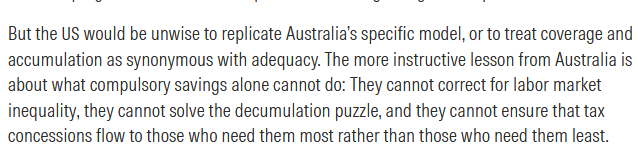
Finally read the @MorningstarInc piece on the idea that the US should adopt Australia's superannuation system. Here's the key point, and it's a good reminder in light of the recent EO: universal access is vital, but it's not the end goal—or, rather, it's just one component.
The EO is a start. But the real prize is a nationwide minimum coverage standard—and that needs Congress.
We've been pushing for this at @BPC_Bipartisan for years. Time to make it happen.
Read more: https://t.co/jx5z1sm0uR
👇 Breaking down today's executive order on retirement.
First thing's first:
- A lot of American workers (probably ~1/3 of private-sector employees) lack access to an ESRP
- SECURE 2.0 created the Saver's Match—a federal retirement match for LMI workers
- Anyone can open an IRA
To be clear, I have immense respect for SSA's Actuarial Services team and strong faith in their modeling. But the labor market's going through a big (and fast) shift!
Increasingly part of Social Security solvency conversations. Even small payroll tax rate increases make a big fiscal difference! But:
1⃣ With current labor market disruption, how harmful are these disincentives to hiring?
2⃣ How well does current modeling account for AI?
Only way to limit coming AI backlash is to start shifting taxes from labor to compute. The average voter needs to see salient benefits from AI. Today we tax labor > compute (income vs corp tax, depreciation for machines not education, payroll tax, etc). This will have to invert.
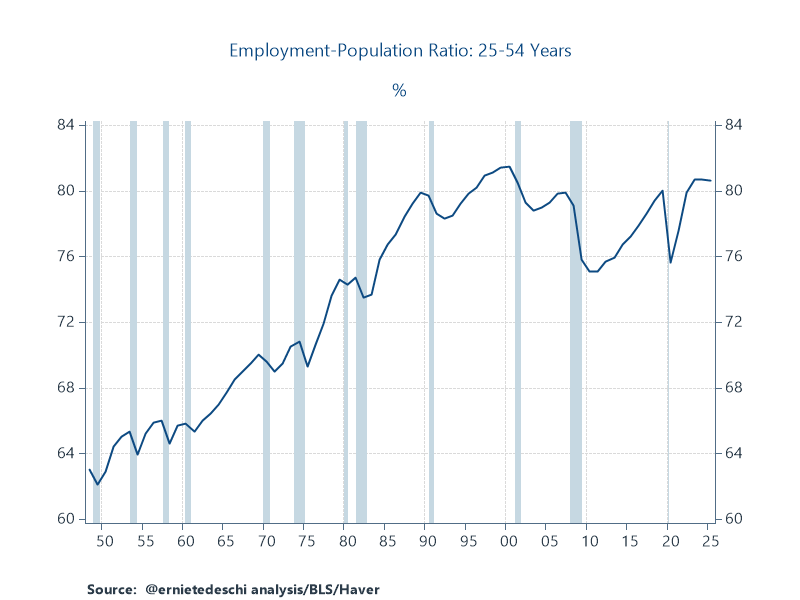
The most basic rebuttal against this worry is that, if technology displaced jobs **in the long-run**, employment rates would be at record lows rather than the near-record *highs* they actually are. 1/2
A few tweets down the thread: "Over the coming years as the real migration challenge becomes clear, the debate will change from ‘how do we keep people out’ toward ‘how do we get them to come.’"
We would do well to start that narrative shift sooner rather than later.
Estimates of the global efficiency gains of removing barriers to the international movement of people range from 67% to 148% of global GDP. This alone would be significant enough to sustain strong global growth and convergence for decades.
2 thoughts on this from our recent polling:
#1: Tax increases on $250k+, large biz, and certain products still earn decent support - across party lines too.
#2: Support for tax increases rises when paired w/specific programs. Going to need it for Social Security insolvency.
New from @te_sprick and I:
There's a large, underdiscussed, and bipartisan trend toward new tax-advantaged savings account proposals underway in Congress.
But what would happen if we brought half a dozen new accounts online in short order? We explore:
https://t.co/wdA1nclIQT
“Social Security’s fundamental structure is sound. ... What’s needed is the kind of reform Congress undertook regularly throughout the 20th century: straightforward, bipartisan adjustments to ensure Social Security continues as the backbone of retirement security.”
In a letter to the editor in this morning’s @washingtonpost, our own @te_sprick, director of retirement and labor policy, underscores why strengthening Social Security requires reform, not reinvention. Pragmatic, bipartisan updates can keep the program sustainable for years.
NEWS: The Trump administration is exploring options to build on Trump Accounts and its 401(k) EO by creating a new retirement savings plan for adults who don't have an employer-sponsored one without going through Congress, I’m told.
One option: resurrecting the MyRA program, which could then be tied to the Saver's Match program.
Trump is considering touching on the idea during his SOTU address.
In 2019, ~500 people held $25 million+ in an IRA. 25,000 had at least $5 million. For them, the tax incentive isn't doing anything to help them prepare for retirement—it's just prompting them to shift savings from one type of account to another.
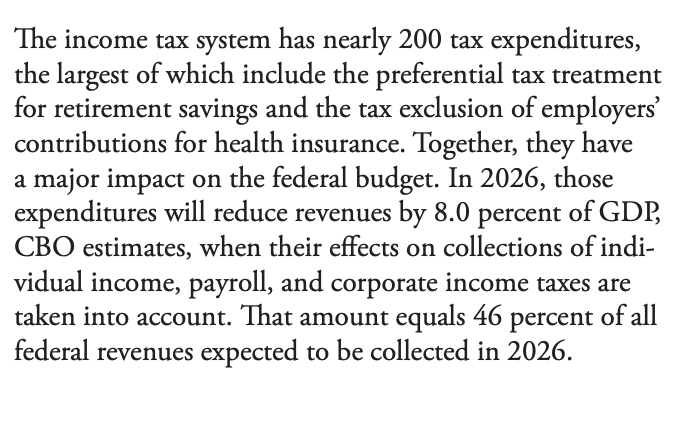
A wild stat from CBO: tax expenditures equal 8% of GDP in 2026 - more than the cost of Social Security, or Medicare, or Medicaid, or the defense budget.
We @BPC_Bipartisan summarized the top tax expenditures by budget impact back in 2024: https://t.co/3gcpxEAJcB