This is what real growth looks like.
If you really want to know if a project's healthy, you don't look at the chart. You look at who's building on it. And on that front, CKB just had a brilliant quarter.
Their community developer programme has grown to nearly a hundred active builders, with over 25 new ones joining just this quarter. Their project tracker jumped from 45 projects to 59. And they ran a hackathon focused on Fiber, their payments tech, that pulled in around a hundred participants and 66 submissions.
But here's the part I love most. Look at where this growth is coming from. Not just the usual Silicon Valley crowd. We're talking real, in-person meetups in Kenya, Nigeria, and Vietnam. Nairobi, Mombasa, Hanoi. Developers in emerging markets, where fast, cheap payments can really make an impact.
And it's not just solo devs either. Teams from other ecosystems, Cardano, Bitcoin, Lightning, are now showing up to explore building on CKB too.
A lot of these are still early prototypes and there is still a lot of work to do.
But a growing, global, grassroots community of actual builders? That's the strongest foundation any project can have. Price comes and goes. But people building, all over the world? That's how something lasts.
$CKB @NervosNetwork@ckba_build
@KupiaSecurity@ckba_build The Lock source code is open. Anyone can take it and deploy the immutable way, making the exact Lock, just that no-one controls.
CKB can add quantum-resistant signatures without a network upgrade, and one is already live. But a quantum-safe lock does little if your wallet can't use it or your exchange won't accept the deposit. On the road to quantum safety, that is where most of the work remains.
Part 1 covered Jan Xie's (@busyforking) notes from a @FraunhoferSG talk on where post-quantum migrations stall. His follow-up scores CKB against the same picture. By design, CKB never faced the protocol hurdle Bitcoin is still stuck on, and what's left looks like the work facing everyone else 👇
👉 The core protocol is already quantum-safe. Mining on CKB relies on hashing, a kind of cryptography quantum computers aren't known to break. Signature checks sit outside the core rules, in lock scripts, so a new signature scheme can be added as a new lock with no network upgrade.
The live lock, SPHINCS+, is audited, and so is Quantum Purse, the wallet built on it. Three more schemes are running on testnet, and we broke down all four last week.
👉 The cost of bigger signatures is block space.
Post-quantum signatures are much larger than today's. With the largest SPHINCS+ signatures, a block that holds about 1,000 ordinary transactions holds about a dozen.
That's a real throughput cost. If demand grows while signatures get bigger, blocks fill sooner and fees rise as users compete for space. At CKB's minimum fee rate, a SPHINCS+ transaction costs under 0.0001 CKB, but the minimum only holds while blocks have room.
What doesn't grow is the cost of running a node. CKB caps the bytes and computation in every block, so bigger signatures mean fewer transactions per block, not heavier blocks. That answers the worry about centralization. Capacity is the trade-off, and it's why smaller schemes matter: the lattice-based locks on testnet produce much smaller signatures than the largest SPHINCS+ options.
👉 A quantum-safe lock is only as safe as whoever can upgrade it.
On CKB, the code that checks your signature lives in its own cell, and locks point to that cell. They can point to it in a way that allows upgrades, so whoever controls the code cell can replace the code. If that cell is guarded by a classical key, funds behind a post-quantum lock still depend on classical cryptography.
The SPHINCS+ lock works this way: its code cell sits under a multisig lock with classical keys. The code hasn't changed since it went live, so what runs today is the audited original. For now, though, those classical keys are still part of what protects the funds.
The alternative is for a lock to point to its code by its hash, a unique fingerprint of the code itself. Then nobody can mess with it, because any change would produce a different hash. As Jan puts it, quantum resistance "has to cover the whole authorization path."
👉 The hard part now is adoption.
Post-quantum locks are already on CKB. Getting them used is the work now: wallets that can sign with them, hardware wallets that can hold the keys, and exchanges and custodians that will accept the deposits. In Jan's words, an exchange that can't credit a SPHINCS+ deposit is "a hard stop, whatever the chain allows."
Some of that software needs rebuilding, not just updating. Exchanges often generate a fresh deposit address for every customer from a single public key, and today's standard post-quantum schemes can't do that.
CKB's peer-to-peer protocol and Fiber, its payment channel network, still use classical cryptography too. But both can be upgraded without touching the core rules, so neither has to wait for a network-wide vote.
👉 A new lock only protects the funds moved into it.
Funds under the default lock stay on today's cryptography until their owners move them, and some never will.
That's true on every chain. On chains that need a protocol upgrade, the upgrade gives owners somewhere safe to go, but it can't move funds on their behalf. No upgrade will move Satoshi's coins for Satoshi.
@coinbase's recent blog post on Bitcoin's quantum migration starts from the same fact. It urges the community to begin the work now, and treats coins that may never move as a separate problem that needn't hold that work up.
What CKB changes is the timeline. Bitcoin is still debating the upgrade that would let owners migrate. On CKB, the door to migration is already open.
Whether and when to walk through it is each owner's call. The ecosystem's job is to make sure it works, end to end, when they do.
A different kind of building at #CKCon 2026! 🇲🇾🌺
We're in Kuala Lumpur this week! Catching up, sharing ideas, and talking about what's next for CKB.
Great to hear updates and fresh ideas from people across the ecosystem, including @RunningCKB, @ckbsamurai, @JackyLHH, @aaaaaaaalive24, @kashortgirl, @aszepieniec, @teaplusplus11, @BitcoinLightApp, with @ebubedev and @rypto joining remotely. Lots of interesting work and discussions about what's next!
And finally we put the laptops aside and built miniature cities together. 🏙
Turns out we've got some pretty good city builders on the team too! 😄
CKB Off-Chain is coming to Vietnam! 🇻🇳
In collaboration with @bps_club, we will be hosting a builder-focused event involving CKBuilders, local blockchain developers and students for an evening of education, exploration and networking!
We will discuss what makes CKB interesting and unique for blockchain developers, ways to get started on CKB, as well as presentations from current CKBuilders about their own experiences. It promises to be an enlightening event!
A forgotten HTTP status code from the 1990s is becoming a checkout layer for machines.
402 Payment Required was reserved for digital payments long before the web had money software could actually use.
Now it does.
x402 turns a 402 response into something an AI agent can understand: here’s the price, here’s how to pay, send proof and get the resource.
L402 applies the same basic idea to Lightning: pay the invoice, prove payment, access the service.
Different protocols, same shift.
Instead of sending software to a checkout page, the web itself can tell it what something costs and how to pay for it.
That makes payment part of the HTTP request, not a separate workflow that necessitates a human in the loop.
What still matters underneath is the rail that actually moves the money.
That’s where Fiber comes in: settling the tiny, frequent payments these protocols are designed to create 👉https://t.co/iknGMeeHWJ
One of the more encouraging things this year is that CKB’s builder ecosystem kept expanding while much of the industry was doing the opposite.
Teams were shrinking, budgets were being cut, and a lot of speculative activity disappeared.
Meanwhile, more developers kept showing up to experiment on CKB.
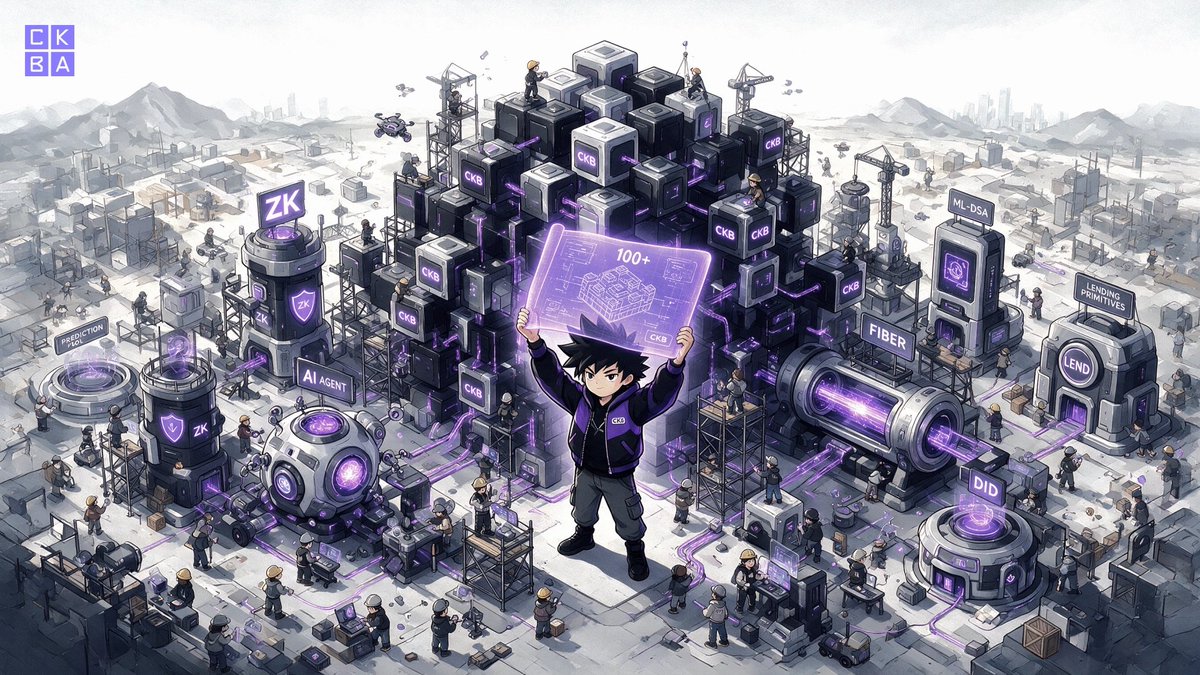
Today, over 100 are working on or exploring the network:
- 70 formal CKBuilders working through a structured program
- ~40 more coming in through Build on CKB, an open group for developers curious about the chain
- 45 projects now listed on the CKBuilder tracker, with 23 added in a single quarter and 15 submitted for technical review by core CKB developers
Claw & Order, a two-week AI Agent hackathon, closed with 22 open-source submissions; 16 came from CKBuilders, including the top two prize winners
- The work spans a surprisingly wide range: ZK key recovery for AI agents, a Groth16 zkSNARK verifier, a Fiber desktop client, an ML-DSA post-quantum implementation, a DID reference dashboard, lending primitives, prediction pools, and more
Some of these builders are now graduating from experimentation into independent projects.
But the more important signal is that all of this happened during one of the bleakest periods for the industry.
If this is what the builder pipeline looks like when capital and attention are scarce…what happens when they aren’t? 👀
Quantum computing stopped being a science project somewhere along the way, and announcements like this are how you can tell.
Helios is being deployed through Oracle Cloud Infrastructure. Quantinuum has signed a manufacturing partnership to help build future systems at scale. Revenue grew 279% year-over-year. Sol is on the roadmap for 2027, Apollo for 2029.
For years, the skeptical case was that quantum computing might never escape the research phase; that the papers, prototypes, and laboratory demonstrations would never become machines that can be error-corrected, manufactured at scale, deployed reliably, and improved generation after generation.
Announcements like this chip away at that argument.
Quantinuum has not built a cryptographically relevant quantum computer. But more of the obstacles between today’s machines and a CRQC are becoming engineering problems: fault tolerance, manufacturing, systems integration, cloud deployment, and successive hardware generations with explicit roadmaps.
Enormous hurdles remain, but betting the security of long-lived cryptographic systems on those hurdles never being cleared is becoming harder to defend.
For blockchains, the relevant timeline is not the date a quantum computer can break secp256k1.
It is that date minus the time required to replace secp256k1 across a live network.
Replacement cryptography has to be selected, implemented, audited, integrated into wallets and infrastructure, and adopted by users whose assets remain protected by vulnerable keys. None of that happens instantly.
There is another problem too: we do not yet know which post-quantum schemes will prove durable enough to rely on for decades.
That is exactly what makes CKB different.
CKB does not need to wait for the industry to settle on a single post-quantum winner. Cryptographic verification lives in programmable Lock Scripts running on CKB-VM, so new schemes can be introduced without changing CKB’s consensus rules.
SPHINCS+ is already live on mainnet.
If a better scheme emerges, it can be added alongside it. If cryptanalysis weakens one, users can migrate again without redesigning the protocol underneath them.
For CKB, the post-quantum migration does not start when Q-Day gets close.
It has already started, and if circumstances change, we can change direction on the go instead of starting over.
There’s an interesting connection between two of the biggest changes in Vitalik’s updated Ethereum roadmap.
The first is that quantum safety has clearly moved up the priority list.
The work being discussed is substantial: leanSPHINCS, signature aggregation, zkzk frames to make post-quantum signatures economical, and formal verification as part of the path toward getting there.
The second is architectural.
Vitalik suggests that those zkzk frames could eventually expose a simpler ISA such as leanISA or RISC-V, with the EVM becoming an IR on top rather than something permanently enshrined in the base protocol.
These may look like separate roadmap items, but they point toward the same underlying lesson: the less you permanently bake into the base protocol, the easier it is to change the things above it.
That is especially relevant now that quantum safety is becoming a concrete engineering priority rather than a abstract concern.
CKB was designed around this idea from the beginning.
CKB-VM has used RISC-V since mainnet launch, but RISC-V itself is only part of the story. The VM is deliberately crypto-agnostic, so cryptographic verification can be implemented as ordinary executable code in Scripts rather than hard-coded into the protocol.
That’s what gives CKB crypto agility. A new signature scheme such as SPHINCS+ can be deployed as a Lock Script without changing CKB’s consensus rules, and users can migrate when they need to.
Interestingly, when Vitalik first proposed replacing the EVM with RISC-V in 2025, he pointed to CKB-VM as one of the precedents.
Ethereum is now treating quantum safety as a major protocol priority.
Different architectures and different paths, but the direction is familiar:
Keep the base protocol simple, general and stable.
Make everything that may need to evolve programmable.
Bitcoiners deserve a lot of credit for pioneering many of these ideas (see Utreexo).
But yes, this is what the current proposed Ethereum scaling strategy looks like in action.
We want Ethereum to have the best of UTXO-style state, dynamic state, and everything in between, allowing the great majority of Ethereum's activity to be hyperscaled without sacrifice to decentralization, ease of node running and censorship resistance.
https://t.co/rVylwVtgP5
The easiest payment infrastructure to use is often the infrastructure that puts one company in control.
And, if we’re being honest, the convenience and UX benefits are real. So are the trade-offs.
A managed provider can abstract away liquidity, settlement, compliance, and technical complexity while offering businesses a predictable experience, customer support, and a single accountable counterparty.
For many businesses, that is precisely what makes new payment rails usable in the first place.
But convenience comes with dependency. Businesses rely on the provider to keep supporting the assets, markets, and payment flows they need. If the provider changes its pricing, restricts access, suffers an outage, or discontinues the service, users cannot simply route around it.
Fiber explores a different model.
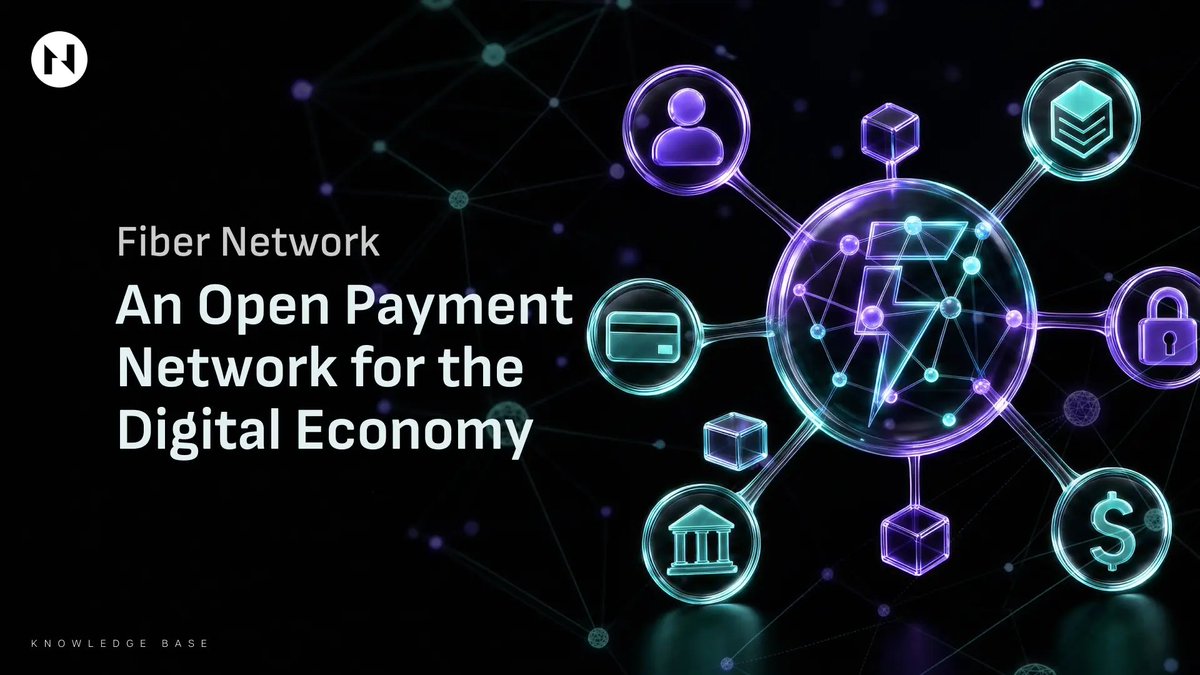
Fiber is open payment infrastructure that anyone can use, build on, or help operate.
Connect to the network and pay across it. Or strengthen the network by opening channels, providing liquidity, routing payments, running watchtowers, and helping connect Fiber with other payment networks.
There is no single company controlling every payment, route, or service. Fiber grows through the independent participants who use it, operate it, and build businesses on top of it.
It is less like a product owned by one company and more like a living economic network—one that becomes more useful, resilient, and valuable as more people contribute to it.
Try Fiber today 👉 https://t.co/yfSHXyhSQl
Or, build on it 👉 https://t.co/NzO8Ncuthh
🚴 Fiber Dev Log 34 🚴
v0.9.0 is live 🟢
After weeks of release hardening, the final milestone cleanup is complete, and Fiber v0.9.0 is released, making nodes more reliable, recoverable, and easier to operate.
Highlights:
- A unified database migration system with backup and restore support
- Stronger payment recovery with Cross-Chain Hub improvements
- More reliable reconnect and channel recovery flows
- Smoother node onboarding with new install and quick-start scripts
Full dev log: https://t.co/v7n5tltcxf
The payments industry is arriving at a shared conclusion, and it is worth stating plainly: the digital economy needs faster, smaller, more frequent, and more flexible ways to move value than either legacy rails or individual onchain transactions can provide.
Look at what is being built.
Circle Gateway offers gas-free USDC nanopayments through offchain authorizations and batched settlement.
Stripe and Bridge are building stablecoin infrastructure for payments, payouts, treasury, and global money movement.
Tempo’s MPP Sessions let customers pay continuously through offchain vouchers, while x402 gives applications and agents an open standard for requesting payments over the internet.
Different projects, different approaches, one direction: more value is moving offchain, into smaller and more programmable payment flows.
Fiber belongs to this movement, but tackles a different layer of the problem.
x402 and MPP help software request and authorize payments. Tempo makes repeated payments inside a bilateral service relationship more efficient. Circle and Stripe make stablecoin payments operationally convenient through managed infrastructure.
Fiber is building the open network those payments can travel through.
Rather than requiring a separately funded relationship with every recipient, Fiber routes payments through shared network liquidity. Anyone can connect, run a node, provide liquidity, route payments, or build applications on top—and payers can reach recipients across the network without opening a direct channel with each one.
The simplest way to understand Fiber:
Connect to the network. Pay across it.
Read how Fiber routes value, what open payment infrastructure changes, and what becomes possible when payments become programmable 👇
https://t.co/8JgAdKQ0Iz
Great ideas are always worth learning from. ⚡️
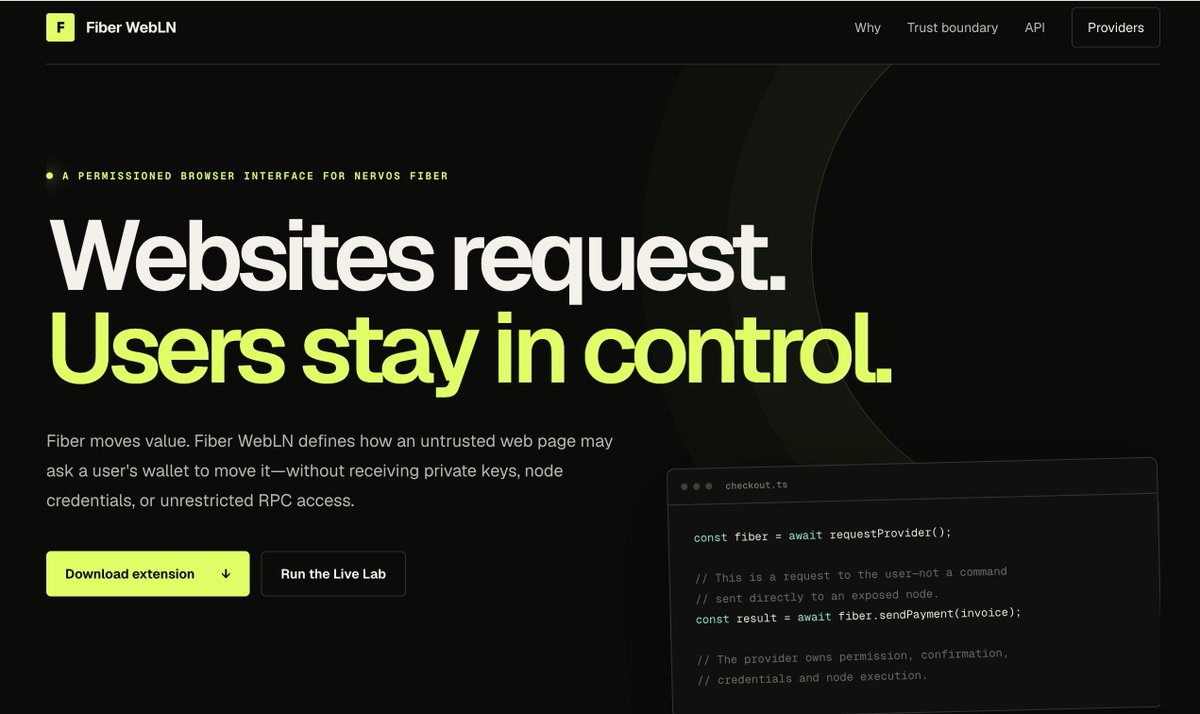
Inspired by Lightning's WebLN, a new community experiment explores an important question:
When websites can request payments, how to make sure users remain in control?
A web payment interface is never just about making API calls easier. It also about building the right boundaries between websites and users:
→ What should a website be allowed to do?
→ Which actions need user confirmation?
→ How can users stay in control of their payment capabilities?
Fiber WebLN explores a browser-facing interface where websites can request: Fiber actions, while users decide what is allowed.
It creates a trust boundary between the page and the Fiber node: Fiber moves the money. Fiber WebLN governs how the web asks.
It also shows how different Fiber node setups can work through the same interface, so websites don't need to care where the user's node is running.
Try the demo: https://t.co/yWr90bIgdg
GitHub: https://t.co/60SxlSCFgb
Dev's thoughts: https://t.co/S4omYAqdg5
Fiber is being built as an open network where people, businesses, applications, and machines can exchange value continuously, without a payment processor sitting at the center of every relationship.
In practice, that means creators can be paid as their work is consumed rather than waiting on monthly platform payouts.
Applications can charge a fraction of a cent per request instead of forcing subscriptions on occasional users. Devices can pay for the exact bandwidth or electricity they use, as they use it.
These are payments that card fees and per transaction settlement rule out today, and they become practical the moment value moves offchain and flows at internet speed.
How the network makes that possible 👇
https://t.co/MGRxWfQnXd
Businesses accepting stablecoin payments from AI agents is the clearest signal yet of where payments are heading: software buying services in real time, in amounts cards were never built for.
The open question is what carries those payments at scale.
One API call or one minute of compute is too small for card fees and too frequent to settle onchain individually.
Payment channels were designed for exactly this: open once, pay continuously offchain, settle when done.
That's the domain Fiber is being built for. An open, peer-to-peer payment network on CKB, built in public, designed to support emerging machine payment standards like x402 and MPP.
The complete guide 👇
https://t.co/MGRxWfPQ7F
The recent Fiber Network Infrastructure Hackathon yielded an unprecedented level of participation, with around 100 participants and 66 final submissions.
It might be a bear market, but developer activity on CKB and Fiber is surging. Read the full roundup and project summaries on Nervos Talk
https://t.co/uZr6bXxgpD