@CallumLyon Costly, isn't it. But don't compare a supermarket run with a business move. The UAE business numbers only made sense after my accountant modelled tax, legal and banking.
Nifty 50 Trails Asian Peers as Kospi and Taiex Nearly Double
₹100 invested in Nifty in Oct 2024 is now worth ~₹90, versus ₹255 in Kospi and ₹218 in Taiex.
Nifty 50 is the second-worst major index over the past year, down 10.6% to an 18-month low, ahead of only Indonesia.
South Korea’s Kospi rose 86.7% and Taiwan’s Taiex 80.6%.
https://t.co/zxly5WoAZ0
This is what I wrote and advised two years ago, yet very very few believed or cared about it. The number of things AI can’t do is now much smaller and continues toward zero soon.
“Our focus should now be on what the world will look like in a few years and how we prepare for these massive transitions. Saying ‘AI will never do that or replace this human feature’ is no longer a viable argument.”
🔥BULLISH: Bitcoin's bear market COULD already be OVER, per this Glassnode chart.
BTC's MVRV momentum has turned POSITIVE, flashing the same recovery signal seen in 2019 and 2023.
The MVRV ratio now stands at 1.54, above its annual average of 1.44, suggesting bullish momentum is returning.
I've never funded a project on a central bank cut. Only ~5% of firms respond strongly, per NBER. My constraint: covenant headroom.
https://t.co/1i7t0TNJ83
@nberpubs@td_econ@THEdanjlewis@pilossopher I think this matters because aggregate policy effects hide a narrow responsive tail. For founders, timing and financing access usually beat rate cuts. What does that 5% actually look like?
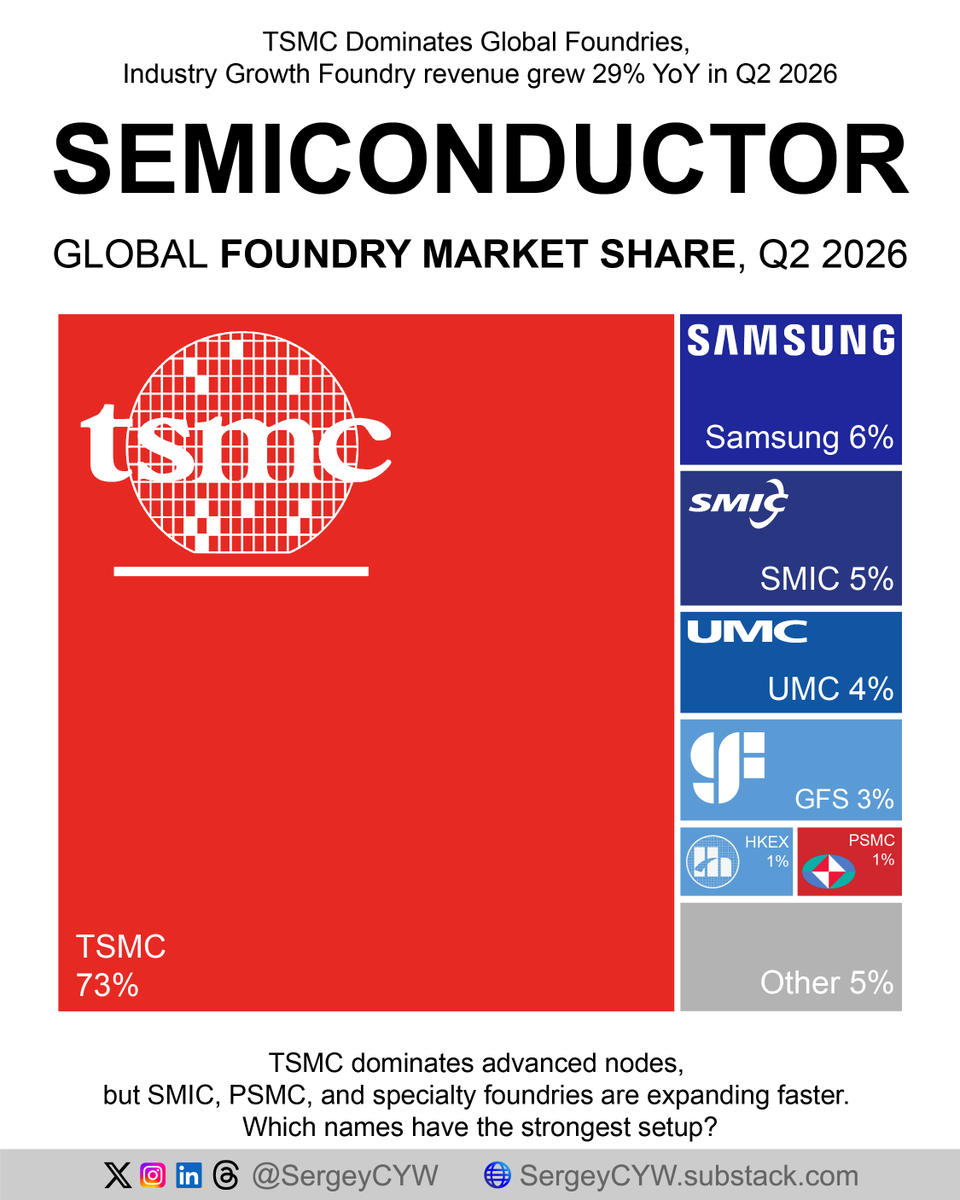
TSMC Captures 73% of the Foundry Market as AI Demand Drives 29% Sector Growth
Global pure-play foundry revenue grew 29% YoY in Q2 2026, supported by AI-related demand, capacity reallocation, and tight supply across advanced and mature nodes.
$TSM TSMC remains the clear leader with $39.9B in Q2 revenue, +25.0% YoY growth, and 73.2% market share. HPC generated 66% of revenue, while 2nm, 3nm, and 5nm together represented 66% of wafer sales. Gross margin reached 67.7%.
Samsung Foundry ranked No. 2 with $3.26B in revenue, +3.1% YoY, and 6.0% market share. Samsung continues investing in 2nm and benefits from HBM base-die demand, although Foundry and System LSI remain loss-making.
SMIC generated $3.01B, up 36.1% YoY, reaching 5.5% market share. Utilization climbed to 93.7%, supported by domestic Chinese demand.
$UMC UMC reported $2.16B in revenue, +17.0% YoY, with 4.0% share. Its 22/28nm business reached a record 37% of wafer revenue.
$GFS GlobalFoundries generated $1.79B, up 5.8% YoY, and held 3.3% share. Silicon photonics and SiGe are becoming important growth drivers.
Smaller foundries are growing rapidly.
Hua Hong: $718M, +26.8% YoY; Powerchip: $543M, +40.8%; $TSEM Tower: $460M, +23.7%; VIS: $448M, +11.9%; Nexchip: $448M, +22.1%; DB HiTek: $268M, +7.4%.
@JamiePBrown76@JGWorldThoughts Exactly. The pub queue is often a card queue. I keep hearing small firms funding payroll and stock on terms; households do the same, just with better branding.
@JGWorldThoughts I think people are still financing pub meals and new cars because credit is lagging the essentials squeeze. The queue isn't proof of prosperity, it's debt with a pint.
@davidpattersonx I think the robot side feels a little... aggressive. Cognitive work can run ahead, but power, parts, and liability will decide the real curve.
@Dr_Singularity I'd want independent wet-lab replication and a human explanation before anyone injects a mystery cocktail. Lean proves the math, not the biology.
When we talk about taxing the super-rich this is what we mean...
Only 0.03% of the UK population has wealth of more than £10 million.
& someone with £11,000,000 would pay just £20,000 with our Wealth Tax proposal.
I agree with the IMF here. Caps are easy to announce and hard to unwind. My accountant kept flagging that 3 to 22x fiscal gap: blunt instruments cost more than targeted transfers.
Highly relevant!
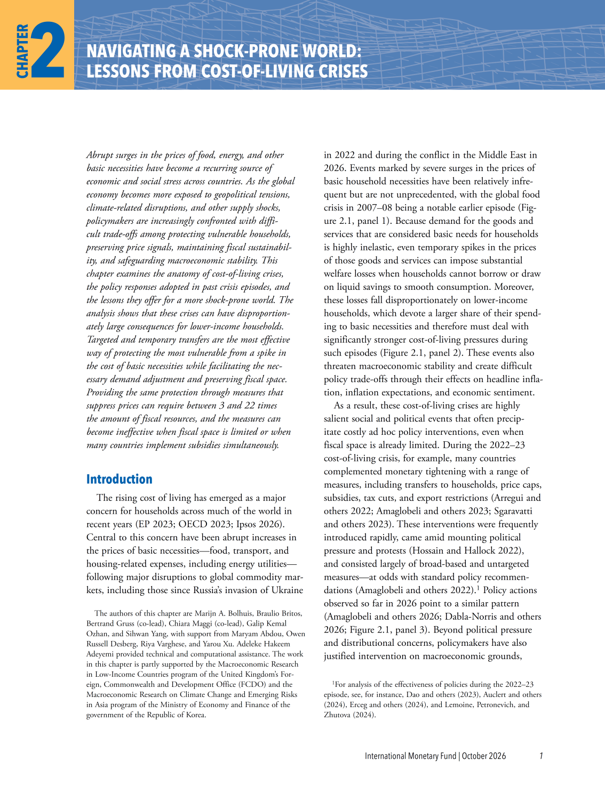
"Navigating a Shock-Prone World: Lessons from Cost-of-Living Crises" (IMF, Chapter World Economic Outlook)
"Over the past five years, food and energy price surges have strained household budgets and fueled economic and social pressures across the world. This chapter examines cost-of-living crises: episodes marked by sharp increases in the price of basic necessities, falling purchasing power, and persistently higher inflation and inflation expectations, as well as worsening inequality and poverty. Drawing on new evidence from a global database of policy interventions and a novel economic model, it assesses how governments have responded and which policies work best. The findings show that targeted, temporary transfers offer the most effective and cost-efficient protection for vulnerable households, while preserving fiscal space and allowing prices to adjust. By contrast, measures that suppress prices can require 3 to 22 times more fiscal resources and may become ineffective when fiscal space is limited or many countries adopt them simultaneously."
https://t.co/RDfsyR07ef
JUST IN: CFTC warns investors that even gold and silver can be highly volatile.
"When economic instability is high, the people who typically profit from precious metals are the sellers."
The memo comes 8 months after silver volatility hit a 40-year high.
@goawaysanta@BullTheoryio For most SMBs I’d look at workflow: fewer support tickets, faster invoices, less admin. If the vendor can't show cost per resolved task, it's a demo. What workflow are you testing?