The US government, citing national security authorities, has issued an export control directive to suspend all access to Fable 5 and Mythos 5 by any foreign national, whether inside or outside the United States, including foreign national Anthropic employees.
The net effect of this order is that we must abruptly disable Fable 5 and Mythos 5 for all our customers to ensure compliance.
Access to all other Claude models is not affected.
We apologize for this disruption to our customers. We believe this is a misunderstanding and are working to restore access as soon as possible.
Read our full statement: https://t.co/bwn0sximKZ
Jeg har en betalings abbonement hos Schibsted som gir meg tilgang til Aftenposten , VG, mm. Jeg føler at jeg har lyst å kansellere abboen for familien da jeg må samtykke til kommersiell bruk av min personlig info ellers må jeg betale enda mer. Ikke greit.
"Los mejores Skills se quedan en carpetas privadas porque nadie quiere que le copien."
Esta frase me paró en seco.
Es exactamente por eso que la IA genérica sigue siendo mediocre.
Los que de verdad saben no comparten nada. Capafy acaba de cambiar eso.
Introducing Gemini Spark ✨
It’s your 24/7 personal AI agent that helps you navigate your digital life, taking action on your behalf, and under your direction.
🧠 It runs on Gemini 3.5 and is built on @Antigravity, so it can perform long-running tasks easily in the background.
⏱️ And because it runs on dedicated virtual machines on Google Cloud, you don’t even need to keep your laptop open.
🧰 Spark will integrate seamlessly with Google tools, and soon with third parties through MCP.
#GoogleIO
Fortnite is back on the App Store around the world for iPhones and iPads! 🌍 Jump in and level up today to unlock the Yeddy outfit: https://t.co/Sv7ZD0iuKn
For more, see here: https://t.co/OTxMiBNtyS
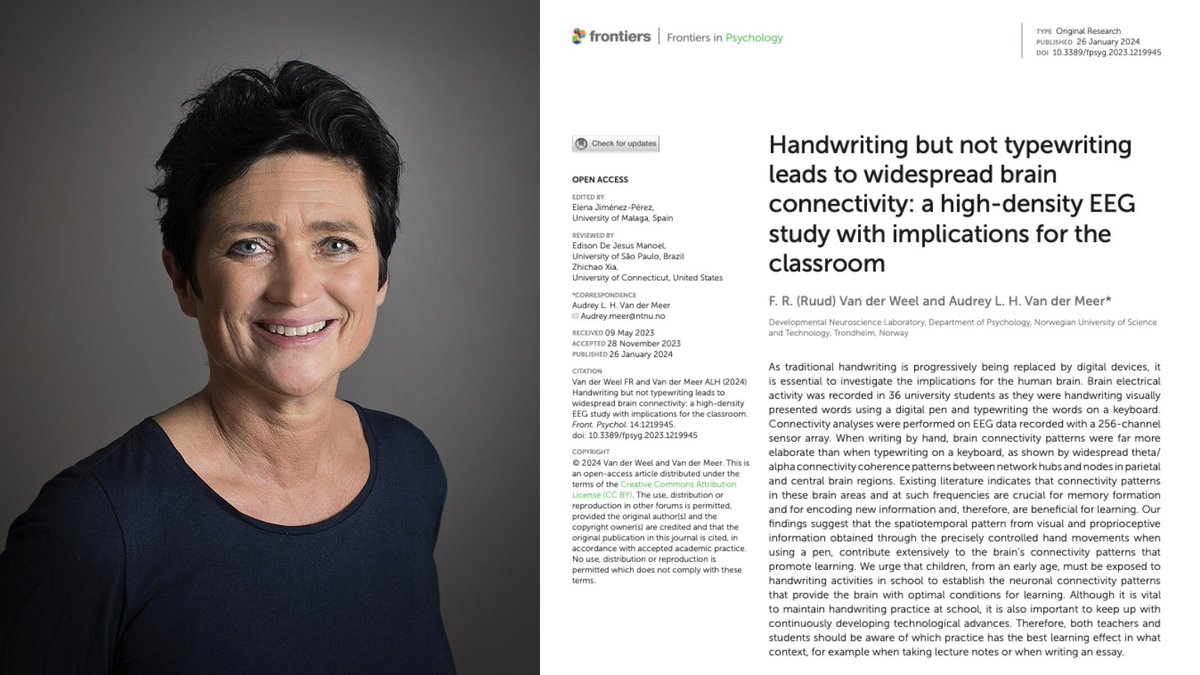
A Norwegian neuroscientist spent 20 years proving that the act of writing by hand changes the human brain in ways typing physically cannot, and almost nobody outside her field has read the paper.
Her name is Audrey van der Meer.
She runs a brain research lab in Trondheim, and the paper that closed the argument was published in 2024 in a journal called Frontiers in Psychology. The finding is brutal enough that it should have changed every classroom on Earth.
The experiment was simple. She recruited 36 university students and put each one in a cap with 256 sensors pressed against their scalp to record brain activity. Words flashed on a screen one at a time.
Sometimes the students wrote the word by hand on a touchscreen using a digital pen, and sometimes they typed the same word on a keyboard. Every neural response was recorded for the full five seconds the word stayed on screen.
Then her team looked at the part of the data most researchers had ignored for years, which is how different parts of the brain were communicating with each other during the task.
When the students wrote by hand, the brain lit up everywhere at once.
The regions responsible for memory, sensory integration, and the encoding of new information were all firing together in a coordinated pattern that spread across the entire cortex. The whole network was awake and connected.
When the same students typed the same word, that pattern collapsed almost completely.
Most of the brain went quiet, and the connections between regions that had been alive seconds earlier were nowhere to be found on the EEG.
Same word, same brain, same person, and two completely different neurological events.
The reason turned out to be something nobody had really paid attention to before her work. Writing by hand is not one motion but a sequence of thousands of tiny micro-movements coordinated with your eyes in real time, where each letter is a different shape that requires the brain to solve a slightly different spatial problem.
Your fingers, wrist, vision, and the parts of your brain that track position in space are all working together to produce one letter, then the next, then the next.
Typing throws all of that away. Every key on a keyboard requires the exact same finger motion regardless of which letter you are pressing, which means the brain has almost nothing to integrate and almost no problem to solve.
Van der Meer said it plainly in her interviews.
Pressing the same key with the same finger over and over does not stimulate the brain in any meaningful way, and she pointed out something that should scare every parent who handed their kid an iPad.
Children who learn to read and write on tablets often cannot tell letters like b and d apart, because they have never physically felt with their bodies what it takes to actually produce those letters on a page.
A decade before her, two researchers at Princeton ran the same fight using a completely different method and ended up at the same answer. Pam Mueller and Daniel Oppenheimer tested 327 students across three experiments, where half took notes on laptops with the internet disabled and half took notes by hand, before testing everyone on what they actually understood from the lectures they had watched.
The handwriting group won by a wide margin on every question that required real understanding rather than surface recall.
The reason was hiding in the transcripts of what the two groups had actually written down.
The laptop students typed almost word for word, capturing more total content but processing almost none of it as they went, while the handwriting students physically could not write fast enough to transcribe a lecture in real time, which forced them to listen carefully, decide what actually mattered, and put it in their own words on the page.
That single act of choosing what to keep was the learning itself, and the keyboard had quietly skipped the choosing and skipped the learning along with it.
Two studies. Two countries. Same answer.
Handwriting makes the brain work. Typing lets it coast.
Every note you have ever typed instead of written went into your brain through a thinner pipe. Every meeting, every book highlight, every idea you captured on your phone instead of on paper was processed at half depth.
You did not forget those things because your memory is bad. You forgot them because typing never woke the part of the brain that would have made them stick.
The fix is the thing your grandmother already knew.
Pick up a pen. Write the thing down. The slower road is the faster one.
I’ve always believed the No.1 application of AI should be to improve human health.
That work started with AlphaFold, and now at @IsomorphicLabs with the mission to reimagine drug discovery and one day solve all disease!
We are turbocharging that goal with $2.1B in new funding.
Un estudio de Stockholm School of Economics muestra que al quitar sucesiones en Suecia crecieron inversión, beneficios, salarios y pagos fiscales en empresas familiares. La izquierda ve patrimonio para confiscar. Un país serio ve empresas para crecer. https://t.co/XKTk9uMpG4
TODAY: Amazon is opening its entire logistics network—freight, distribution, fulfillment, and parcel shipping capabilities—to every business, of all types and sizes. 📦
Amazon has built one of the most reliable and efficient supply chains on Earth. Now, Amazon Supply Chain Services gives all businesses access to the same infrastructure that moves, stores, and ships goods for hundreds of thousands of Amazon sellers.
Healthcare, automotive, manufacturing, retail, and more. Businesses across industries can now tap into Amazon's logistics network. Learn more here. ⬇️
Today, we’re launching the @link wallet for agents. It lets you securely empower agents to spend on your behalf. Your payment credentials are never exposed and you approve every purchase.
https://t.co/TcvEiVNth9
Claude Security is now in public beta for Claude Enterprise customers.
Claude scans your codebase for vulnerabilities, validates each finding to cut false positives, and suggests patches you can review and approve.
AI has stopped being a feature and started being the foundation.
We're excited about a new wave of startups rebuilding software, services, and silicon— and pushing AI into the physical world.
https://t.co/QCIz6DnQnN
New in Claude Code: /ultrareview (research preview) runs a fleet of bug-hunting agents in the cloud.
Findings land in the CLI or Desktop automatically. Run it before merging critical changes—auth, data migrations, etc.
Pro and Max users get 3 free reviews through 5/5.
Introducing Claude Design by Anthropic Labs: make prototypes, slides, and one-pagers by talking to Claude.
Powered by Claude Opus 4.7, our most capable vision model. Available in research preview on the Pro, Max, Team, and Enterprise plans, rolling out throughout the day.
A 19-year-old drops out of school in Paris, teaches himself to code on an Apple II, builds X-rated chat rooms, and makes his first million before he can legally drink.
Then he hacks the French president's phone. To prove a point about weak security. He gets arrested. Spends a month in jail.
Most people's story ends there. His starts.
He founds Iliad in 1999 and launches a telecom brand called Free. The name is the strategy. He prices unlimited mobile at €19.99/month when every French carrier was charging €45+. The entire industry collapses into a price war overnight. French consumers save an estimated €10 billion over the next five years. Three legacy carriers post the worst quarterly results in their history.
Today Iliad has 52 million subscribers across France, Italy, and Poland. €10 billion in annual revenue. €2.25 billion in operating free cash flow last year, up 23% year over year. Niel took it private because he got tired of quarterly earnings calls constraining his ability to start wars in new markets.
While building a telecom empire, he also bought Le Monde (France's paper of record), co-owns the rights to "My Way" by Sinatra, founded 42 (a tuition-free coding school with zero teachers that accepts anyone regardless of credentials), built Station F (the world's largest startup campus in a converted Paris freight depot), seed-funded Mistral AI, invested €100 million in Kyutai alongside Eric Schmidt, and bought a Parisian palace from a Qatari prince for $227 million.
His partner is Delphine Arnault. The CEO of Dior. The daughter of Bernard Arnault, the richest person in Europe. He sits on the board of KKR.
Yesterday he launched Free Max. Unlimited 5G data in 135+ countries for €19.99/month. Same playbook he's been running for 25 years: walk into a market where carriers charge $15/day for roaming, price it at 66 cents, and watch every competitor scramble.
Xavier Niel is worth $14.2 billion and the only CEO in telecom who responds to customer death threats by showing up to the parking lot.
i love this story. ai won't replace your job.
IKEA created an AI agent called billy that earned them a new $1.2 billion rev stream: interior home design
- ikea created billy to handle customer service requests. it did a great job (57% approval rate) but they noticed something else..
- the 43% of cases it couldn't answer were all people asking for interior home design advice.
- so ikea spun up a brand new design consultancy, re-trained employees with ai tools and they made $1.2B in the 1ST YEAR
i love this because they didn't just take the efficiency win on the customer service rating, instead they used it to discover NEW opportunities to make money (and leverage humans for it)
how sick is that?