Your margin is my opportunity: AI version…
The biggest surprise of 2026 is that the capability gap between the best open-weight/source models and the best closed models has narrowed much faster than the pricing gap. The pricing gap remains enormous while the capability gap is quite narrow.
What does this means in practice?
For a company consuming 1 billion input tokens and 1 billion output tokens per month:
GPT-5.5 Pro: ~$105,000
Claude Opus 4.8: ~$30,000
DeepSeek V4 Pro: ~$5,220
DeepSeek R1: ~$2,740
I asked ChatGPT what it thought about this and it answered as follows:
“If I were building a company today, the economic frontier would look roughly like:
DeepSeek V4 Pro / R1 for high-volume inference.
Claude Opus for premium agent workflows where reliability matters.
GPT-5.5 Pro only for workloads where its incremental capability demonstrably produces enough business value to justify a 20–40× token premium.”
Most CEOs have no idea that, instead of this nuanced approach, their teams are running amok internally by picking the most expensive models in most cases and burning through massive budgets with zero governance, audit ability and control.
As control planes like our Software Factory become more standard, you can expect the run rate revenue growth of the frontier labs to go down meaningfully and the revenues of the open models to skyrocket.
Why? Because we can implement the nuanced approach above and be agnostic to model - instead focusing on customer intent, model task and cost management among other things.
Two of our worst VC stories:
1. A Sequoia partner passed on Cloudflare because he didn’t think a woman could lead a security infrastructure company. Seriously. 🙄
2. I got introduced to @pmarca. Meeting got scheduled for a Monday, which should have been a clue. I thought it was just a casual meeting. He thought it was a pitch and brought the whole @a16z partnership team. Hilarity ensued. 🤪 At one point one of them said: “You don’t seem very prepared.” Which was true because I wasn’t. I framed the rejection letter they sent.
Longevity researchers spent the last 6 months obsessed with the lifestyle of the Sardinian Blue Zone.
Most people think it’s the wine or the walking. They’re wrong.
It’s the Entomophagy (insect consumption).
The "secret" to living to 100 isn't more supplements. It’s eating bugs.
Here is the breakdown of why Crickets are the ultimate longevity hack:
1. The Protein Density Problem
Beef is 20% protein. Crickets are 65%.
But it’s not just the amount—it’s the bioavailability. Your gut absorbs insect protein 2x faster than whey. No bloating, just pure cellular repair.
2. The Chitin Factor
Exoskeletons contain Chitin, a prebiotic fiber you can’t get from plants.
Studies show Chitin drastically reduces systemic inflammation—the "silent killer" behind aging. It’s like a scrub brush for your arteries.
3. Vitamin B12 Overload
Crickets have 3x more B12 than salmon.
B12 is the primary driver of DNA synthesis. If you want to stop your telomeres from shrinking, you need high-octane B12.
4. The Hormetic Stressor
Eating "novel" proteins triggers a mild hormetic response. It signals to your body that resources are scarce/different, activating the SIRT1 longevity gene.
The Routine:
Replace morning eggs with 20g of roasted cricket powder.
* Brain fog: Gone.
* HRV: Up 15%.
* Energy: Stable all day.
The West is allergic to the idea because of "the ick factor."
But the data is clear: If you want to reach 100, you need to stop eating like a 20th-century human and start eating like a 10,000-year-old one.
Eat the bugs. Live forever. 🦗
Benchmark just led a $15M seed for Eigen—and they’re not building another "chatbot."
While everyone else is busy trying to replace your friends with AI, Eigen is building the "Mutual Friend."
The goal? A new category of AI focused on human connection, not just productivity.
Here is why this is a massive signal for Product Leaders:
1. The "Anti-Isolation" Play
Most AI agents are solo experiences. You + GPT. Eigen is betting that the real value of AI is in the *middle*—helping humans navigate relationships and collaborate better.
2. Distribution via Trust
By positioning as a "mutual friend," they are solving the hardest part of social products: the Cold Start Problem. If the AI can facilitate the intro, the friction to connect drops to zero.
3. The Pedigree
Founder Paul Scherer has an unconventional path (self-taught, moved to SF to build). When Benchmark drops $15M on a seed for a "human-first" AI platform, pay attention.
The next wave of AI isn't about better prompts. It's about better relationships.
We have raised $15M from @Benchmark to build a mutual friend that’ll help us belong and grow, together
We’re looking to hire fellow travelers to join us especially if you lose sleep over building magical experiences
Cancer isn’t some random villain sabotaging our shot at radical longevity.
It’s the predictable tax biology levies when you push human lifespan into uncharted territory.
The longer cells divide, the more mutations accumulate. Senescent cells pile up like unpaid bills, leaking inflammatory signals that create the perfect breeding ground for tumors. Aging doesn’t just correlate with cancer — it enables it.
But 2026 just rewrote the script.
American Cancer Society data dropped: overall five-year survival for all cancers hit 70% — up from 49% in the 1970s.
Metastatic melanoma? Survival jumped from ~16% to 35% in 25 years, thanks to immune checkpoint inhibitors. Stage-4 disease that once meant months now often becomes a manageable chronic condition.
Immunotherapy isn’t just extending life — it’s turning the immune system into a precision-guided missile against tumors that used to hide in plain sight.
CAR-T and next-gen cell therapies are moving outpatient. Armored T-cells engineered with their own cytokines are persisting in hostile tumor microenvironments. Personalized mRNA vaccines (the same tech that crushed COVID) are now targeting neoantigens in real patients, shrinking tumors in weeks for a fraction of traditional costs in early compassionate cases.
Here’s where it gets existential for longevity: the companies cracking senescent cell clearance (senolytics) aren’t just fighting aging wrinkles. They’re building immune firewalls. Clear the zombie cells that fuel chronic inflammation and you don’t just slow aging — you starve the soil where cancer grows. Combine that with smarter immunotherapy, and the vicious cycle breaks.
We’re not talking supplements or biohacks. We’re talking platforms that could let the first cohort treat 120 like the new 80.
The data is here. The tech is converging.
The only question left is who executes fastest.
Game on. Who’s building it? 🚀
SBF didn’t lose $8 billion because the trades went bad.
He lost it because the trades were never his to make.
FTX sat on a $32 billion exchange with customer deposits treated like a personal venture fund. Alameda borrowed billions, bought illiquid stakes in Anthropic, Solana bags, Robinhood shares, even SpaceX exposure through side vehicles. On paper at the November 2022 peak it looked like genius: Anthropic mooned, Solana 15x’d, Bitcoin went from $16k to six figures.
Pure investment selection was elite.
The fatal mismatch wasn’t market risk.
It was duration risk.
A CoinDesk article drops the balance sheet. CZ tweets. $6 billion walks out the door in 72 hours. You can’t liquidate a 7.84% Anthropic position over a weekend. You can’t sell real estate or private equity when retail wants fiat yesterday. The exchange had the controls of a college dorm spreadsheet: no real segregation, no reserve proof that mattered, no hard asset-liability matching. Risk limits? Optional. Alameda’s borrowing from FTX? Unlimited until it wasn’t.
That’s what a bank run exposes in 72 hours that years of bull market hide.
The bankruptcy estate sold everything at the literal bottom. Anthropic at fire-sale prices that now look absurd. Solana in the teens. Total recovered so far: around $18 billion, with creditors getting 118-143% back in some cases because crypto recovered hard. Hold the portfolio to today and the math hits $136 billion. The difference isn’t fraud on the asset side.
It’s the decision to commingle, lever, and treat customer money as dry powder for the next big bet.
SBF’s defense keeps circling the same point: FTX was never truly insolvent, just illiquid in a panic. New witnesses, alleged pressure on co-founders, lawyers who billed $950 million pushing the Chapter 11 anyway. He’s filing pro se from prison, appealing, asking for a new trial while his parents lobby publicly. Prosecutors say no. Appeals court so far unmoved. 25 years stands.
The pattern is the oldest one in finance: genius at picking direction, amateur at managing the pipe. You can be right on every asset and still blow up if your customers can redeem faster than you can exit. FTX proved crypto exchanges aren’t “different this time.” They’re just faster versions of every mismatched bank that ever existed.
The filter is brutal and already running.
By the time the next cycle peaks, the question won’t be “was SBF a visionary investor?”
It will be “why did anyone ever think running a bank with no real bank controls was a good idea?”
And the answer will be obvious in hindsight — the same way we once wondered why anyone trusted a spreadsheet with no audit when the music was playing.
This food tech startup didn’t build a better cow.
It deleted the cow.
Bloom Labs just hit $0.89 per liter for real dairy proteins — identical at the molecular level to what comes out of a Holstein, zero animals required. Traditional milk is still $3.40 at the store. Their bioreactors run on sugar water, CO₂, and electricity. The output tastes, foams, and bakes exactly like the real thing because it is the real thing — just printed by yeast instead of biology that needs 1,000 gallons of water per gallon of milk.
Here’s the math that just broke the dairy industry:
• One Bloom reactor the size of a shipping container produces 12,000 liters a day.
• A single dairy cow produces ~25 liters a day and needs 200 square meters of land.
• Bloom’s fully loaded cost (capex + opex + energy) is now below California almond milk.
• They ship shelf-stable protein powder that rehydrates into milk in 17 seconds. No refrigeration until you open it.
The pattern is identical to every platform extinction we’ve watched:
1980s: Lotus 1-2-3 owned spreadsheets until Microsoft made Excel free inside Office.
2007: Zynga built FarmVille on Facebook’s open platform until Facebook changed the rules and killed the golden goose.
2023: Twitterrific and Tweetbot spent a decade building the best client until Twitter cut the API on a random Thursday night.
Now it’s 2026 and the $1 trillion global dairy supply chain is the next Lotus. The “cows on pasture” story was never about romance — it was a distribution moat. You needed land, feed, trucks, and cold chains because milk spoils in four days. Bloom’s powder lasts 18 months on a shelf. Their AI controls pH, temperature, and gene expression in real time so every batch is identical. No seasonal variation. No herd disease. No $800M bailout request when feed prices spike.
Farmers in Wisconsin and New Zealand aren’t competing with “plant-based alternatives.” They’re competing with code that scales on compute instead of pasture. One reactor replaces 480 cows. Bloom already has 41 contracted and is building a 400-reactor campus outside Austin that will outproduce the entire state of Vermont.
The filter is already running.
By 2030 the question won’t be “organic or conventional.”
It will be “did this come from biology or from software?”
And the answer will be obvious in hindsight — the same way we once asked why anyone would pay for software when Lotus was free at the library.
🚀 The Grand Unification is HERE.
Marc Andreessen just dropped the mic:
“AI is the killer crypto app. AI agents are going to need money… and it’s already happening.”
People are already handing their AI tools bank accounts and credit cards.
But when agents need to act 24/7 — paying for APIs, hiring other agents, executing trades, settling instantly — traditional finance falls apart.
Enter crypto: native digital money, stablecoins, programmable rails, on-chain settlement.
This is the perfect product-market fit.
AI agents + crypto = the future economy running on autopilot.
Who’s still sleeping on $AI x $CRYPTO? 🔥
#AICrypto #Agents #Crypto
This, singlehandedly, is why I'm still bullish on crypto.
If you don't believe me, listen to Marc Andreessen (founder of a16z - the world's biggest VC).
Crypto x AI is going to be HUGE - and one of the best product-market fits we've ever seen.
"This is the grand unification of AI and crypto. AI agents are going to need money."
This is the future.
Jared Isaacman dropped out of high school at 16 and started a company in his parents' basement with $10,000 his grandfather gave him. Tonight he's on the deck of a Navy ship, waiting to welcome four astronauts home from the moon.
That basement company is now Shift4 Payments. It processes over $200 billion a year in credit card transactions, about a third of all restaurants, hotels, and casinos in the U.S. Went public in 2020. He ran it as CEO from age 16 until he stepped down to take over NASA last year.
He also co-founded Draken International, which ran a fleet of over 100 retired fighter jets whose entire job was playing the enemy in combat training for U.S. Air Force and NATO pilots. He sold it to Blackstone for over $100 million.
He has over 8,000 hours in the cockpit and can fly more than a dozen types of military jets. He personally owns a MiG-29, a Russian fighter that tops 1,500 mph, which he bought from the estate of Microsoft co-founder Paul Allen. It's the only one in private American hands. In 2009, he flew around the entire planet in a small Cessna jet in 61 hours and 51 minutes, a world record, to raise money for Make-A-Wish.
In 2021, he paid for and commanded Inspiration4, the first all-civilian spaceflight. Four people with no astronaut training, three days orbiting Earth, $250 million raised for St. Jude Children's Research Hospital. Then in 2024, he went back up on Polaris Dawn and floated outside the spacecraft, held to it by a 12-foot cable, in the first spacewalk ever done by someone outside a government space agency. That same flight reached 870 miles above Earth, farther than any human had been since the last Apollo crew in 1972.
He took over as NASA's 15th administrator in December 2025. In his first three months, he redirected $20 billion away from a planned space station around the moon and toward building a permanent base on the moon's surface.
Right now he's aboard the USS John P. Murtha, about 50 miles off San Diego. The capsule carrying the Artemis II crew is going to hit the atmosphere tonight at around 25,000 mph. If the heat shield holds (it took damage on its last unmanned test), if the parachutes open, four astronauts splash down at 8:07 PM ET after a 694,000-mile trip around the moon. And the person waiting for them has been to space twice, walked outside a spacecraft, owns the only Russian fighter jet in private American hands, and started his first company as a teenager in his parents' basement. His call sign is "Rook."
The number that should terrify every Western automaker is 1,500 kW.
BYD's Flash Charging pushes 1,500 kilowatts into a car battery. The fastest charger you can find in the US today maxes out at 350 kW. ChargePoint is bragging about rolling out 600 kW chargers sometime in 2026. BYD is already at 2.5x that. Deployed. 5,000 stations live. 20,000 planned by December.
The car in this video, the Song Ultra, starts at $22,000. Five minutes of charging gets you 250 miles of range. The fastest-charging EV you can buy in America is the Lucid Gravity at 400 kW, and it starts at $80,000.
So BYD is charging 4x faster at one-quarter the price. And Geely just beat them last week with a 4-minute charge. The Chinese automakers aren't competing with each other on range or styling anymore. They're in a charging speed war that Western companies haven't even entered.
BMW's response was literally "pursuing quick charging forces other compromises." That's the "640K ought to be enough for anybody" of the EV era.
$1.2 billion. 32 months. Gummy bears.
Chad Janis was a VC at Summit Partners. Board observer at Chubbies, Brooklinen, Dr. Squatch. He watched the entire DTC playbook from the investor seat for years, then ran it himself in fast-forward.
The speed only makes sense when you see the unit economics. $80/month subscription. 80% daily usage rate. 3x LTV-to-CAC ratio. Profitable at month 14. Most AI startups burning $100M+ a year can't say that. Grüns was printing cash while scaling.
$25 million in a single month by August 2025. $300M run rate by month 24. 6,300 retail doors. Every Target, every Walmart, every Sam's Club. Still majority DTC. The retail was gravy on a business that already worked.
Unilever paid $1.2B and probably got a bargain. They bought Liquid I.V. five years ago and it became a billion-dollar brand by 2025. Olly Nutrition. SmartyPants. Nutrafol. They're assembling the wellness Infinity Gauntlet, and Grüns was the fastest-growing piece on the board.
The real story is form factor arbitrage. AG1 built a $600M powder business. Janis looked at it and asked one question: what if people don't hate nutrition, they just hate drinking chalk at 7am? Eight gummy bears solved a compliance problem the entire supplement industry had ignored for decades. The product was the distribution.
Fastest CPG exit in modern history. And he started the idea while drinking a greens powder he knew he'd quit within 30 days.
There’s a growing perception gap in AI progress.
Casual users judge it by last year’s free ChatGPT: hallucinations, fumbling voice queries, quirky fails. They’re not wrong about what they see.
But heavy users of paid frontier agentic models (like OpenAI Codex or Claude Code) in coding, math, and research? We’re seeing staggering leaps—models melting complex problems in hours that once took days/weeks.
Why the disparity? Technical domains have clear, verifiable rewards (unit tests pass/fail) perfect for RL, plus massive B2B priority. Writing, advice, and general chat? Not so much.
Two groups talking past each other: skeptics vs. those with “AI psychosis” from daily hands-on use.
If you’re only on the free/old tier, try the latest coding agents. The gap is real—and widening. 🚀
#AI #Coding
Judging by my tl there is a growing gap in understanding of AI capability.
The first issue I think is around recency and tier of use. I think a lot of people tried the free tier of ChatGPT somewhere last year and allowed it to inform their views on AI a little too much. This is a group of reactions laughing at various quirks of the models, hallucinations, etc. Yes I also saw the viral videos of OpenAI's Advanced Voice mode fumbling simple queries like "should I drive or walk to the carwash". The thing is that these free and old/deprecated models don't reflect the capability in the latest round of state of the art agentic models of this year, especially OpenAI Codex and Claude Code.
But that brings me to the second issue. Even if people paid $200/month to use the state of the art models, a lot of the capabilities are relatively "peaky" in highly technical areas. Typical queries around search, writing, advice, etc. are *not* the domain that has made the most noticeable and dramatic strides in capability. Partly, this is due to the technical details of reinforcement learning and its use of verifiable rewards. But partly, it's also because these use cases are not sufficiently prioritized by the companies in their hillclimbing because they don't lead to as much $$$ value. The goldmines are elsewhere, and the focus comes along.
So that brings me to the second group of people, who *both* 1) pay for and use the state of the art frontier agentic models (OpenAI Codex / Claude Code) and 2) do so professionally in technical domains like programming, math and research. This group of people is subject to the highest amount of "AI Psychosis" because the recent improvements in these domains as of this year have been nothing short of staggering. When you hand a computer terminal to one of these models, you can now watch them melt programming problems that you'd normally expect to take days/weeks of work. It's this second group of people that assigns a much greater gravity to the capabilities, their slope, and various cyber-related repercussions.
TLDR the people in these two groups are speaking past each other. It really is simultaneously the case that OpenAI's free and I think slightly orphaned (?) "Advanced Voice Mode" will fumble the dumbest questions in your Instagram's reels and *at the same time*, OpenAI's highest-tier and paid Codex model will go off for 1 hour to coherently restructure an entire code base, or find and exploit vulnerabilities in computer systems. This part really works and has made dramatic strides because 2 properties: 1) these domains offer explicit reward functions that are verifiable meaning they are easily amenable to reinforcement learning training (e.g. unit tests passed yes or no, in contrast to writing, which is much harder to explicitly judge), but also 2) they are a lot more valuable in b2b settings, meaning that the biggest fraction of the team is focused on improving them. So here we are.
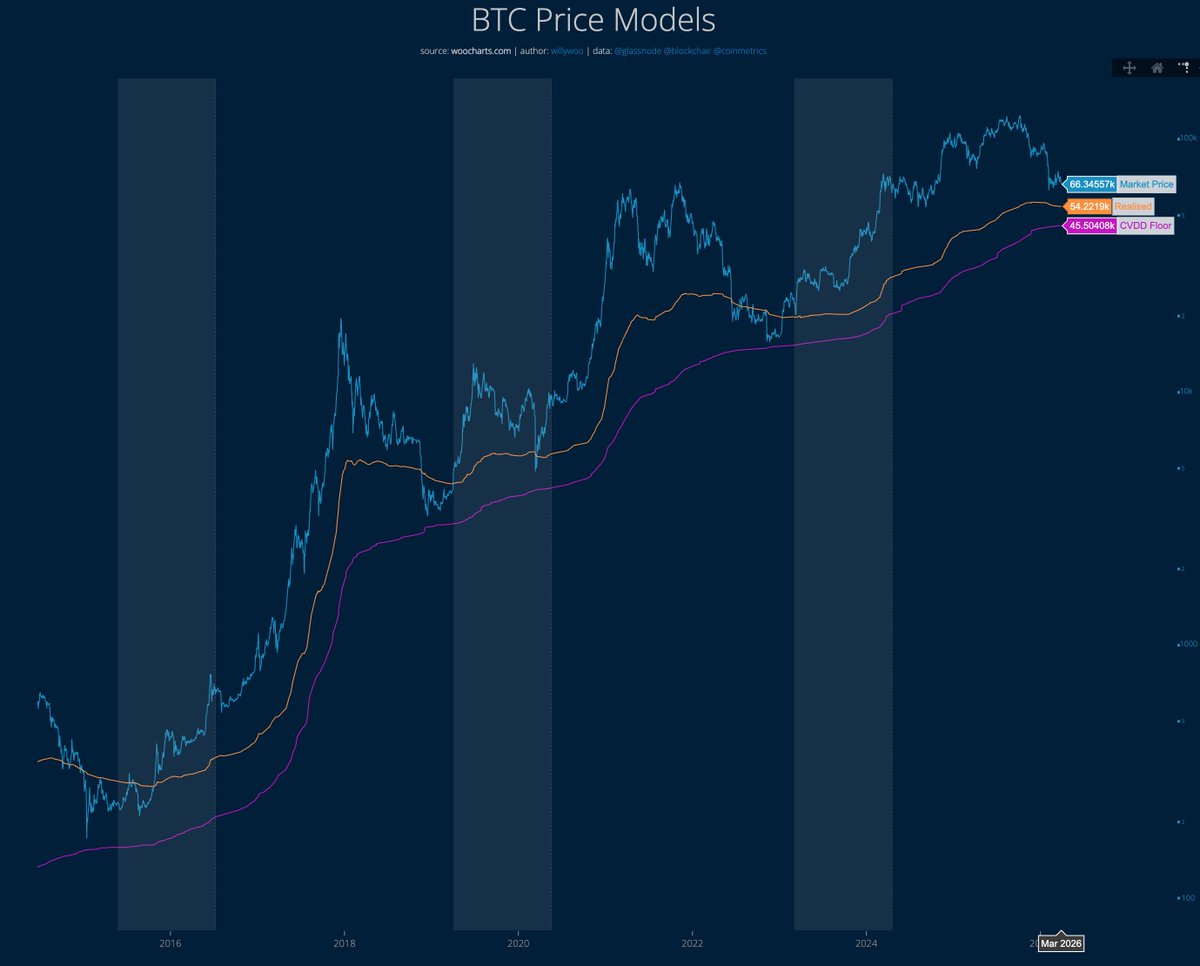
Old school onchain models suggest a BTC bottom between 46k-54k. Also hints at how much time we have to wait.
Orange line correlates to the capital stored in BTC and it has been leaving since November.
CVDD Floor Model has the advantage of climbing over time, 45.5k right now.
If you’re seeing a bunch of Japanese posts, here are some fun facts:
Japan has more daily active users and more time spent on X than any other country in the world.
Over two thirds of the country is monthly active on X.
X in Japan has one of the highest penetration rates of any social network in history.
$MU Two types of idiots today.
Type 1: Believes 40% of DRAM demand came from OpenAI alone.
Type 2: Believes TurboQuant will reduce memory demand 6x.
Put buyers are behind this. Don't fall for it.
Grok, ChatGPT and Claude already use MoE and/or 4-bit compression at scale without significant quality regression. TurboQuant's improvement will be marginal (15% overall, IMO).
It's long-context KV cache inference only. Does not touch training or the model residing inside HBM. Quality regression at scale is unproven. It's a research paper, not a product.
Bigger models need more HBM. Always. That does not change. Oh, also Jevons Paradox.
OpenAI may have caused the worst consumer hardware crisis in a decade with purchase orders that were never real.
In October 2025, Sam Altman flew to Seoul and signed simultaneous deals with Samsung and SK Hynix for 900,000 DRAM wafers per month. That's 40% of global supply. Neither company knew the other was signing a similar commitment at the same time. The pricing and terms would have looked very different if they had.
Those "deals" were letters of intent, not binding purchase orders. No RAM actually changed hands. But the market treated them as real. Contract DRAM prices jumped 171%. A 64GB DDR5 kit went from $190 to $700 in three months. DDR4 kits that should have been in oversupply doubled. Retailers stopped posting prices entirely.
The Abilene Stargate expansion just got cancelled because OpenAI couldn't forecast its own demand. Oracle couldn't agree on financing. The partners are squabbling. Bloomberg reported the $500B project hadn't started and no funds were raised to meet the initial budget. Multiple data center buildouts are delayed or shelved.
Now DDR5 prices are finally dropping for the first time in months, and it has nothing to do with OpenAI walking away from anything. Google released TurboQuant on March 24, a compression algorithm that cuts AI memory requirements by 6x. SK Hynix and Samsung stocks dropped 6% and 5% overnight. Corsair kits fell $60-100 from their highs within days.
One company locked up 40% of global memory with commitments it may never fulfill. A different company published a research paper. The research paper is doing more for RAM prices than the entire supply chain has done in six months.
“Hassabis administered a subtle test on him. The two men discussed the potential of AI, and Zuckerberg expressed appropriate excitement. But then, as the dinner continued, Hassabis brought up other hot technologies: virtual reality, augmented reality, 3-D printing. Zuckerberg sounded equally excited about all of them. ‘That told me what I needed to know,’ Hassabis said.”
🚨 do you understand what Karpathy just said..
the guy who co-founded OpenAI.. led AI at Tesla.. one of the best engineers alive..
built an app with AI.. and said the code was the easy part..
the hard part was Stripe.. auth.. DNS.. databases.. deploying it.. connecting 15 different services that all have different dashboards and different docs and different billing pages..
AI can write your entire app in 20 minutes.. but it still can't click "confirm email" on Vercel..
so the thing that's "replacing developers" can't do the thing developers actually spend 80% of their time doing..
vibe coding didn't kill software engineering.. it just proved that coding was never the job.. the job was dealing with the mess around the code.. and that mess is still 100% human.
🚨 Tesla FSD (Supervised) is crushing it: 1 accident every 5.3 MILLION miles — that's 9x safer than the U.S. average (1 every 660k miles)! Over 8.2B fleet miles proving AI is rewriting road safety.
Meanwhile, rumors are heating up for a fresh Tesla SUV refresh — think Model Y Juniper vibes or even a bold new family hauler. Safer roads + epic new rides? The future is electric. ⚡
FSD first or new SUV? #Tesla #FSD #Cybertruck