I don't blog often, but when I do, I buy the domain names. 😜 https://t.co/gTVDlQEInF https://t.co/tRY468GETJ https://t.co/aaKDtpAXxM https://t.co/SwZgbILyyZ https://t.co/b6pPs2WU4s https://t.co/AgOtn4muzq https://t.co/d1A5eCs5kj https://t.co/XFu4ZFghv1
Announcing Dagger for GitLab.
Run the same checks before and after push. See results in your terminal and merge request.
Cut out the middleman: just GitLab and Dagger Cloud.
Stop wasting compute: checks are cached, and you pay for exact usage, not machines.
https://t.co/hh1CDlTmP5
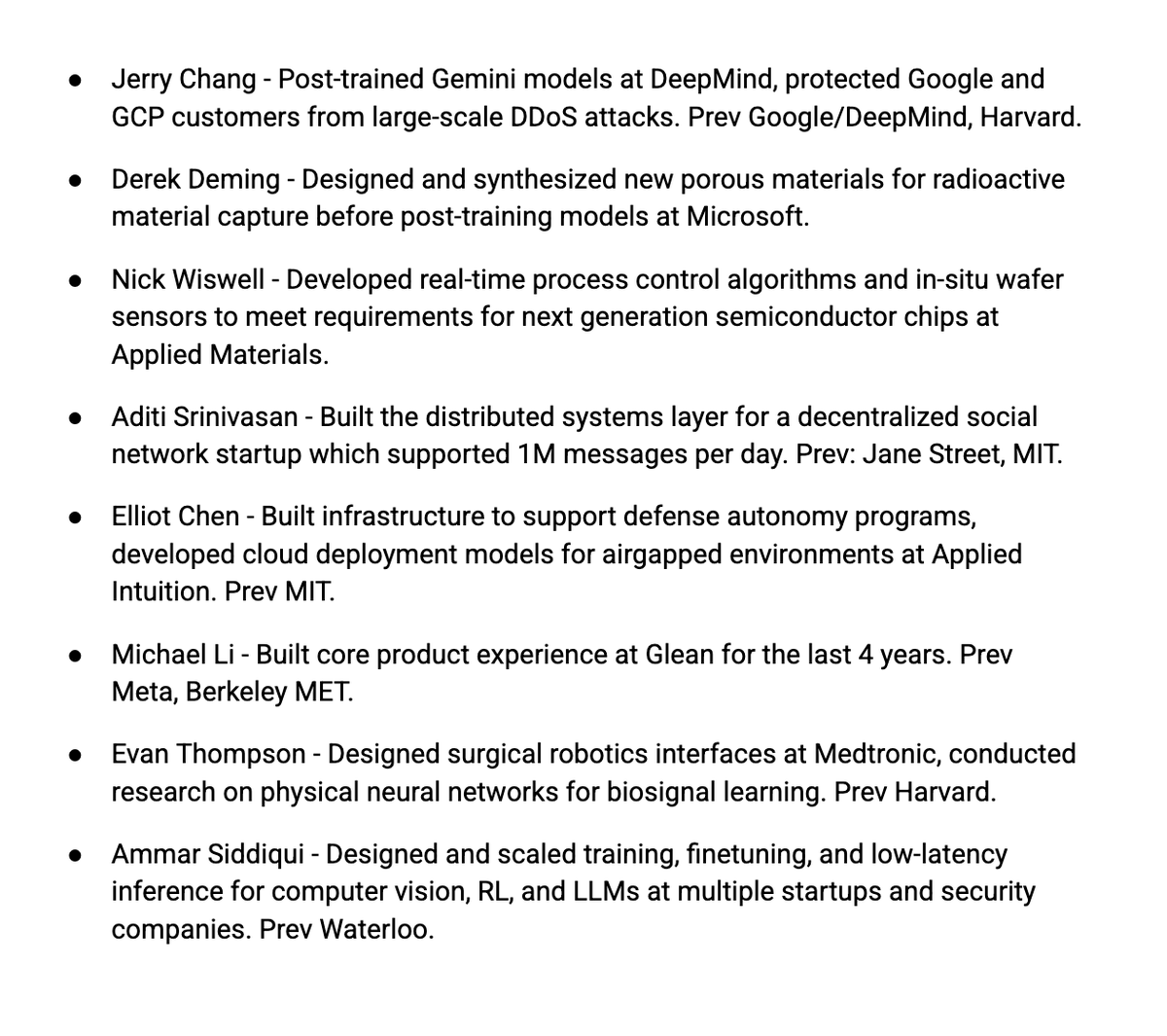
Some of Altara’s early technical team. I’m grateful to be building every day alongside incredible teammates who bring deep expertise at the intersection of AI and scientific research.
On my way to SF for @aiDotEngineer CODE, to give a talk and host the first ever Niteshift conference booth. Booth demos were a huge part of Datadog’s early GTM success (we’re an ex-Datadog founding team), because we did things a bit differently:
- Engineer staff: devs working directly on the product were the primary booth staff
- Demos, demos, demos — the whole goal of the booth was to give as many (great!) demos as possible. At one AWS re:Invent, I remember us giving 20k-30k demos out of a total of 60k for the conference in just a few days
- Demos are visually distinctive from 30 feet away and looked like nothing else on the market. Screens were oriented vertically.
- 5-8 minutes per demo, tightly scripted. Though since the engineers knew the product, we frequently went off script
- No chairs. Staff were always looking up and engaged, greeting passerby and looking eager to demo (yes, shifts were very hard work)
- Extended follow up questions handed off to an “expert” desk in the center of the booth to keep demos moving
- No one too senior to demo. Even as a VP managing hundreds of engineers (with a full schedule of customer meetings), I made time to demo every AWS re:Invent
- Integration logos: biggest objection was always “ok sick demo, but no way this will work with *my* stack” So, we had an integrations page with a wall of logos of every DB, queue, language, framework, cloud service out there (along with the actual integrations to back it up)
- Swag: everyone loved the purple Datadog t shirts. Insanely soft, so even if tech t shirts weren’t your vibe, they were great for the gym, as pajamas, or for giving to your partner. I still own about a dozen of these shirts.
At @niteshiftdev, we have to chart our own path, but the core principles remain. We’ve worked hard on our first set of booth demos and I have a suitcase full of the first ever NITESHIFT t-shirts. We are excited to share it with you all. Hit us up if you’ll be at the conference!
Transitioning dev to the cloud is as inevitable as moving production to the cloud, but it’s going to take time, and we (ie @niteshiftdev and other providers) are going to have to win users over by simply shipping a better product. Can’t expect users to move for any other reason.
Agentic AI is moving from pilot to production. What does the stack need? Microsoft AI, Nous Research and OpenRouter weigh in, moderated by Greylock's @jerrychen at Ignite.
Register: https://t.co/rEjtwU0Yah
Niteshift has always been cloud-only, which makes us a bit different than other tools out there.
Because of this focus, we’ve been able to handle the most complex environments and accelerate the work of top teams with cloud agents
Conductor Cloud users looking for alternatives have joined teams like @appliedcompute, @ListenLabs, and @ambrook in using Niteshift.
Many of you missed having a macOS app, so today we're launching Niteshift Desktop! We're also launching Campaigns for long horizon automations.
Niteshift is magically ergonomic.
It just works. Sets up your dev environment, spins up previews and verifies its own work.
The engineering done by the Niteshift team is incredible and I can't wait for you to experience it.
⚡ Quanton engine is really freakin fast. Here’s the receipt. Uber put out a blog that unpacks Quanton evaluation at production scale against OSS Spark and found it 4.7x-5.5x faster.
https://t.co/1XFhDRLFbn
More than 200,000 CPU cores power Uber’s data lake ingestion. At that scale, every efficiency gain counts.
Making better use of that compute means examining how Spark executes queries, moves data, and writes to growing tables. Accelerating one stage can leave other bottlenecks untouched.
Uber engineers are improving production workloads with native vectorized execution and evaluating new ways to accelerate write-heavy pipelines.
Explore the engineering choices behind those efforts, where the benchmarks showed gains, and what remains to be optimized.