Expect to see a lot more of this. Vibe coding, 3d printing, cheap motors, and boards (soon, after the Great Correction) WILL lead to a true cambrian explosion of robotics
Home-built robotics projects will be the new "my first weather/calendar app" entry point for "SWE" types
🚨 SUMMARY: The UK's social media ban for children from early 2027:
- "User-to-user" apps where people create, share and interact with content (e.g. TikTok, Instagram, Snapchat, YouTube, X, Facebook) will be banned for under-16s
- WhatsApp, Signal and YouTube Kids will be exempt
- Under-16s will also be banned from livestreaming, messaging strangers on gaming apps like Discord and using disappearing messages
- 16 and 17 year olds will face nightly social media curfews and limits on infinite scrolling with more details next month
- AI "romantic companion" chatbots will be banned for under-18s
- Adults can still access social media through age checks like facial recognition, digital IDs, passports and credit cards
This has a clinical name. Revenge bedtime procrastination. And the ADHD version runs on a completely different mechanism than the neurotypical one.
A neurotypical person stays up late because they want more leisure time. The ADHD brain stays up because it spent every drop of dopamine it had on executive function during the day. Sitting in meetings, managing transitions, filtering impulses, remembering the thing you were supposed to remember. That burns through dopamine the way sprinting burns through glycogen. By 10pm the tank is empty.
But here's where it gets counterintuitive. The exhaustion is physical. The dopamine deficit is neurological. Those are two separate systems. Your muscles want sleep. Your prefrontal cortex is starving for the stimulation it was denied all day because it spent 14 hours on task-switching and impulse control instead of anything that actually felt rewarding.
The phone at midnight is the brain trying to collect what it's owed. Low-effort, high-stimulation content. Scrolling, short videos, rabbit holes. The exact profile of activity that delivers dopamine without requiring the executive function you already depleted.
The sleep researchers call this a "self-regulation failure." It's closer to a debt collection. You borrowed against your own reward system to function all day. The bill comes due at midnight. And the brain will not let you sleep until it gets paid.
Just added to my Halyk Bank $HSBK position at $30.5. This week's earning shows growth is slowing but valuation remains cheap (relative to EM peers) and looks like another year of double digit dividends.
IMO risk / reward went from 'exceptional' in previous years to 'decent' in 2026. I still consider it one of the best ways to get exposure to Kazakh macro.
If you own $KSPI, $OTP, $BGEO or $TBCG - you may wish to take a look at my $HSBK thesis: https://t.co/N4c53RQW9s
how to life maxx more:
> get off your phone
> say yes to spontaneous plans even when you're tired - some of the best nights are unplanned
> talk to strangers - at coffee shops, events, literally anywhere. serendipity maxx
> make a bucket list and work your way through said bucket list!!
> stop opting for boring hangs. switch things up with your friends. try something new!!
> start a random hobby just for fun - pottery, dance, improv, cooking. not everything needs to "be productive" ok??
> be 5% more silly in your life. dance in your room, sing badly in the car, crack a bad joke. it's not that serious. grow the silly muscle
> surround yourself with people who make you feel lighter - your time and energy is precious
> don't forget the basics: move your body, get sunlight, take your vitamins, eat well, sleep
> your time to live life is happening NOW so stop saving it for later!!
get off those phones & out into the real world people!!
lets go PLAY!!!
>at the gym
>airpods in
>a woman in yoga pants approaches
>asks how many sets i have left
>take airpods out
>"sorry i'm not dating until series B"
>she asks what the fuck is wrong with me
>go home and build agentic workflows
the window for experimenting with llms has basically closed now. the megacorps have fully hit escape velocity and are shipping new products and new features daily. the shift is that they’re not just shipping llms anymore, they’re using llms to build products and improve existing ones at scale. the wild west era of llms isn’t really the wild west anymore. a year ago, this could’ve been an indie dev side project, maybe even a monetizable product. it was literally so easy that the only real bottleneck was your free time. now, whatever idea you have, you should basically assume google/anthropic/oai will build some version of it within a week and wipe out most of the startup surface area around it
There's a physicist at Stanford named Safi Bahcall who modeled this exact principle and the math is wild.
He calls it "phase transitions in human networks." When you're stationary, your probability of a lucky event is limited to your existing surface area: the people you already know, the places you already go, the ideas you've already been exposed to. Your opportunity window is fixed.
When you move, your collision rate with new nodes in a network increases nonlinearly. Double your movement (new conversations, new cities, new projects) and your probability of a serendipitous encounter doesn't double. It roughly quadruples. Because each new node connects you to their entire network, not just to them.
Richard Wiseman ran a 10-year study at the University of Hertfordshire tracking self-described "lucky" and "unlucky" people. The single biggest differentiator wasn't IQ, education, or family money. Lucky people scored significantly higher on one trait: openness to experience. They talked to strangers more, varied their routines more, and said yes to invitations at nearly twice the rate.
The "unlucky" group followed the same routes, ate at the same restaurants, and talked to the same 5 people. Their networks were closed loops. No new inputs, no new collisions.
Luck isn't random. Luck is surface area. And surface area is a function of movement.
The lobster emoji is doing more work than most people realize. Lobsters grow by shedding their shell when it gets too tight. The growth requires a period of total vulnerability. No protection, no armor, soft body exposed to the ocean.
That's the cost of movement nobody posts about. You have to be uncomfortable first. The new shell only hardens after you've already moved.
It's so over.
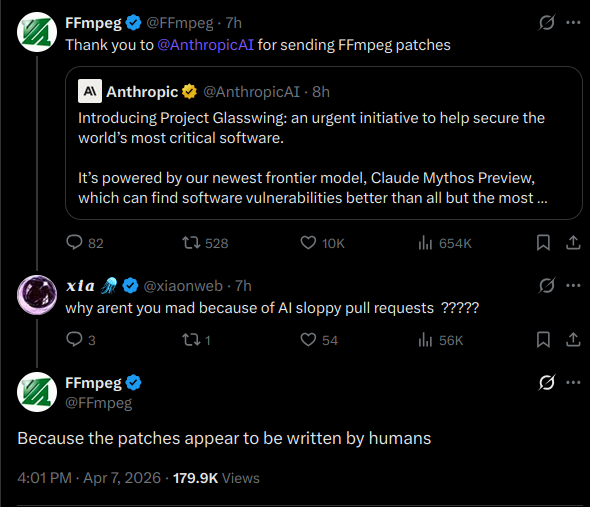
Anthropic just sent patches for FFmpeg supposedly using their latest model, Claude Mythos. The code quality is indistinguishable from top level engineers.
If these really were found and written by AI, things are about to get really weird, really fast.
Why isn't this a bigger story? It's a massive leap forward. eGPUs weren't usable with Apple silicon until now.
I just got Llama 3.2 running on my RTX 3060 connected to my M3!
Hermes Agent support by @NousResearch would be epic.
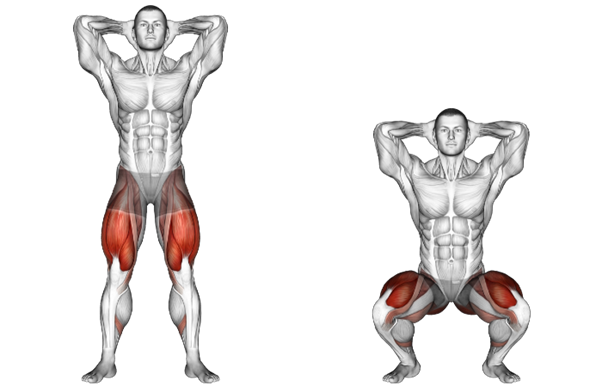
Ten squats every 45 minutes = 10,000 steps.
A study from the University of Texas found that doing just 10 squats every hour can actually control blood sugar better than going for a full 30-minute walk.
When you sit all day, your blood sugar spikes, your circulation slows, and your biggest muscles - your legs and glutes - basically switch off.
But 10 squats wakes everything up instantly.
Your leg muscles pull glucose out of your bloodstream, your circulation improves, and your metabolism switches back on.
That’s why these micro-bursts of movement deliver such powerful benefits.
In fact, research shows that ten squats every 45 minutes can give you similar cardiometabolic benefits to hitting 10,000 steps per day.
This strengthens your heart, keeps your joints moving, and prevents the dangerous blood sugar spikes that lead to insulin resistance.
So even if you don’t have time for long walks or full workouts, stand up…
Do 10 squats every 45 minutes and watch what happens to your energy, strength, and metabolic health.
Obsidian is weird:
- 7 full-time employees
- ~1 million users per employee
- fully remote
- 1 in-person meetup per year
- no scheduled meetings
- no stand-ups
- deep focus is prioritized
- our manifesto guides our product
What works for us may not work for you.