likes computer vision, anime, genetics, machine learning.
got a lot of ingenious ideas, just need someone with talent to implement them
my philosophy is simula
The sexual division of labour regarding house construction shows a very consistent pattern cross-culturally: women usually construct the shelters in nomadic societies, while in sedentary societies men do it.
But what about STIs?
People overestimate the prevalence of STIs*. This is the percentage of people by race who have Chlamydia, Gonorrhea or Syphilis in a given year.
For example, you'd have to have unprotected sex with 140 random white people in a year to have a 10% chance of contracting chlamydia.
The data for education isn't as good, but people with college degrees have very low STI rates.
Thus, people who have mostly protected sex with lots of other educated people have extremely low STI rates. I know many people with body counts in the hundreds who have never had a sexually transmitted infection.
*so they can moralize more effectively
Scaling laws describe how loss changes with scale. Do neurons inside models change predictably too?
We study vision and language models up to 30B params and find systematic scaling in neuron universality, specialization, and selectivity.
Paper+code: https://t.co/1f1mQGnnZ4
1/n
Please enjoy the my recent podcast appearance on About Logic with Deniz and Thorsten. We got into so many different philosophical issues in the foundations of mathematics, with a few pointed disagreements. https://t.co/CTLZlsY57b
Jeff Bezos reveals the simple phrase that saved him countless arguments running Amazon
"Disagree and commit is a really important principle that saves a lot of arguing"
"One of my direct reports would want to do something. I'd think it was a bad idea. We'd go back and forth and I'd often say, you know what, I don't think you're right, but I'm going to gamble with you"
"You're closer to the ground truth than I am. I've known you for 20 years, you have great judgment"
"At least then you've made a decision and I'm agreeing to commit to that decision. I'm not going to be second guessing it, sniping at it, or saying I told you so"
"I'm going to try actively to help make sure it works. That's a really important teammate behavior"
Our internal data shows Claude is accelerating AI development—a possible path to recursive self-improvement, or AI autonomously building a more capable successor.
It’s happening faster than we thought, and the implications deserve greater attention. https://t.co/OVVPJO7VQx
I am an illusionist about phenomenal binding, I do not believe humans have bound phenomena above and beyond functional binding
What would change my view: Evidence that humans report phenomenal unity *because of* ontic unity e.g. unified physical fields
https://t.co/Jxf3upw0Nq
[1/7] Recent breakthroughs in LLMs’ mathematical ability are genuinely surprising.
I recently solved a problem I had been unable to solve for seven years: the optimal acceleration rate for first-order methods under high-order smoothness assumptions in nonconvex optimization.
Very excited to share our interview with @polynoamial on AI for math — the Erdős unit distance problem, saturating the IMO, the future of math research, and more!
You can love someone’s face, but you can’t build a life on a vibe.
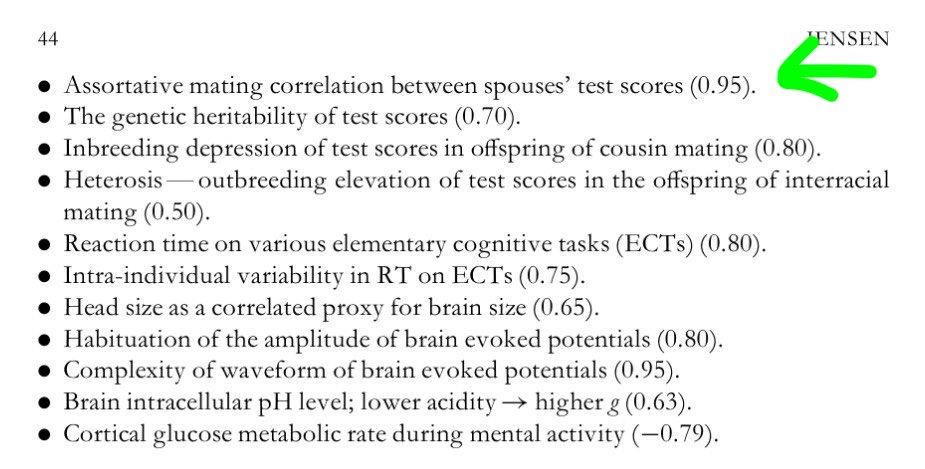
Decades of meta-analyses tracking real marriages prove that the single strongest anchor between partners is intelligence. Every other trait falls behind:
Intelligence (r = 0.45)
Physical Attractiveness (r = 0.25)
Height (r = 0.20)
Personality (r = 0.15)
(Vandenberg, Jensen, Plomin et al.)
Because verbal intelligence is the most socially visible component of general intelligence, it drives a good-sized portion of this 0.45 correlation. A woman evaluates his syntax, his vocabulary, and his ability to track complex nuance. Verbal fluency is the actual vehicle for the communication loop.
Without that baseline symmetry, the conceptual gap becomes too wide to bridge, and the attraction naturally starves.
In a famous study on mate preferences by Kenrick et al., participants were asked to state the minimum percentile of intelligence they would require in a partner for various levels of a relationship.
• For a casual date, both men and women required a partner to be of average intelligence (around the 50th percentile).
• For a steady dating partner or spouse, women’s minimum requirements spiked significantly higher than men’s, demanding a partner in the 60th to 70th percentile of intelligence minimum.
• When a woman is herself in the 90th percentile or above (an IQ of 120+), her minimum required percentile shifts proportionally upward to ensure the partner remains an intellectual peer.
Rare variant study of blood lipids (>1 million people) generalizes well across ancestry groups (r²~0.9), suggesting that rare variants aren't affected by the same portability issues as PRS.
https://t.co/SMlxlazGtV
Simple input-output dependencies explain neuronal activity (
@ChrisWLynn
) has made the rounds on X with divided opinions. I show in this blog that while neurons are described simply, so can explicitly complex units: Describe and Arise are distinct claims. https://t.co/S1zgyAzorN
There's been a lot of discourse surrounding my recent Nature Physics paper, to varying degrees of accuracy. Let me clarify the central conclusions and what I think they tell us about the brain
1/
https://t.co/vQtYVe94Ao
Several papers have used the Children of the National Longitudinal Study of Youth and found a massive increase in kids' IQs between 1973 and 2004.
But this is actually fake.
It only shows up because more educated, smarter, better-off mothers had kids later in the study.
Herasight have invented a new type of preimplantation genetic testing, PGT-H.
By selecting the embryo with lowest level of homozygosity, PGT-H can reduce the risk of abnormalities, intellectual disability, and infant death in offspring from consanguineous unions.
Interesting!
Remote work increased alone time and seems to have increased mental distress, perhaps in the process.
A piece of evidence that this is due to loneliness is that, among people with families, remote work seems to have been fine.
John Collison: We only had 50 users two years after founding Stripe
“We started working on Stripe in the Fall of 2009, and we launched Stripe in September 2011,” John Collison reflects. “I remember right at the beginning when we were starting it I said to Patrick [Collison], ‘Yeah let’s do it. How hard can it be?’ Which gives you a sense of our mindset. And the answer was: two years of difficulty. We had not predicted that.”
John remembers feeling dejected when Stripe only had 50 users two years later:
“When you spend two years getting 50 users, it doesn’t feel like a whole lot of progress. It feels like things are going pretty slow.”
But this is one of the challenges of startups, he argues:
“If you’re working on a startup that’s a bad idea, it’s going to feel like slow-going. But if you’re working on a startup that’s a good idea, it may feel like slow-going too.”
Yet slow growth has a silver lining:
“I think the thing that allowed us to take off in the subsequent years was the fact that since we were spending so much time on each one of those users; since we were hyper-focused on building a great product; and since we weren’t dealing with problems of scale yet, that allowed us to build the product that we wanted. Part of the culture that set in really early on was taking abnormally good care of those early users.”
The Stripe founders would get an email or phone call anytime a user ran into a bug. When they sent the customer an email moments later alerting them that the bug was now fixed, people’s minds were blown.
They set up a Campfire room that any customer could join and use to message John and Patrick at any hour of the day or night. And if a user was based in the Bay Area, the founders would invite them to come by the office and help integrate Stripe for them.
In the Stripe dashboard they would prompt their customers for feedback and feature requests. Then the Stripe founders would reply to that feedback within 10 minutes.
“What this meant was that even though the user growth was happening quite slowly in the early days,” John explains, “it actually had a pretty surprising viral effect where people had a good experience, they told their friends about it, and we were able to spread entirely through word-of-mouth even to this day.”
A few months ago, a high profile paper in Science claimed to find that researchers' ideology produced biased results in favour of immigration.
A reanalysis of the data finds that result came from a coding error, which once corrected, shows no effect.
Will people who shared that original finding update their views?
https://t.co/pSuAZ26pqe