We have created a micro-site for Messy Jobs, at https://t.co/6kQuA00d8Y, were you can find Part I of the book in open access, and an experimental feature, that we will be enriching with data, helping you determine how "Messy" your job is.
Enjoy!
https://t.co/hpcabDIKrk
Delighted to tell you that Messy Jobs is coming out on June 21st. The kindle preorder link is available!
Here are advance reviews/blurbs for you to ponder by @raffasadun@davidautor@patrickc@alexolegimas@bengtmit and Evan Guo.
"Messy Jobs is a brilliant application of price theory. AI changes what is scarce in the economy and therefore what is valuable. When intelligence becomes cheap, judgment, coordination, trust, and responsibility become more valuable. The authors use this simple, powerful logic to illuminate how AI will reshape work and organizations." Bengt Holmström, Paul A. Samuelson Professor of Economics at MIT and recipient of the 2016 Nobel Memorial Prize in Economic Sciences
"In Messy Jobs, Garicano, Li, and Wu bring the discipline of organizational economics to a question too often left to speculation: How will AI actually reshape work? They move past the usual debates about what AI can or cannot do and ask the harder questions. What shapes the incentives to adopt it? How does adoption reshape the incentives to learn? What new configuration of skills will emerge as AI advances? A rigorous, original, and engaging account of how AI will reshape organizations and labor markets, and what it will take to thrive in them." - Raffaella Sadun, Charles Edward Wilson Professor of Business Administration, Harvard Business School
"This is the first book in the AI era that recognizes that most of what organizations struggle with does not involve computational problems. People in messy jobs must hold coalitions together, adjudicate between competing interests, and make change stick. These are political, diplomatic, and interpersonal challenges. As a result, these types of messy jobs will persist well into our AI future. Garicano, Li, and Wu, are neither techno-utopian nor techno-dystopian. They take seriously what machines can do, what humans will do, and how jobs will be rebundled. The economics analysis is lucid and penetrating, and the book pinpoints where human agency will remain paramount. The book is hopeful and practical for anyone charting a career in the coming decade." - David Autor, Daniel (1972) and Gail Rubinfeld Professor, Google Technology and Society Visiting Fellow, Margaret MacVicar Faculty Fellow, MIT Department of Economics
"This is simply a must-read book if you are interested in the future of work in the age of AI. For decades, Luis Garicano has been a leading voice in how organizations morph and change with new technology and innovation. Together with Jin Li and Yanhui Wu, they have written the definitive text on how AI will affect the labor market. The book is an impressive feat of combining academic rigor with clear explanations and concrete examples. I would recommend this book to anyone interested in learning about what comes next. "- Alex Imas, director of AGI Economics, Google DeepMind, and the Roger L. and Rachel M. Goetz Professor of Behavioral Science, Economics, and Applied AI, and Vasilou Faculty Scholar at the University of Chicago Booth School of Business
"There is a lot of woolly thinking on the topic of AI and jobs. This excellent book contains by far the most thoughtful and economically literate account that has yet been written." - Patrick Collison, CEO, Stripe
"AI is not going to lead to mass unemployment, and this is the best book to explain why not. It also illuminates how labor markets are likely to evolve. It is short, to the point, eminently readable, and of extreme relevance. ""- Tyler Cowen, professor of economics at George Mason University
"This book isn't just some economist's armchair theorizing; it's a practical guide. I hope you get as much out of it as I did. "-- Evan Guo, CEO of Zhaopin Group, the largest career development platform in China
https://t.co/L7UM3bHHYO
El @cbamadrid lleva décadas siendo la sede por excelencia en Madrid del contraste real de ideas sobre los asuntos que realmente importan.
La vivienda no iba a ser una excepción.
Este miércoles vamos a debatir a fondo con @Gil_JavierGil.
Nos moderará @JL_Aranda.
Venid.
Famously (there is a beautiful Works in Progress piece on this) in 2016, Geoffrey Hinton told an audience in Toronto that medical schools should stop training radiologists, since AI would soon outperform them at reading scans. Ten years later, there are more radiologists than ever, and they earn more than they did then.
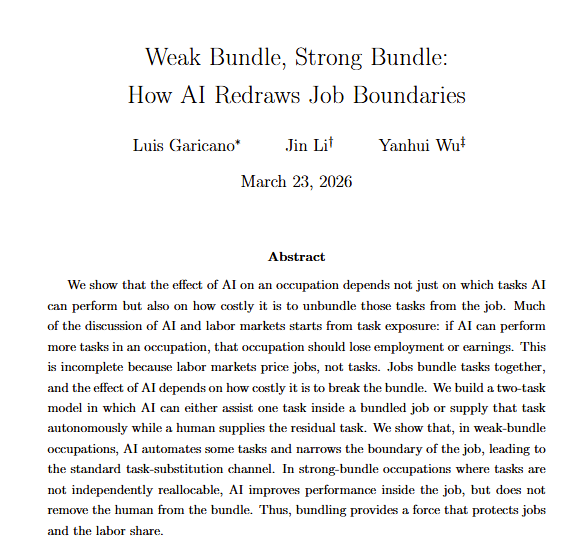
Hinton was right about the task, but he was wrong (so far!) on the future of the radiology profession. Times have never been better for them. The gap between those two claims, the difference between tasks and jobs, is the subject of a paper I have written with Jin Li and Yanhui Wu, and that we release today: "Weak Bundle, Strong Bundle: How AI Redraws Job Boundaries." (Very relatedly we are also finishing the first draft of our book "Messy Jobs" on AI and Jobs!! You will be the first to hear).
We start from the observation that the growing literature on AI and labor markets measures the AI shock by task exposure: people count how many tasks AI can perform in a given occupation AI can perform, and infer that more exposure means more displacement. Eloundou et al. published a paper in Science in 2024 that started this literature, and many follow the same logic. The inference they make is that the more exposed tasks, the worse the outcomes.
This is incomplete, because labor markets price jobs, not tasks. A radiologist does not just sell image classification, but does many other jobs: triages cases, communicates with other physicians, trains residents, makes the difficult decisions, and signs a diagnosis. The market buys a bundled service. The question AI poses is not whether it can do one task inside the bundle. The question is whether that task can be pulled out.
Thread (1/3)
https://t.co/wEYMfjGbeX
Nada es Gratis echa la persiana. Infinitas gracias por las millones de horas de iluminadoras lecturas a varias generaciones de economistas @nadaesgratis https://t.co/8E0iCCqIjE
¿Cuánto se ha reducido la brecha salarial de género en España y por qué persiste?
Lo responde el análisis que hicieron @claudiahupkau y Jimena Contreras para @EsadeEcPol con datos de la Encuesta de Estructura Salarial (2010-2022) 🧵
No es fácil explicar lo importante que fue @nadaesgratis. Para toda una generación de científicos sociales de este país, sobre todo si eras estudiante en universidad lejos de “donde todo sucedía”, encontrarnos esto en el internet de 2009 fue a la vez faro y linterna. Linterna, porque aquellas piezas nos iluminaba maneras de entender mejor los problemas que tanto nos preocupaban: estallido de la burbuja, mercado laboral segmentado, precariedad, desigualdades, crisis de deuda... Todo por lo que estaba pasando España. Y faro porque al hacerlo nos señalaban que había un camino a seguir si queríamos contribuir. Aún hoy intentamos seguirlo.
Lo que puede hacer un blog bien escrito por gente que se lo toma en serio. A veces cambia carreras. Y a veces se atreve a intentar mejorar un país.
https://t.co/LCvZyanG09
¿SIRVE REDUCIR EL TAMAÑO DE CLASE EN ESPAÑA?
Reducir el tamaño de las clases es una de las políticas educativas más populares que existen. Pero, ¿qué efectos tiene realmente? Dentro análisis de @jmontalbancas en @esadeecpol 👇
🔬 Qué encuentra el estudio
Reducir cinco alumnos por aula sí mejora algo el clima de clase: baja 4 puntos la probabilidad de disrupción grave y aumenta ligeramente la enseñanza personalizada.
Pero esas mejoras no se traducen ni en rendimiento en pruebas estandarizadas, ni en repetición, ni en bienestar del alumnado.
Esto se sostiene en todos los subgrupos analizados: nivel socioeconómico, tipo de centro, perfil docente, materia, curso. No hay "bolsas ocultas" de impacto positivo.
🟢 ¿Hay efectos positivos?
Sí. Según este mismo análisis, los docentes (equivale a unos 1.800€ anuales de mejora salarial implícita en bienestar) y las familias (más satisfechas con la escuela). Beneficios reales y legítimos, pero que quizás no corresponden al objetivo declarado de la política.
Quizás esto ayuda a entender por qué la política es tan popular, en cualquier caso.
🤔 Entonces, ¿qué hacemos?
Reducir ratios cuesta mucho: el 70-80% del gasto educativo son salarios. Más aulas, más profesores. Y mientras ese dinero se destina a reducir de 28 a 23 alumnos por clase con impacto casi nulo, otras intervenciones con evidencia sólida (tutorías intensivas, formación y selección docente, programas de atención temprana) quedan infra-financiadas.
Ojo. ¿Hay algún caso en que las ratios más bajas tengan sentido? Sí, pero acotado: en centros con alta conflictividad y combinado con prácticas pedagógicas que amplifiquen el efecto.
📝 Una nota final, que no debería ser opcional
Estudios como este son fundamentales. No porque siempre confirmen lo que queremos escuchar, sino exactamente porque no lo hacen.
En un contexto de presión fiscal creciente y caída de la natalidad, España no debería permitirse destinar recursos escasos a políticas que tienen alternativas mejores enfrente. Necesitamos más evaluación rigurosa, más microdatos enlazados, más voluntad institucional de publicar resultados incómodos.
Sin eso, la política educativa seguirá estando expuesta a convertirse demasiadas veces en gestión de preferencias adultas disfrazada de interés por el alumnado.
🚨JOB ALERT 🚨 we are working on a super beautiful experimental project on AI and education with the Roma community in Spain with my amazing co-authors @Lnavarrosola and @LuciaCobreros
I’m copying below the ToR for the RA position focused on web scrapping and text anaysis.
🤗 Please apply and share with anyone who might be interested! 🙌🏻
🦾 Hoy mi querido @sancheztrinanes escribe un excelente texto sobre el impacto de la tecnología en el aprendizaje.
🧠 Existe ya abundante evidencia (también causal) de los efectos nocivos de los móviles y redes sociales en la educación de los niños y adolescentes. Es buena noticia que gobiernos como el de España estén tomando medidas al respecto. Se ha convertido en un problema ya no solo educativo, sino también de salud pública.
💡Pero, como dice Abel, la tecnología también puede ser una gran aliada si se usa bien: debe servir para reforzar y complementar el insustituible trabajo de los maestros.
🚀Con Abel al frente llevamos más de un año trabajando en #MaestrIA, una start-up de refuerzo educativo con esa idea en el centro. Pronto podremos compartir más.
Cómo la tecnología afecta al aprendizaje de los niños
https://t.co/qFEXrUjjPK
10 cosas que hacen las escuelas con mejores resultados de los esperados: “Tratamos de sacar el máximo de unos recursos limitados”
https://t.co/Dv0MaYt5UE
Mario Draghi: «L'Europa ha molti nemici, forse più che mai, sia interni che esterni. Per preservarla, gli europei devono essere più uniti che mai. Dobbiamo superare le nostre debolezze autoinflitte. E dobbiamo diventare più forti: militarmente, economicamente e politicamente».
Este texto de @and_rizzi debería ser el próximo programa electoral de todos los partidos demócratas y liberales que quedan en Europa.
https://t.co/pn3qNE0hbP
🚀 ¡Estamos contratando! Buscamos analista de investigación con ganas de hacer economía aplicada que impacte realmente en el debate y las decisiones sobre política pública.
¡Vente! 👉 https://t.co/8G3ZdmRF4J
You know things are bad when the most boring person doing the most boring job for decades has to come out and say, “Stop trying to arrest us for doing math”
Asumo la dirección de @EsadeEcPol.
Desde el primer día, un objetivo: aportar evidencia a las decisiones de política pública que más afectan la vida de la gente. Convertirla en impacto. Que sirva.
Hoy esto me parece más necesario que nunca. Porque necesitamos:
→ Políticas para un crecimiento que realmente desbloquee oportunidades
→ Datos útiles para quien de verdad quiera entender los problemas y escoger mejores soluciones
→ Luz y rigor en un debate público oscurecido
Lo haremos con el excepcional equipo que hace esto posible, construyendo sobre lo que @toniroldanm inició.
Vamos allá 🚀
@toniroldanm, gracias por abrirnos la puerta. Por confiar. Por crear un espacio donde aprender y crecer. EsadeEcPol vuela, sí. Pero vuela porque alguien le enseñó a hacerlo ;)
Suerte en lo que venga. Y gracias, de verdad.
Cuando llegué a @EsadeEcPol no sabía bien lo que me esperaba. Ahora, viendo este video, lo entiendo: un proyecto que te exige todo, pero que te devuelve mucho más.