On December 29th, an S-4 amendment for the Ethena DAT was filed. It’s a bit of a depressing read, since it serves as a reminder that this thing will de-SPAC with unrealized losses on all of its ENA (much of which vests over several years), despite being given 30% discount at the time of the token purchase agreements.
The DAT also has not yet secured approval for listing on Nasdaq or another national securities exchange. This is a condition for closing to occur unless waived.
The CEO of the SPAC is expected to continue as either CEO or CFO of the new DAT. He was previously the CFO at Celsius 2019-2020 (not mentioned in his background on p186)
We also have confirmation that Guy Young is expected to own 5.5-5.6% of the Class A shares (not including his participation in the PIPE), Ethena entities own around 13% (inclusive of participation in the PIPE).
Class B shares, which have the voting power, will be controlled by Ethena (65.3-65.4% ownership), which confirms Ethena will have control over the DAT. For the avoidance of doubt, the DAT is prohibited from launching a token.
Moving to the financial information in the filing, I think Ethena will come to regret having its DAT so closely related to Ethena Foundation and Ethena OpCo. Beginning life with unrealized losses on the ENA is only going to make them wish harder they had structured this DAT with a better understanding of rules around GAAP valuations on crypto.
The filing seems to confirm that accounting statements are almost guaranteeing poor GAAP book value growth once audited statements are required post de-SPAC. Accounting Note 4(C) states digital assets value “reflects the fair value of the ENA tokens...” continuing with “…has therefore valued the ENA tokens as of December 22, 2025…”
Unfortunately for the DAT, they will NOT be able to use fair value and shouldn’t be using them now. GAAP generally only allows for fair value accounting of crypto under specific circumstances, which this DAT seems like it will obviously be unable to meet, due to the DAT’s close affiliation with the token issuers. They likely need to use cost-less-impairment, which means accounting value can only go down and not up.
For now, this valuation (~20 cents) won’t cause problems because it’s basically the bottom price since holding. But the DAT will have to continue to carry these tokens at the low price even if ENA 10x’d.
Let’s also think about how the can justify carrying these years-locked tokens at market value even if they could use fair value 🤔
With an estimated net loss per share of $0.41 for 2025, the DAT will feel the impact of not being allowed to show gains if ENA price recovers. They’ll need to work hard to broadcast nonstandard accounting metrics to a retail audience (like Saylor does with mNAV), but that’s easier said than done because you need to convince your prospective investors that GAAP isn’t actually a good way to view your company.
In all fairness, the Ethena DAT is probably not the only one to have skimmed over the accounting relief for crypto, but this is why you don’t want token issuers involved in the DAT — you get worse accounting treatment!
The Event Isn’t the Edge, Positioning Is
A follow-up post on the recent ideas around how markets front-run expectations and why trades often die on delivery.
Markets don’t move on reality; they move on expectation vs. reality. When something is obvious, it’s already priced in. The trade has already happened.
Short-term players bid up catalysts in advance, assuming flawless execution and instant impact. But markets price forward - so when the event arrives, it’s rarely good enough. Even meeting expectations can lead to a markdown.
This is why Buy the Rumor, Sell the News works - unless the news beats expectations or positioning is caught offside.
---
Why It Happens
1. Everyone Prices in the Event Ahead of Time
- The earlier you hear about a catalyst, the earlier smart money has positioned.
- By the time retail is piling in, early buyers are already looking for exits.
- Liquidity moves first, price follows. By the time the event happens, the move is exhausted.
2. The Market Wants Surprise, Not Just Execution
- The market doesn’t just reward good news - it rewards unexpected news.
- If an event is fully priced in, even meeting expectations leads to a sell-off.
- The sharper the pre-event run-up, the less room there is for surprise.
- If positioning is crowded, everyone is already long → no one left to buy.
3. Short-Term Players Price to Perfection
- Shorter-term events get priced in faster - traders rush in early, bidding up the move before it even develops.
- Impatience and FOMO accelerate positioning, especially in high-beta assets where speed matters.
- Reflexive feedback loop - people buy because they expect others to buy, but once positioning is saturated, there’s no one left to push it higher.
- When positioning is too one-sided, risk skews down. If everyone expects the same outcome, even a neutral result can trigger a sell-off.
- Even strong events can fail to move price—not because the news is bad, but because the move already happened ahead of time.
- Any sign of delays, weakness, or even “as expected” results → instant markdown as traders exit en masse.
Short-term trades often peak before the event itself. Not because the event is bad, but because markets move first - traders don’t wait for confirmation, they exit before the crowd.
---
How to Trade This for Best R/R
1. Think Through Outcomes in Advance
- What’s already priced in?
- What needs to happen for this to actually move?
- Where does money rotate next?
Before placing a trade, map out:
- Best case → What’s the upside if the catalyst plays out?
- Base case → What’s the most likely reaction?
- Worst case → If expectations are too high, where’s the risk?
The best setups come when positioning is misaligned with reality.
2. Position Early, Exit Before the Herd
- The best risk-reward is before an event becomes consensus.
- If something is widely expected, the trade is already over.
- If an event is crowded, fading it is often higher EV than playing it.
3. Second-Order Thinking – What Trades Flow From This?
- If everyone expects "Buy the Rumor, Sell the News," what happens next?
- Early players start front-running the sellers.
- Rotation trades emerge. Where’s capital moving next?
- If positioning is too one-sided, a real squeeze can emerge.
Trading events is about knowing what’s priced in and positioning where expectations haven’t fully adjusted yet.
@Deebs_DeFi add filter Total Transfers for wallets. To exclude bots that make 1000 txs per day
Or total tokens traded, to exclude scalper bots.
add filter Date Last token bought (or minimum sol balance) - to exclude abandoned wallets.
and let me in, ofc.thnx
*apologies for the mega tweet, each section was too big to fit into like the replies at the bottom lmao idk, formatting may be shit too :( *
-----------------------------------------------------------
so, some thoughts about the recent trading competition where i turned $2,000 - $775,000 in 20 days, on eth, using only @bananagun, and did half of it using just my phone (as my pc was broken halfway through).
figured the timing to share was rather good as eth is seeing a bit of downtime as other chains have taken the spotlight in recent weeks. gives times to practice on eth while it's rather quiet and there aren't constant deploys, so you can align yourself for the future when mania picks up again. if you'd like to have some more thoughts about how i trade and my general mindset, consider checking out the banana ama i did a couple days ago here: https://t.co/Hxox1cnnWx (you'll still need 10 banana for access)
i will preface it by saying this, even though it is known, a lot of the "flex" posts you see on twitter are people w/ ulterior motives, and are not always legitimate, always observe what you see on here and consider why they are sharing what they share.
contest wallet for legitimacy where all trades can be seen: https://t.co/IuboQcefdy
below i'll cover the following points briefly, by no means in-depth, and assumes a roughly basic understanding of the space (it's by no means alpha either, it's rather basic, but it's focused towards people just starting out really):
- my essential tools
- general vetting process
- toughest sections during the competition
- mistakes / edges
- couple simple trade examples
- couple xtra thoughts
-----------------------------------------------------------
essential tools:
- bananagun, obviously: https://t.co/iIFCbbEA1y. don't need a reflink shill, but i suggest you use it to simply stay competitive on eth. people have gotten a lot better, faster, smarter over the last few months, you need every edge you can get. fiddling with the uniswap ui is not the way, losing bundles by sitting on maestro isn't the way either. when the meta changes you need to adapt with it and banana is on top atm. in the ama i covered a few settings that i use, but i also suggest reading into the documentation as well and understanding it. the medium via which you trade is the most important thing to start off with imo.
- twitter: most people fundamentally don't use twitter effectively as a tool for trading. they follow ct influencers who shill things after loading up, doomscroll shitposts on their tl at 1am, base their trading theses on what internet anons with their own motives say about coins that they are holding. my suggestions: utilize lists well, group every project you're invested in, or wish to invest in the future into a list and check for changes and react to them first. when you notice a narrative that you're late to and did well - go back on twitter, check the accounts that started sharing it first, put them into your list of traders you need to follow. often your success in this space is gated by the build-up of micro-bouts of laziness in your workflow that degrades your edge over time, sometimes taking that little bit of effort is worth it.
- new contracts checker / new pair checker: during the competition, i was checking 95%+ of new contracts that deployed on eth while i was awake and active, same for new pairs. this is generally manageable on eth where the gas fees are a bit higher compared to other chains and the deploys are less common. for instance this type of playstyle would not work on SOL due to the sheer number of coins that launch every hour. eth still favours the hunter. i prefer to buy things post-launch after vetting buyers and volume, other people prefer to set up banana snipes after vetting a contract and socials, it depends on the individual and their level of comfort really
- a way to track volume: this is for charts that come flying out the gate with immediate volume and no info, scouting out reversals on older charts that have died for a while (for ex. syncus), or charts that recently had a lot of volume and died out, but started to pick up steam - you could use something like dexscreener volume trends on a 5m timeframe, or something like yardtools (not free and also takes some time to tweak to your own preference)
- a wallet tracker: this is for a few reasons, such as back-tracking wallets that bought in early in the current coins that are running, or for tracking the movements of the top wallets with a large supply in coins that you're already holding, or tracking the activity of dev wallets that haven't yet launched and watching their movements.
- a launch simulator: this is for those who want to snipe and want to figure out how to prepare for it, for things such as deadblocks, tax, max wallet, etc ahead of time. doesn't work all the time but it's a good start, a good one is otto: https://t.co/Hqmg9j0XwE (free) (also does checksums)
- copyscape/who.is: for checking if a website is stolen/checking the registry dates of the website for when you need to research the legitimacy of a project.
these are generally all the essentials you need for hunting onchain!
-----------------------------------------------------------
general vetting process:
ill keep this relatively short --
- checksums are very important to look out for rugs, although they aren't the be-all and end-all, but help you to filter the most blatant scams. understanding how checksums work would also be beneficial. https://t.co/M0qfDFe9ip (free) is a nice bot for looking out for bad checksums pre-launch and also price-checking post-launch. @discobot3 is also rather good for checking the differences in lines of code between a given contract and the closest similar contract, given that it is verified.
- using copyscape from above to check if a website is stolen, etc. a lot of scammers operate in "rug rings", and all it takes is a bit of pattern recognition after a while to understand who is behind it. for instance there are a ring of utility scammers that always launch coins related to some sort of lp farming utility, with stolen websites, a couple times every day
- intuition from long term experience grinding through coins that rug. after you get rugged on a new coin, try to understand why/how you got rugged, and how you would avoid getting rugged in a certain way in the future, as well as any warning signs you may have missed
-----------------------------------------------------------
toughest sections during the competition:
there were two sections i found tough during the competition:
- the beginning (1-10 eth): this is where trades were the most stressful for sure, simply because gas/bribe cost was a legitimate portfolio hit rather than just a cost of trade, few pieces of advice if ur below 5e and grinding:
keep trade size low, very low. i'd say 5% max per trade. you want to be hitting shitters early (sub 50-100k max) and flipping for your initials asap, around 2-4x. if the project looks like it has potential, then scale out slowly with what you have left. when you're trading at small size, 10k-100k mcap is the same as 100k-1m mcap for your port, only that it takes a lot less in buy pressure to get the same effect for your bags. one thing you may notice when perusing my trades on the competition wallet is just how much scalping i did until i had a comfortable trading port.
- the end (300+ eth, partly unrealized pnl): biggest issue here was knowing which bags to trim/sell completely and which still had an upwards trajectory. to do this you need to forecast upcoming metas and predict how that would affect your bags (this was before brc-related tokens really took off, and affected some of those holdings, but i won't dive any deeper into that)
-----------------------------------------------------------
biggest mistake during competition:
i'll just copy this one straight from the ama:
"Oh. That's an easy one.
I was swinging the Froge bottom with 2E, I think I made like 0.35E in total. It then proceeded to do like a straight 100x from where I sold, and I was too annoyed to buy back in the entire time it was going up. At the top it was like worth 750K or something.
The mistake? Impatience, especially when the narrative was rather good (OpenAI mascot), and there weren't many 'Froge' contracts doing well at the time.
That's another thing. For narrative plays, it's not enough to check new pairs, often the right play is a bottomed coin that is already existing that follows the following criteria:
1. 0 tax
2. Burned LP
3. Obviously needs to match the name.
As an example, if Elon were to tweet Froge, your first thought should always to be to immediately rush and buy an existing coin, rather than gamble your NW away on fresh farmers waiting to take your money." (check out the rest of the ama for more context etc.)"
but basically, impatience is the biggest mistake you can have in this market once you have a comfortable port. often waiting just that extra hour or day is all you need, especially after you've secured your initial holdings.
biggest edge?
mainly just experience. knowing exactly what to do/check when i see 30+ buyers on a new coin i have no information about, and deciding on it in seconds, getting into a habit/flow of understanding patterns that ruggers tend to use, being in established groups with people who work as hard if not harder than myself (this is not to say that it is not possible to trade alone, you simply are more prone to missing things. 1 person cannot do it all). understanding narratives behind volume spikes on different coins and knowing when to buy/not to buy. experience comes with time and effort, autopiloting only creates bad habits and causes you money in the long run, being strict with yourself is extremely beneficial.
-----------------------------------------------------------
- couple simple trade examples:
touching on some things previously mentioned, some may ask "well this is cool and all, but how do i actually find a good project below x marketcap and buy it?", well, the good news is a lot of the time you don't have to, as you can simply follow better wallets into a trade. the lower your bankroll, the harder it is to compete in snipes, so my suggestion is for post-launch buys. the general meta on eth ebbs and flows between tax (3/3-5/5) utility coins and low/zero tax meme coins. we're sitting generally in a utility meta and that's where a lot of reversals tend to be easy to pick up.
what constitutes a "better" wallet:
- good wr on the coins that they buy (generally profitable)
- does not buy many coins (aka not really a degen)
- on average buys good coins instead of poor performers
- tends to hold things instead of flipping
for example, i will show two random wallets, one belonging to a degen, and one thats "better" - to drive home the point of who you'd prefer to see buying your coins early:
https://t.co/Wn3BOPsRUs
vs
https://t.co/ZH1YIa96UJ
when you identify a trend of good wallets buying the lows of a coin, you simply join in with them and track their movements. often there's an initial reversal candle of a coin where you can secure your initials and simply ride the rest up after. i've included the charts of 3 coins just from the last week where it was easy to buy the dip if you either paid attention to the buyers or simply interacted with the project socials after the initial dip. majority of the profit i made was actually from dcaing or buying coins during these dips or reversals.
https://t.co/okugd9RK7T (hrzn)
https://t.co/bd5XDlU41T (tpad)
https://t.co/WPInytcCbX (4096)
-----------------------------------------------------------
couple xtra thoughts:
- shitcoining on eth has been extra difficult/pvp since the competition ended, mainly due to liquidity fragmentation across all chains primarily. thus at the moment it's generally more profitable to trade on chains like sol/avax when you're on a low-med bankroll. however this won't always be the case, and it's important to train your trading skills across various areas. sidechaining is a weakness of mine that i've been working on and frankly sidelined myself to a lot of the strong runners on other chains simply due to laziness. (bonk/coq/ninja, etc.) always trade to your strength but don't become too set in your ways when the tide changes, it is always better to be profitable than to be right.
- dealing with tilt is never easy when you're on a losing streak. identify how you react to tilt and try to mitigate the effects as much as possible. personally when i hit a losing streak i tend to just blindly fire at coins and burn a bunch of $, taking a few deep breaths and focusing again tends to help. for some it may be taking a walk, for others taking a break, find your flow.
- comparison is the thief of joy, rather use the success of others as motivation
- the experience i got came with thousands of hours of going through contracts, trading and refining my workflow, it takes a lot of time and effort to reach a level where it is second nature to you, but the space has also advanced to the point where you no longer need to spend thousands of hours to be relatively competitive. bots help.
- and lastly, it's always good to believe in yourself first and foremost. manifest success in the space for yourself!
- ill include a bunch of accounts later on below that will be useful to follow as well, as i respect them all a lot
from: req (also disclaimer that i will obviously never dm for funds and such)
@fozzydiablo they do this for many coins
0x286E9085D293982ff08BeE793C790D04Fd70436C TRB
0x11C4E1dfc74e315b6B12dB0aC0471cD06e84b9a1 Bond
0x4f8427F0226ad0d31A8Af9AD874B608b7D89b005 Loom
0xf589758D7083ff3A50E28E6A174761e9cd3CF442 Storj
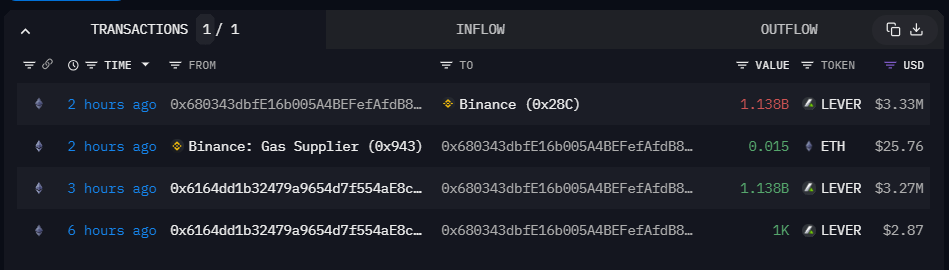
2 hours ago, the @LeverFi team deposited 1.138B $LEVER ($3.27M) to #binance at $0.00287.
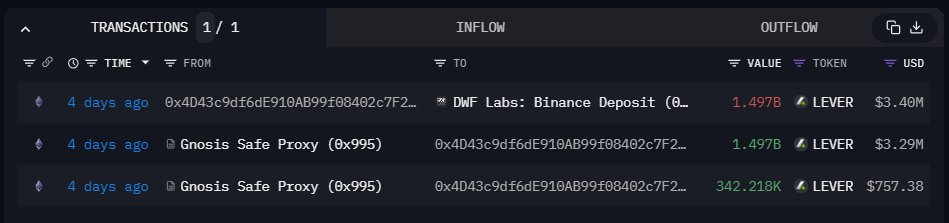
Notably, they transferred a total of 3.29B ($6.13M) to @DWFLabs 4 days ago.
Soon after, @DWFLabs deposited all of these tokens to #binance.
Everyone wants to make 100x returns without getting rugged.
I went through 100+ tools focused on keeping your funds safe.
Here's my top 10 tools you can use to stay safe. 🧵