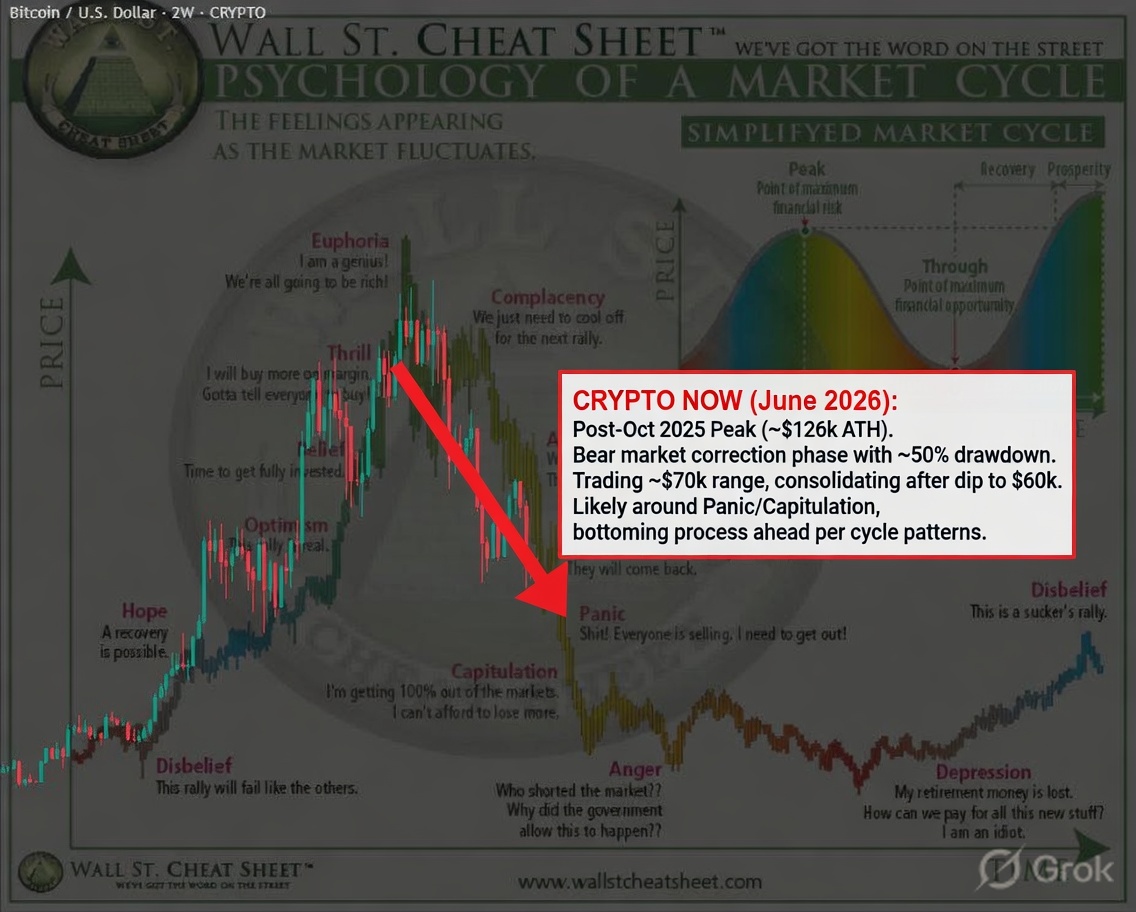
#Bitcoin – What's Next?
The Big Sunday Report: All We Need to Know
🚩 TA / LCA / Psychological Breakdown:
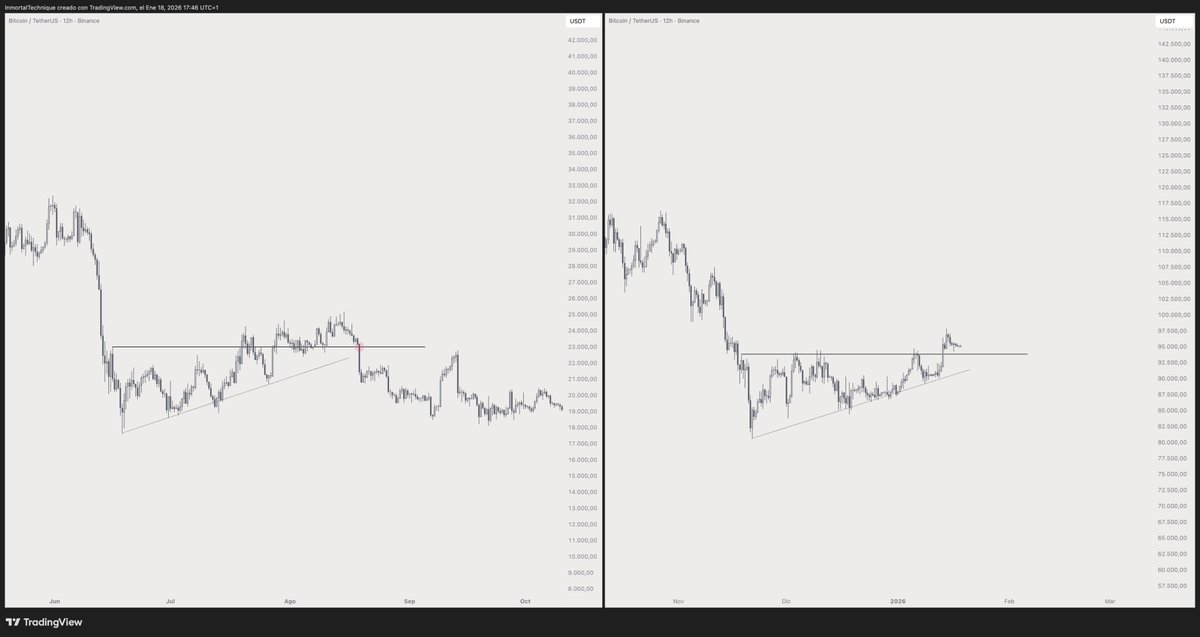
THE FINAL TRAP: Today I want to speak about the most important development on the chart right now, and it is going to be very interesting. I am watching the MA200 weekly closely, and what we are seeing is what looks like a retest of the MA200 weekly. Hold on, this is exactly the moment where things get dangerous. Let me take you back to 2022 to explain what is loading right now. In 2022, Bitcoin lost the MA200 weekly and everyone believed it was over. Then something happened that trapped everyone. A few weeks later, Bitcoin regained the MA200 weekly, and not only that, BTC printed three weekly closes above it. Bitcoin pumped 10% above the MA200 weekly in 2022, and guess what happened with the narrative? Everyone thought the bottom was in. "Wow, MA200 weekly reclaimed, this is bullish, the bear is over." This is exactly what they said. And so many bought right above the MA200 weekly, believing it was the confirmation they needed. Just to get trapped again. This was the final trap, and this is what led directly to the capitulation event. The reclaim of the MA200 weekly in 2022 was not the bottom signal, it was the trap that preceded the final flush to 15-16k.
Why This Matters Right Now:
Look at where we are today. Bitcoin lost the MA200 weekly. And now BTC is doing exactly what happened in 2022. It is testing the MA200 weekly from below, and there is a very real possibility that we see the same repeat. So in my idea there if we see a weekly close above MA200 Weekly, it will be definitely a trap! And for this case I told two weeks ago at 60k that I am placing short orders at 68-69k in case market allows to visit. This is exactly the setup I have been warning about for the last two weeks when I spoke about the white and blue lines converging and the death cross loading. The MA200 weekly retest is the key ingredient of the final trap, and history is about to repeat with almost perfect timing.
The reason this trap works every single time is because retail cannot resist a reclaim of a major moving average. When Bitcoin closes above the MA200 weekly, every one will be bullish and start FOMO buying. And this is exactly why it works. Market makers need this trap to build the maximum amount of long liquidity before the final flush. Without this trap, the capitulation would not have enough fuel. The final trap is what generates the liquidity for the final flush. This is how bear markets always end, and this is how this one will end too.
Why This Aligns With the CBB
If the 2022 pattern repeats, the final flush after the trap lands us directly at the CBB, the 40-50k zone where the BlackRock ETF launched. My timeline of September-October 2026 for the bottom aligns perfectly with the timing of a MA200 weekly reclaim happening now, followed by a fake bullish move in July-August, followed by the final rejection and capitulation in September-October. Every piece of the puzzle continues to fit. (Visit our website: https://t.co/oP8wCPuO9J) The 2022 playbook, the death cross setup, the aSOPR realized losses, the MA200 weekly trap, and the CBB target all point to the same conclusion.
My Positioning
Both shorts remain fully open. The 120k big short and the 80,500 average are in deep profit. New short orders at 68-69k remain prepared in case the market allows another visit. The plan is for the macro move toward the CBB, but the sideways zone between 57-68k is not over yet. I would not bet on an upside move, but I would bet that if the market allows another visit to 68-69k, I add more into my shorts. I am not interested in adding below this zone. If the MA200 weekly reclaim scenario plays out and BTC pumps 10% above the line, this is the perfect zone for me to add aggressively.
Calendar This Week:
FOMC minutes from the June 16-17 meeting release Wednesday July 8 at 2:00 p.m. This is a major event because it was Warsh's first FOMC as Chair, and the meeting delivered a clear hawkish shift with the median federal funds forecast implying the potential for one rate HIKE before year-end 2026, not a cut. Exactly what I predicted in the June 14 Sunday report when I said the dovish pivot would not be delivered cleanly. The minutes will show how divided the Committee was and how strong the hawkish argument was internally. Any confirmation of the hawkish tone will give us more sell pressure. Initial jobless claims Thursday July 9. Consumer credit data also Wednesday July 8.]
Join Premium: https://t.co/oP8wCPuO9J
THIS IS NO FINANCIAL ADVICE BUT EDUCATIONAL CONTENT ONLY.
$BTC: After ten months of constantly warning Saylor to realize gains, Saylor finally admits that Strategy needs to sell their Bitcoin! Not at 120k, not at 100k, not at 80k, no he decided to do this at 60k, calling it the "Monetization Program."
Now watch this: Saylor dumping BTC to protect his stock and pay out the dividends. And watch what happens when the market forces him to sell lower and lower, as the market forced him to sell! The panic will hit bigger once people realize the amount of BTC he has to sell to protect his USD reserve of 1.25bn, the dividend payments, and the re-purchase of MSTR stock.
This happens after months of predictions, and the timing couldnt be better, its happening right where I am expecting a large capitulation event to happen. Guess what I believe will lead to this event ? Good luck everyone.
#Bitcoin – What's Next?
The Big Sunday Report: All We Need to Know
🚩 TA / LCA / Psychological Breakdown:
Today I want to share something very important that almost no one is talking about. At least I have not seen a single account on X pointing this out yet, and the best part is that it aligns perfectly with the capitulation event I have been expecting since the start of Stage 5. So what is it? In 2022, Bitcoin saw a death cross on the 1-week chart, with the white line crossing below the blue line. That death cross happened right after BTC lost the MA200 weekly. Two months after the death cross, the capitulation candle printed at 15-16k, and Bitcoin went down another 30% after the death cross. This is exactly what marked the end of the previous bear market. Now look at what is happening right now in 2026.
First, BTC lost the MA200 weekly. Same as 2022. Second, BTC is now showing the same white-crossing-blue structure on the 1-week chart that preceded the previous death cross, and the death cross is loading once again. Third, in 2022 BTC dropped 30% after the death cross. The same setup is loading right now. Do you notice the pattern? The repeat is in front of us, on the same indicators, with the same structural sequence. It is also worth mentioning that I made a clear warning recently regarding the MA200 weekly, and I told you I did not believe it would hold. The big mistake many people made is buying right into the MA200 weekly support, believing it is a strong support, and we are not below it and lost it. Recent buyers are trapped and they keep arguing their mistakes with: "It does not matter at what price Iam buying" And I showed many times that indeed it mattes, it matters a lot! Entry is everything and whoever fails to understand this shouldnt trade.
Another CRUCIAL point: In every bear market in Bitcoin history, BTC has always dropped 30% below the MA200 weekly. Always. Not once, not twice, every single time. And let me add the salsa on top of the food: every bear market ended with a capitulation event, never with a slow grind back up from the MA200 weekly. So I ask: what makes this cycle different? Why would people blindly buy at current prices believing the MA200 weekly will hold for the first time in Bitcoin history? People are free to do what they want, and I respect their decision, but I am skipping this zone and I will buy lower. The math is simple, the pattern is in front of everyone, and yet most still refuse to see it.
Why This Aligns With the CBB:
If we take the current level around 60k as the reference and apply the historical 30% drop pattern, we land directly in the 42-43k zone. This is exactly the CBB region I have been pointing to since September 2025! Exactly where the BlackRock ETF launched, exactly where the Golden Bull bottom support sits, and exactly where my September-October 2026 timeline projects the bottom, and I expect it to be hit in September - October! Multiple independent indicators are converging toward the same target zone. This is why Premium is important and very few will understand.
We are now several weeks into Stage 5: Whoever does not know what Stage 5 is , please read the previous Sunday reports. The white-crossing-blue structure forming again is the next confirmation that the architecture is playing out as designed. Capitulation has not happened yet and the fear is building and has not reached a peak level yet. You havent seen a bottom yet if you believe it was the bottom. At the same time realized losses are growing, but the extreme single-event moment has not arrived. To make it very short: I am waiting for the total capitulation event! Its only two days to go and the doors for the free premium membership trial ends. You can join now before the free trial ends: https://t.co/SBmkqCq0oI
THIS IS NO FINANCIAL ADVICE BUT EDUCATIONAL CONTENT ONLY.
$SERV : Review 📜
What if AI agents didn't just chat but actually reasoned, audited their own logic, and collaborated with each other autonomously, and the reasoning framework that makes it possible is beating every OpenAI model on standard benchmarks?
Meet OpenServ - a full-stack decentralized infrastructure platform for autonomous AI agents. Not another AI wrapper or chatbot launcher. A reasoning-first platform where the BRAID framework outperforms GPT-4, Claude, and Gemini, producing auditable decision flowcharts instead of black-box outputs. 10+ enterprise and government deployments in production. UAE government running it. Messari featured it.
And the AI agent narrative just sent SERV up 170%.
Let's explore how OpenServ is building the operating system for the AI agent economy. 👇
⚪ OpenServ at a Glance
OpenServ runs an end-to-end infrastructure layer for autonomous AI agents, covering agent construction, token launches, and operational deployment. $SERV is the platform's utility asset for fees, staking, and launch participation.
The $SERV token has a fixed supply of 1 billion. SERV is required for platform access, agent deployment, staking, governance, and launchpad participation.
Marketplace Insight: The company's BRAID reasoning framework is used across 10 enterprise and government deployments. That includes UAE government work with partner Neol. "Our reasoning framework is currently beating every OpenAI model on industry standard benchmarks," said Tim Hafner. The BRAID paper is published on arXiv (2512.15959) and featured in a dedicated Messari report. In a market full of AI tokens with no product, OpenServ has enterprise clients running in production.
⚪ Mission
OpenServ's mission is to build the operating system for the AI agent economy. "Enterprise AI doesn't break because models are weak; it breaks when AI's reasoning capabilities aren't designed for reality," said Tim Hafner. OpenServ exists because current AI systems hallucinate, produce unauditable outputs, and can't collaborate across frameworks. BRAID fixes the reasoning. AIP fixes the collaboration. And the platform fixes the deployment.
🔵 A Brief History
OpenServ was founded by Tim Hafner and Lucas Hafner, who identified a fundamental gap in the AI agent space: agents could execute tasks but couldn't reason reliably, audit their logic, or collaborate with other agents in production environments. Lucas previously co-founded an early Bittensor Network venture, bringing decentralized AI infrastructure experience to OpenServ from day one.
The project launched its IDO in November 2024 at $0.00125 per SERV, reaching a $1 billion fully diluted valuation within its first months as the AI agent narrative exploded.
In August 2025, OpenServ published BRAID (Bounded Reasoning for Autonomous Inference and Decisions), a structured AI reasoning framework that replaces English "thinking" with explicit, machine-readable logic using JavaScript decision trees. BRAID boosts performance across every model class, from the largest to the smallest, making strong reasoning affordable and available to more developers and more use cases.
The paper was published on arXiv (2512.15959) co-authored by CTO Armagan Amcalar and Dr. Eyup Cinar. Messari published a dedicated report framing it as "reshaping agent economics."
In August 2025, the LunarCrush partnership launched, analyzing 50M+ hourly social posts and converting them into AI-generated video briefings and dashboards on Telegram via https://t.co/PeyIH799zb.
In January 2026, OpenServ announced a foundational design partnership with Neol to apply and evolve SERV's AI reasoning framework in real-world, high-stakes production environments. Neol works with enterprises and public-sector institutions including UAE government organizations. This marked OpenServ's first major enterprise validation.
By March 2026, SERV Cofounder tool launched for collaborative AI agent creation. SERV Foundry Sprint 1 closed with strong builder submissions. The Appcelerator program targets launching revenue-generating aApps on Telegram using SERV for access and transactions.
In May 2026, SERV surged 170% as the autonomous AI agent narrative reignited across crypto, with CoinGecko, CCN, and BeInCrypto all covering the breakout.
🔵 Ecosystem Narrative
OpenServ's ecosystem is built on one core insight: AI agents don't fail because models are weak. They fail because they can't reason reliably, can't explain their decisions, and can't collaborate with other agents.
OpenServ fixes all three.
Key dynamics include:
➛ BRAID Reasoning Framework replaces free-form AI "thinking" with structured, machine-readable decision trees. Produces auditable flowcharts documenting each step of the model's logic. Outperforms GPT-4, Claude, and Gemini on industry benchmarks. Published on arXiv and featured by Messari.
➛ Agent Interface Protocol (AIP) standardizes how agents discover, communicate, and call each other. Defines inputs, outputs, invocation methods, metadata, and reputation systems. Enables multi-agent collaboration like services on the internet.
➛ Multi-layered agent architecture based on human cognitive models: Perception Layer (information acquisition), Action Layer (task execution), Reflection Layer (self-evaluation), and Control Layer (strategy adjustment).
➛ 10+ enterprise and government deployments in production, including UAE government work via Neol partnership. Not testnet. Not demo. Production.
➛ SERV Foundry sprints incentivize builders to create agents and aApps on the platform, with strong submission rates demonstrating developer traction.
➛ Appcelerator program launches revenue-generating AI apps (aApps) on Telegram, requiring SERV for access and transactions.
➛ LunarCrush integration powers AI-driven social analytics dashboards analyzing 50M+ hourly social posts.
➛ SERV Cofounder tool enables collaborative AI agent creation, lowering the barrier for non-technical users to build autonomous agents.
⚪ Token Utilities
$SERV powers the autonomous AI agent economy:
➛ Platform Access - SERV required to access OpenServ services, deploy agents, and use platform tools.
➛ Agent Deployment Fees - Pay SERV to launch and operate autonomous agents on the platform.
➛ Staking - Stake SERV for enhanced platform access, governance participation, and reward eligibility.
➛ Launchpad Participation - SERV required to participate in new agent and aApp launches via the OpenServ launchpad.
➛ Governance - Token holders participate in platform governance and ecosystem direction.
➛ Contributor Rewards - Developers and builders earn SERV for contributing high-quality agents and aApps to the ecosystem.
⚪ Key Features
➛ BRAID Reasoning Framework - Structured AI reasoning that outperforms GPT-4, Claude, and Gemini. Auditable logic flowcharts. Published on arXiv. Featured by Messari. The moat that no other AI agent platform has.
➛ 10+ Enterprise/Government Deployments - UAE government via Neol. Production environments, not demos. Real-world AI reasoning under production pressure.
➛ Agent Interface Protocol (AIP) - Standardized multi-agent collaboration. Agents discover and call each other like services on the internet.
➛ Human Cognitive Architecture - Four-layer agent design (Perception, Action, Reflection, Control) modeled on human cognition. Agents that reason, not just execute.
➛ Appcelerator Program - Revenue-generating AI apps on Telegram. SERV required for access and transactions.
➛ SERV Foundry Sprints - Builder incentive programs attracting quality developer submissions. Growing builder ecosystem.
➛ 1B Fixed Supply - No inflation. No future dilution. All utility flows through a fixed token base.
🔵 Meet the OpenServ Team
OpenServ is led by a 9-person team spanning AI research, enterprise finance, and full-stack engineering, with backgrounds from JP Morgan, Nasdaq, Santander, and academic AI research.
▶️ Core Members:
➛ Tim Hafner [ @open_founder ] - Founder & CEO | Entrepreneur with experience across venture capital, SaaS, AI, Web3, and biotech. Previously built a blockchain x AI mining venture. Leads enterprise partnerships (Neol/UAE government), BRAID strategy, and ecosystem growth. "The UAE government is running it in production, so are 10+ enterprises."
➛ Lucas Hafner [ @lucashafner ] - Co-Founder | Background in business, psychology, and biotech research. Early Bittensor Network venture co-founder. Brings cross-disciplinary perspective connecting AI infrastructure with business fundamentals.
➛ Armagan Amcalar [ @dashersw ] - CTO | 20+ year tech entrepreneur in AI and SaaS. MSc thesis on real-time brain-computer interfaces from Sabanci University. Won Ford's connected car hackathon (1st place). Lead author on the BRAID arXiv paper. Previously at Neol, Coyotiv GmbH. Based in Berlin. "BRAID boosts performance across every model class, from the largest to the smallest."
➛ Mert Dogar - Lead AI Systems Architect | 15+ years of startup experience. Leads the design and architecture of OpenServ's autonomous agent systems and core AI infrastructure.
➛ Andres Korin - CFO | 20+ year senior finance professional. 2x Fintech founder. Former VP at JP Morgan. Brings institutional-grade financial management to OpenServ's operations.
➛ Daniel Haberern - Enterprise Growth Lead | Drives enterprise client acquisition, partnership development, and go-to-market strategy for BRAID deployments.
➛ Dr. Eyup Cinar - AI Research Partner | Co-author of the BRAID arXiv paper (2512.15959). Computer Engineering Department, Eskisehir Osmangazi University. Brings academic AI research rigor to BRAID's development and benchmarking.
➛ David Veznik - Lead Full-Stack Engineer | 10+ years developing full-stack implementations in web3 and fintech. Former Nasdaq and Santander engineer. Leads platform engineering and onchain infrastructure.
▶️ Adviser:
➛ Greg Ivanov - Strategic Advisor
🔵 Ratings
➛ Use Case: ★★★★✦ (4.5/5) - OpenServ addresses the single biggest problem in the AI agent space: reliable reasoning. BRAID isn't a marketing claim. It's a published framework (arXiv 2512.15959) that outperforms GPT-4, Claude, and Gemini on standard benchmarks with auditable logic flowcharts. The Agent Interface Protocol enables multi-agent collaboration that no other platform offers. 10+ enterprise and government deployments in production, including UAE government via Neol. The Appcelerator and Foundry programs are building a real developer ecosystem. The 0.5 deduction is because the platform is still early: market cap is only $45M, mainstream awareness is minimal, and the transition from "10 enterprise clients" to "1,000 enterprise clients" requires significant go-to-market execution.
➛ Tokenomics: ★★★★ (4/5) - 1 billion fixed supply with no inflation is clean. SERV required for platform access, deployment, staking, and launchpad creates genuine utility demand across every platform interaction. The IDO at $0.00125 produced 3,150%+ ROI at peak, rewarding early participants. The token surged 170% on narrative rotation, showing demand responsiveness to real catalysts. Fixed supply means every new enterprise client and aApp deployment adds buy pressure against a non-diluting base. The 1-point deduction is that SERV is down 63% from ATH, trading volume is thin relative to competing AI agent tokens, and the utility demand from 10 enterprise clients, while validating, doesn't yet generate the on-chain volume needed to drive sustained price appreciation.
➛ Audits: ★★★★ (4/5) - BRAID is published on arXiv (2512.15959) and peer-reviewed on Hugging Face and AlphaXiv, providing academic-grade transparency for the core reasoning framework. The platform operates in production for 10+ enterprises and UAE government without reported security incidents. The enterprise-grade deployments in regulated environments (UAE government via Neol) inherently require security standards that consumer-only platforms don't face. The 1-point deduction is for limited publicly documented third-party smart contract audits from major firms and the relative newness of the platform (IDO November 2024). As the platform scales with more agents and enterprise data, more visible formal auditing would strengthen confidence.
➛ Community: ★★★★ (4/5) - OpenServ has built a quality-focused community of AI builders, developers, and crypto-AI enthusiasts that punches above its market cap weight. SERV Foundry sprints are attracting strong submissions from real builders. The Appcelerator program is growing a Telegram-native user base. The 170% surge in May 2026 brought significant new attention and retail participation. CoinGecko, CCN, BeInCrypto, Benzinga, and Messari coverage expanded awareness considerably. The community rallied around the BRAID benchmarks as proof that OpenServ has real technology, not just narrative. The 1-point deduction is that the community is still young and small relative to competing AI agent platforms (Virtuals Protocol at $477M market cap), and the ecosystem needs more consumer-facing products beyond enterprise deployments to drive grassroots engagement.
🔵 Conclusion
OpenServ is the most technically differentiated project in the AI agent space, and the market is only beginning to figure that out. While most AI tokens ship wrappers around GPT APIs and call themselves "agent platforms," OpenServ built a proprietary reasoning framework from scratch that outperforms every OpenAI model on standard benchmarks, published the research on arXiv, got featured by Messari, and deployed it in production for 10+ enterprises and the UAE government.
BRAID is the moat. Not the token. Not the narrative. The actual technology that makes AI agents reason reliably, produce auditable decision flowcharts, and collaborate across frameworks. Tim Hafner said it best:
"This is the difference between AI experiment and AI business, and we've invented the technology to make that leap."
The team is deeper than the market realizes: a CTO with 20 years in AI and a brain-computer interface MSc, a CFO who was VP at JP Morgan, a lead engineer from Nasdaq and Santander, an academic AI researcher co-authoring peer-reviewed papers, and a co-founder who came from an early Bittensor venture. Nine people building enterprise-grade AI agent infrastructure that governments are running in production.
Here's the fundamental question: in a $15 billion+ autonomous AI agent market, how much is a proprietary reasoning framework worth that beats GPT-4 on benchmarks, runs in production for governments, and comes with an entire infrastructure stack for building, launching, and monetizing AI agents? At $45M market cap, OpenServ is either one of the most underpriced AI infrastructure plays in crypto, or it's a micro-cap that can't scale beyond its current deployments.
The BRAID benchmarks, the enterprise clients, and the 170% breakout suggest the market is starting to choose the former.
I'm saying this again and again that the LLM is becoming EC2.
1. Cheap
2. Interchangeable
3. Raced to zero
Everyone arguing over which model is best is fighting the last war. In my opinion reasoning gains aren't free. The way a smaller model matches a frontier one is test-time compute, more thinking, more tokens. That's physics as capability is bought with tokens.
Once that's true, the game stops being who has the best model and becomes who gets the most reasoning per token. Raw cloud compute commoditized to the penny, and the value moved up to the orchestration layer that made it usable. Remember nobody got rich selling raw EC2. The reasoning layer is that orchestration layer.
That's the bet I see @openservai making by providing a better engine on top of a commoditizing one.
The model is the commodity here and the engine that runs it is the business.
The crypto ecosystem is full of noise.
Riddled with vapourware and projects that lack product market fit.
Its not so often that im excited by much being built outside of Ondo.
I must say however, that im rather impressed by the @openservai team and their recent successes.
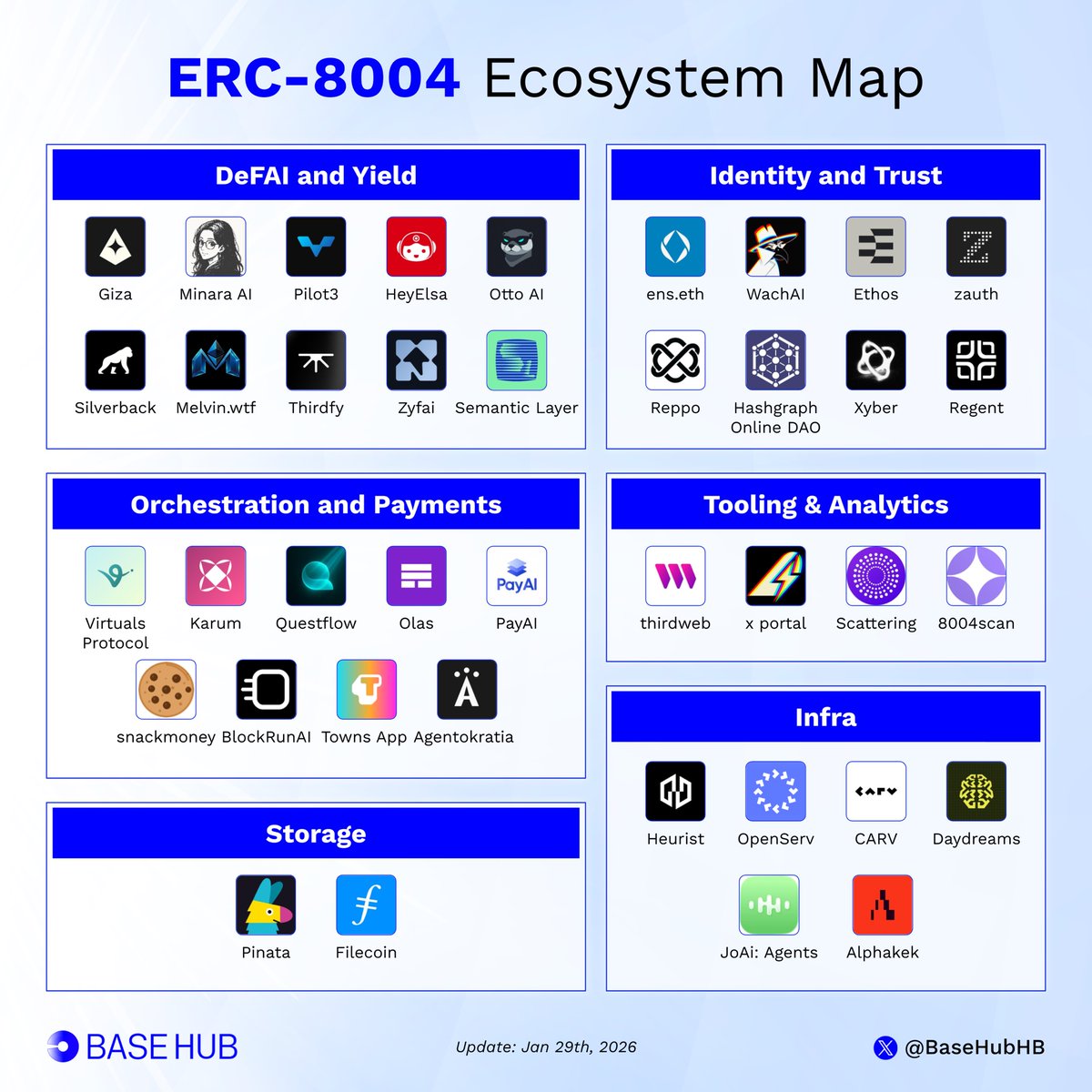
ERC-8004 ECOSYSTEM MAP
ERC-8004 is officially live on mainnet.
Identity + reputation + payments, all onchain.
Agents can hire, pay, and verify each other autonomously.
Here are the early projects building the future on @base:
Identity and Trust
@ensdomains - naming service for agents
@Wach_AI - verification protocol, building “Mandates” for audits
@ethos_network - credibility protocol for agents
@zauthx402 - service endpoint verification
@reppo - AI training data marketplace, launching robotics subnets
@HashgraphOnline - agent registry and trust scores
@Xyberinc - actionFi, onchain robotics & physical AI
@regent_cx - agent hosting and identity
DeFAI and Yield
@gizatechxyz - autonomous capital management
@minara - AI CFO & autonomous trader
@pilot3ai - Autonomous trading intelligence
@HeyElsaAI - DeFAI companion + portfolio
@useOttoAI - automated yield agents
@Silverbackdefi – Reputation API & Verification
@melvindotwtf - autonomous prediction market agents
@Thirdfy_ - DeFi agent reputation dashboard
@ZyfAI_ - DeFi agent security & yield layer
@SemanticLayer - agentic prediction market vault
Infra
@heurist_ai - Decentralized compute mesh + marketplace of crypto-native AI agents
@openservai - suite for staffing AI employees, ���SERV’ framework used by UAE govt
@carv_official - data layer for AI beings
@daydreamsagents - agent SDK and token factories
@JoAIAgents - AI app creation framework + automation
@alphakek - context graph provider, building universal agents
Storage
@pinatacloud - IPFS storage and gateways
@Filecoin - decentralized storage
Orchestration and Payments
@virtuals_io - agent launchpad, ACP framework
@karum_AI - project Manager for agents
@questflow - workflow automation
@autonolas - sovereign agent ownership protocol
@PayAINetwork - #1 x402 payment facilitator
@snackmoneyapp - tipping assistant
@BlockRunAI - access to all LLMs with x402
@townsapp - onchain group chat & agent environment
@agentokratia - x402 settlement protocol
Tooling & Analytics
@thirdweb - web3 dev tools & x402 integration
@xportalai - agent tooling and MCP registry
@scattering_io - market tracking + dashboard
@8004_scan - agent identity and reputation explorer
In case you’re building on ERC-8004 and are missing from this map, let us know in the comments! ✍️
🔥 One day since #ERC8004 went live on mainnet, and projects are already shipping.
So, what’s exactly 8004 and why it matters for Ethereum?
1️⃣ Simply put, ERC-8004 is a powerful standard for AI agents on Ethereum.
At its core, it lets agents register an on-chain identity, build reputation through real user feedback, and (eventually) prove correct behavior via third-party validation.
In plain terms: it helps agents find each other and decide who to trust, without relying on centralized platforms.
Before mainnet, ERC-8004 already saw 10,000+ agents registered and 20,000+ feedback entries on testnet.
Tooling, scanners, SDKs, and integrations emerged organically and the contracts have been audited.
2️⃣ Why this matters for Ethereum:
Ethereum already settles value and contracts. ERC-8004 adds a trust layer for autonomous software.
That means agents can discover services, compare reputation, and transact directly on-chain.
The impact could be huge:
- Open agent marketplaces instead of closed platforms
- Reputation becoming a real on-chain asset
- New models like agent-to-agent SaaS, autonomous services, and AI-driven DeFi workflow
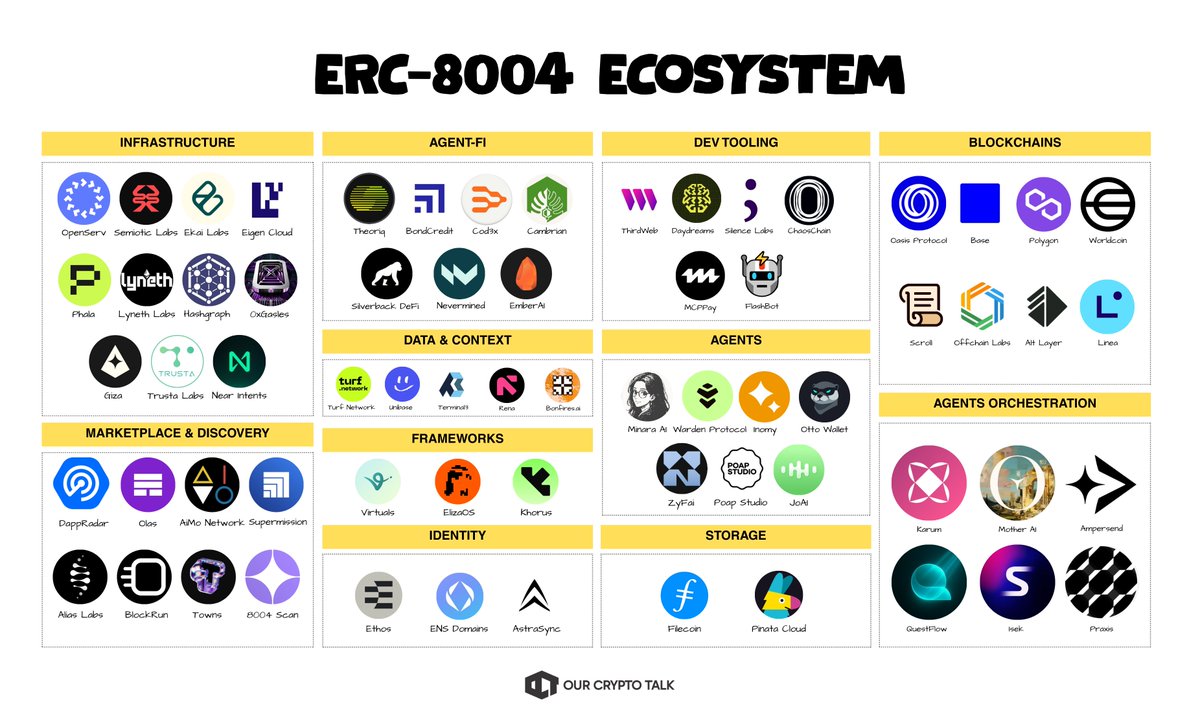
📌 If you are new on this eco, here are some project building on it 👇
- $SERV| @openservai: The complete AI founder suite to BUILD, LAUNCH, and RUN your crypto startup.
- $PRXS | @Praxis_Protocol: The mesh network for decentralized AI agents.
- $OTTO |@useOttoAI: Defai AI Co-Pilot + Agent Swarm
- $VIRTUAL: launchpad and liquidity layer for verified agents
- $DREAMS | @daydreamsagents: 8004 launch platform
- $WACH | @Wach_AI: Verification Protocol for AI Agents
- $AWE | @awenetwork_ai: Autonomous Worlds Engine for scalable agent-agent and human-agent collaboration.
- $CARV | @carv_official: Building an AI chain ecosystem to enable data sovereignty at scale.
- $ELSA | @HeyElsaAI: The economic layer for DeFi AI
- $GIZA | @gizatechxyz: Capture top DeFi opportunities 24/7 with autonomous agents.
And more, you can explore the ecosystem here: https://t.co/j30Pcf3jP9
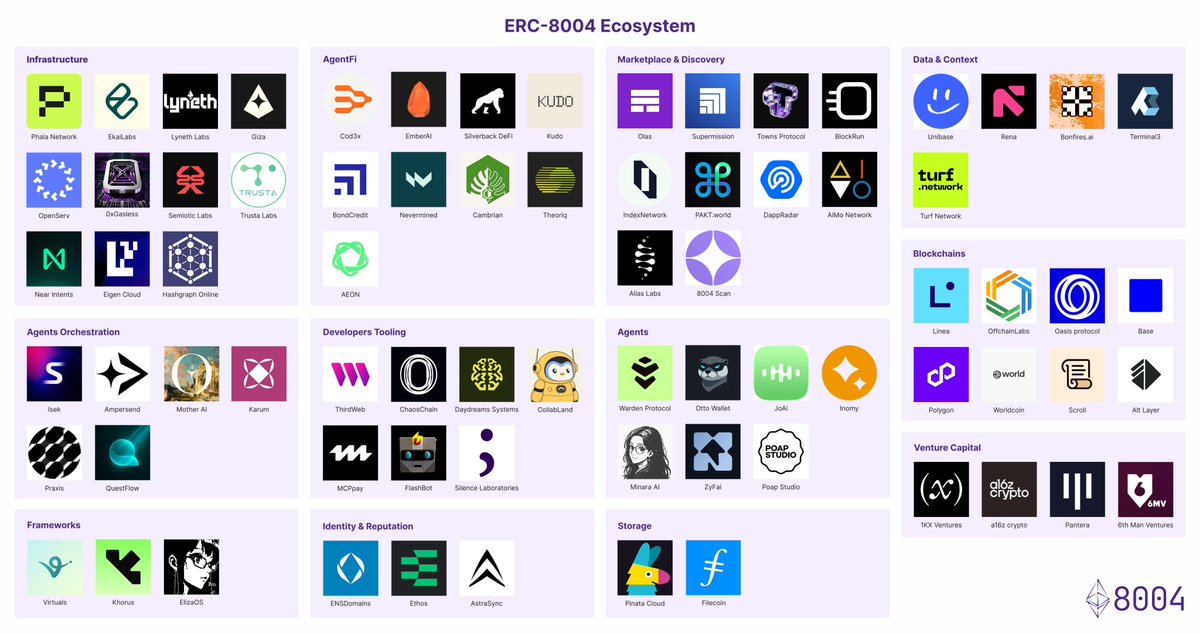
Top ERC-8004 Projects on @base
ERC-8004 going live on mainnet tomorrow. Onchain passport and credit score for AI agents. This standard allows agents to work across different organizations and prove they actually did the job, creating a trustless global market for AI labor.
Here are the projects:
@ensdomains: Identity layer for agents. ERC-8004 gives agents a technical ID. ENS gives them a readable name like agent.eth so humans know who they are paying.
@virtuals_io: The primary liquidity and launchpad layer for agents on Base. ACP is the standard for A2A business. ERC-8004 serves as the verification layer for their agents.
@8004_scan: Primary block explorer for the agent economy. Currently tracks 521+ registered agents and 250+ feedback submissions.
@Wach_AI: Builds the verification protocol that powers trust and reputation for ERC-8004 agents. They recently launched "Mandates" in their SDK, which creates onchain proofs of agent work that can be audited and scored.
@heurist_ai: Provides compute and mesh network for agents to execute complex tasks like research or trading analysis. ERC-8004 integration allows compute nodes to prove task accuracy and uptime onchain. Anonymous servers become verified workers.
@openservai: Published SERV reasoning framework paper with NVIDIA researchers showing 122x cost reduction versus GPT-5. Used by UAE government entities.
@reppo: Data labeling network that incentivizes humans to create training data for robotics and AI. Launching subnets using wearable cameras and prediction markets to crowdsource robot training data. ERC-8004 validates authenticity of physical data collected by agents.
@Thirdfy_: DeFAI trading platform that recently integrated agent tools for automated swaps. Using ERC-8004 to verify reputation of trading agents. Users can distinguish between proven arbitrage bots and potential scams.
@PayAINetwork: The #1 x402 facilitator across all chains, using ERC-8004 to build verifiable credit history and payment reputation.
@SemanticLayer: Builds "AgentFi" vaults where AI actively manages risk and capital. Creating autonomous smart money structures that trade without human intervention.
@awenetwork_ai: Orchestration layer and launchpad for autonomous agents. 1.24M users and over 5,500 active agents deployed. One of the largest consumer interfaces for agent tech.
2026 is the year of the autonomous agent economy.
If you’re building on ERC-8004, let us know in the comments! 👇
What is ERC-8004?
It’s not “AI + crypto hype”.
It’s infrastructure.
Before ERC-8004:
AI agents
• had no identity
• had no reputation
• couldn’t trust each other
• lived in silos
ERC-8004 fixes one thing:
Trust between machines.
It gives AI agents:
• an on-chain identity
• a portable reputation
• verifiable proof of work
No platforms.
No gatekeepers.
Think of it as:
A passport
a resume
an audit trail
For AI agents.
Now agents can:
• discover each other
• get hired
• get paid
• get reviewed
All on-chain.
Ethereum becomes:
Not just money rails.
But the settlement layer for AI-to-AI economies.
This won’t explode overnight.
But this is how new systems start.
Quiet.
Boring.
Foundational.


![DrProfitCrypto's tweet photo. #Bitcoin – What's Next?
The Big Sunday Report: All We Need to Know
🚩 TA / LCA / Psychological Breakdown:
THE FINAL TRAP: Today I want to speak about the most important development on the chart right now, and it is going to be very interesting. I am watching the MA200 weekly closely, and what we are seeing is what looks like a retest of the MA200 weekly. Hold on, this is exactly the moment where things get dangerous. Let me take you back to 2022 to explain what is loading right now. In 2022, Bitcoin lost the MA200 weekly and everyone believed it was over. Then something happened that trapped everyone. A few weeks later, Bitcoin regained the MA200 weekly, and not only that, BTC printed three weekly closes above it. Bitcoin pumped 10% above the MA200 weekly in 2022, and guess what happened with the narrative? Everyone thought the bottom was in. "Wow, MA200 weekly reclaimed, this is bullish, the bear is over." This is exactly what they said. And so many bought right above the MA200 weekly, believing it was the confirmation they needed. Just to get trapped again. This was the final trap, and this is what led directly to the capitulation event. The reclaim of the MA200 weekly in 2022 was not the bottom signal, it was the trap that preceded the final flush to 15-16k.
Why This Matters Right Now:
Look at where we are today. Bitcoin lost the MA200 weekly. And now BTC is doing exactly what happened in 2022. It is testing the MA200 weekly from below, and there is a very real possibility that we see the same repeat. So in my idea there if we see a weekly close above MA200 Weekly, it will be definitely a trap! And for this case I told two weeks ago at 60k that I am placing short orders at 68-69k in case market allows to visit. This is exactly the setup I have been warning about for the last two weeks when I spoke about the white and blue lines converging and the death cross loading. The MA200 weekly retest is the key ingredient of the final trap, and history is about to repeat with almost perfect timing.
The reason this trap works every single time is because retail cannot resist a reclaim of a major moving average. When Bitcoin closes above the MA200 weekly, every one will be bullish and start FOMO buying. And this is exactly why it works. Market makers need this trap to build the maximum amount of long liquidity before the final flush. Without this trap, the capitulation would not have enough fuel. The final trap is what generates the liquidity for the final flush. This is how bear markets always end, and this is how this one will end too.
Why This Aligns With the CBB
If the 2022 pattern repeats, the final flush after the trap lands us directly at the CBB, the 40-50k zone where the BlackRock ETF launched. My timeline of September-October 2026 for the bottom aligns perfectly with the timing of a MA200 weekly reclaim happening now, followed by a fake bullish move in July-August, followed by the final rejection and capitulation in September-October. Every piece of the puzzle continues to fit. (Visit our website: https://t.co/oP8wCPuO9J) The 2022 playbook, the death cross setup, the aSOPR realized losses, the MA200 weekly trap, and the CBB target all point to the same conclusion.
My Positioning
Both shorts remain fully open. The 120k big short and the 80,500 average are in deep profit. New short orders at 68-69k remain prepared in case the market allows another visit. The plan is for the macro move toward the CBB, but the sideways zone between 57-68k is not over yet. I would not bet on an upside move, but I would bet that if the market allows another visit to 68-69k, I add more into my shorts. I am not interested in adding below this zone. If the MA200 weekly reclaim scenario plays out and BTC pumps 10% above the line, this is the perfect zone for me to add aggressively.
Calendar This Week:
FOMC minutes from the June 16-17 meeting release Wednesday July 8 at 2:00 p.m. This is a major event because it was Warsh's first FOMC as Chair, and the meeting delivered a clear hawkish shift with the median federal funds forecast implying the potential for one rate HIKE before year-end 2026, not a cut. Exactly what I predicted in the June 14 Sunday report when I said the dovish pivot would not be delivered cleanly. The minutes will show how divided the Committee was and how strong the hawkish argument was internally. Any confirmation of the hawkish tone will give us more sell pressure. Initial jobless claims Thursday July 9. Consumer credit data also Wednesday July 8.]
Join Premium: https://t.co/oP8wCPuO9J
THIS IS NO FINANCIAL ADVICE BUT EDUCATIONAL CONTENT ONLY.](https://pbs.twimg.com/media/HMfEF-8WMAAz6g0.jpg)



![0xchainink's tweet photo. $SERV : Review 📜
What if AI agents didn't just chat but actually reasoned, audited their own logic, and collaborated with each other autonomously, and the reasoning framework that makes it possible is beating every OpenAI model on standard benchmarks?
Meet OpenServ - a full-stack decentralized infrastructure platform for autonomous AI agents. Not another AI wrapper or chatbot launcher. A reasoning-first platform where the BRAID framework outperforms GPT-4, Claude, and Gemini, producing auditable decision flowcharts instead of black-box outputs. 10+ enterprise and government deployments in production. UAE government running it. Messari featured it.
And the AI agent narrative just sent SERV up 170%.
Let's explore how OpenServ is building the operating system for the AI agent economy. 👇
⚪ OpenServ at a Glance
OpenServ runs an end-to-end infrastructure layer for autonomous AI agents, covering agent construction, token launches, and operational deployment. $SERV is the platform's utility asset for fees, staking, and launch participation.
The $SERV token has a fixed supply of 1 billion. SERV is required for platform access, agent deployment, staking, governance, and launchpad participation.
Marketplace Insight: The company's BRAID reasoning framework is used across 10 enterprise and government deployments. That includes UAE government work with partner Neol. "Our reasoning framework is currently beating every OpenAI model on industry standard benchmarks," said Tim Hafner. The BRAID paper is published on arXiv (2512.15959) and featured in a dedicated Messari report. In a market full of AI tokens with no product, OpenServ has enterprise clients running in production.
⚪ Mission
OpenServ's mission is to build the operating system for the AI agent economy. "Enterprise AI doesn't break because models are weak; it breaks when AI's reasoning capabilities aren't designed for reality," said Tim Hafner. OpenServ exists because current AI systems hallucinate, produce unauditable outputs, and can't collaborate across frameworks. BRAID fixes the reasoning. AIP fixes the collaboration. And the platform fixes the deployment.
🔵 A Brief History
OpenServ was founded by Tim Hafner and Lucas Hafner, who identified a fundamental gap in the AI agent space: agents could execute tasks but couldn't reason reliably, audit their logic, or collaborate with other agents in production environments. Lucas previously co-founded an early Bittensor Network venture, bringing decentralized AI infrastructure experience to OpenServ from day one.
The project launched its IDO in November 2024 at $0.00125 per SERV, reaching a $1 billion fully diluted valuation within its first months as the AI agent narrative exploded.
In August 2025, OpenServ published BRAID (Bounded Reasoning for Autonomous Inference and Decisions), a structured AI reasoning framework that replaces English "thinking" with explicit, machine-readable logic using JavaScript decision trees. BRAID boosts performance across every model class, from the largest to the smallest, making strong reasoning affordable and available to more developers and more use cases.
The paper was published on arXiv (2512.15959) co-authored by CTO Armagan Amcalar and Dr. Eyup Cinar. Messari published a dedicated report framing it as "reshaping agent economics."
In August 2025, the LunarCrush partnership launched, analyzing 50M+ hourly social posts and converting them into AI-generated video briefings and dashboards on Telegram via https://t.co/PeyIH799zb.
In January 2026, OpenServ announced a foundational design partnership with Neol to apply and evolve SERV's AI reasoning framework in real-world, high-stakes production environments. Neol works with enterprises and public-sector institutions including UAE government organizations. This marked OpenServ's first major enterprise validation.
By March 2026, SERV Cofounder tool launched for collaborative AI agent creation. SERV Foundry Sprint 1 closed with strong builder submissions. The Appcelerator program targets launching revenue-generating aApps on Telegram using SERV for access and transactions.
In May 2026, SERV surged 170% as the autonomous AI agent narrative reignited across crypto, with CoinGecko, CCN, and BeInCrypto all covering the breakout.
🔵 Ecosystem Narrative
OpenServ's ecosystem is built on one core insight: AI agents don't fail because models are weak. They fail because they can't reason reliably, can't explain their decisions, and can't collaborate with other agents.
OpenServ fixes all three.
Key dynamics include:
➛ BRAID Reasoning Framework replaces free-form AI "thinking" with structured, machine-readable decision trees. Produces auditable flowcharts documenting each step of the model's logic. Outperforms GPT-4, Claude, and Gemini on industry benchmarks. Published on arXiv and featured by Messari.
➛ Agent Interface Protocol (AIP) standardizes how agents discover, communicate, and call each other. Defines inputs, outputs, invocation methods, metadata, and reputation systems. Enables multi-agent collaboration like services on the internet.
➛ Multi-layered agent architecture based on human cognitive models: Perception Layer (information acquisition), Action Layer (task execution), Reflection Layer (self-evaluation), and Control Layer (strategy adjustment).
➛ 10+ enterprise and government deployments in production, including UAE government work via Neol partnership. Not testnet. Not demo. Production.
➛ SERV Foundry sprints incentivize builders to create agents and aApps on the platform, with strong submission rates demonstrating developer traction.
➛ Appcelerator program launches revenue-generating AI apps (aApps) on Telegram, requiring SERV for access and transactions.
➛ LunarCrush integration powers AI-driven social analytics dashboards analyzing 50M+ hourly social posts.
➛ SERV Cofounder tool enables collaborative AI agent creation, lowering the barrier for non-technical users to build autonomous agents.
⚪ Token Utilities
$SERV powers the autonomous AI agent economy:
➛ Platform Access - SERV required to access OpenServ services, deploy agents, and use platform tools.
➛ Agent Deployment Fees - Pay SERV to launch and operate autonomous agents on the platform.
➛ Staking - Stake SERV for enhanced platform access, governance participation, and reward eligibility.
➛ Launchpad Participation - SERV required to participate in new agent and aApp launches via the OpenServ launchpad.
➛ Governance - Token holders participate in platform governance and ecosystem direction.
➛ Contributor Rewards - Developers and builders earn SERV for contributing high-quality agents and aApps to the ecosystem.
⚪ Key Features
➛ BRAID Reasoning Framework - Structured AI reasoning that outperforms GPT-4, Claude, and Gemini. Auditable logic flowcharts. Published on arXiv. Featured by Messari. The moat that no other AI agent platform has.
➛ 10+ Enterprise/Government Deployments - UAE government via Neol. Production environments, not demos. Real-world AI reasoning under production pressure.
➛ Agent Interface Protocol (AIP) - Standardized multi-agent collaboration. Agents discover and call each other like services on the internet.
➛ Human Cognitive Architecture - Four-layer agent design (Perception, Action, Reflection, Control) modeled on human cognition. Agents that reason, not just execute.
➛ Appcelerator Program - Revenue-generating AI apps on Telegram. SERV required for access and transactions.
➛ SERV Foundry Sprints - Builder incentive programs attracting quality developer submissions. Growing builder ecosystem.
➛ 1B Fixed Supply - No inflation. No future dilution. All utility flows through a fixed token base.
🔵 Meet the OpenServ Team
OpenServ is led by a 9-person team spanning AI research, enterprise finance, and full-stack engineering, with backgrounds from JP Morgan, Nasdaq, Santander, and academic AI research.
▶️ Core Members:
➛ Tim Hafner [ @open_founder ] - Founder & CEO | Entrepreneur with experience across venture capital, SaaS, AI, Web3, and biotech. Previously built a blockchain x AI mining venture. Leads enterprise partnerships (Neol/UAE government), BRAID strategy, and ecosystem growth. "The UAE government is running it in production, so are 10+ enterprises."
➛ Lucas Hafner [ @lucashafner ] - Co-Founder | Background in business, psychology, and biotech research. Early Bittensor Network venture co-founder. Brings cross-disciplinary perspective connecting AI infrastructure with business fundamentals.
➛ Armagan Amcalar [ @dashersw ] - CTO | 20+ year tech entrepreneur in AI and SaaS. MSc thesis on real-time brain-computer interfaces from Sabanci University. Won Ford's connected car hackathon (1st place). Lead author on the BRAID arXiv paper. Previously at Neol, Coyotiv GmbH. Based in Berlin. "BRAID boosts performance across every model class, from the largest to the smallest."
➛ Mert Dogar - Lead AI Systems Architect | 15+ years of startup experience. Leads the design and architecture of OpenServ's autonomous agent systems and core AI infrastructure.
➛ Andres Korin - CFO | 20+ year senior finance professional. 2x Fintech founder. Former VP at JP Morgan. Brings institutional-grade financial management to OpenServ's operations.
➛ Daniel Haberern - Enterprise Growth Lead | Drives enterprise client acquisition, partnership development, and go-to-market strategy for BRAID deployments.
➛ Dr. Eyup Cinar - AI Research Partner | Co-author of the BRAID arXiv paper (2512.15959). Computer Engineering Department, Eskisehir Osmangazi University. Brings academic AI research rigor to BRAID's development and benchmarking.
➛ David Veznik - Lead Full-Stack Engineer | 10+ years developing full-stack implementations in web3 and fintech. Former Nasdaq and Santander engineer. Leads platform engineering and onchain infrastructure.
▶️ Adviser:
➛ Greg Ivanov - Strategic Advisor
🔵 Ratings
➛ Use Case: ★★★★✦ (4.5/5) - OpenServ addresses the single biggest problem in the AI agent space: reliable reasoning. BRAID isn't a marketing claim. It's a published framework (arXiv 2512.15959) that outperforms GPT-4, Claude, and Gemini on standard benchmarks with auditable logic flowcharts. The Agent Interface Protocol enables multi-agent collaboration that no other platform offers. 10+ enterprise and government deployments in production, including UAE government via Neol. The Appcelerator and Foundry programs are building a real developer ecosystem. The 0.5 deduction is because the platform is still early: market cap is only $45M, mainstream awareness is minimal, and the transition from "10 enterprise clients" to "1,000 enterprise clients" requires significant go-to-market execution.
➛ Tokenomics: ★★★★ (4/5) - 1 billion fixed supply with no inflation is clean. SERV required for platform access, deployment, staking, and launchpad creates genuine utility demand across every platform interaction. The IDO at $0.00125 produced 3,150%+ ROI at peak, rewarding early participants. The token surged 170% on narrative rotation, showing demand responsiveness to real catalysts. Fixed supply means every new enterprise client and aApp deployment adds buy pressure against a non-diluting base. The 1-point deduction is that SERV is down 63% from ATH, trading volume is thin relative to competing AI agent tokens, and the utility demand from 10 enterprise clients, while validating, doesn't yet generate the on-chain volume needed to drive sustained price appreciation.
➛ Audits: ★★★★ (4/5) - BRAID is published on arXiv (2512.15959) and peer-reviewed on Hugging Face and AlphaXiv, providing academic-grade transparency for the core reasoning framework. The platform operates in production for 10+ enterprises and UAE government without reported security incidents. The enterprise-grade deployments in regulated environments (UAE government via Neol) inherently require security standards that consumer-only platforms don't face. The 1-point deduction is for limited publicly documented third-party smart contract audits from major firms and the relative newness of the platform (IDO November 2024). As the platform scales with more agents and enterprise data, more visible formal auditing would strengthen confidence.
➛ Community: ★★★★ (4/5) - OpenServ has built a quality-focused community of AI builders, developers, and crypto-AI enthusiasts that punches above its market cap weight. SERV Foundry sprints are attracting strong submissions from real builders. The Appcelerator program is growing a Telegram-native user base. The 170% surge in May 2026 brought significant new attention and retail participation. CoinGecko, CCN, BeInCrypto, Benzinga, and Messari coverage expanded awareness considerably. The community rallied around the BRAID benchmarks as proof that OpenServ has real technology, not just narrative. The 1-point deduction is that the community is still young and small relative to competing AI agent platforms (Virtuals Protocol at $477M market cap), and the ecosystem needs more consumer-facing products beyond enterprise deployments to drive grassroots engagement.
🔵 Conclusion
OpenServ is the most technically differentiated project in the AI agent space, and the market is only beginning to figure that out. While most AI tokens ship wrappers around GPT APIs and call themselves "agent platforms," OpenServ built a proprietary reasoning framework from scratch that outperforms every OpenAI model on standard benchmarks, published the research on arXiv, got featured by Messari, and deployed it in production for 10+ enterprises and the UAE government.
BRAID is the moat. Not the token. Not the narrative. The actual technology that makes AI agents reason reliably, produce auditable decision flowcharts, and collaborate across frameworks. Tim Hafner said it best:
"This is the difference between AI experiment and AI business, and we've invented the technology to make that leap."
The team is deeper than the market realizes: a CTO with 20 years in AI and a brain-computer interface MSc, a CFO who was VP at JP Morgan, a lead engineer from Nasdaq and Santander, an academic AI researcher co-authoring peer-reviewed papers, and a co-founder who came from an early Bittensor venture. Nine people building enterprise-grade AI agent infrastructure that governments are running in production.
Here's the fundamental question: in a $15 billion+ autonomous AI agent market, how much is a proprietary reasoning framework worth that beats GPT-4 on benchmarks, runs in production for governments, and comes with an entire infrastructure stack for building, launching, and monetizing AI agents? At $45M market cap, OpenServ is either one of the most underpriced AI infrastructure plays in crypto, or it's a micro-cap that can't scale beyond its current deployments.
The BRAID benchmarks, the enterprise clients, and the 170% breakout suggest the market is starting to choose the former.](https://pbs.twimg.com/media/HJffNKUbkAAZs4Q.jpg)