I was a rather precocious nine-year-old in Taipei on June 4th 1989. In my childish mind's eye...helpless students were kettled into Tienanmen square like animals in a pen before the tanks rolled over them, creating a kind of bloody, dense, student-patty. It was a flashbulb moment that represented the evil of the communist party of China and the destruction of the flower of China, the best of the best, by the worst of the worst.
Growing up sometimes means finding out the fairytales of your childhood is far more complicated than you thought.
This is Tienanmen Square 1989, as I understand it today. There was no bloodshed in the square. Dissident leader Liu Xiaobo (who subsequently won the Nobel Peace Prize) negotiated the peaceful withdrawal of demonstrators as the troops moved in. By the time the iconic Tankman stood in the way of PLA tanks, the crackdown was basically over. If you watch the video all the way through, you'll see tankman block the tank a few times, climb on top of it, before being led away.
This is not to say, of course, that there was no bloodshed. They mostly happened in clashes between violent demonstrators and PLA troops off the square. The "peaceful protestors vs brutal regime" picture is inaccurate and incomplete. The crowd ambused, mutilated, lynched, disembowled and burned the corpses of PLA soldiers. This is when the shootings happened: not in the square, not on the students.
You have to understand, in 1989, China didn't know how to deal with protests. They had no riot police. They rolled out the tanks and the troops not because they were determined to exterminate the crowd, but becauses they were unprepared. Since then, it's been largely a hushed and censored topic in China, which I think is a mistake. Because once you go through what actually happened, June 4th was a tragedy, not a crime.
It was Deng Xiaoping that made the decision to initiate the crackdown. He knew he'd bear the infamy. But looking at China in 2026, it's hard not to come to the conclusion that Deng did the right thing. The students in the square might have been truly idealistic and only wanted the best for China, but if the Chinese government have given in to their demands, China would not have been a democratic paradise but might have fallen into a chasm of chaos. We all saw what happened when the people of Russia cast off the Soviet Union only to be plunged into decades of pitch black despair. Had China done what the students asked, could the results have been any better? Already almost in retirement...Deng, who already saved China with his reform-and-open-up, arguably saved it again.
Most ordinary Chinese people I know now sees June 4th as an example of a failed color revolution, or an externally-driven attempt to destabilize China from the outside. They don't percieve the crackdown as the government oppressing the people, but of China asserting its sovereignty.
I know this is a controversial topic, and will probably draw a lot of condemnation from the usual crowd. So let me end with a criticism of the Communist Party of China: Stop censoring and shielding the history so much, and be frank about the past. When you try and erase June 4th, it means you yourself cannot tell your side of the story. The cultural revolution, for instance, works far less well as an anti-China talking point because the mistakes of that era are widely acknowledged and digested in China itself while June 4th still seems too raw to touch.
Below you can find the full "tankman" video. It only takes two minutes to watch. Try and watch it as if you're seeing it for the first time. What do you see? See less
The Tank Man image is so powerful that most people believe tanks crushed protesters at Tiananmen.
They didn't. The tanks stopped for Tank Man. He lived.
The Israeli bulldozer did not stop for Rachel Corrie.
She was 23.
She was American.
She was wearing an orange vest.
She died on March 16, 2003.
Marco has never posted about March 16.
A 35-year-old Japanese nuclear technician walked into work on the morning of September 30, 1999. By the end of the day he had been exposed to the highest dose of radiation any human being has ever survived. His chromosomes were destroyed. His skin started falling off. His DNA could no longer copy itself. He should have been dead within a week.
His doctors kept him alive for 83 days against his will.
I read the actual medical records last night and could not stop thinking about it.
His name was Hisashi Ouchi.
The textbook story of nuclear accidents names Chernobyl. Names Fukushima. Names Three Mile Island. The big explosions. The evacuations. The reactors melting down on the evening news.
The Ouchi case is none of those things. It is something far smaller, far more intimate, and in some ways far more disturbing. It is the story of one ordinary worker who was asked to pour uranium into a bucket, and a country that then refused to let him die for almost three months.
Here is the story almost nobody tells you.
Hisashi Ouchi was 35 years old, a former high school rugby player, married with a young son. He worked at a small uranium reprocessing facility in Tokaimura, about 80 miles northeast of Tokyo, run by a company called JCO. The plant converted uranium oxide into fuel for an experimental research reactor.
The procedure for doing this safely was strict and slow. The uranium had to be mixed with nitric acid in a specific automated pump system, in carefully measured small batches, with multiple shielding layers between the workers and the material. The procedure existed because uranium in solution can, under the wrong conditions, suddenly start a self-sustaining nuclear chain reaction. The procedure was designed to make sure that never happened.
JCO was behind on a delivery deadline. The company had quietly been instructing workers to skip steps. By the late 1990s, the official procedures had been replaced with what amounted to a homemade workflow. Workers were told to mix the uranium and nitric acid by hand, in stainless steel buckets, then pour it through a funnel into a precipitation tank. None of the three workers on duty that morning had been formally trained on what they were actually doing. None of them understood what critical mass was.
On the morning of September 30, 1999, Ouchi stood on a small platform holding a funnel over the tank. His coworker Masato Shinohara poured uranium solution from a bucket through the funnel. Ouchi did this seven times.
On the seventh bucket, the uranium in the tank reached critical mass.
The room flashed blue.
What the workers saw was Cherenkov radiation, the same blue glow that comes from the core of a nuclear reactor. A burst of gamma rays and neutrons passed through their bodies at the speed of light. The radiation alarm began screaming. Their supervisor yelled for them to run.
Ouchi made it to the changing room before he began vomiting. He lost consciousness within minutes.
When he was transferred to the University of Tokyo Hospital three days later, the doctors who examined him were quietly stunned. He was conscious. He could talk. He looked, at first glance, almost normal. Only his right hand, which had been closest to the tank, was swollen and red.
Then the test results came back.
His chromosomes were not damaged. They were destroyed. Scattered into fragments across every sample they took. The medical team had never seen anything like it. His body had received an estimated 17 sieverts of radiation. Eight sieverts is universally fatal. A normal lifetime exposure for a human being is around 0.1.
The doctors understood, within hours of his arrival, that no human being was going to recover from what had happened to Ouchi's body. His bone marrow could no longer produce new cells. His skin would eventually slough off because the cells could not reproduce themselves to replace what wore away. His internal organs would gradually disintegrate. He had, in the most literal sense, been broken at the genetic level.
The decision the doctors then made is the part of this story almost no journalist writes about clearly.
They decided to keep him alive.
His family agreed. The Japanese government wanted the medical data. The University of Tokyo Hospital had never had access to a patient with this level of radiation exposure, and never would again. Ouchi was placed in a special radiation ward. He was given multiple blood transfusions. He was given a peripheral blood stem cell transplant from his sister. He was hooked up to machines that breathed for him, machines that cleaned his blood, machines that supplied nutrients his digestive tract could no longer absorb.
For 83 days, he was kept alive at the absolute edge of what modern medicine could do.
Within the first two weeks, his skin began to come off. Not in patches. In sheets. Medical tape applied to his chest came off taking the underlying skin with it. The medical team began wrapping him in gauze that was changed constantly to keep him from being torn apart by his own dressings. By week three, his eyes leaked blood instead of tears. By week four, he was begging the doctors to stop. According to the Japanese medical book published later, he said clearly, more than once, "I can't take it anymore. I am not a guinea pig."
The treatment continued.
His heart stopped on day 59. The doctors resuscitated him. His family had instructed them to. His heart stopped again. They resuscitated him again. The cycle repeated.
On December 21, 1999, after 83 days of treatment, Ouchi's organs finally collapsed in a way the machines could not compensate for. He died of multiple organ failure and cardiac arrest. His coworker Shinohara survived another seven months on the same treatment protocol, including an umbilical cord stem cell transplant, before dying on April 27, 2000. Their supervisor Yokokawa, who was further from the tank, survived with mild radiation sickness and was later charged with negligence.
The detail that should disturb every reader is what came out in the public reports after both men died.
The medical team had known, from the first chromosome test, that no recovery was possible. The 83 days of treatment Ouchi underwent were not a fight for his life. They were a controlled study of how a human body breaks down under maximum radiation exposure. The data collected during those 83 days is now in the standard medical literature on acute radiation syndrome. It is the most detailed record of human radiation death ever assembled. Every emergency response protocol for nuclear accidents in the world has been shaped by what the doctors learned from Ouchi's body.
His suffering produced the knowledge. The knowledge was the reason the suffering was extended.
The Japanese government overhauled its entire nuclear safety regime after Tokaimura. JCO was stripped of its license. The plant was permanently shut down. Six executives were eventually convicted of professional negligence. The procedures Ouchi had been told to use were retroactively classified as illegal. The shortcut had not even been authorized internally. It had spread through informal practice among undertrained workers trying to hit a deadline.
The most uncomfortable line in the entire historical record is the one Ouchi himself reportedly said, repeatedly, in the second month of his treatment.
He asked his doctors to let him die.
They had already decided, weeks earlier, that they were not going to. His pain was not the variable they were optimizing. His data was. His family had been told he might recover. The doctors who knew better did not correct them. Some of the medical staff later said, in interviews after his death, that they had been unable to look at him by the end. The nurses who changed his dressings several times a day were rotated out frequently because of psychological trauma.
There is a Japanese-language medical book about the case titled "A Slow Death: 83 Days of Radiation Sickness," published in 2002 by NHK Television. It is the most clinical document ever written about a human being's bodily disintegration. It is also one of the most haunting documents in the modern medical literature.
The reason most people on the English-language internet have heard of Hisashi Ouchi is because gory leaked photographs of his body have been circulating online for over a decade. Most of those photographs are not actually him. The real medical photographs were never publicly released by the University of Tokyo Hospital. What has spread online is largely a combination of unrelated burn victims and digital manipulation. The actual story is far darker than the viral version, because the actual story is not a horror photograph. It is a moral question.
When the technology exists to keep a person alive after their body has been destroyed, and the only reason to keep them alive is to gather data on the destruction, who is the experiment for?
Walk into any hospital ethics committee today. Ask them where the line is between treatment and observation when a patient cannot recover and has asked to stop. Almost none of them will name Hisashi Ouchi as the case that should have set the standard. The case is taught in radiation medicine. It is almost never taught in medical ethics.
Hisashi Ouchi did not die because of his accident.
He died because the system that received his body after the accident was more interested in what his body could teach than in what his body was asking for.
His name is rarely spoken in the country whose nuclear regulations were rewritten because of him. The plant where he worked is gone. The company is gone. The procedures he was told to follow are gone.
He is buried in a small cemetery outside Tokyo.
The medical knowledge his body produced is in every emergency response handbook in the world.
He never agreed to be the textbook.
He was right. The system was late.
And every time a nuclear safety protocol saves a life today, it is paid for in 83 days of a man begging to be allowed to die in a hospital bed in Tokyo.
Fakta mengajar yang jarang dibahas:
-> Ketika guru menjelaskan dengan sangat jelas, murid sering merasa sudah paham meskipun sebenarnya belum benar-benar paham.
Fenomena ini disebut illusion of understanding (ilusi pemahaman).
Saat mendengarkan penjelasan guru yang runtut dan mudah dipahami, otak murid mengenali informasi tersebut dan muncul perasaan, "Oh iya, saya mengerti."
Namun pengenalan (recognition) berbeda dengan pemahaman (understanding) yang sesungguhnya.
Cara termudah membuktikannya adalah dengan bertanya, "Sekarang coba jelaskan kembali dengan kata-katamu sendiri."
Bisa jadi banyak murid terdiam.
Mereka merasa paham saat mendengar, tetapi belum mampu:
- menjelaskan kembali,
- memberi contoh baru,
- menerapkan pada situasi berbeda,
- atau mengajarkannya kepada teman.
Karena itu, indikator terbaik bahwa murid memahami sesuatu bukanlah ketika mereka berkata, "Saya paham." Melainkan ketika mereka mampu menjelaskan, menerapkan, dan menghubungkannya dengan situasi lain.
Kondisi ini juga menjelaskan fenomena di mana banyak guru merasa, "Tadi di kelas semua sudah mengerti. Kok waktu ujian banyak yang salah?"
Sering kali yang terjadi bukan murid lupa. Namun mereka sebenarnya belum pernah benar-benar memahami sejak awal. Mereka hanya mengalami ilusi pemahaman karena penjelasan guru terlalu lancar dan mudah diikuti.
MELAWAN LUPA!
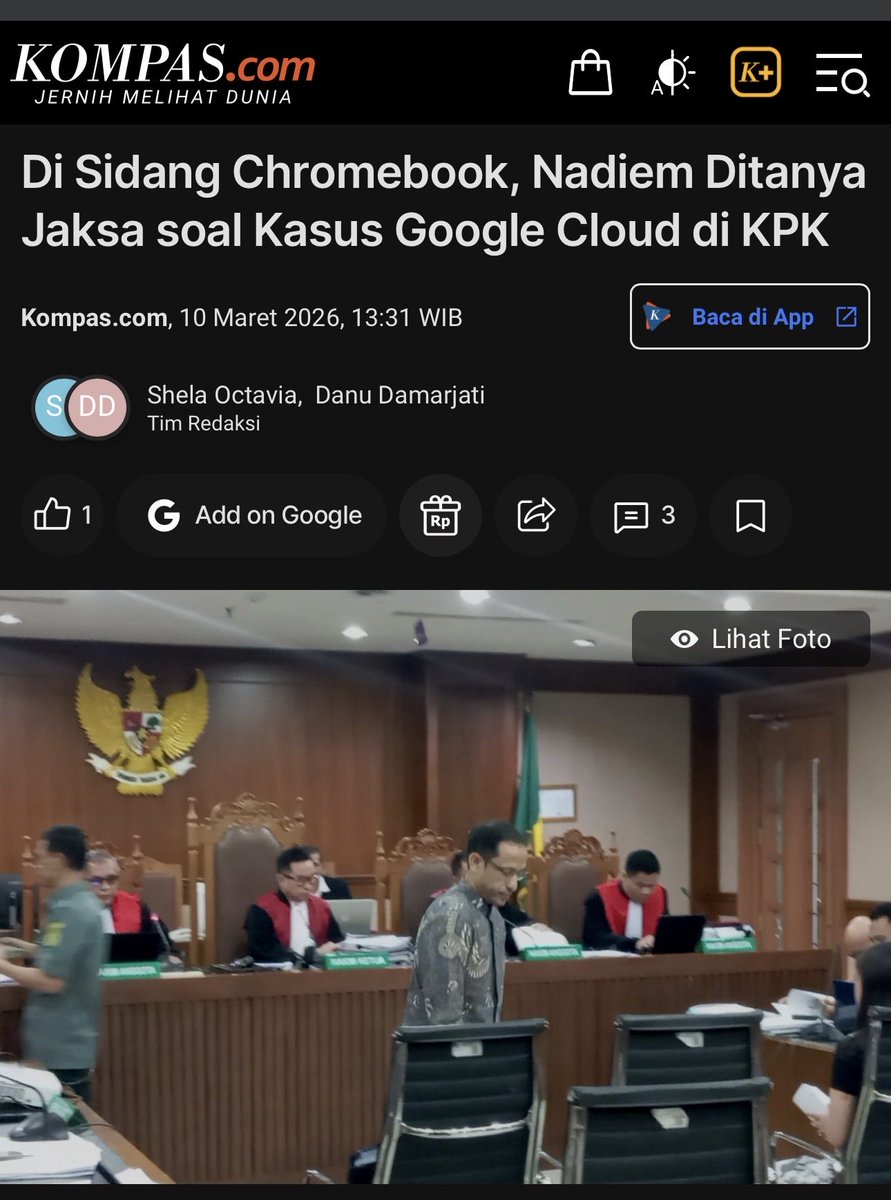
Perjalanan kasus korupsi Nadiem bukan cuma chromebook tapi ada juga Google Cloud. Mari malawan lupa!!
Kalau kasus google cloud sampai hilang menang banyak Nadiem. Banyangin permainan cantiknya, beli laptop chromebook dan google cloude ke google. Anggaran google clode itu 400 miliar pertahun dikali tiga tahun sama dengan 1,2 triliun.
Lalu google investasi ke goto, sebuah kebetulan yg ajaib. Kalau yang pernah dibilang Anggota DPR, Hinca Panjaitan, “kalau sebuah kebetulan terjadi berulang kali, maka itu bukan lagi kebetulan.”
Dirac couldn't get hired as an electrical engineer. A 19-year-old with a Bristol degree in 1921, during a post-war depression that had no use for him. So he stayed at Bristol and studied math for free because there was nothing else to do.
Two years later he got a fellowship to Cambridge. His advisor, Ralph Fowler, handed him proofs of an unpublished Heisenberg paper in August 1925. Dirac read it and realized the math resembled Poisson brackets from classical mechanics. Within months he had built an entirely new mathematical framework for quantum theory.
He published 11 papers before submitting his thesis. Eleven. Most PhD students struggle to publish one. Dirac had a body of work that constituted an entire theoretical foundation, and he still needed to package it into a dissertation to satisfy the degree requirements.
The thesis title tells you everything about the confidence level. When you title your PhD "Quantum Mechanics" at age 23, you are either delusional or correct. Dirac was correct. It was the first PhD thesis ever written on the subject.
Two years after that he wrote the Dirac equation, unifying special relativity with quantum mechanics and predicting antimatter before anyone had observed it. By 1932 he held the Lucasian Professorship of Mathematics at Cambridge. The same chair Isaac Newton held. He was 30.
Nobel Prize at 31. The youngest physics laureate at the time.
The entire arc from unemployable engineer to owning Newton's chair took 11 years. The field he named his thesis after is now the operating system of modern physics.
On The Big Bang Theory, Sheldon Cooper called 73 the best number. It sounds like a joke — but the math behind it is surprisingly beautiful.
First, 73 is a prime number. But it also holds a special spot in the list of primes. If you count them one by one, 73 turns out to be the 21st prime number. Now flip the digits of 73 and you get 37 which is the 12th prime number (21 reversed becomes 12).
Second, take the number 21 and factor it: 21 = 7 × 3. Those are the exact digits that make 73.
And finally, write 73 in binary (the language computers use): 1001001. Read it left to right or right to left — it’s the same. That makes it a binary palindrome.
aku mau respon postingan ini dari sudut pandang lain yagesyaa~
bayak yang liat video ini langsung label mereka zombie, tapi dari sudut pandang sains, apa yang terjadi di tubuh mereka itu jauh lebih kompleks dan lebih tragis dari sekadar label zombie itu.
yang mereka konsumsi namanya tranq dope, campuran fentanyl dan xylazine.
fyi, fentanyl itu opioid sintetis yang kekuatannya 100x lebih kuat dari morfin. zat ini bisa mengikat reseptor opioid di otak dan secara harfiah ngematiin sinyal rasa sakit.
selain itu, sintetis ini juga memicu pelepasan dopamin dalam jumlah yang melampaui apapun yang bisa dihasilkan otak secara alami.
oiya, fentanyl juga bisa menekan sistem pernapasan, detak jantung, dan tekanan darah ke level yang bisa mengancam jiwa.
sementara itu, xylazine atau tranq adalah obat penenang yang dipake buat hewan, bukan manusia. efek dari tranq juga mirip kek fentanyl, bikin napas lambat, detak jantung, dan tekanan darah ke level berbahaya.
terus, kalo efeknya mirip, kenapa dicampur?
xylazine dijual seharga $6-20 per kilogram dari supplier China. kartel Sinaloa dan Jalisco di Meksiko menggunakannya sebagai campuran untuk memperpanjang efek fentanyl sekaligus mengurangi jumlah fentanyl yang dibutuhkan, sehingga keuntungan mereka meningkat.
artinya, bagi pengedar, tranq dope itu biaya produksinya bisa ditekan dan lebih menguntungkan kalo dijual.
sementaradari kacamata pengguna, efek tranq dope lebih lama dari fentanyl murni, walau harganya lebih mahal.
efek di tubuh mereka, kombinasi fentanyl dan xylazine itu kek dua rem sekaligus di sistem saraf pusat.
otak bisa menerima sinyal euforia yang dar der dor dari fentanyl, sementara xylazine menekan hampir semua fungsi vital secara bersamaan.
makanya mereka kek mati sementara, kan? masih bernapas tapi pelan, detak jantung slow, otot lemes dan tubuh bisa jatuh dalam posisi apapun tanpa bisa mereka kontrol.
oia, xylazine itu bisa bikin luka terbuka di kulit walau ga ada luka di bagian tersebut sebelumnya. luka itu bisa membusuk dan meluas karna xylazine bikin vasokontriksi, kek penyempitan pembuluh darah yang bikin aliran darah berhenti ke jaringan sekitarnya.
nah, jaringan yang ga kebagian aliran darah itula yang bakal mati. itu kenapa xylazine disebut flesh eating, atau pemakan daging.
jauh-jauh lah ya wak, usah konsumsi narkoba jenis apapun biar redam penasaranmu untuk konsumsi narkoba jenis ini. ngeri kali.
sumber bacaan lainnya:
https://t.co/k7jH1r1HPZ
https://t.co/5foEC4DPL1
🚨 Hati-hati! Seniman manga Jepang kehilangan seluruh akun Google-nya secara permanen hanya gara-gara mengupload komik lama buatannya sendiri ke Google Drive. 😱
Google AI otomatis memindai file itu lalu langsung menandai sebagai pelanggaran. Ia sempat ajukan banding, tapi ditolak tanpa review manusia yang memadai, sehingga akunnya dibanned total.
Akibatnya bertahun-tahun gambar pribadi, email, dan akses login ke berbagai situs hilang begitu saja. Seniman itu bilang ini sangat memalukan dan merepotkan, lalu memperingatkan semua orang untuk lebih waspada.
Google memang secara terbuka melakukan scanning terhadap semua file di Drive, Gmail, dan Photos meski kita anggap private. Mereka memegang kunci enkripsi, jadi data kita bukan sepenuhnya milik kita.
Kasus ini jadi pengingat keras. Cloud storage memang nyaman, tapi kita tidak pernah punya kendali penuh atas data pribadi di sana.
Tapi ya kalo dipikir-pikir lagi scan data pribadi untuk AI itu ngga etis apalagi ga ada kontrol manusianya.
Photographer Phil Thurston shot a wave.
Slowed it down until those few seconds became 40.
Turns out the ocean is doing something extraordinary every single moment.
We're just moving too fast to notice.