I'm sure you've seen the article by @mattshumer at this point. Read it.
If you want to see where AI economic impact hits first, watch contact centers.
We have seen a massive increase in deployment velocity and enterprise commitment over the past few months.
Unpopular Opinion: We aren't building the future 10x faster with AI. We are just generating legacy code 10x faster.
Everyone is currently bragging about developer velocity. "I built this entire backend in a weekend!" "AI wrote 80% of my codebase!"
But here is the reality check we are ignoring: Code is a liability, not an asset.
If an AI tool spits out 1,000 lines of functional boilerplate in five seconds, that is still 1,000 lines that a human being has to read, review, secure, and maintain when the dependencies inevitably break next year.
We are treating code generation like a pure productivity win, but we are optimizing for the wrong metric. The bottleneck in software engineering was never how fast we could type. The bottleneck has always been comprehension, architecture, and maintenance.
If we don't shift our focus from "generation speed" to "architectural sanity," the tech debt of the next five years is going to be an absolute, unmaintainable nightmare.
"Service as Software" is Silicon Valley's hottest buzzword right now.
Everyone's talking about SaaS becoming service providers, but no one's explaining HOW. The answer? After 6 months of research and 100s of startup conversations, we have the answer: Systems of Agents.
We're looking at a $4.6T opportunity.
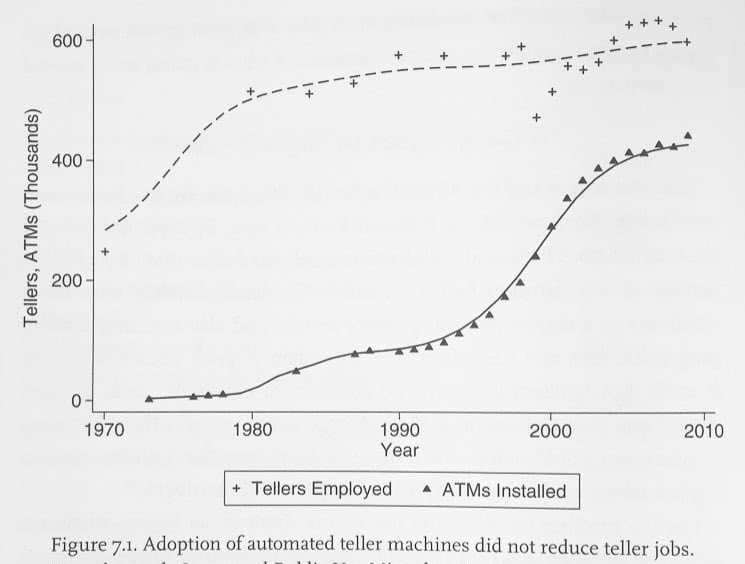
Bank teller employment continuing to grow during the rise of ATMs is a perfect example of how automation lowers the cost of delivering a particular task, letting you serve more customers, and thus growing the category. We are going to see this over and over again with AI.
What has happened in the last decade?
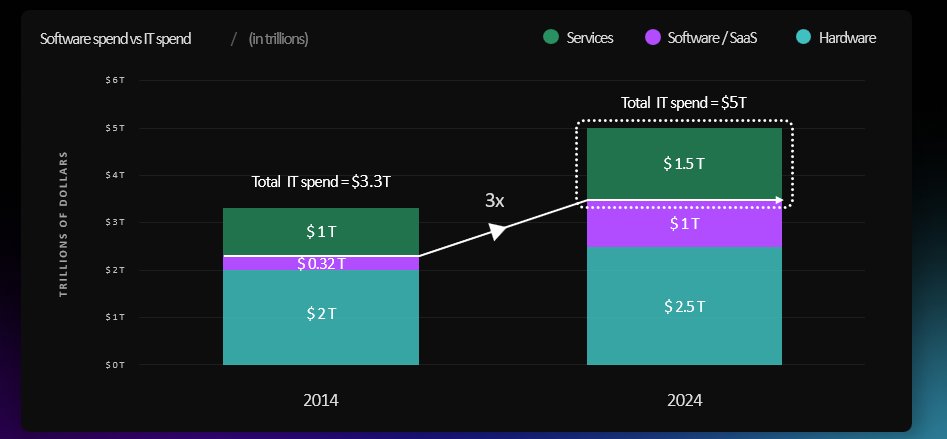
This bar chart shows how much companies worldwide spend on IT.
In 2014, IT spend was $3.3T.
In 2024, IT spend grew to $5t.
This spend consists of software, services, and hardware.
Software or SaaS spend, which is in purple, has 3x from $300b to over a $1T.
This growth occurred because in the last decade, software cannibalized the hardware part of IT spend.
This was primarily driven by the shift from on premise to cloud.
In the next decade, we believe software will cannibalize services spend.
@joannezchen