I’ve been a SpaceX $SPCX investor since 2020, before the IPO. What most people still don’t grasp is that SpaceX isn’t a company you value with a DCF. It’s a civilization company. The moment it succeeds at making life multiplanetary and captures even a fraction of the Sun’s energy, the economic system the model assumes no longer exists. You’re not discounting cash flows inside an economy. You’re discounting the replacement of the economy itself.
That’s why I told people before the IPO: don’t put money in until you deeply understand what this company is actually building. New investors saw rocket launches and data centers and bought the feeling of upside. That’s not the same as holding a civilizational thesis through a 50% drawdown. Elon’s “hold your shares” is a conclusion for him. For the market, it’s still an assumption most haven’t earned.
Once you truly understand what this company is set to become — how far ahead Starship is from every competitor, how dominant Starlink’s technology already is — price swings stop being threats. They become either noise you ignore or opportunities to add. You don’t panic-sell, because you’ve already done the work that makes panic unnecessary.
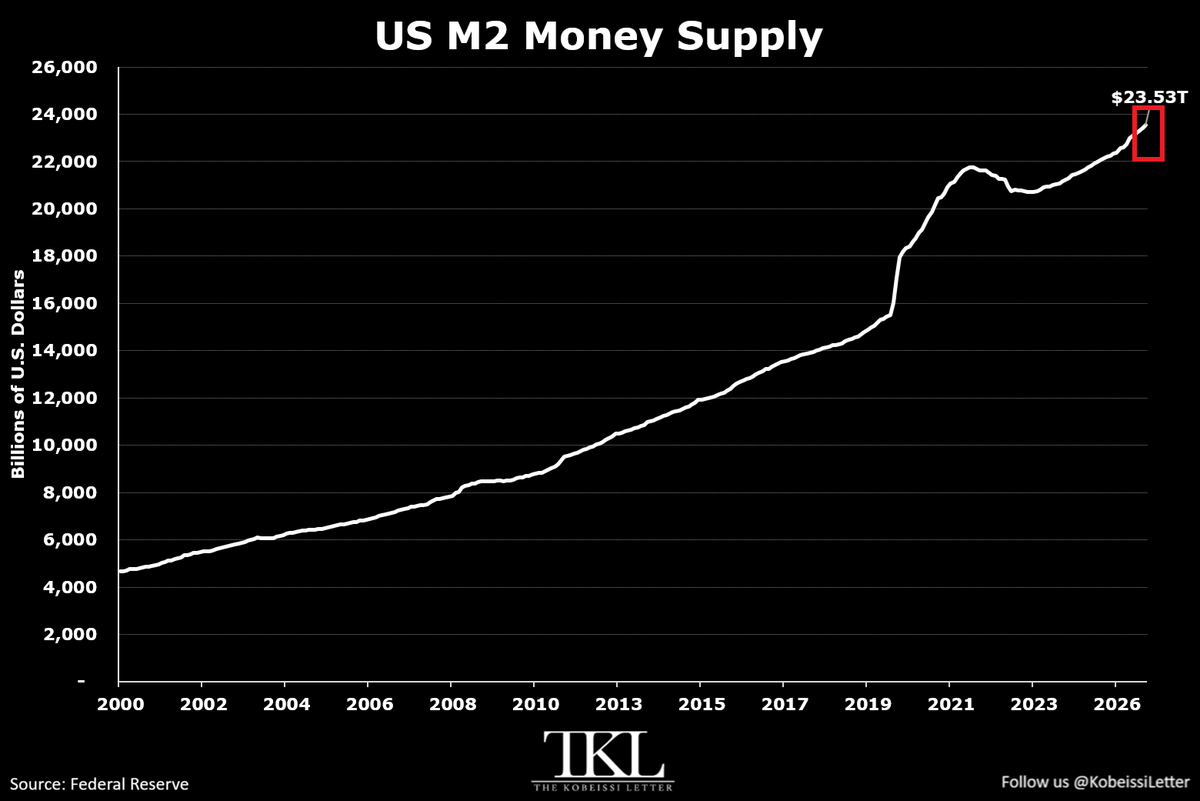
BREAKING: US M2 money supply surged +$119 billion in October, to a record $23.53 trillion.
YoY, M2 growth accelerated to +5.9%, its highest since May 2022.
This also marks its 32nd consecutive month of YoY growth.
Since October 2023, M2 has soared +$2.82 trillion, or +$78 billion per month on average.
US M2 money supply is now $8.18 trillion above its 2019 pre-pandemic levels.
The purchasing power of the US Dollar is in an eternal bear market.
An increasingly asset-heavy US economy that runs on credit will likely force a Fed pivot and create a buy signal for gold, commodities and cyclical assets. Not a Trump put. Until then, be cautious. A Trump put barely reaches the real economy or credit. Yesterday the Nasdaq rose 6.5%. IG moved 3bp. HY faded the move.
We have a dollar squeeze, and yesterday proved it. Only the Fed can end a dollar squeeze. Gold and copper still have downside risk until the Fed turns.
The Trump put stopped the forced selling. It lifted the collateral, margin calls stopped, and gold rose 4% with the Nasdaq. Gold rising with stocks tells you it was sold for cash. The panic went. The squeeze stayed.
On a risk-on day the dollar falls. Money leaves the safe haven. Yesterday stocks had their best day since April 2025 and the dollar rose to a new high. Nobody was hiding in it. They needed it.
A Trump put cannot replace a Fed pivot. It lifts the price of the collateral. It adds no dollars. Recessions are not conceived in the equity market. They are conceived in credit. An asset-heavy economy is a credit-sensitive one, and the Fed plans to make credit dearer in December, until it cannot.
Once we see a real pivot that reaches credit and dollar liquidity, then lock and load on gold, commodities and cyclical assets. Until then, be prepared for more downside that will wake up policymakers to the increasingly asset heavy world we now live in.
Objective Analysis Is Dead on Wall Street
Objective analysis is dead on Wall Street. The job was to question the story. Now Wall Street repeats it, trades it and calls it research. This month it swallowed three stories whole.
First, the spies. A New York Times report that a businesswoman close to Jensen Huang was recruited by China’s spy agency has run through every story on Nvidia. Nvidia says no secrets were compromised, and its board judged Huang no security risk. The accusation still travels farther than the qualification. Durham found the FBI could not corroborate a single substantive allegation in the Steele dossier. The 51 former intelligence officials who flagged the Hunter Biden laptop as Russian disinformation conceded they had no evidence. Credentials did the work evidence could not.
Second, the election. Democrats swept the midterms, and the AI buildout was declared finished. Chip stocks are down 17 per cent since election day. Nobody checked with the customers. Big Tech guides $ 720 billion to $ 740 billion of capital spending this year, and none cut. Rent on a two-year-old H100 hit a record $ 3.46 an hour last week. Nobody pays record rents for a dead technology.
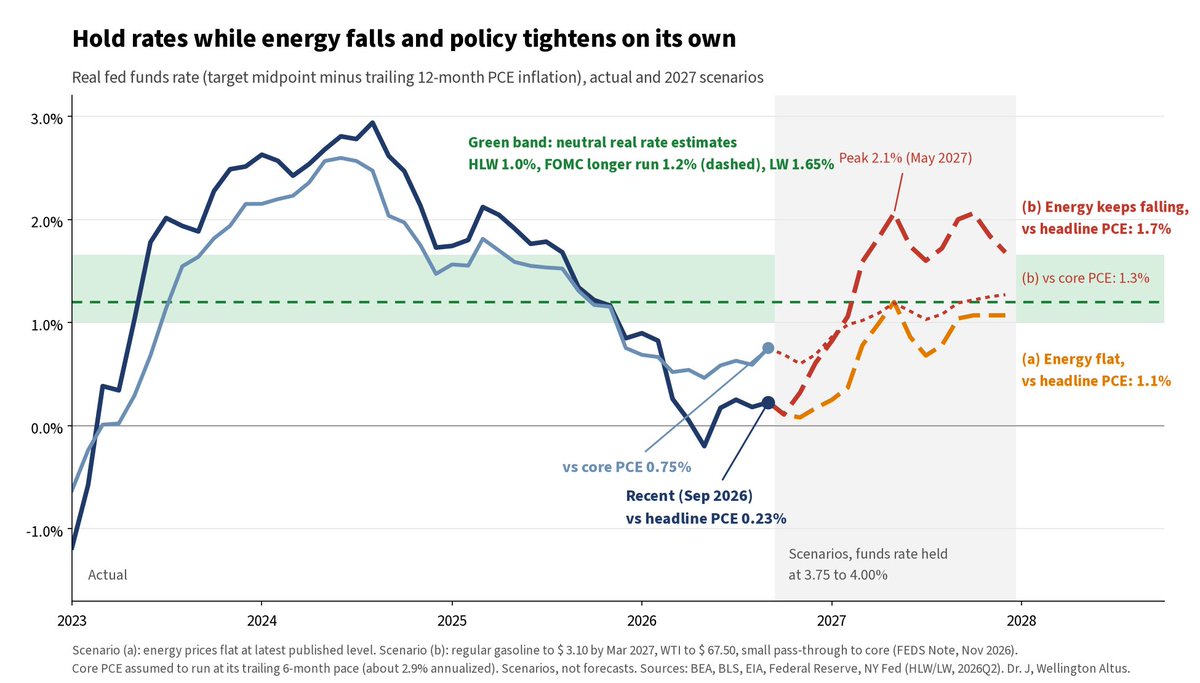
Third, the Fed. Fedspeak is uber-hawkish. Waller wants a half-point hike to “shock people.” Musalem floats four more hikes by spring. Wall Street salutes, with strategists calling for 50 basis points in December.
Monetary policy is a sledgehammer, not a fine-tuning instrument, and it works with long lags. Look through the windshield. There is a glut of oil, and Saudi Arabia has pivoted to fight for market share. West Texas crude is near $ 81, from $ 115 in April. Wholesale gasoline is $ 2.41 a gallon. The crack spread has halved since September. Add the base effects falling off this spring, and any objective view concludes the real fed funds rate is headed to extreme levels: from 0.2 per cent today to roughly 1.9 per cent by mid-2027, with no hike. The Fed is steering by the rear-view mirror.
Three stories, three questions nobody asked. Suspicion passes for knowledge, an election for a valuation, severity for rigour. Objective analysis is dead on Wall Street, and investors are paying for the funeral.
Michael is brilliant. He was one of the reasons I made 600% in 2023 across the portfolio and someone I should have listened to more near the end of 2025.
Traditional and onchain finance continue to converge.
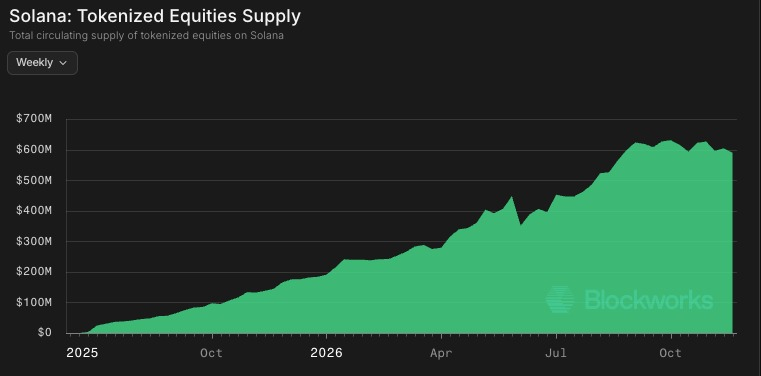
As tokenization has become increasingly popular in US markets, tokenized stock on Solana can now serve as collateral.
For example, owners of Ondo's tokenized Tesla stock, $TSLA, can be utilized as collateral for DeFi lending.
This means investors can now obtain liquidity without directly selling exposure to the underlying asset.
Meanwhile, institutional activity now includes JP Morgan, BNY Mellon, State Street, and others using Solana-related infrastructure in different capacities.
This shift has driven tokenized equity supply on Solana to over $600 million, up +210% YTD despite the broader market drawdown.
Jupiter, the largest onchain platform on Solana, has reported a 72% QoQ increase in volume in these tokenized assets amid the shift.
The future of finance is quickly moving toward tokenization and more efficient transactions.
Elon found the most profitable job in the entire AI boom, and it's renting chips to Anthropic for about $3.1 billion a month.
He's the only AI boss being honest about where the money is, and the rest of the industry should be worried about what he figured out.
The New York Times reported on Monday that Elon has told SpaceX staff the company is falling behind in AI, and that renting computing power to rivals pays better than building Grok.
SpaceX disbanded its 60-person Grok Imagine team this month. It shut its AI companions project in September.
Back in August, Elon told his engineers that competitiveness comes down to "revenue per GPU, not benchmarks."
That one line explains the whole move.
And the rent on those GPUs is ENORMOUS:
Anthropic's own IPO filing says it agreed to pay SpaceX's AI unit up to $120.5 billion over terms running into 2029.
Once all the capacity is delivered, which the filing expects in December, that's roughly $3.1 billion a month. That's about $37 billion a year from ONE customer.
Google signed its own deal in June for about 110,000 Nvidia GPUs.
So 2 of the biggest names in AI are paying the company that runs Grok for the compute behind the models that compete with Grok.
And the numbers in SpaceX's own quarterly report are wild:
Its AI segment, which lumps chip rentals together with Grok, Cursor and X, brought in $7.56 billion in the third quarter. That's just over half of SpaceX's $14.575 billion in total revenue.
That segment made $431 million of operating profit. A year earlier it LOST $1.722 billion.
And this is where it gets really interesting:
The model business keeps getting cheaper to copy. Prices fall every few months, open models close the gap, and every lab has to keep spending to stay at the front.
The landlord doesn't care who wins that race.
Anthropic owes the rent whether Claude's prices go up or down, at least through early 2027. Google owes its rent whether Gemini wins or loses. And SpaceX gets paid either way.
That's the same reason Nvidia printed money for 3 years. Elon just built himself a second version of that trade and got his rivals to pay for it.
But this deal has a real weak spot:
The rent isn't locked in for long. Anthropic's filing says the initial non-cancelable periods end in January and March 2027. After that, either side can walk away with 90 days' notice.
Meanwhile Elon said in October that SpaceX had secured $40 billion of debt for GPUs arriving in the first half of 2027. The segment put $16.4 billion of capex to work in Q3 alone.
So SpaceX is borrowing long to rent short.
If Anthropic's other capacity comes online and it gives notice in 2027, SpaceX is holding tens of billions of dollars of fresh chips with nobody paying for them.
Elon clearly doesn't think that happens. He said at DealBook last week that Anthropic told him it's "extremely likely" to keep renting, and wants significantly more.
He might be right. Anthropic keeps asking for more compute, and so does everyone else.
But that's the bet: SpaceX traded the uncertain upside of winning the model race for rent checks from the companies still running it.
And when the richest man in the world, who owns one of the biggest AI clusters on the planet, decides the chips are worth more than his own chatbot, I'd take that as the clearest signal yet about what AI models are actually worth.
We'll see at least one more company that builds its own AI models start renting its GPUs to rivals, because Elon already showed that the rent pays better than the race.
Stablecoin holdings in Western Europe personal wallets surged 131%, far outpacing global growth of 52%.
Holdings rose in every country we measured. Austria (+308%) and France (+281%) saw the strongest gains. The region’s share of global stablecoin balances rose from 3.4% to 5.1%.
Euro-backed stablecoins could play a bigger role in Europe's digital financial infrastructure, even as regulators and banks weigh the risks to financial stability and monetary sovereignty.
The vast majority of stablecoin activity in Europe is still denominated in U.S. dollars.
Buy when there is blood in the streets!
Extreme fear is setting up the next leg higher
The S&P 500 has fallen 11.6% from its October high in seven straight sessions. Friday’s close sat 4.1 standard deviations below the 50-day average, the most oversold reading since August 2015. The Arms Index posted back-to-back capitulation readings. This is what extreme fear looks like, and extreme fear has historically marked buying opportunities, not the start of bear markets.
The market closed the week at 6,910, right on 6,900, the key Fibonacci support level of this year’s rally. Fast V-shaped recoveries form within days of capitulation, and corrections that hold support don’t become bear markets. From 6,900, the strongest past fast-V recoveries delivered 12-month gains of up to 38%, which puts 9,500 within reach. The timing adds to the case.
The market is entering the sweet spot of the four-year presidential cycle, and the S&P has been higher a year after every midterm election since 1950.
Add a Fed pivot, and 10,000 is still in play. S&P 500 earnings will reach $450 in 2027, so the only argument is over the multiple. With the energy crisis passing, the 10-year Treasury yield will head to 4%, and the Greenspan Fed model then implies a multiple of 25.
Even 22 times earnings gets the index to 10,000. Nothing has changed except the level of fear. There is no recession and no financial crisis, and investors will come to see AI not as a three-year buildout but as something like the railroads.
Fear flips to greed, as it did in 1998. After the Asian currency crisis and the Russia and LTCM shock, the S&P 500 fell 19% from its July peak. The Fed cut three times, the index regained its high by late November, and a year after the October low it was up 39%. When the Fed has eased after a no-recession sell-off, as in 1998, 2019 and 2025, the median 12-month gain has been 33.7%.
Many cite the 1990s to argue that the supply of AI capacity is outstripping demand. That’s wrong. The real lesson of the 1990s is the one Alan Greenspan drew: productivity gains let an economy run hot without stoking inflation. In 1995, after the Fed pivoted from hiking to easing with no recession, the S&P 500 gained 34.1%, the best pre-election year since 1950.
Leveraged products now amplify every swing between fear and greed, and this week’s selling was fear at full volume. The old saying is to buy when there is blood in the streets. Today there is no recession and no financial crisis, the energy shock is ending, and productivity and earnings are growing strongly. A Fed pivot is coming, and the market is cheap.
That’s the time to buy.
Here's how the AI bubble bursting will make Elon Musk and SpaceX win.
Let's start with what Democrats figured out.
In the midterms, they won by running against data centers. Bernie Sanders wants a national moratorium. And they understood one thing: AI can't really be regulated anymore. The models are everywhere, many of them are open source, and they run on millions of machines.
But a bubble can be popped.
And today's AI sits on a mountain of debt. The labs lose more money than they make. Big Tech will spend over $800 billion on infrastructure this year, more than their businesses generate in cash. Lenders are getting nervous. Blocking data centers is aiming exactly where it hurts.
I think some of them have run the math, consciously or not.
First, superintelligence is going to become a commodity. Like an operating system. Like Linux. When ten models do the same thing and open source is six months behind, there's no moat at the model layer. Nobody pays a premium for intelligence that can be copied.
Second, value is going to move to infrastructure. Chips, energy, cooling, launch. The ones who own the atoms, not the ones renting someone else's.
And two players stand out. Google on Earth, with its own chips, its own cloud, and twenty years of ad money funding it all. And Elon Musk in space, with SpaceX, which absorbed xAI in February for one reason: to put compute in orbit, where the sun almost never sets.
Third, the two big labs, OpenAI and Anthropic, are the most exposed. Massive valuations, massive losses, rising debt. If the money stops flowing, they could go down.
So the logic is simple: if you can't regulate AI, starve it of capital. And if the American economy, which now leans heavily on that investment, goes down with it, so be it. When your power rests on scarcity, you'd rather have a recession than abundance.
But they forgot one thing.
A bursting bubble doesn't kill a technology. It kills the fragile.
In 2000, the dot-com bubble burst. https://t.co/vAW0rIhzhu shut down. Then WorldCom and Global Crossing went bankrupt. Amazon lost more than 90% of its value. Everyone declared the internet dead.
Twenty years later, Amazon is worth trillions, and the fiber laid by the companies that went bust carries the entire web.
The crash didn't kill the internet. It sorted the winners from the losers. And it handed the keys to the most antifragile.
This time will be no different. The labs living off fundraising will suffer. The ones who own the infrastructure will buy up assets at fire-sale prices and come out stronger.
And the most antifragile of them all is Elon. SpaceX has a business that runs without AI: launch and Starlink. And his bet is compute that needs neither the power grid nor a local building permit.
You can vote a moratorium in every county on Earth.
You can't vote one in orbit.
BREAKING: Nvidia, $NVDA, is set to post the largest 45-day loss in market cap by any stock in history, down -$2.55 trillion from the October 6th high.
Nearly 40% of the total market cap lost by the S&P 500 since October 6th has come from Nvidia alone.
It's clear now more than ever:
Ultimately, this bear market in tech stocks will be remembered as the best buying opportunity of the last decade.
Unless your view is that the AI is worthless and the AI Revolution is over, many key parts of this market are extremely cheap.
Democrats will be more friendly to AI than expected, Nvidia will survive its leadership crisis, and concerns around CapEx and free cash flow will prove to be overblown.
To top it off, current sentiment is as if the market has just gone through another 2008, all while the S&P 500 is posting +32% earnings growth.
The comments on this post will show you just how polarized sentiment has become in the direction "bubble" callers.
Fear creates an investor's biggest opportunity.
Bookmark this post.
My first appearance on @KitcoNewsNOW comes amidst a sell-off on gold and other precious metals.
@JeremySzafron asked me where I stand on gold at the moment and whilst I said I was cautious, it's not because of gold itself, but because of the wider liquidity squeeze that is emerging.
Gold is a hedge against a longer-term solvency crisis, not an immediate liquidity squeeze. When dollars become scarce, investors sell what they can to raise cash, and gold happens to be one of the easiest assets to liquidate.
Remember what I said on @business last week about the two boogeymen of commodities - scarcity and debasement: Scarcity is the fear of running out of the commodity. Debasement is the fear of running out of money.
Pair that with the issuance of debt from costly data centre build-outs, issues with NASDAQ and the equity sell-off, a looming interest rate hike, and you've got a huge demand for dollars at a time when supply is decreasing. It has created the perfect storm to release gold, copper and other hard assets to raise cash.
So, where gold is currently susceptible to dollar liquidity, oil is a different story, and it all comes down to economics of storing inventories.
With industrial metals, storage is relatively cheap. You need a physical location, a chain-link fence and a guard dog. You can stack inventories to the moon if you wanted to - the point is, it much easier to build up stocks and liquidate them when you need to raise cash.
The same doesn't apply to oil: storing large volumes of oil requires expensive infrastructure and carrying costs. You can't store quantities of oil as you would gold on anywhere near the same scale.
The bottom line: Dollar liquidity pressures can drive selling across the market, but oil is far less exposed to liquidity dynamics - and crucially, those dynamics do not make the physical cost of delivering said oil any cheaper.
My interview in full will be release shortly, so stay tuned for that - a great discussion with Jeremy, thank you for having me on.
Thrilled to announce $5B in funding for @IsomorphicLabs to accelerate our mission to Solve All Disease. We continue to make rapid progress reimagining drug design from first principles with AI to radically cut the time & cost to find new medicines. Gradually, then all at once...
BREAKING: China’s central bank officially bought +26 tonnes of gold in October, its biggest monthly purchase since August 2023.
This follows +23 tonnes acquired in September, and marks its 24th consecutive month of gold purchases.
For perspective, in 2025, China’s gold purchases did not exceed +5 tonnes in any month.
Year-to-date, China has officially acquired +129 tonnes of gold, lifting its holdings to a record 2,435 tonnes.
As a result, China now holds just 2 tonnes less gold than France, the world’s 4th-largest gold holder.
China’s demand for gold shows no signs of slowing.
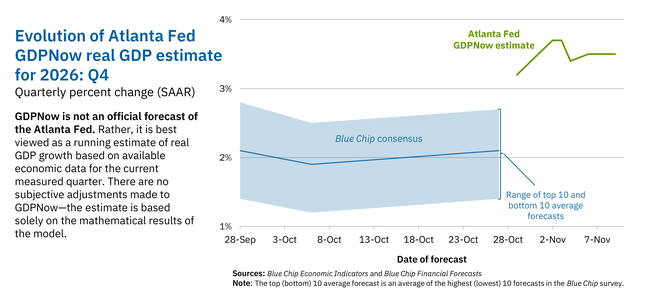
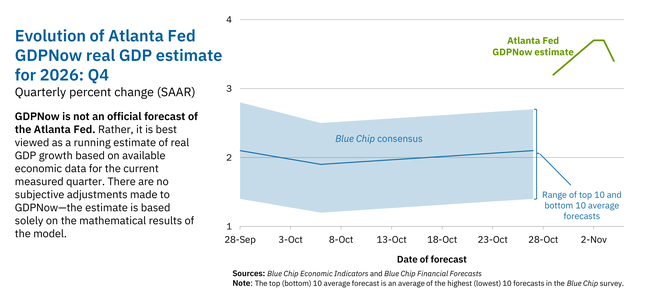
On November 9, the #GDPNow model nowcast of real GDP growth in Q4 2026 is 3.5%: https://t.co/T7FoDdgYos. #ATLFedResearch
Download our EconomyNow app or go to our website for the latest GDPNow nowcast: https://t.co/JPMzsC5TNo.
On November 4, the #GDPNow model nowcast of real GDP growth in Q4 2026 is 3.4%: https://t.co/T7FoDdgYos. #ATLFedResearch
Download our EconomyNow app or go to our website for the latest GDPNow nowcast: https://t.co/JPMzsC5TNo.
On October 28, the #GDPNow model nowcast of real GDP growth in Q3 2026 is 3.3%: https://t.co/T7FoDdgYos. #ATLFedResearch
Download our EconomyNow app or go to our website for the latest GDPNow nowcast: https://t.co/JPMzsC5TNo.