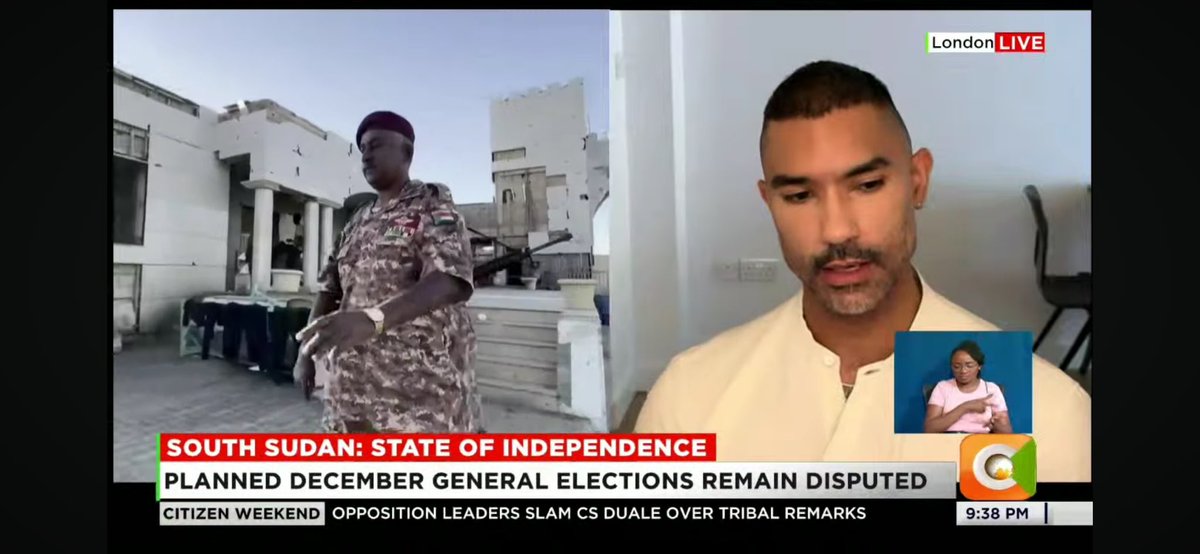
It is deeply irresponsible for a media house of your stature, @citizentvkenya, to report on South Sudan while simultaneously airing footage of the Presidential Palace in Khartoum, Sudan. Such a glaring editorial error reflects a troubling lack of diligence in fact-checking and content verification. The editor and producer responsible for this broadcast should be ashamed of allowing such a fundamental misrepresentation to reach the public. Accuracy is the cornerstone of credible journalism, and mistakes of this nature undermine public trust.
@citizentvkenya@OBurrows@MediaCouncilK
An interesting debate, this one........My response to this interesting topic.
1. Every generation tends to develop strengths based on the realities it grows up in. Millennials came of age in environments where stability, endurance and “pushing through” difficult systems were often necessary for survival. Gen Zs, on the other hand, have grown up in a period where speaking out, questioning authority and prioritising dignity and mental well-being are more accepted and visible.
2. Neither approach automatically makes one generation stronger or weaker than the other. They are simply responding to different economic, political and social conditions.
3. At the same time, responsibility does change how people make decisions. When people become responsible for families, mortgages, medical bills and dependants, risk is no longer personal alone. That reality has shaped many millennials’ choices, just as today’s realities are shaping Gen Z behaviour.
4. But it is also worth noting that courage can take different forms at different stages of life. Sometimes courage is confrontation and demanding change publicly; other times it is endurance, sacrifice and quietly holding families together under pressure.
5. So perhaps the debate should not be about which generation is “better,” but about recognising that each generation develops different survival tools for the times they inherit. The real test for every generation comes when ideals meet responsibility, and history usually gives a more balanced verdict with time.
The debate between Gen Zs and millennials is totally imbalanced because we are comparing people at very different stages of life, under very different burdens, and then pretending the answers are already clear.
Gen Zs are right to say they are bold, outspoken and less willing to tolerate humiliation, especially in workplaces, politics and society. That is a good thing, and Kenya has benefited from that courage. But millennials are also not weak simply because many learnt how to endure bad systems, survive quietly, keep jobs, swallow pride and carry responsibilities without making noise every day.
The truth is that we may not get the real answer now. We will only know when Gen Zs are in their 30s and 40s, with children in school, ageing parents to support, rent or mortgages to pay, medical bills arriving without warning, loans hanging over them, and entire households depending on one salary.
That is when life tests political courage, workplace courage and social courage differently. It is easy to say people should walk away from oppressive spaces when you are mostly carrying yourself. It becomes more complicated when your resignation, rebellion or public confrontation can immediately affect your children, your parents, your spouse and everyone who eats from your table.
So maybe millennials were tough in survival while Gen Zs are tough in confrontation, but the debate is not complete until both generations have faced the same weight of adult responsibility.
Let us wait and see whether the same fire remains when life adds school fees, hospital bills, dependants, debt and the fear of one wrong move collapsing a whole family.
Until then, this argument is interesting, but it is not settled......
Kenyan boxing, regrettably, has devolved into a spectacle devoid of professionalism or discipline. There is little that reflects seriousness, structure, or clinical preparation within the sport in its current state.
The so called “Mbavu the Destroyer” by all indications, appeared inadequately prepared—seemingly more preoccupied with social visibility and clout than the rigorous training such a contest demands. In stark contrast, his opponent approached the bout with the level of dedication and focus befitting a life-defining opportunity.
The environment at the venue further compounded this disappointment. The crowd was unruly, the atmosphere chaotic, and the excessive noise and disorder undermined any sense of organization or respect for the sport.
While Obinna’s efforts to support and elevate boxing are commendable and deserve recognition, the overall execution reflects deeper structural shortcomings within our sporting ecosystem.
Taken together, this was a deeply underwhelming display—one that underscores the urgent need for reform. A fair assessment would place it at no more than 3 out of 10.