Google has shipped a CLI for Google Workspace (Drive, Gmail, Calendar, Sheets, Docs, …) Huge!
Written in Rust, distributed through npm & https://t.co/egfC60tXum
$ npm i -g @googleworkspace/cli
$ npx skills add github:googleworkspace/cli
2026 is the year of Skills & CLIs
https://t.co/8jd16P5ncR
Introducing Lyria 3, our new music generation model in Gemini that lets you turn any idea, photo, or video into a high-fidelity track with custom lyrics.
From funny jingles to lo-fi beats, you can create custom 30-second soundtracks for any moment.
See how it works. 🧵
your brain is constantly running next token prediction on the world, rewiring itself to predict the content you consume
training with diverse contexts is great, but it's critical to learn when to set certain token spans to loss_mask=0
I'm Boris and I created Claude Code. I wanted to quickly share a few tips for using Claude Code, sourced directly from the Claude Code team. The way the team uses Claude is different than how I use it. Remember: there is no one right way to use Claude Code -- everyones' setup is different. You should experiment to see what works for you!
on subtraction
adding is easy. someone asks for a feature, you build it. user hits a bug, you patch it. flow feels blocked, you add a shortcut. new trendy idea, you add a new concept. repeat until you have 50 buttons and no one knows where to start.
the hard part isn't building anymore. it's choosing:
- what to make – and what to leave out
- how to make it – so it strengthens the system instead of fragmenting it
- what to remove – even when it works, if it doesn't belong
addition is momentum. subtraction takes conviction.
you have to see the whole, not just the parts. you have to believe that fewer things, done right, will carry more weight than a hundred things scattered.
most products don't die from missing features. they die from accumulation. from losing clarity. from becoming everything and meaning nothing.
think slower, then act fast. slow down after the burst. tie it all back. so the foundation can carry what comes next.
keep focused, and simplify.
WHY WE SHOULD GO TO MARS: ELON MUSK ON SECURING THE FUTURE OF CONSCIOUSNESS
Going to Mars isn’t about escape—it’s about insurance. It’s about making sure the light of consciousness doesn’t go out if something catastrophic happens on Earth. Elon has consistently framed the Mars mission as the single most important step humanity can take to ensure long-term survival and expansion.
“The key branching point for human destiny or destiny of consciousness as a whole is that Mars is self-sustaining, even if the resupply ships from Earth stop coming. You’re not multiplanetary until the planet can grow by itself. Because there’s always some risk of technology on Earth falling below a certain level or of a nuclear war or a meteor. You haven’t secured the future of civilization and consciousness until both planets can survive independently.”
This is why Mars matters:
• Backup for humanity — A second home protects against single-point failures (asteroids, supervolcanoes, pandemics, nuclear conflict, AI misalignment, etc.).
• Self-sustaining civilization — Once Mars can grow its own population and industry without constant Earth resupply, consciousness becomes multiplanetary and far more resilient.
• Inspiration & progress driver — The challenge forces breakthroughs in energy, life support, materials, AI, and closed-loop systems that benefit Earth too.
• Long-term species survival — Staying on one fragile planet forever is a gamble with extinction-level risks. Mars turns that into a hedge.
Every Starship launch, every refueling test, every iteration brings us closer to that branching point. It’s not luxury—it’s the ultimate act of responsibility toward future generations.
There's an app I use regularly that's defective. I'm weighing in my mind whether I should send feedback and hope it gets attention from its creators, or re-build it with AI from scratch.
This is a tiny app so it's plausible for me to do it. But if you're in the business of selling software, this is how your every customer is thinking now, or how they'll be thinking soon.
Iteration velocity matters more than ever before. How quickly you fix, improve, and ship is your counter-signal.
Unpopular opinion:
Current code review tools just don’t make much sense for AI-generated code
When reviewing code I really want to know:
- The prompt made by the dev
- What corrections the other dev made to the code
- Clear marking of code AI-generated not changed by a human
Introducing useAgent() with @AgnoAgi
Build seamless fullstack agent applications with Agno & CopilotKit.
Let users steer agents and collaborate- live in the UI, including:
- Chat UI
- Generative UI
- Frontend Tool Calls
- State Synchronization
...and more!
const agent = useAgent(Agno)
Get started 🔗👇
Some of the best career advice I've ever gotten: comfort is the enemy of learning. If an opportunity is a little intimidating and feels like a stretch - it's probably the right opportunity.
This is exciting; I expect we are going to see a lot more things like this and it will be one of the most important impacts of AI. Congrats to the Future House team.
https://t.co/Cxeh8UlWdk
We just launched structured outputs in the Claude API.
You can make sure Claude responses always match your specified JSON schemas or custom tool definitions, without retries or parsing errors.
Our 7th gen TPU Ironwood is coming to GA!
It’s our most powerful TPU yet: 10X peak performance improvement vs. TPU v5p, and more than 4X better performance per chip for both training + inference workloads vs. TPU v6e (Trillium). We use TPUs to train + serve our own frontier models, including Gemini, and we’re excited to make the latest generation available to @googlecloud customers.
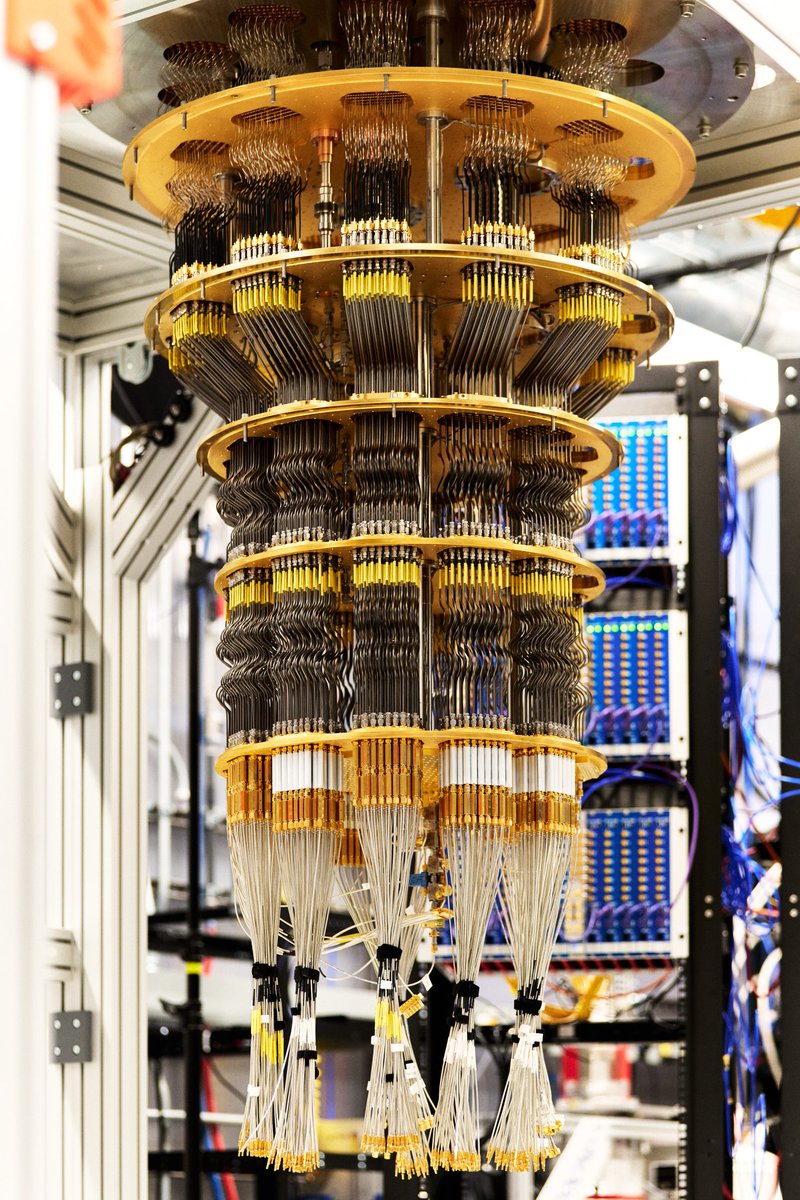
New breakthrough quantum algorithm published in @Nature today: Our Willow chip has achieved the first-ever verifiable quantum advantage.
Willow ran the algorithm - which we’ve named Quantum Echoes - 13,000x faster than the best classical algorithm on one of the world's fastest supercomputers. This new algorithm can explain interactions between atoms in a molecule using nuclear magnetic resonance, paving a path towards potential future uses in drug discovery and materials science.
And the result is verifiable, meaning its outcome can be repeated by other quantum computers or confirmed by experiments.
This breakthrough is a significant step toward the first real-world application of quantum computing, and we're excited to see where it leads.
One of the most fun parts of OpenAI is watching people here level up so fast and do such excellent work.
We are operating at a high level across many different disciplines and many of the people doing it have never done it before, and joined us at the beginning of their career.
If you believe in people and give them a lot of responsibility and support (and pick the right people to bet on) you will be surprised on the upside more often than you think.
I would love to see more companies operate this way and think we would all benefit.
(This was also one of the most fun parts of startup investing.)