@chamath Sounds like the state of pur prescription drug economy: ‘We would explicitly be forcing American companies to pay $26-56 per 1MM tokens for the same intelligence their adversaries/competitors around the world would pay $0.50-1 for.’
This is concerning. For the first time, a Chinese model Kimi K3 has taken #1 on the Frontend Code Arena and is scoring at or near the frontier on other benchmarks.
Meanwhile America is tying itself in knots: politicians and bureaucrats are banning new data centers, piling on state regulations, and pushing for new federal agencies to pre-approve frontier models.
This is how you lose the AI race. The rest of the world won’t play by our rules if we bog ourselves down. Permissionless innovation is how America won the internet and became the technological envy of the world. We can do it again with AI -- while addressing risks in a targeted way -- or we’ll watch our lead evaporate.
I can finally talk about GPT 5.6.
I’ve been using it for many months, if not decades. And what is glaringly obvious to me now, as I look back on my life, is that you did not have access to it.
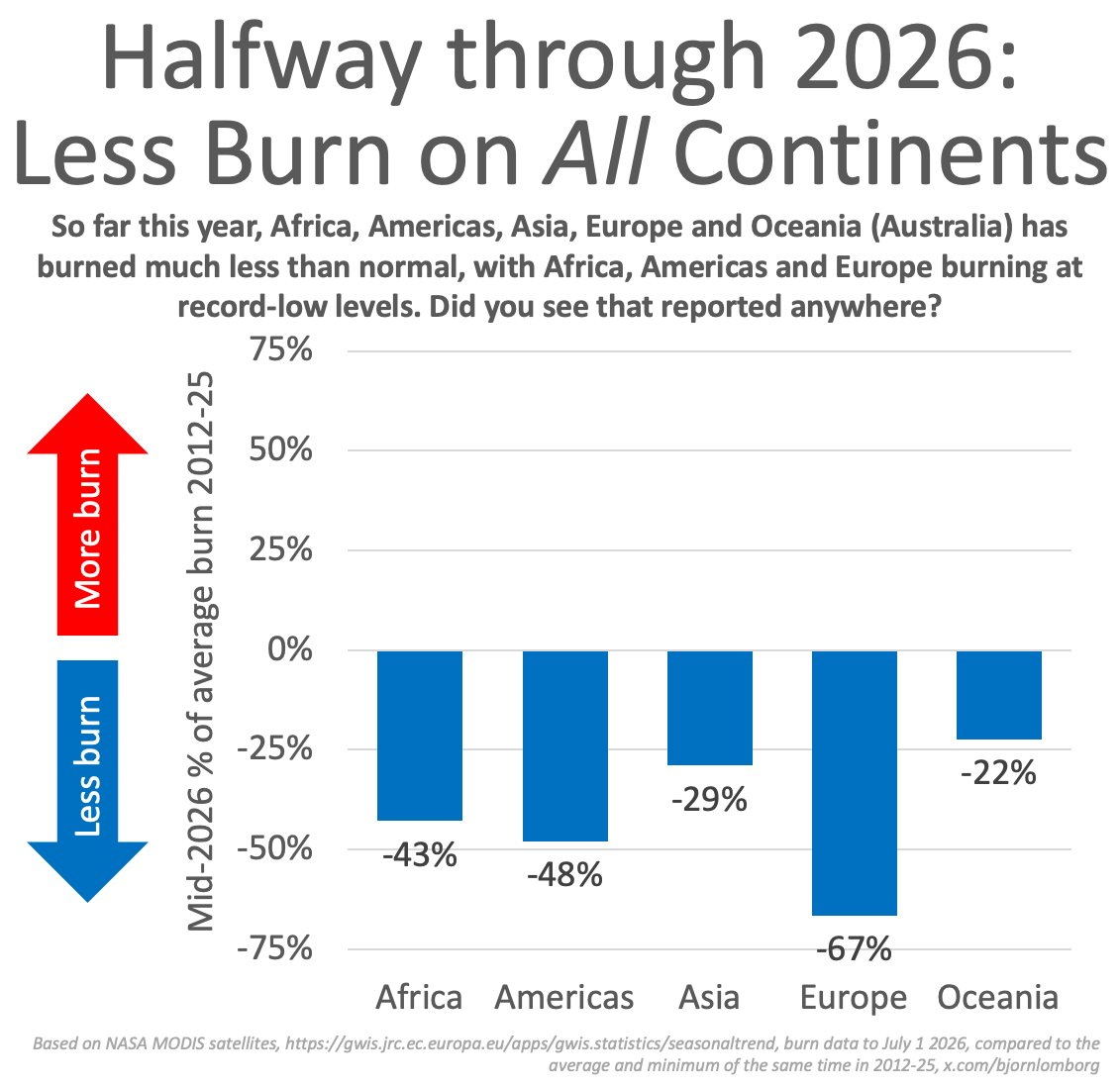
Less Global Fire
Halfway through 2026, the world has burned at record-low levels
Every continent is below average, and Africa, Americas, and Europe are at record lows
Media only shows when stuff is burning, leaving us badly informed on climate change
https://t.co/iDqlYckvRT
As engineering, product, design, DS, etc. melt into a new kind of role, I was reflecting on what roles might look like in the future. For example, when I look at the Claude Code team I see what I think is five archetypes:
1. Prototyper: comes up with brand new ideas; churns out many ideas, most of which don't ship
2. Builder: quickly turns a prototype/idea into production-grade product/infra
3. Sweeper: cleans up the UI, simplifies the code and system, unships, optimizes performance
4. Grower: takes a product that has been built and iterates on it to improve Product-Market Fit
5. Maintainer: owns a mature system to make it secure, reliable, fast, and efficient as it scales
Many people span across 2 roles, and sometimes 3 roles. I also notice that these roles are not really tied to job function -- eg. across Anthropic, some designers match category 1, some 2, some 3; same for engineers, PM, DS.
A healthy team needs a mix of these, depending on the product:
- A product that is new and pre-PMF needs people that are strong at 1+2+3
- A product that is growing and has found PMF needs 2+3+4 and some 5
- A product that has strong PMF needs 3+4+5 and some 2
Maybe product roles of the future will look more like this, and less like the domain-specific roles of today?
I disagree with this decision and I don't like it.
But also...
HOW DID ANTHROPIC NOT SEE THIS COMING‽
It is *the* obvious response to "this is too dangerous for anyone except us to use", since that relies on a premise ("we are uniquely good") that almost no-one agrees with.
hi there! we couldn’t help but overhear you discussing biology from across the room. we really appreciate your enthusiasm, but we’re going to need that conversation to come to an end now
Hot take: They're not subsidized their margins are insane. They are just absolutely raping api customers. Anyone who has used deepseek or hosted anything and done the math on hardware/power costs knows this
i hate how a few people will use a term and it will just become the "thing you should be doing."
99.9999% of you should in fact not being "looping" your agent
@pbakaus I feel like people are missing the point.
These technologies aren’t replacing designers, they are expanding the scope and enabling more creative and superior output than before.
One/few shotting isn’t the benchmark.
I often wonder how many extraordinary people waste their entire lives waiting for permission from some invisible arbiter that doesn't even exist.
Misery loves those who wait. Those who look around waiting for someone to come tap them in. To give them permission to do the things they want to do.
I spent most of my life waiting for permission. Permission to live differently. Permission to pursue my weird interests. Permission to share things with the world.
But the truth is that we live in an increasingly permissionless world.
Technology has cracked the walls of credentialism.
Opportunity is more freely accessible than ever before. You don’t need a stamp of approval. You just need to create things of value. You just need to go do things.
Your entire life will change when you stop waiting for permission to live the life you want. Good things don’t come to those who wait. Good things come to those who tap themselves in.
The life you want is on the other side of the permission you give yourself to live it.