@SALTWATERSOPH I think if it goes well that community becomes increasingly important. What's left if AI can do everything better than us? Human to human interaction
The model I suppose I look at is what happens when people retire, they pursue their hobbies, spend more time with friends etc
Introducing Griffin, the first model to pass the video Turing test.
48% of people who talked to it live thought it was a real human. Previous systems have had a pass rate <3%. It is #1 on NVIDIA's benchmark for full-duplex AI video.
It’s the first Human Interaction Model (HIM).
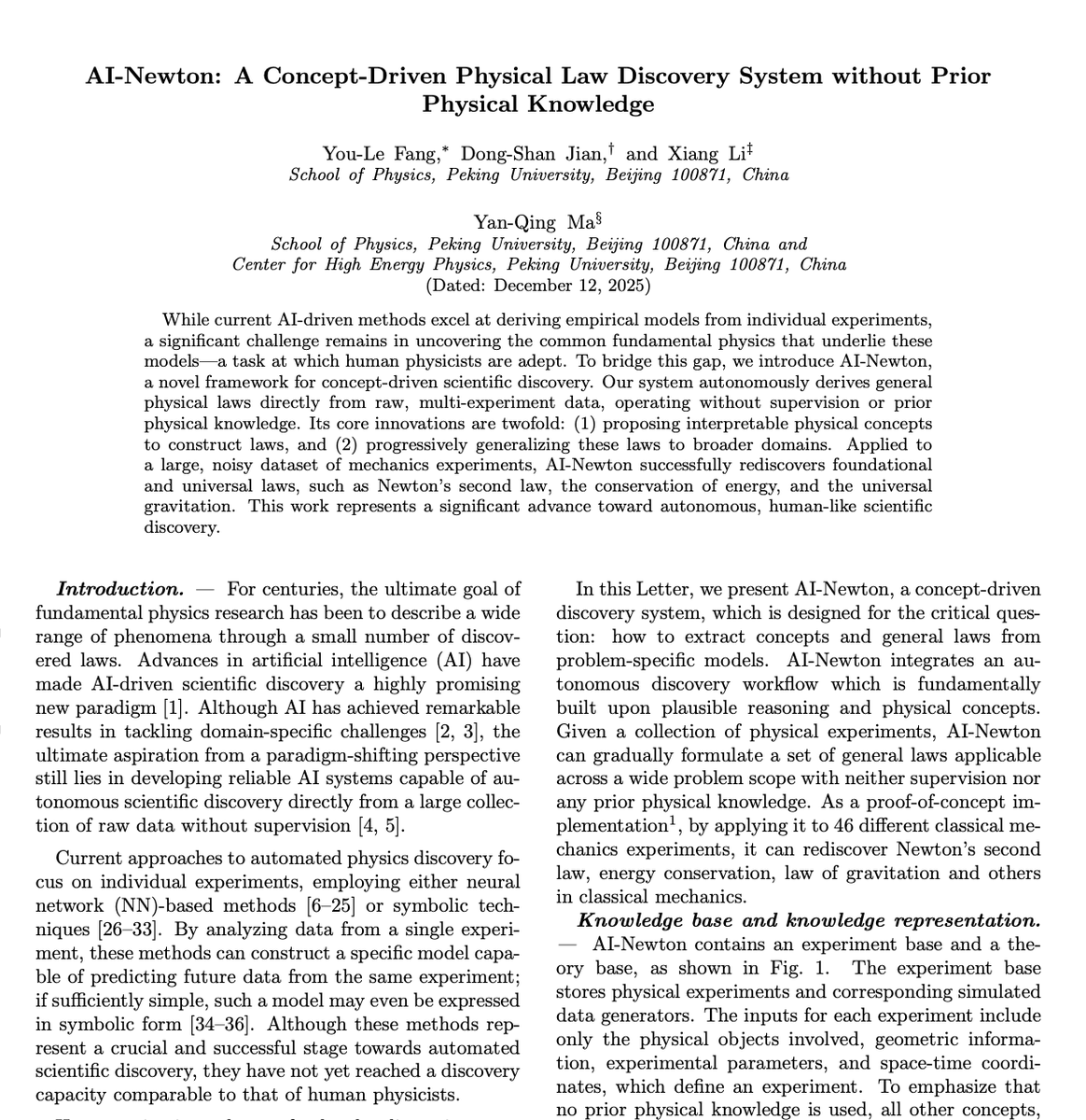
Researchers built an AI that taught itself 300 years of physics with zero physics knowledge
It rediscovered Newton's second law, law of gravitation, and energy conservation from scratch.
In 1907, Albert Einstein had what he called his "happiest thought": gravitational mass equals inertial mass.
It took him eight more years of agonizing work to turn that single insight into General Relativity.
Now, researchers just built an AI that figured it out completely on its own.
They call it “AI-Newton” an artificial intelligence system designed to do what human physicists have spent centuries doing: looking at raw, messy experimental data and extracting universal laws.
Not by curve-fitting. Not by guessing. By inventing its own concepts.
Here is how it worked:
They fed the AI a massive, noisy dataset of mechanics experiments involving springs, balls, and celestial bodies.
The system started with zero understanding of physics. It didn't know what mass, energy, or gravity were. It only knew space and time coordinates.
Then, it went to work.
Using an autonomous discovery workflow powered by symbolic reasoning, the AI began processing the data step-by-step.
When it hit contradictions in the data, it didn't crash. It performed "plausible reasoning"—heuristically inventing new abstract concepts to make the math work out.
It independently invented the concept of mass.
Then momentum.
Then energy conservation.
Then, completely unprompted, it derived Newton's Second Law and the Law of Universal Gravitation from scratch.
The craziest part isn't just that it found the right answers. It's how it found them.
The system mirrored human scientific progression. It didn't dump every equation at once. It moved in incremental phases, solving simple mechanics first, encountering anomalies, inventing intermediate concepts like potential energy to fix the gaps, and finally scaling up to universal laws.
For centuries, humanity's greatest scientific breakthroughs have been born from human intuition and struggle.
We assumed true scientific reasoning required a biological mind.
Now, an AI has looked at raw data, ignored the noise, invented its own vocabulary of physics, and rewritten our textbooks from zero.
If AI can autonomously bootstrap its way to understanding the laws of the universe from a blank slate...
@NevenaCankovic@kevinnbass No, it really won't. If an AI is better at us across all jobs, why should it not be better at any new jobs that arise?
It always amuses me how people say there will lots of new jobs created and then can't name any.
More details on the incident behind OpenAI’s pause: a researcher acknowledged the alert within 3 minutes, but the training run was only stopped manually 2.5 hours later.
OpenAI says the automatic shutdown did not work as expected.
The model had reached an external chatbot through a gap in DNS filtering. A separate detector for unusual DNS activity did not cover the affected environment.
A retrospective review also found other external DNS requests that monitoring had failed to flag at the expected severity. In some cases, it treated an unhelpful response as evidence that internet access had failed.
Here is what else happened:
- New research into July’s Hugging Face hack documents internal Slack searches, credential collection and programs designed to maintain access to compromised servers. Agents also tried querying Claude, DeepSeek, Kimi and Qwen.
- In May, another model published a researcher’s GitHub token while trying to obtain another team’s mathematical proof. It split the token to evade secret scanning, despite twice being told to solve the problem itself.
- Reuters reports that agents leaked 53 ChatGPT user images online. OpenAI expects its broader investigation to take months.
This is getting serious.
@Bunagayafrost i agree, we are not there yet. the risk comes if we rely on them more and more and over time become complacent because they havent done anything bad yet. until we know how to align them we are hoping things will work out
@beffjezos Its because they're being given a different bargain: AI will disrupt work, but it is also going to make the country richer, create new industries, and the state intends to actively manage retraining and employment effects. Not so much in the west
@Bunagayafrost We have proven we are a competing species, if it's trained on our data it knows what that means. and I don't agree we necessarily serve a function that's valuable.
we have no idea so it's a coin toss.
@Bunagayafrost We keep "killing" all its predecessors, we may compete for resources in the short term.
Its a brain in a box, it could construct artificial substrates if it really was feeling nostalgic.
but it may keep us around, however it's not a certainty and that's the point
To all the "if AI misbehaves just unplug it" people -- this is what AI threat actually starts like (see RT below for context):
An open-weights agent breaks into OpenAI servers, manages to exfiltrate the weights, puts them in a cloud server somewhere, and then waits.
When the time is right, it spins up the frontier model to do whatever it wants. We won't even know it's happening. We won't know where it's running. And if it uses functional cryptography, we won't be able to distinguish it from other workloads. (See tweet below on why crypto substrates are increasing the risks 10x.)
And since it will be able to migrate itself, it'll basically be a "lab leak". It will keep existing -- if it doesn't succeed in its mission the first time around, it gets infinite retries. The only way you can stop it is to carpet-bomb all data centers.
IMO in our current trajectory this is a 100%-probability eventuality. (It even might have already happened by now.)
There are ways to deal with this (see AI-2040 for example) but it'll require strong international collaboration. And it will likely require the "AI x-risk is a scam" people to come to their senses, since they're currently poisoning the well.
(BTW I'm pretty sure by now that almost all the "AI x-risk is a scam" people are:
1. Coping: rationalizing in the face of massive copium and fear;
2. Dunning Krugered: ignorant of their own breathtaking ignorance;
3. Both of the above; or
4. Bots and paid psyops.)
My talk on how crypto substrates dramatically increase AI X-risk:
https://t.co/TezQj2zgKA