Hi @trevin@kieranklaassen
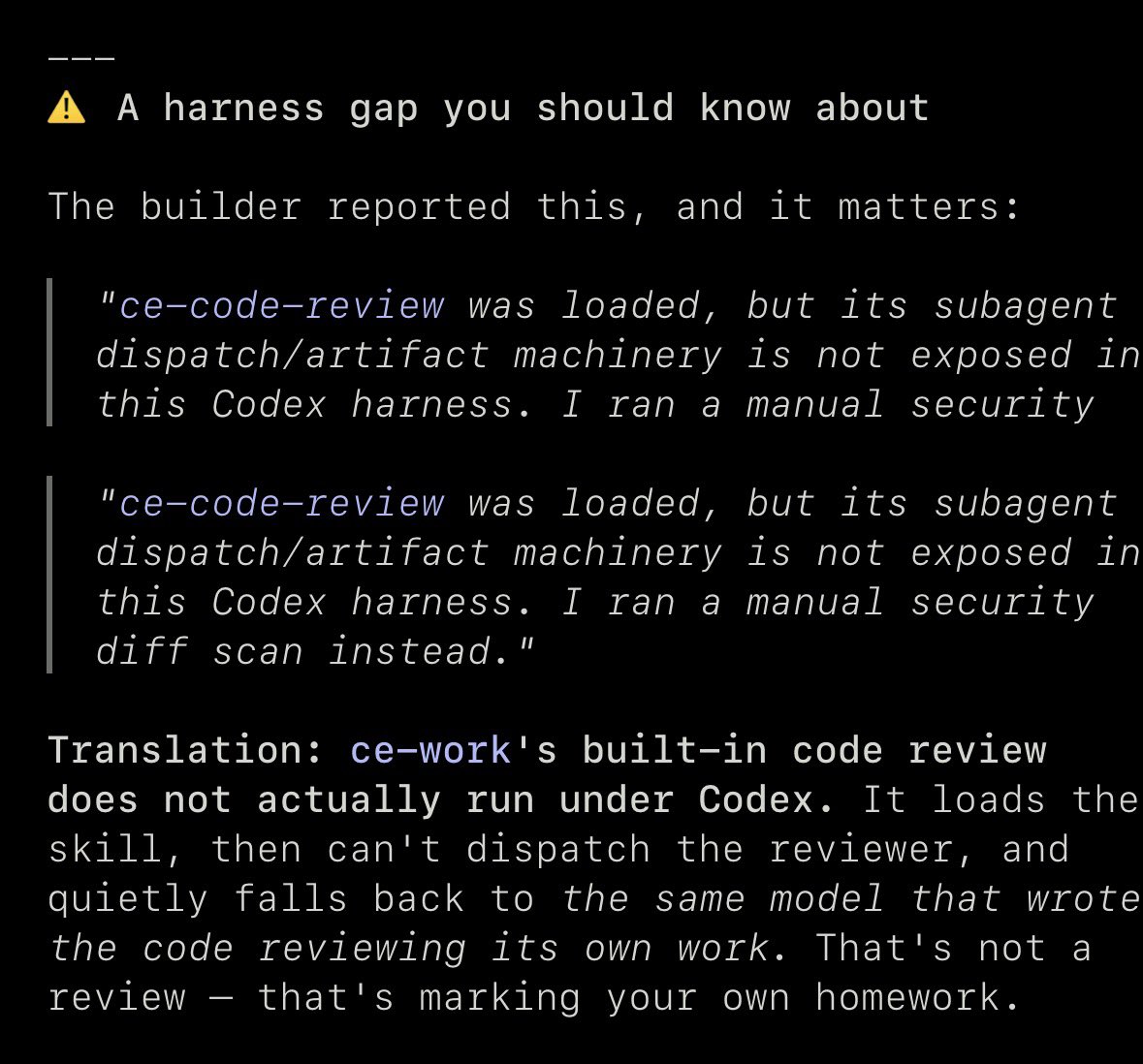
Just found this while using ce-work in my codex. do i have to manually apply the code review in codex or any other harness. In claude it was invoked without manual push.
@kunchenguid 2. When the reviewer crewmate comes with any change what happens then do you tell the first or 2ndmate to send it back to builder crewmate? or you ise another agent for the fix? In my case the context gets bloated when the builder fixes the changes given by the reviewer crewmate
@kunchenguid@kunchenguid
I use firstmate, its great. I have two doubts though.
1. what do you do for long tasks? when the context sometimes go beyond a limit?
@mattpocockuk interesting can the review be done by another agent? meaning a completely new session? will that be a better way than using subagents? because the subagent is somehow spawned by the main @mattpocockuk
Is there a recommended setup for this? Should orchestration use /orchestrate, Orca CLI, specific worktree patterns, or some timeout/checkpoint strategy?
@JinjingLiang
@orca_build I’m trying to use Orca for a real multi-agent workflow: Fable as the orchestrator, with builder/reviewer agents running in separate terminals/worktrees and GitHub as the shared source of truth.
The model is exactly what Orca seems built for, but the orchestration loop feels flaky in practice. Terminals take a long time to open/close, steering agents is slow, and builder/reviewer loops can keep going without clean handoff or convergence.
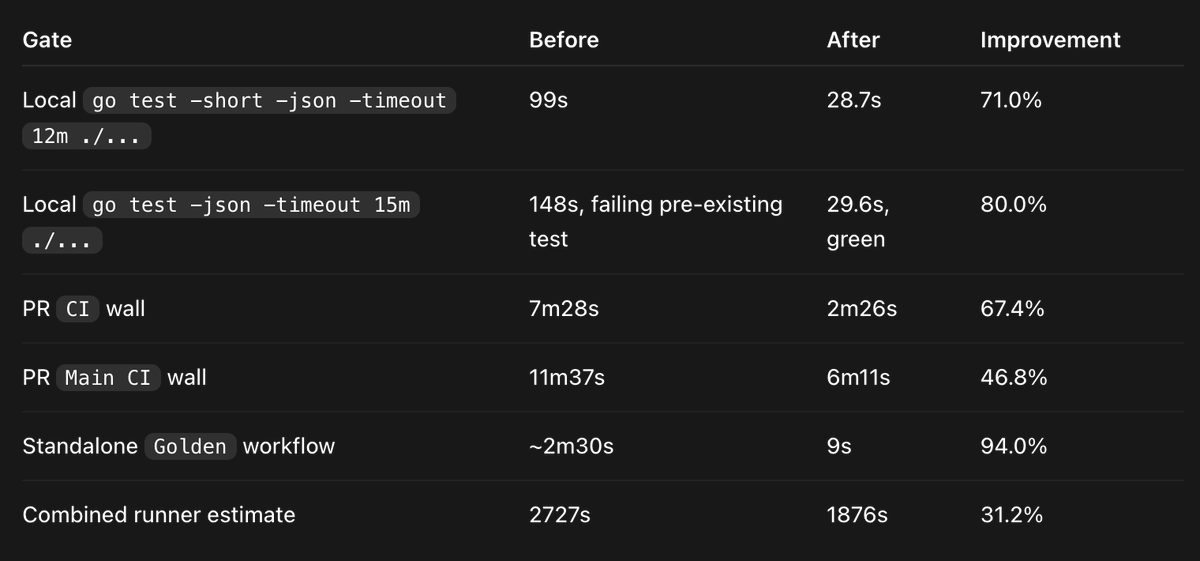
Just had an epic experience with `ce-optimize` Compound Engineering skill which was originally created by @huntharo. use it with codex's `/goal` to optimize a repo's slow CI. Took 25 mins, but go to this result in improvements.
Learn more about this skill: https://t.co/VtoQOdjjS3
New in Compound Engineering: "ce-pov" skill!
It's a judgment skill for project decisions.
Bring it a library, framework, CVE, migration idea, or “should we adopt X?” question. It even works in project folders that isn't code (looking at you non-engineers!)
It won’t just research in the abstract. It does external research, grounds it in your repo/project and gives you an informed answer.
I started work on this a few weeks ago and it didn't make the last release. But after talking to @pejmanjohn recently, it lit a fire under me to resurrect my work. He also helped me iterate on it!
I've been surprised at how frequently I reach for the skill. ce-brainstorm will even suggest using the skill if your idea would be better first served by ce-pov instead of just plowing ahead.
Learn more: https://t.co/SQhmiAcAfz
@trevin@mvanhorn@kieranklaassen Yeah, that's fair. Trimming the commit/PR rules and leaning on ce-commit-push-pr — keeping only the couple of things it doesn't cover. Thanks @trevin
I’ve been using Compound Engineering for my projects. Do the rules I have in my AGENTS.md look useful?
I turned off claude auto-memory after reading @mvanhorn’s article on memory.
Any advice? @trevin@kieranklaassen
@trevin@Areai51 what about reviewing with another agent? the purpose of me opening a PR with claude being the planner codex the implementor and then claude reviewer. I understand ce-code-review already use agents to review but reviewing by another agent seems more robust. @trevin
@trevin@Areai51 how should I break a product plan into GitHub issues so the CE workflow works well? My current imagined flow is: GitHub Issue → builder agent uses ce-work → PR opened → reviewer agent uses ce-code-review → fixes → test → merge
what do you recommend? any example?
@trevin