built in India, for the world.
our founder and general partner natasha malpani spoke to businessline about the thesis behind boundless and why India’s operating conditions make for products that hold up everywhere.
as frontier intelligence gets cheaper, value is moving into proprietary data, real-world infrastructure and trust. India’s scale, cost structure, languages and regulation make it one of the most demanding places to deploy anything, and founders who build for it build products the rest of the world can use. that’s where we write our first cheques, at pre-seed and seed, before the world agrees the category matters.
thank you to @businessline and @that_sanjana for the conversation and for taking the time to get into the detail.
full interview below.
getting in front of a large financial institution usually takes months.
an intro, a first call, the pitch, and then a long wait to hear back.
at the unbundling, it takes one day. India’s leading institutions like @MotilalOswalLtd, @HSBC, @ICICIBank, @zerodha, @Razorpay, the @OpenAI team and a curated set of leading fintech startups, together in bangalore on november 30th.
you get honest feedback from the people who run these businesses, off the record, and every startup leaves with OpenAI credits.
a few seats are still open. link in comments.
the billion dollar question: what data do we actually need to collect in robotics?
failure annotation, tactile data, teleoperation, sim and who’s willing to pay for all of it.
we’re picking this up next week in silicon valley.
our second edition of evals, retraining, and reality comes to qualcomm’s santa clara campus on 17th november at 6pm, with @Qualcomm_Dev.
sign up through the link in the comments.
most of what investors really think never makes it onto a panel. it comes out over dinner and a second drink, once nobody is on record.
after hours is an evening built for that, and for the people in this community simply getting together. a small group of VCs, a long table and flowing conversations, co-hosted with our friends at @awscloud.
we spend most of the year racing to deals, so for one evening, we’d like to raise a glass to the people we run alongside every day.
monday, 30 november, 7 pm, ashok nagar
India’s biggest financial institutions are about to share what they want to reinvent next, with 15 founders, at one table.
they built how India invests, saves, insures and borrows. now, they’re leading the next shift, with AI.
the unbundling, co-hosted with @OpenAI, november 30th in bangalore. joining us are @MotilalOswalLtd, @Razorpay, @HSBC, @ICICIBank, @zerodha and more.
a few seats left, by invitation. reach out if you’d like to be part of it.
financial services holds up the Nifty 50. at 37.45%, it carries more weight than the next five sectors combined.
and it's moving fast. the question now for India's financial institutions is who they build with.
on november 30th, the unbundling brings them together with the founders building AI for wealth, credit, insurance and broking.
co-hosted with @OpenAI.
after our popping bangalore edition, we’re taking evals, retraining, and reality to silicon valley.
together with @Qualcomm_Dev, we’re bringing the conversation to qualcomm’s silicon valley campus on 17th november at 6pm, for founders and operators deploying physical AI who want to talk honestly about what happens after a robot ships.
seats are limited. sign up through the link in the comments.
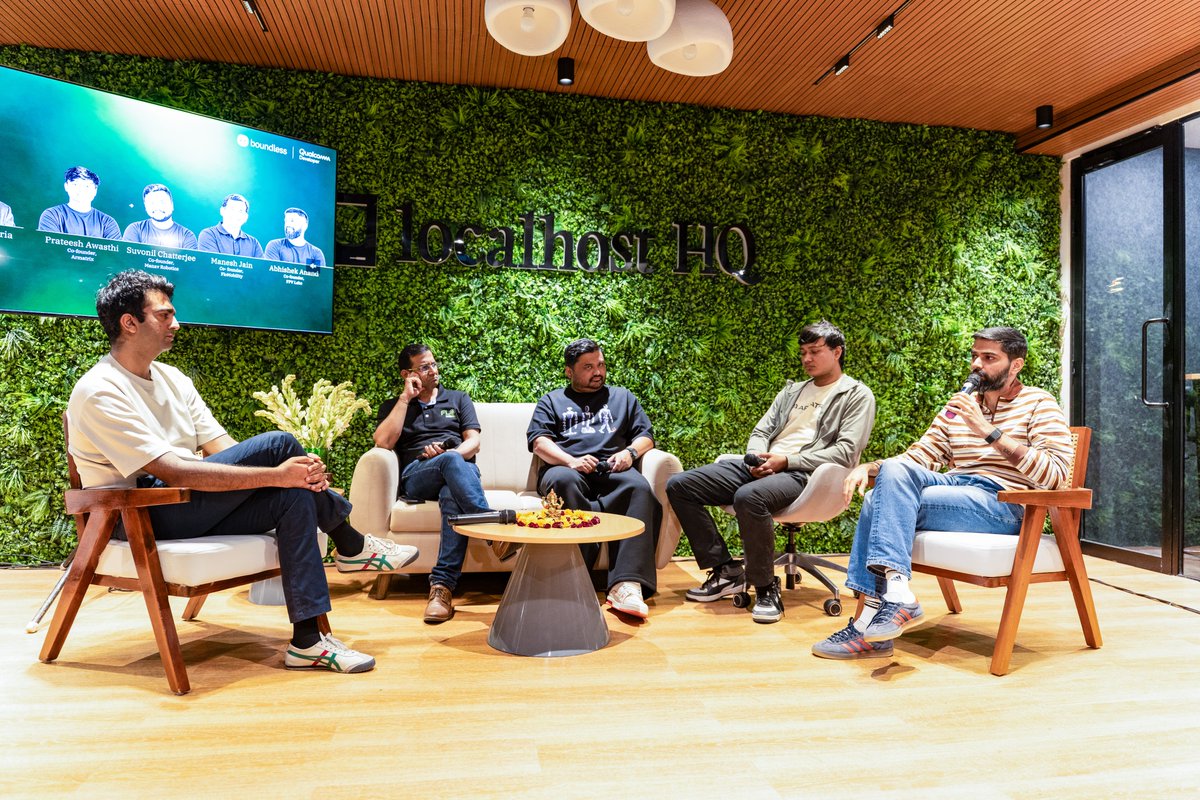
four physical AI founders deploying in robotics, a carefully curated audience, and some very heated + honest answers about what happens when robots meet real factory floors and construction sites.
we had close to 200 registrations for a 30-person session on building evals and failure loops. thank you to everyone who showed up with tough questions and stayed long after we wrapped.
thank you to Prateesh Awasthi of @armatrix_IN, @suvonil of manav robotics], @itsmanesh of @Flo_Mobility and @levelheaded_94 of @fpv_labs for sharing so openly.
and to @Qualcomm_Dev for co-hosting, and @localhosthq for having us.
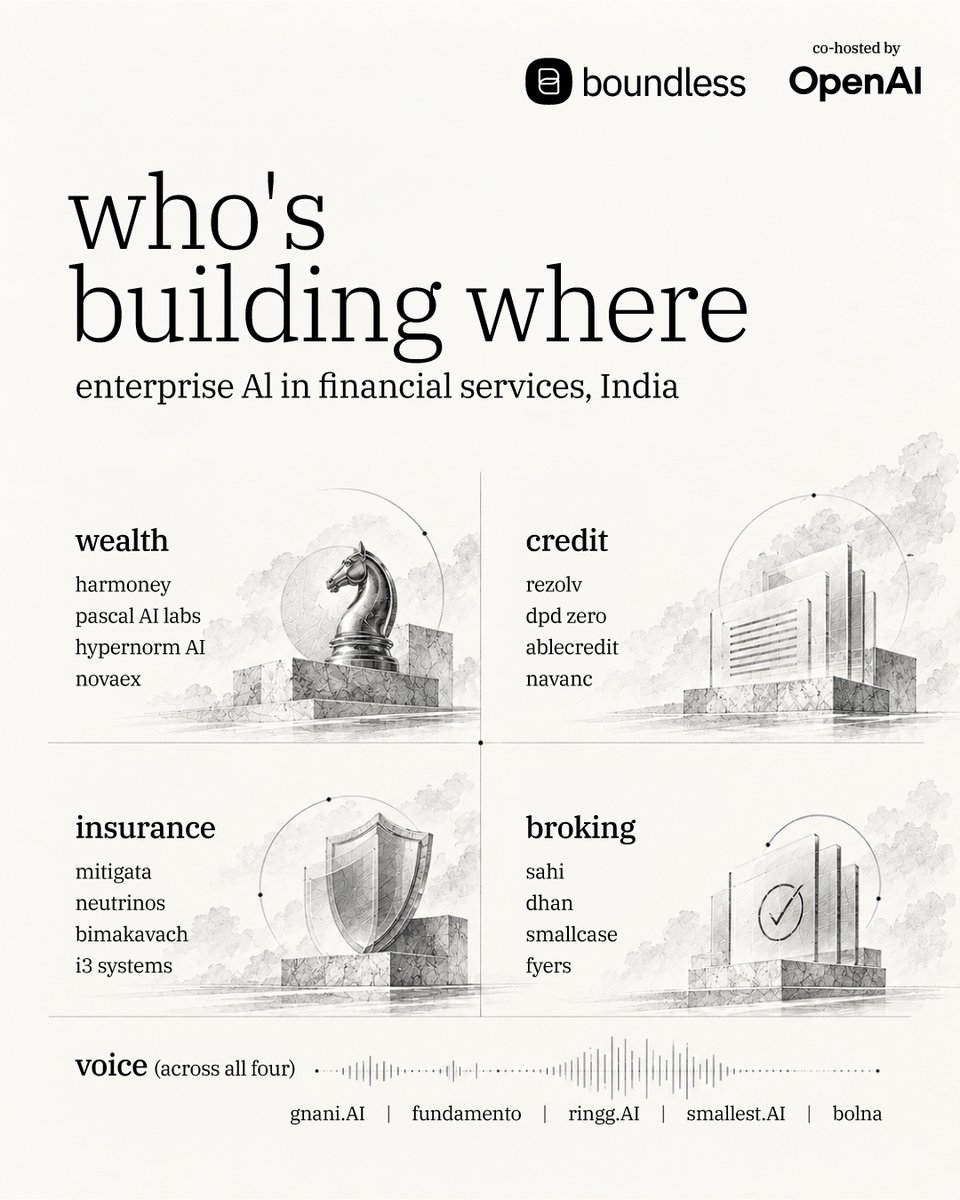
the unbundling: co-hosted by @OpenAI
enterprise AI in financial services is starting to move from pilots into production in India.
broking, where every trade gets an analyst.
wealth management, where research takes seconds.
credit, where every document gets read.
insurance, where claims move faster.
across all four, institutions are working out where AI fits, and a new set of founders is building for exactly those decisions.
we mapped who’s building where.
are you on this map, or think you should be?
applications for the unbundling close november 12th.
link in comments.
we had a very honest debate at @ventureindia with Kedaara Capital, @ChirataeVC, @NIIFIndia, India Alternatives Investment Advisors and @theboundlessvc on exits, fundraising, founder quality, how you price geopolitical risk and what the sovereignty stack needs.
we believe frontier tech rarely rhymes with what came before.
when the technology is new, the founders are new, and the markets they sell into are being invented while you watch, there are no comparables to underwrite against.
so the edge moves to proximity. we spend our weeks with frontier labs and the founders building right at the edge of what they ship. that’s how you recognize real category creation.
founders are changing. markets are changing. venture is changing with them.
this is a great moment to build at the frontier, and india is a great place to do it from.
@ventureindia@arunontw | Manish Kejriwal | @sudhirksethi | Rini Singhal | Shivani Bhasin Sachdeva | @natashamalpani
we had a provocative session on what it takes for robots to keep getting better once they’re out in the world.
our speakers weren’t afraid to differ in their take on what actually works in the real world when it comes to data collection, business models and hardware form factors.
we are so early.
we heard from:
@itsmanesh of @Flo_Mobility on everything a robot needs around it to keep working on site.
@levelheaded_94 of @fpv_labs on scaling human data for robot learning.
@suvonil of manav robotics on why the moments a person steps in are the most valuable data there is.
prateesh awasthi of @armatrix_IN on pairing learning with optimisation for precise, safe control.
they did agree that the hardest work starts after a robot ships, the field is split on what data matters most, and evaluation is still the bottleneck.
in fact, India’s conditions are hard on robots and very good for the data they produce, which is why we think India can win physical AI.
the session ran far over time and we loved the high trust energy of the room.
thank you to the founders for being so open, and to @Qualcomm_Dev for co-hosting the conversation.
part 2 coming soon.
wrap notes in the comments.