My mum owns a primary and secondary school somewhere in Akeja, Ogun Sate. There is this man, Papilo, a supplier who handles FMCG products in that area. He comes Tuesdays, Thursdays, and Fridays. Sundays are for my mum and other school owners stocking up for students during break.
He is not the only one. They are everywhere like that.
One thing I know is that most of these sellers don’t pay him immediately, They pay on the next supply day or after a week. Sometimes it stretches to 3 supplies before payment clears.
I've watched him argue back and forth with customers who say no money yet. He still gives them all or little. I've seen this for over 15 years growing up. This is the practice across every informal market in Nigeria. This is Africa’s informal supply chain.
Papilo knows all his customers. He knows their children’s names. He argues, negotiates, and finds a middle ground. No App or AI can replicate this.
Papilo now runs plenty of small kekes distributed all over Akeja and beyond.
In African businesses, relationships aren’t just nice-to-haves. They are part of the infrastructure. And this is where the majority of our builders get it wrong.
A techie once went to get bread at a store and stumbles on a sole distributor supplying them wines. He thinks “so this is how these get their stocks” he goes home to google the numbers and sees millions of retailers, no central database, orders on phone call, cash payments, manual records. He sees the classic Manufacturer → Distributor → Wholesaler → Retailer chain and he goes “yes! This is a gap. This is untapped. I can build this on an app”.
Actually, he is right. But here is what he missed;
The supplier extends credit
The wholesaler knows who always pays at each time.
The sales rep knows whose child just got admitted into university.
The delivery driver knows which shop opens late or earlier
None of this can fit in an app database because they are the everyday circumstantial reality of Nigerian business owners. Your app can’t document this.
A retailer doesn’t always buy from who is cheaper. She buys from who’s delivered consistently for years. The one who lets her pay next week. The one who picks up the phone immediately there is a problem.
See your app can calculate credit just fine. But the distributor knows Mama Olomi missed payment because her shop flooded last week. That context is the business in this part of the world.
You will think funding fixes this but marketForce had $42M and still died. Sendy had $27M, Medsaf had $7M.
Your investors will push you to the usual playbook; free delivery, discounts, cashback, promotions, etc and growth will look incredible at first but the moment the subsidies disappear, you will start to compete with relationships using economics alone.
Then you’d realize your capital didn't buy survival, it brought speed to a broken model. Somebody say Reality!
Now let’s look at the ones who didn’t die. They simply mutated.
Sabi moved into traceability/export infra. OmniRetail leaned into embedded finance.
Sendy’s co-founder built TABB on trade credit data.
Rather than say we’re replacing distributors, they became the operating system behind the distributors helping them;
📍 Manage inventory
📍 Collect payment
📍 Access financing
📍 Discover retailers
📍 Forecast demand
📍 Coordinate logistics
This is the lesson for anyone building in African informal market.
Don’t ask How do i remove the middleman
Ask, what valuable job is the middleman doing that technology can make easier?
Don’t compete with the market woman, equip her. Build the layer she can’t build herself (credit history, verified supply chains, payment infrastructure, etc).
This is because Africa’s distribution problem was never about apps vs humans. It’s about who controls the trust layer. Build that, not the marketplace.
@blocstreets
On the lookout for a solid film+video editor with Final Cut Pro + Premiere Pro skills.
₦300k/month. Full-time role.
Must be in Abuja or willing to move. Must be a team player who genuinely loves films, storytelling, and creating.
Please DM portfolio/showreel + location.
Building trust in the city of Abakaliki wasn’t as easy! We met resistance in the market that compelled us to think on our feet
These experiences were the foundation that got us here!
Today the exciting news is that there are good numbers of delivery companies in Abakaliki!
Brandolini's law, or the bullshit asymmetry principle, states that the energy required to refute misinformation is significantly higher than the energy required to produce it.
A lie only needs a statement. But the correction needs a paragraph, a source, a caveat, and a certain level of nuance that most people don’t have the patience to apply.
A lie or half-truth can travel around the world before the truth even wears its shoes
It’s why arguing with lazy people and conspiracy theorists is so exhausting and we’re seeing it in real time
I’ll be honest , context matters.
Filled milk simply has its natural milk fat replaced with vegetable oil. It’s not “fake” milk.
The real question is: what do you need?
Want more satiety? Full cream
Watching calories or cholesterol? Skimmed
On a budget? Filled milk works.
•Full cream milk: richer in natural fats, more satiating
•Skimmed milk: lower in fat, useful for calorie control
•Filled milk: sits in between, depending on the oil used
If you have hypertension or high cholesterol, lower-fat options may help, I recommend skimmed.
If you’re managing blood sugar, overall diet matters more than just the milk type but I always recommend full cream.
Personally, I lean towards full cream or well-formulated plant milk but no option is “bad” on its own.
I hope you find this useful.
@hurtch This is inaccurate. Whole milk exists both in liquid and dry form. Full cream powder like Dano full cream Milk is real milk, the only difference is that the liquid underwent spray drying to turn it into powder. Once it is reconstituted, it is exactly the same
We need to come face to face with the fact that a lot of Nigerians are in poverty.
This is why a lot of these issues are arising.
In the midst of it all, it is important to educate over causing outrage through sensationalism.
Many brands in order to meet up with the various needs of their customers. As such they introduce varieties.
Dano brand has Dano full cream, Dano Cool cow which is the fat filled milk and Dano skimmed milk.
Beyond economy, using powdered milk has become our culture.
An angle that isn’t considered is the fact that the economy is what is driving the adoption of Fat filled milk powders.
How many Nigerians can currently afford full cream Peak Milk?
Heck I can’t remember the last time I’d saw Lahda or Oldenburger milk on the shelves.
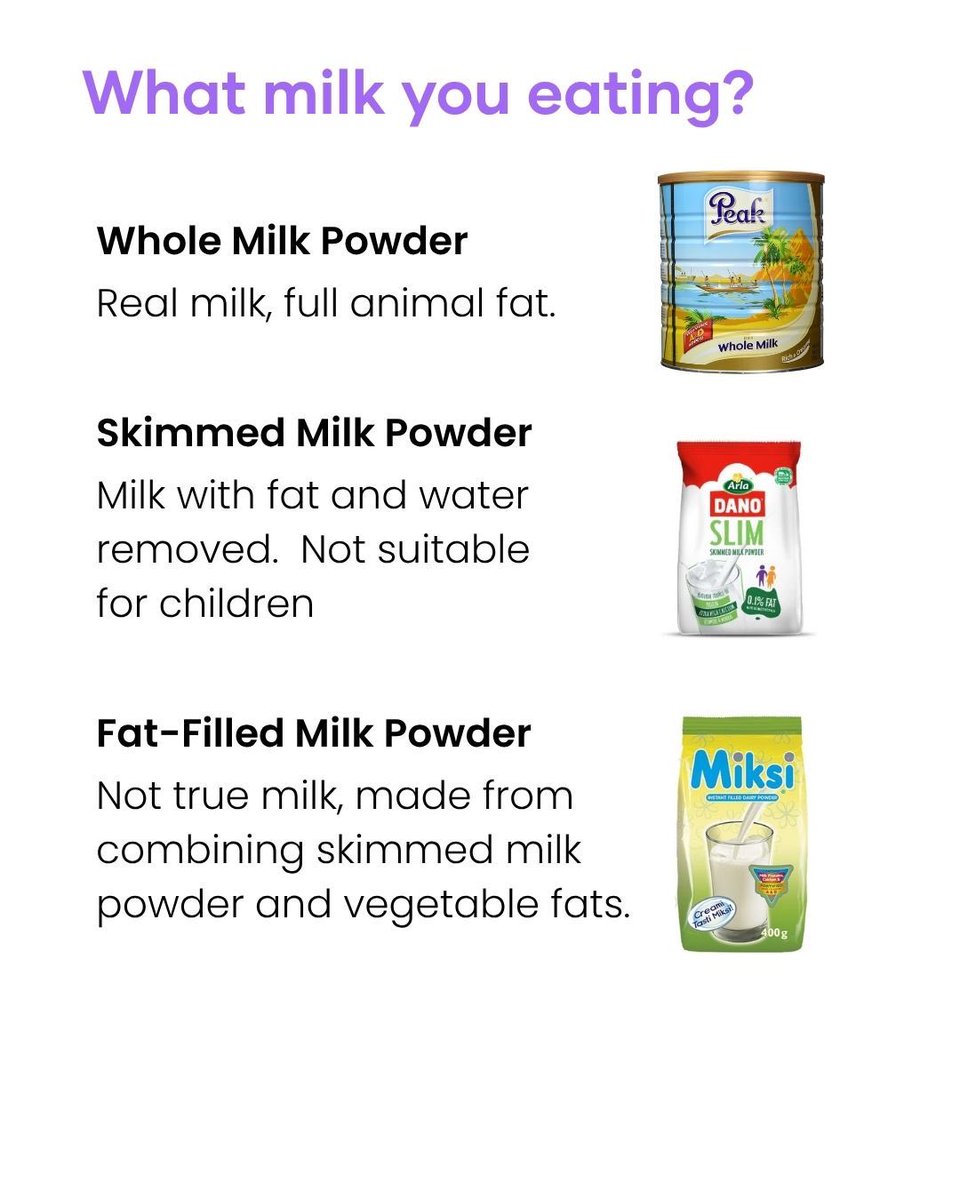
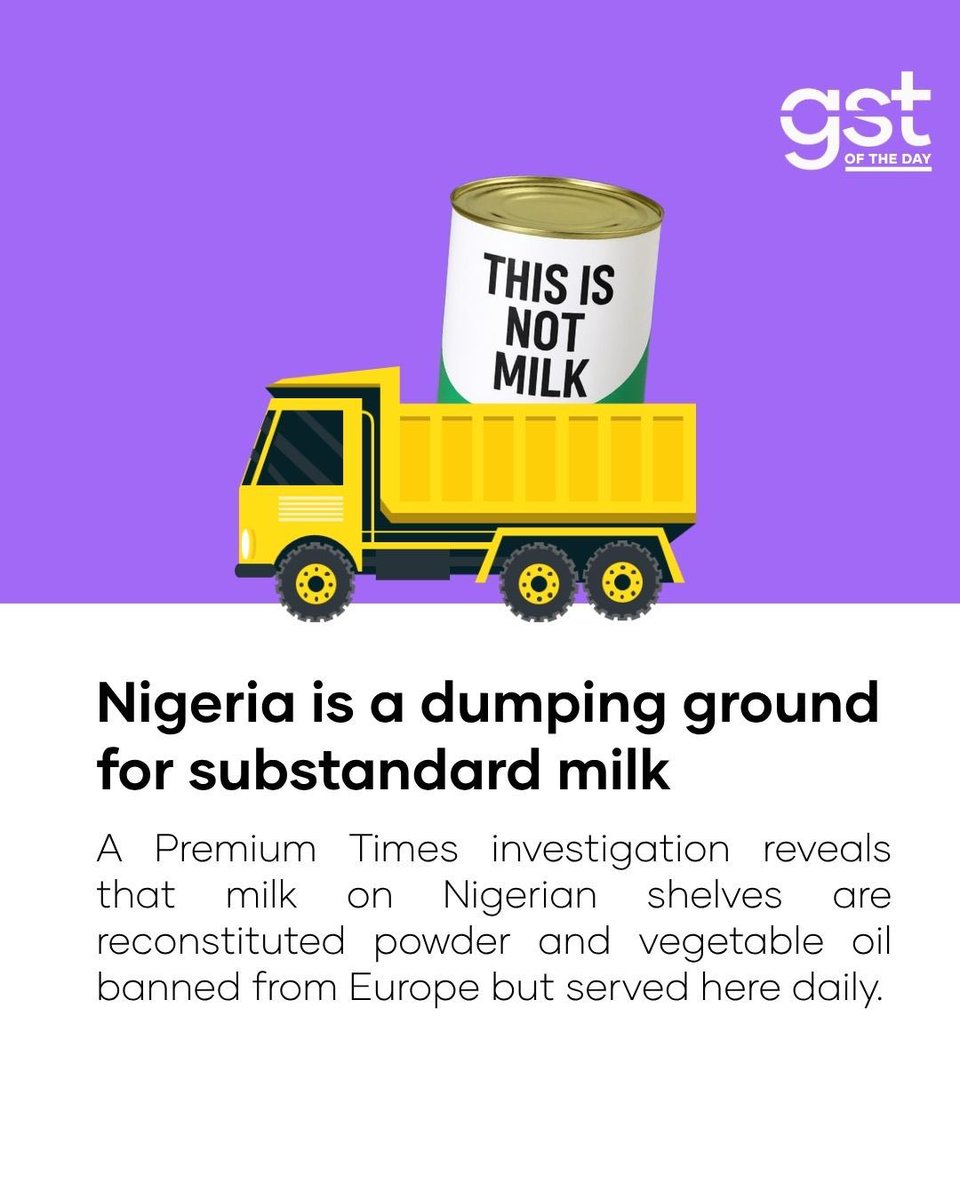
Most Nigerians think they are drinking milk. They are drinking Fat-Filled Milk Powder (FFMP).
In the EU, FFMP can’t be sold as milk, it must be labelled as a milk ingredient, not a dairy product.
Here, it’s “milk”. Nigerians are eating what others aren’t allowed to call food.
It’s also a fallacy to allege that Nigerian brands do not have whole milk powders?
Loya Milk, Dano Full Cream, Peak Full Cream milk are all examples of full cream powders. They are exactly the same as the liquid milk. The difference is that they have undergone spray drying.
Yes, I’m pained. Truly pained. Because these programmes are not easy journeys: B.Pharm takes a minimum of 5 years. Pharm D takes at least 6 years. BMLS takes at least 5 years. B.Rad. takes at least 5 years. B.NSc takes at least 5 years. These courses are demanding in every sense;
Do people know that teaching hospitals are not places you should just able to walk into.
Teaching hospitals are meant majorly for referred cases and training specialist healthcare workers like nurses and resident doctors.
After specialising in teaching hospital, a huge number of these specialist doctors and nurses are supposed to be working in your general hospitals, federal medical centers and state specialist with tons of medical officers working under them.
Most emergencies and clinical conditions should actually be handled by specialists both medical and surgical at this secondary healthcare level.
But walk into most general hospital in this country apart from lagos and what you'd meet is crickets.
You'd be lucky to find one or two MOs shooting far above their pay grade.
You'd see MOs doing ex-laps, CS, and ortho procedures just because if they don't, thousands will die.
Walk into their emergency room and you'd be lucky to find functional resuscitation items and an oxygen cylinder.
Yet, rather than these people to protest about their useless leaders.
They'd rather point to the overworked doctor and nurses, they'd say we lack empathy, that we deserve our poor pay because of our lackadaisical attitude and that God will punish us if we don't attend to them on time.
Godforsaken country.
You guys are making sweet yogurt and not greek yogurt. Greek Yoghurt is expensive because it’s made with raw cow milk not factory made milk.
How to Make Greek Yogurt from Raw Cow’s Milk
Ingredients:
•1 gallon raw cow’s milk
•About 1/2 cup live yogurt culture (you need yogurt to make yogurt)
Directions:
1.Heat the gallon of milk to about 109°F (43°C).
2.Remove from heat and mix in the yogurt culture.
3.Put it in an oven with the light on and leave for 12–24 hours.
•At this point, you have yogurt.
4.Strain the yogurt with a cheesecloth to your desired consistency (for about 18 hours)
That’s it—after straining, it becomes thicker like Greek yogurt.
(See quote for visual explanation)