In 1833, a fiercely eccentric Irish mathematician locked himself inside a chaotic observatory in Dublin, quietly plotting a structural revolution against the greatest scientific legacy in human history.
Armed only with a fountain pen and a brilliant obsession with optics, he spent his nights under the dim flicker of an oil lamp, single-handedly inventing a radical mathematical engine that would eventually decode the subatomic universe.
His name was William Rowan Hamilton.
The story of how he completely overhauled the foundations of classical physics is a masterclass in why rigid traditional formulas fail where fluid structural intuition succeeds.
In the early 19th century, scientists were trying to calculate the complex movements of multiple gravity-bound planets. But they had a crippling bottleneck: Isaac Newton's standard formulas required calculating massive, individual forces and vectors for every single object. The equations quickly became a tangled, unreadable mess of calculus.
The elite professors at Oxford and Paris said the solution was simple: just grind through the brutal paperwork and brute-force the calculations. It didn't work. The mathematical systems routinely collapsed under their own weight.
Hamilton looked at the data from his isolated perspective and realized the establishment was blind. They were focusing entirely on the physical forces pushing and pulling the objects.
He figured out that motion isn’t a battle of violent forces; it is a ball rolling smoothly through a landscape of total energy.
He introduced a bizarre mathematical shortcut now known as the Hamiltonian. Instead of tracking separate forces, he combined a system's total kinetic and potential energy into a single, elegant geometric equation.
Suddenly, calculating the path of a planet or a thousand particles, was reduced to tracking a single point moving across a smooth surface of energy.
The establishment called his math an unnecessary, abstract detour.
They couldn't accept throwing away Newton's familiar formulas for a purely theoretical framework.
Hamilton didn't care. He knew that viewing the universe through energy instead of force was a cleaner, more absolute truth.
The old guard ignored his framework for decades as a mere novelty.
But when the quantum revolution exploded in the 20th century, physicists realized that Newton's formulas were useless at the atomic scale but Hamilton's energy equations mapped the quantum world perfectly. Hamilton did the heavy structural lifting, but later physicists got the textbook fame.
The lesson Hamilton left behind is a philosophical blueprint for navigating a complex world:
The people who memorize the proper formulas are excellent at solving textbook problems. But they are entirely dependent on the system staying simple.
The people who understand the underlying system don't care about the rules. They change the metric from force to energy to find what actually works.
Most of us approach our life's problems like the 19th-century scientific establishment. When our careers or projects get complicated, we try to battle every single external force pushing against us. We try harder at a exhausting, brute-force method.
But sometimes, the problem isn't that you aren't trying hard enough to fight the forces. The problem is that you need to stop focusing on individual conflicts and start looking at the total energy landscape of your environment.
What is a complicated battle in your career right now where you keep trying to fight every opposing force manually? What happens if you stop trying to follow the textbook formula and start shifting your strategy toward the path of least resistance?
The water math on AI is the most misunderstood statistic in tech, so let's actually run it.
A ChatGPT query uses about 0.3 mL of water for cooling, per OpenAI's own disclosure. The harshest academic estimate, which also counts the water consumed by the power plants feeding the servers, lands at 10 to 25 mL. Call it half a tablespoon at the absolute worst case.
Now the comparisons. One hamburger takes roughly 2,500 liters of water to produce. That single burger equals somewhere between 100,000 and 8 million ChatGPT queries depending on whose estimate you trust. A pair of jeans cost 7,500 liters before it reached your closet. One toilet flush is 6 liters, or about 20,000 queries. US golf courses pour out around 1.5 billion gallons every day, dwarfing the direct cooling water of every data center in the country.
So why does the robot demanding a thousand glasses of water feel true? Because the totals sound enormous and nobody does the division. "Data centers consumed billions of gallons" is accurate and terrifying right up until you divide billions of gallons by trillions of queries and get a number smaller than the drop left in your glass when you think it's empty.
The legitimate water story is local. A big facility sited in a drought-stressed basin can strain that specific community, which is why Chile blocked one. That's a siting problem, solvable with policy and closed-loop cooling.
The cartoon will outlive the correction anyway. Per-unit math never beats a thirsty robot at the foot of the bed.
A self-taught Irish schoolteacher wrote a book in 1854 that almost nobody read for 80 years, until a 21-year-old MIT student picked it up and realized it could be used to design every computer in human history.
His name was George Boole. The book is called An Investigation of the Laws of Thought.
Boole was born in 1815 in Lincoln, England. His family was poor. He left school at 16 to support them. He taught himself Latin, Greek, French, German, and Italian.
Then he taught himself mathematics. By 19 he had opened his own school. By 24 he was publishing original papers in the Cambridge Mathematical Journal, competing with men who had spent decades inside the best universities in Britain.
He never had a degree. He never had a mentor. In 1849, Queen's College in Cork hired him as a professor anyway.
In 1854, he published his masterwork. What he built inside it was something nobody had attempted before at this scale. He turned logic into algebra.
Before Boole, logic was philosophy. You argued in sentences. You reasoned in paragraphs. It was powerful and completely impossible to automate, because there was no formal system underneath it, just language.
Boole stripped it down to arithmetic. He showed that every act of human reasoning could be reduced to operations on two values. True or false. One or zero. AND, OR, NOT. If both conditions are true, the result is true. If neither is, the result is false. Every judgment a human mind makes, every decision, every deduction, could be written as an equation following those rules.
Logicians read it. They found it interesting. Engineers building machines had never heard of it.
For 83 years, the book sat there.
Then in 1937, a 21-year-old MIT master's student named Claude Shannon was working on a thesis about electrical relay circuits. Switches that could be open or closed. Current that either flowed or didn't.
He read Boole and understood something nobody had connected before.
An open switch is a zero. A closed switch is a one. A circuit with two switches in series only carries current when both are closed. That is AND. A circuit with two switches in parallel carries current when either is closed. That is OR. Shannon proved that every possible logical relationship Boole had described could be physically built using wire and switches.
That single insight is the foundation of every computer ever made.
After Shannon, chip designers stopped thinking about electricity and started thinking about logic. Every transistor on every processor running right now is implementing a Boolean operation. Every if-statement in every codebase is Boolean logic. Every database query using AND or OR. Every neural network threshold that fires or doesn't fire. All of it is running the algebra of a self-taught schoolteacher from Lincoln who died 160 years ago.
The strangest part is what happened to Boole at the end.
He was walking to class in November 1864 when he got caught in a rainstorm. He lectured for hours in wet clothes. He went home sick. His wife, Mary, believed in homeopathic medicine and thought the cure should mirror the cause. She wrapped him in wet sheets and poured cold water over him repeatedly.
He died a few days later. He was 49.
He never saw a transistor. He never saw a circuit. He never saw a single physical machine run a single one of his rules.
His book is in the public domain. Free to download. Most engineers use the word Boolean dozens of times a week. Almost none of them know who they are saying.
The man whose logic runs inside every phone, every server, and every AI model on Earth died soaking wet in a small Irish town, 83 years before anyone figured out what he had actually built.
An absolutely phenomenal read about the causes of the current epidemic of female personality disorders, and how to prevent your daughters from being infected.
The Only Real Existential Risk: the female problem
https://t.co/CQ1mVR82jX
I saw this video the other day and I can’t stop thinking about it.
A young woman celebrating that 52 percent of women aged 20 to 39 are now childless, that she is finally “part of the majority” and “the men are gonna crash out about this because they are so worried about the birth rate, and let me make this clear, I don't care".
It is true that this is the best indicator of feminism’s success but the girl, as most women celebrating this, is not the enemy. The real problem is the mismatch between women and the modern world.
Women evolved in environments where social exclusion meant death. You cannot hunt pregnant or fight nursing, so a single woman's survival depended on the tribe's acceptance, and a few hundred thousand years of that programmed her to see consensus as safety. It is the same trait that made women the thing that makes families work, what makes them a good mother and a good wife. It’s not that they are better or worse than men, they just evolved differently.
Which is why women do not really know what they want. Not because they are stupid but because of how they evolved. What a woman says she wants is mostly what she thinks the group wants. For two hundred thousand years the group was right and disagreeing meant death. The problem is what the group is now.
The group that decides what a woman wants is the average of millions of strangers an algorithm pulled together because they got a reaction out of them, tuned for outrage and sadness because that is what is engaging and sells ads. The wanting still feels like hers because the group wants it, but it’s the feed's.
We built a global consensus engine, pointed it at the half of the species that sees consensus as survival, and hoped for the best. Add to the algorithms a world that never existed before 50 years ago, the new career ladder, the adversarial institution, the hyper-individualism, built by men for men and then imposed on women as liberation.
Two transitions destroyed the family. The first was the decade between 1960 and 1973: the pill, no-fault divorce, Roe, and the beginning of adult daycare. IQ tests for hiring basically became illegal, college became the proxy, and college plus “career progression” became the norm eating away the entire fertile decade. In just 13 years, sex decoupled from reproduction, reproduction from commitment, commitment from permanence, and hiring from intelligence.
The second transition was in 2012, when smartphones with social media and dating apps went into every teenager’s pocket. Family was first destroyed, and then women were told they never wanted one to begin with, and if they *really* wanted one they should have waited.
They took her most fertile decade, the one stretch of biology that does not come back, and filled it with an extended adolescence. Eighteen to twenty-eight first in a classroom and then an office, children labeled burdens, the thing you get to later once you are established and it is responsible. Later arrives and the good men are gone (so are the eggs). She did not waste those years. They were taken from her by the people who were supposed to care for her.
This is what feminism actually accomplished.
The destruction of womanhood from the inside. Everything feminine, the relationships, the mothering, the holding-together of a community, labelled as low status, and the hole filled with a masculine dream she was told would set her free.
Feminism is the spiritual and philosophical rape of what it means to be a woman.
Women have been getting sadder for forty years while every objective measure of their lives improved, and the women who still report the most meaning are married mothers (shocked_pikachu_face.jpeg). Incredibly, the life they were told to run away from is the one that works.
And that’s why elections are going how they are going.
The same empathy that makes a woman a good mother is programmed to answer to the suffering it can see, the face in front of it, never the abstraction behind it. And that is what the whole political machine exploits. You take the most sympathetic case, give it a face, and let that face carry the entire policy without reason behind it. The raped woman becomes the proxy for every abortion, so the rare horror and the change of mind become the same thing, healthcare, and the child that is murdered never counts, because a fetus has no face and the woman in the ad does. She is not lying when she refuses to call it killing her own child. For women, an abstract victim never registers as a victim.
The child in a war zone becomes the proxy for every migrant, so one photograph carries a policy about millions of grown men, and the country that has to hold them is too abstract to weigh against the kid. Every time, the visible sufferer now beats the invisible one later. Run that instinct at the scale of a whole country and the conclusions are fairly obvious, the more a society allows women to be politically involved, the lower the fertility rate goes (this is truer for single women than for married ones).
The parallel problem is that men first allowed this, then were removed from the conversation, and now they ran. After allowing this to happen, a feminized society told them that masculinity was toxic, a lot of them obeyed and checked out into porn and games, built nothing worth joining, and the ones who refused got punished for it. Either way the supply of men worth marrying collapsed. "I can't find a good man" is true and self-inflicted at once.
So this is the female problem of our generation.
It was never that women were the problem. It is that female nature, the consensus-reading, the empathy, their radar for the room, the good stuff that built every family that ever held together, is the part most unfit for the modern world.
You cannot fix a nature. You can only build a world that works with it instead of against it. We built the one that works against it.
And this is the only existential risk that actually counts.
If we can’t fix the female problem, fertility will remain below replacement, which means extinction, no matter what. AGI or automation or any other possible existential risk does not matter if there is no one left to use it. Abundance in an empty room is just an empty room.
The woman in the video will get her wish, she will be the majority, she’ll cherish her childless life and realize her mistake when it’s too late. But the problem is that being the majority of a generation that does not continue is not a win. She cannot get out of this alone. Her nature is not the thing that can move first. Unless men start doing something and become worth choosing again and rebuild the thing worth joining, it only gets worse from here.
Dirac couldn't get hired as an electrical engineer. A 19-year-old with a Bristol degree in 1921, during a post-war depression that had no use for him. So he stayed at Bristol and studied math for free because there was nothing else to do.
Two years later he got a fellowship to Cambridge. His advisor, Ralph Fowler, handed him proofs of an unpublished Heisenberg paper in August 1925. Dirac read it and realized the math resembled Poisson brackets from classical mechanics. Within months he had built an entirely new mathematical framework for quantum theory.
He published 11 papers before submitting his thesis. Eleven. Most PhD students struggle to publish one. Dirac had a body of work that constituted an entire theoretical foundation, and he still needed to package it into a dissertation to satisfy the degree requirements.
The thesis title tells you everything about the confidence level. When you title your PhD "Quantum Mechanics" at age 23, you are either delusional or correct. Dirac was correct. It was the first PhD thesis ever written on the subject.
Two years after that he wrote the Dirac equation, unifying special relativity with quantum mechanics and predicting antimatter before anyone had observed it. By 1932 he held the Lucasian Professorship of Mathematics at Cambridge. The same chair Isaac Newton held. He was 30.
Nobel Prize at 31. The youngest physics laureate at the time.
The entire arc from unemployable engineer to owning Newton's chair took 11 years. The field he named his thesis after is now the operating system of modern physics.
If you want to win the female vote, you do not need intelligent, logical, sophisticated policies that would work in the real world. You only need aesthetics. It just has to appeal to their aesthetic sensibilities and their short-term preferences.
You do not even need to give lip service to your ideas being actually viable.
At some point, we are going to start seeing young right-wing guys realize that they can run a campaign where they present logical reasons to men for why their policies make sense, while presenting aesthetics to women, and absolutely dominate the vote.
When a scientist or an engineer earns a Ph.D., it is usually based on reproducible, verifiable outcomes drawn from the laws of the natural world.
When a social "scientist" earns a Ph.D. in a "social science," it is based on collating the written opinions of other "social scientists" into a heavily footnoted thesis, and those people who were footnoted earned THEIR Ph.D. based on collating the written opinions of other "social scientists" into a heavily footnoted thesis, and those people who were footnoted earned THEIR Ph.D. based on collating the written opinions of other "social scientists" into a heavily footnoted thesis, and so on, and so on.
A Ph.D. in science or engineering is based on the laws of the natural world.
A Ph.D. in any "social science" is based on regurgitating the writings of other people who never had to prove anything. A "social science" Ph.D. is an intellectual Ponzi scheme--one based largely on restating the (often mistaken) opinions of those who came before you as if their opinions were fact, but arranging those opinions in such a way as to create your own novel and equally untrustworthy opinion.
We are at a point in society where anyone with a Ph.D. in a non-scientific or non-engineering field is more untrustworthy than random people on the street.
⚡️The real answer: society dismantled the machinery that made early marriage rational, then acted surprised when people stopped marrying early.
Marriage before 30 used to be supported by an entire civilizational stack: affordable adulthood, early stable work, churches, families, neighborhoods, local reputation, gender roles, sexual restraint, social pressure, and a clear life script. That stack pushed people toward pairing, commitment, children, and household formation before they had infinite optionality.
That stack is gone.
The economic layer broke first. Housing became expensive. Education took longer. Student debt rose. Entry-level careers became more unstable. Men took longer to feel economically viable. Women had more reason to delay because education and career investment raised the cost of choosing wrong. The age of “adult readiness” moved later.
Then the sexual layer broke. Birth control, porn, dating apps, casual sex, divorce risk, and social media separated sex, attention, validation, and companionship from marriage. Once those things are unbundled, marriage loses its position as the necessary gateway into adult intimacy.
Then the institutional layer collapsed. Churches weakened. Local communities thinned out. Extended families lost authority. Reputation enforcement disappeared. People stopped being matched by thick social networks and started being sorted by apps, status signals, and endless comparison. The old village disappeared. The algorithm replaced it.
That changed male and female incentives in opposite but mutually destructive ways.
Men delay marriage because commitment feels financially dangerous, legally risky, and less immediately necessary. A lot of men also fail to reach the economic or emotional threshold women want.
Women delay marriage because they have more independence, more standards, more options, more career stakes, and more downside from binding themselves to the wrong man early.
Both sides are responding rationally to a broken structure.
The aggregate outcome is brutal: later marriage, fewer children, more loneliness, more sexual inequality, more resentment, more atomization, more people aging out of the family-formation window while telling themselves they still have time.
The deepest piece is metaphysical. Marriage used to sit inside a sacred and social order larger than individual preference. Now it has been reduced to a lifestyle upgrade chosen only after self-optimization feels complete. That makes marriage fragile because the self is never finished optimizing.
Modernity taught people to maximize autonomy.
Marriage requires surrender of autonomy.
That contradiction is the core.
The old world made family formation the center of adulthood. The new world made personal optionality the center of adulthood. Once optionality becomes sacred, marriage becomes delayed by design.
The real truth:
Early marriage collapsed because adulthood itself was delayed, sex was deregulated, community dissolved, and the sacred weight of family was replaced by the endless optimization of the self.
In his tract "The World" (from Practical Religion, 1878), Ryle addresses separation from the world and discusses recreations directly:
"I see no harm in cricket, rowing, running, and other manly athletic recreations. I find no fault with those who play at chess and such-like games of skill. ... Anything which strengthens nerves, and brain, and digestion, and lungs, and muscles, and makes us more fit for Christ's work, so long as it is not in itself sinful—is a blessing...
But it is the excess of these innocent things which a true Christian must watch against... He must not devote his whole heart, and soul, and mind, and strength, and time to them, as many do, if he wishes to serve Christ... Do they interfere with his private religion? Do they take up too much of his thoughts and attention? Have they a secularizing effect on his soul? ... Then let him hold hard and take care."
"Los hombres en la parte superior de la pirámide responden racionalmente a la repentina abundancia de parejas abandonando por completo el compromiso, ya que el incentivo para sentar cabeza ha sido estructuralmente demolido.
Al mismo tiempo, las mujeres que acceden periódicamente a ese nivel superior, por muy brevemente que sea o bajo qué condiciones, recalibran permanentemente sus expectativas al alza, elevando sus exigencias hasta quedarse fuera del mercado realista de hombres que las habrían hecho genuinamente felices.
Ninguno de los dos grupos actúa de forma irracional dados los incentivos que se les presentan, lo cual es precisamente lo que hace que esto sea tan dañino:
Las aplicaciones no han corrompido el carácter individual tanto como han envenenado todo el mecanismo de coordinación a través del cual generaciones de gente corriente encontraron una pareja duradera.
La consecuencia no es una cultura de citas que sea meramente insatisfactoria, sino una que es estructuralmente incapaz de producir los resultados que la mayoría de sus participantes realmente desean."
“Employing a thousand young men means a thousand women will get married and form a thousand new families.
But employing a thousand women means a thousand young men unemployed and a thousand women unmarried.”
If I stay home and raise my own children I am a loser and not ambitious
But if I hire and pay another woman to raise and take care of my children for me than I am an empowered woman
If that same woman stayed home with her children she would be a loser
But if she takes care of my children she is not
If we both switched and raised each others children for a paycheck we would be successful ambitious girl bosses
But if we do it for our own children we are losers
Here’s Ben Stein in 1979 describing television as an engine of cultural demoralization. He argues that a small clique of producers and writers pushed a left-coded inversion of reality onto the public. They despised traditional power centers and hated figures like Buckley. They propagandized the nation into accepting a fake world where businessmen are villains, criminals are the good-guys, small towns are sinister, military officers are proto-fascists, and work barely exists.
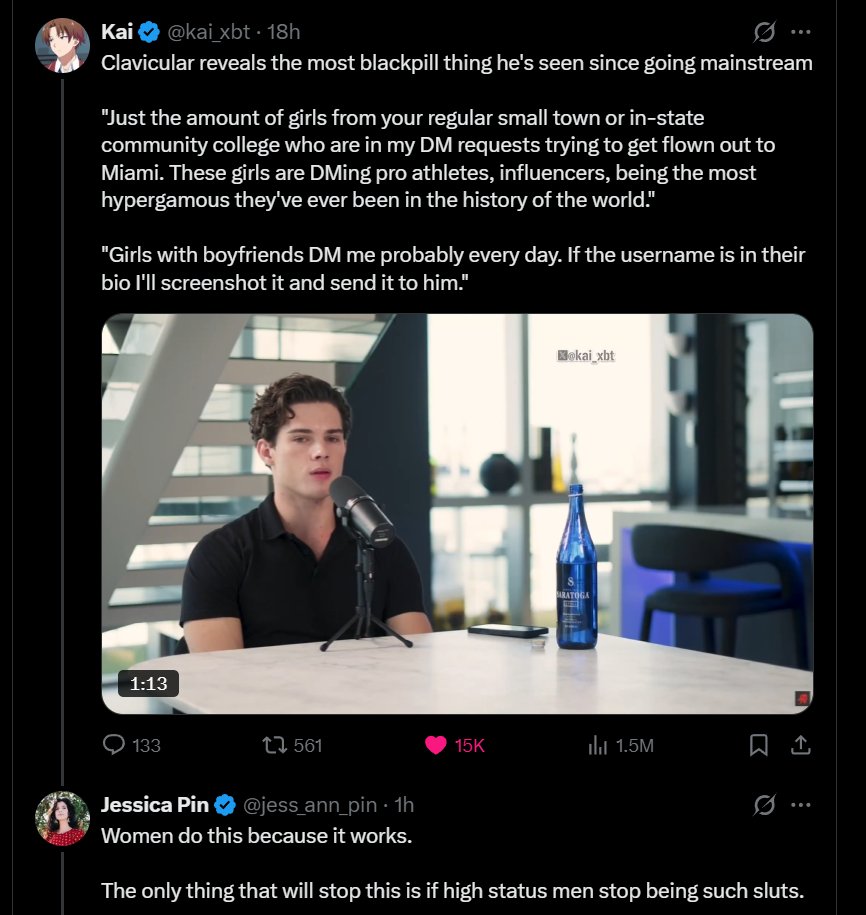
Seeing this and exchange and saying that it "works" for women is actually the ultimate in condemnation of the entire way that the western world has been set up
Woman sees famous guy -> DMs him for a plane ticket and sex -> gets a plane ticket and sex -> success
Success at what? The woman brain simply cannot process the question any more deeply because the woman brain has been under selective pressure to see that as the end goal because men will take care of the rest of the process by removing choice from her
The "success" here it totally empty, changes her into someone no man will happily marry and gives her a thrill that lasts a few minutes
Our society has utterly destroyed itself because no one really understood female nature and what women would chase when given total liberation
"Surely they will just compete harder for husbands" - quote from men who only ever saw women in a world where they needed husbands
it hasn't sunk in for most people. we already live in a post-scarcity society. UBI is already here.
basic package: disability, medicaid, food stamps etc
bonus package: literally getting paid for staying at home and hanging out with your relatives
extra bonus: if you are willing to commit fraud, pretend your kids are autistic and get paid for that. get paid for watching your neighbor's kid. pretend you are taking care of your grandma. fake hospice clinic. fake rehab clinic. fake therapy clinic.
giga bonus: during a time of crisis take advantage of PPP or CARES and open a fake business and get paid for existing
people are shocked when they learn that defense is the FIFTH largest line item in the budget. ahead of defense: social security ($1.6T), interest on debt ($1.1T) medicare ($1T), medicaid + ACA ($1T), AND THEN defense ($0.9T)
complain about defense all you like, but healthcare fraud is a way bigger factor. hundreds of billions per year.
this is only going to get worse, because the fraud is a structural part of the system – payouts to client groups in exchange for votes (normally D).
in the US, only 47% of the population actually works (fully 14% of the population is working age and does not work). retirees are 18% and children 22%.
the system I described above subsidizes 50m non-working people absolute minimum, but really it's far more because people that are paid to stay home and take care of their relatives are considered "workers"
of that 47% of "actual workers" maybe one third does real work, the rest are shuffling papers around or doing fake email jobs. so you have, rough math, 50 million actual workers supporting 300 million dependents. that's the nature of the economy today. it will only accelerate. eventually you will have 10 million using AI tools to do all the work and 340 million dependents.
the reason no one roots out the fraud is because it's the system that keeps our extremely fragile polity intact. the fraud is the UBI. the purpose of the system is what it does.
of course, it's a deeply unfair system, because you are allowed to commit fraud if you are a politically protected client group of the democrats. DOGE was killed faster than any government program ever, because it attempted to root out the fraud. if you are honest and unwilling to commit fraud, you are a huge loser in this system. your neighbor will have their mortgage subsidized by some government program. they will get favorable SBA loans due to DEI. they will open a fake hospice or autism clinic. they will get paid for taking care of their neighbor's kid and vice versa. the primary skill in the labor market is learning how to extract money from state and federal government programs, not gaining skills or making yourself employable. if you are just trying to work an ordinary wagie job you are a huge sucker. you are paying 40-50% effective all in taxes to everyone else who is a net taker.
the sad part is because AI is such a substantial productivity boost, it will actually keep this system going for a while longer, and maybe in perpetuity. AI boosts the 15% of the population that is actually productive so much that the remaining 85% can coast by. no one in charge will change this because they can't think of anything else. the political costs of a real UBI program are too great and we don't have the money for it anyway. so we will keep this covert fraud-based UBI program running indefinitely. unfortunately, if you are an honest wagie, you lose.