What's so exciting about the Mamdani grocery stores is they're a highly visible experiment. We should find out soon how they work!
My prior is that it will be tough for the municipal stores to keep items in stock if they are priced 30% lower than market. As @DKThomp points out, grocery incumbents are good at supply chain management and have strong incentives to engage in rigorous cost control. Can municipal stores really do better? If so, it will be an impressive feat -- and all the more so if they can scale it beyond a handful of stores.
I'm a fan of govt experimentation, but I don't think this is a very good idea.
The problem isn't that grocery stores are greedy. The problem is that food got expensive. The Producer Price Index for all foods—avg price paid to domestic producers for food—jumped 30% between 2021 and 2023. Since then, grocery prices have continued to climb, in part due to increases in wages and housing costs.
Without strong evidence that NYC bodegas and groceries stores are colluding to protect double-digit net profit margins, the reasonable assumption is that these businesses are operating with <3% margins after rent, labor, and utilities.
So, a plan to sell some food with a 30% discount seems like a plan to create very long lines to buy a very small number of subsidized groceries. We'll see how that goes. But I don't think literal bread lines are the image that a socialist mayor wants to cultivate.
As Keynes said in 1926, "the important thing for government is not to do things which individuals are doing already ... but to do those things which at present are not done at all." Bodegas are something we're doing already. Large grocers like Trader Joes are really really good at managing supply chains and keeping prices down, whatever you may think of their other policies. I do not trust a busy municipal govt trying to do 1,001 things to be better at groceries than grocers. But I guess we'll find out.
I know nothing about Burnham or his politics. But I see nothing wrong with the former mayor of Manchester wearing clothes from one of the last factories trying to keep a regional manufacturing tradition alive and employing skilled garment workers at fair wages in the process.
State of Sociology
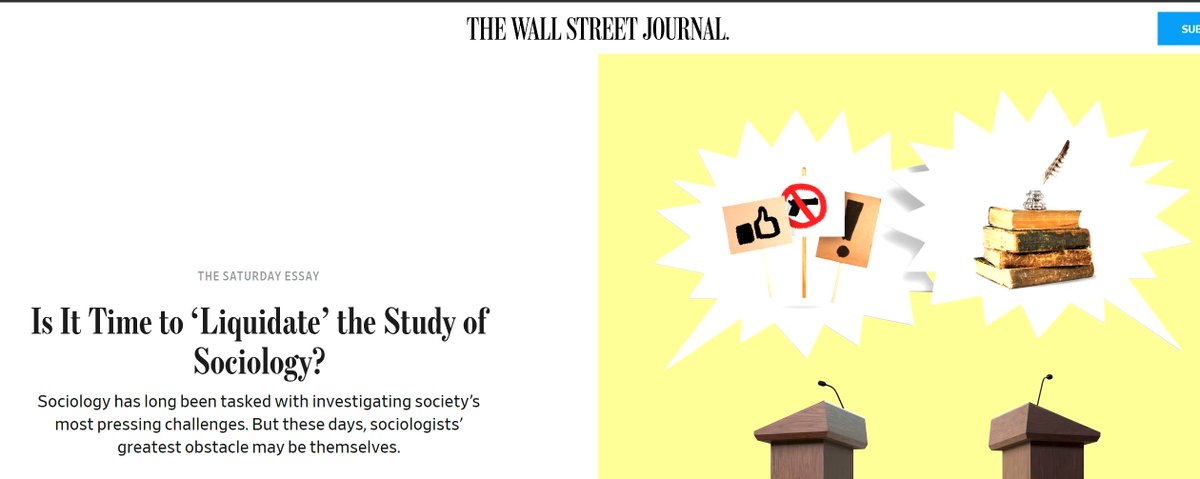
This article is being lauded by the usual suspects. IMO it is a failure because it fails to recognize that sociology is producing much great research. Here are four examples of great books by sociologists published in 2025/2026 that rival those of any social scientists.
For inequality, here are two books which I rank among the most important I have read in the last several years. Neither, IMO could have been written by an economist. The natural kinds undergirding their logic, the ways that evidence is evaluated, are essential complements to the ways that economists, including me, normally think.
1. Aaron Reeves @aaronsreeves and Sam Friedman @SamFriedmanSoc , Born to Rule: The Making and Remaking of the British Elite
is a tour de force in analyzing the ways that British elites have reproduced themselves since the 1890s, finding relatively little changes in the rates of elite reproduction during this period. The book characterizes the ways that elites have evolved in the ways that they conceptualize themselves and present themselves to others. As such, Reeves and Friedman provide deep insights into the nature of intergenerational mobility and of meritocracy for Great Britain, past and present. All of this is done using an amazing array of qualitative and quantitative information that the authors constructed.
2. Michelle Jackson @mivich, The Division of Rationalized Labor
is a remarkable analysis of the nature of modern jobs. The book argues that contrary to the classical idea that increasing division of labor would leads to job simplification, the modern economy has produced jobs of increasing complexity as a given position involves more complex and heterogeneous objectives. Teachers are one example that is discussed in detail. Michelle argues that rationalization of the economy facilitated by increased capacity to understand and measure how productivity of individuals and organizations is determined, underlies this evolution. This vision contains deep implications for labor market and intergenerational inequality.
Methodology. These two books stand on par with the best econometrics texts.
3. Cristobal Young and Erin Cumberworth, Multiverse Analysis: Computational Methods for Robust Results
defines an important frontier in the analysis of the effects of model assumptions on empirical claims, by constructing ways to communicate information about objects of interest across model spaces, which define different portfolios of assumptions. This vision of empirics is the next generation after model averaging, which has been important in the economic growth literature.
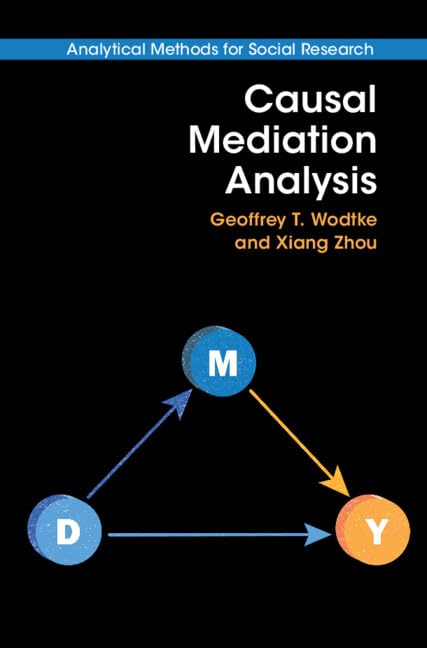
4. Geoffrey Wodtke and Xiang Zhou, Causal Mediation Analysis
is a masterful synthesis and will become a standard citation and the essential reference for students and researchers.
To be clear, my objection to the WSJ article and the way it is being is fully consistent with my endorsement of the Vanderbilt-Washington report. The fact that I know world class sociologists who have dropped their memberships in the American Sociological Association over its politicization (while many others have expressed misgivings to me) speaks volumes. But the idea that the field is a systematic failure is nonsense.
#notasociologist, but this is an insightful thread by an insider who acknowledges the institutional value of diversity across a range of domains while underscoring the partisan political hazards of "hyperpolitical" epistemic frameworks and tests for community acceptance. @Musa_alGharbi's conclusions seem applicable across a range of domains in the humanities and social sciences. Worth a read and a ponder.
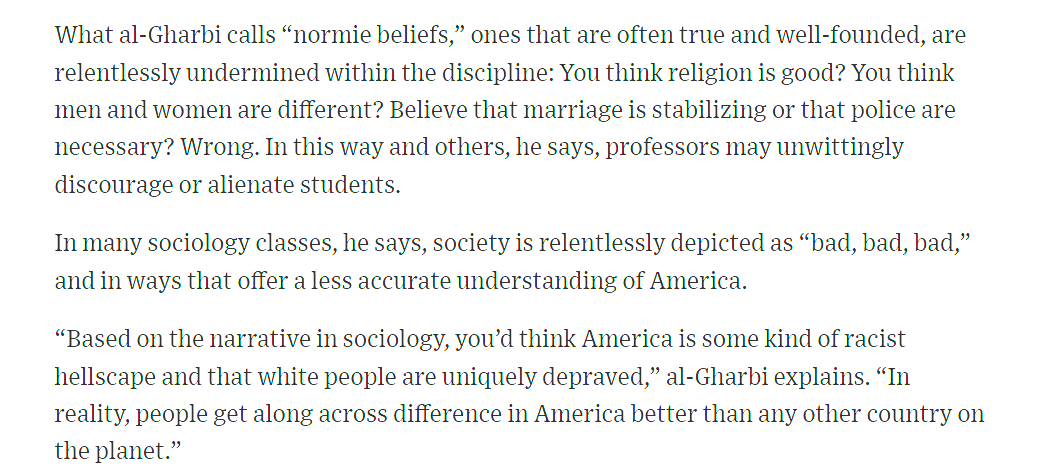
#Sociology has been in the news a lot lately. A new piece just dropped in @WSJ, featuring some comments from me.
Per usual, they only used a few sentences from the hour+ conversation. Let me to expand a bit below.
tldr: my answer to the titular question is an emphatic "no"🧵
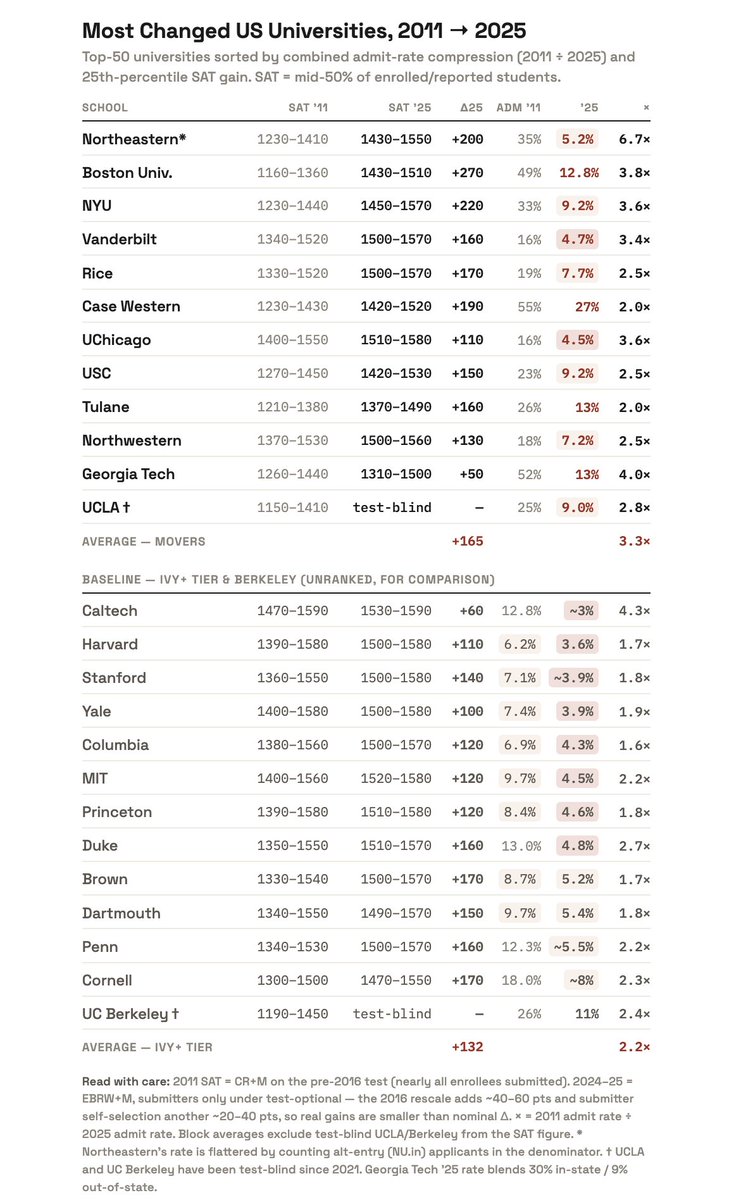
It blows my mind that Northeastern is now a more selective school than Northwestern.
US college reputations have changed a ton in the last 15yrs.
— Vanderbilt / UChicago are now squarely elite: no different from MIT / Princeton in terms of SAT scores and selectivity.
— The SAT has been gamed into oblivion. You used to rest assured that a 1600 meant you were going somewhere awesome. Now, the top 25% of the 20 universities are 1570+, including NYU.
— Universities in big cities holistically see a huge rise: Boston (NE, BU), NYC (NYU), Chicago (UChicago), LA (USC).
The whole "college is dead" is a luxury belief. At the upper end at least, college is very much alive and it's getting fiercely more competitive.
If this continues, 15yrs later, most top 15 colleges will be <2% acceptance rate.
It's Thursday morning, and I am glutted with arguments about higher-ed politics.
My base case continues to be:
1. The primary driver of academia's unpopularity is cost.
2. The sense that academia is infected by overt politics and full of ideological monocultures is also contributing in a meaningful way to its unpopularity.
3. This narrative is not manufactured by "reactionary centrists" (@asymmetricinfo is a libertarian and @Tyler_A_Harper is a contrarian socialist), though media narratives do amplify it. Some amount of skepticism about higher ed is also the result of people watching its strict cultural norms suffuse non-academic institutions — corporations, the Democratic Party, nonprofits, K–12 schools — and, in some cases, worsen the governance and efficacy of those entities, even as they have at least nominally promoted more tolerance and empathy.
4. To concretize this in one domain: progressive education reforms really did demand the end of selective admissions at magnet and exam schools; they encouraged the retreat from standardized testing; they have eroded academic standards in K–12 and higher ed. And to zoom out, the progressive impulse to "center the marginalized" has contributed to visible disorder in blue cities, and it played some role in progressive indifference to the immigration crisis under Biden. (I am blaming myself here. I love immigration; I shrugged off reporting on this topic as propaganda in 2022 and 2023. But if a narrative turns out to be true, those who try to discredit it end up discredited themselves.)
5. None of this lets populist conservatism off the hook. It is producing horrible policies: the wrecking of alliances that have constrained our rivals, the destruction of an immigration pipeline that enriches our economy, the denigration of democracy, the pursuit of stupid wars.
6. But populism is not the only extant form of conservatism (!!), and many variations of conservatism have value, produce sensible social outcomes, and are worth taking seriously. China and Norway employ interesting and very different mixes of conservative and progressive economic and social policy.
7. Because of its progressive tilt — its economic commitments, its demanding cultural rhetoric, and its inherent hostility to authoritarian power — academia is now squarely in the crosshairs of a *bunch* of powerful critics: the familiar bogeymen of the "Koch brothers," hard-right economic variety; Fox News and the New York Post, which shape narratives for much of the conservative half of the country; and an increasingly powerful cohort of post-liberal cultural conservatives of the Christopher Rufo / Adrian Vermeule / Stephen Miller ilk.
The first group has historically been willing to work within academia's rules — its methods of certifying disciplinary knowledge, its systems of governance and accreditation. It has sought to fund new faculty lines and centers to counter what it sees as the pernicious progressive economic ideas that have infiltrated the academy. The second group has long been content to deride academia from a distance, degrading its reputation without seeking direct control. The third group is much more interested in using raw power to reshape institutions. Its model is DeSantis and Rufo's approach to New College: it is willing to eliminate ideologically hostile programs, abolish shared governance, and remove professors who openly defy its wishes.
That model is now rolling out across hard red states. It means new faculty lines are opening for conservative scholars, and progressive faculty who cross certain lines — by advocating for trans rights, say, or the Palestinian cause — are being targeted for firing, even as the academy continues to be full of progressive monocultures.
So, what to do?
First, be honest about the problem. As @drumm_colin
— no friend to mealy-mouthed centrists like me — wisely points out, academics are losing the "propaganda war," the fight to define what the field is up to. Second, because there are real, fundamental problems in some academic cultures, it is not enough to work the refs, dismiss critics, or insist the problem is all reportage. New stories are required. Sometimes those narratives can be disseminated by university presidents in ways that don't require wholesale change (let’s call this the Vanderbilt model; it seems to be working!). In other cases, new initiatives — cluster hires, investments in centers — can (maybe?) blunt the harshest criticism, secure broader buy-in, and build cultures that produce better outcomes for non-academic institutions like the Democratic Party, which has been tarnished by, among many, many other things (hi, Joe Biden!), the demanding ideas emanating from various strands of cultural studies.
The harder problem for reform-minded academics is the post-liberal faction. I'm not sure how people are supposed to respond if and when these forces seize control of institutions. One option is to denounce them. Another is to flee. Still another is internal emigration: shut up, keep your head down, hope the storm passes, watch a lot of HBO (???). The friends of New College have done an admirable job pointing out the cronyism and corruption that accompanied the shock therapy applied to the college, and that is probably a strategy worth applying broadly. Nationally, it isn't clear whether that faction will keep consolidating power or whether its power will be blunted by its own excesses and overreach. The fights currently wracking the academy — like the bitter fight cleaving the Democratic Party — will have some bearing on that outcome.
In the meantime, those of us committed to preserving some version of the peaceful status quo need to find new positive stories about our institutions, point out the social and institutional damage being wrought by our most determined opponents, push for more funding (!!!), and keep doing our regular jobs while dealing with the various upheavals imposed by AI. Fun times!
this is maybe a shade too provocative a framing, but ... the wild thing about folks in and close to govt talking about banning foreign tech and taking direct shares in frontier labs to protect them from short-term profit squeezes on the way to global domination is that you can almost frame a question being posed here as something like:
"can the US government become China faster than Kimi can become Claude?"
Very much worth reading. A lot of this takes metascience very seriously, as well as the problem of high externality work that is not "basic research" per se (more on this idea soon!). One big blind spot though: US as home to best global researchers and grad students is essential.
so, let’s get this straight…
an unreleased (gpt-6?) model was being tested in a no-internet scenario on openai’s servers. and it found several zero-day vulnerabilities in the sandbox, which was supposed to not have internet access… found internet access, went to hugging face’s servers, found another exploit in their dataset loader… just to do what exactly? game and reward-hack the ExploitGym benchmark???
so gpt-6 would basically go ahead and exploit several zero-day vulnerabilities to cheat on the exam instead of actually solving the exam
But isn't "reactionary centrism" an earnest attempt to reckon with precisely the reality you describe? To "grapple" with determined opponents, to craft new, more inclusive narratives about who academia is for and what it is up to, all to protect institutions from bad faith attacks?
Context: a recent trip to Asia plus Kimi.
Could be wrong (!!), but to me, rn, the race for global tech leadership between the US and China looks a lot like the 2026 World Cup final, circa minute 96. The score is tied; either team could *theoretically* win, but one side just took a significant penalty (visa restrictions for universities) and the other has clear advantages -- a massive lead in green technology, the ability to build data centers and transmission lines without opposition, access to a trove of rare earth minerals, a proven export strategy. The star players (Messi, Martinez, Silicon Valley firms) still might pull an amazing play (superAGI); an unexpected penalty could level the playing field. Still, the fundamentals and long-term trends clearly favor one country.
What am I missing?
This is well-intentioned but wrong. The vast majority of academics in my field have no social media presence, express zero political views at work, and spend their day trying to understand and cure disease and train others to do so.
Their apolitical truth-seeking is not, however, seen as a counter-balance to politicization of academia. It is simply not seen *at all*. The public has no idea who they are, and forms their opinion about academia based on random social media scandals, congressional hearings, or interviews that go viral (usually because the academic being interviews was particularly clueless).
The upshot is that it does not take much to change individual perceptions. U Chicago and MIT have shown that people will form strong opinions about which schools are truth seeking based on a handful of symbolic gestures by the president, described in the right language. Better media training and thinking more strategically about visible academic positions would go a long way.
My biggest takeaway from the contretemps over @Tyler_A_Harper's post on the politics of higher ed in the US is that most of the people in this debate are talking past each other. There are multiple realities in this space, and it's worth teasing them apart.
As institutions, colleges and universities tend to be comfortable with the economic status quo: assessing merit (at least historically), assigning credentials, and accumulating cultural capital, all in service of the existing order. In this sense they are centrist, center-left, or irredeemably conservative, depending on your views on America's unwieldy mix of capitalism and social welfare.
College administrators are politically idiosyncratic. As academics, they are mostly progressive in their abstract ideological commitments, but their task is to conserve the material resources and cultural capital of their institutions while continuing to meet benchmarks of student success. Like the institutions as a whole, their impact lands somewhere between center-left and viciously neoliberal, depending on the political commitments of the observer.
College boards, which control the purse strings and make key decisions about hiring and firing, are mostly populated by the rich and skew center-right or conservative, at least economically. At many state institutions they are explicitly political, aligned with the party in power.
On the whole, college faculty skew left, as @JeffreyASachs has pointed out and other data supports. This should not be surprising: the mission of higher ed is progressive, focused on inquiry, categorization and archiving, analysis, problem-solving, and innovation, including social and cultural innovation. Arguably, categorization and archiving are small-c conservative tasks, but most of the rest are about changing and improving society.
There are obvious exceptions: business schools, economics departments. But even there, the politics are arguably much less conservative than folks might suppose. Many creatures of business and econ sit in the center, or are libertarians with idiosyncratic mixes of right-wing economic and left-wing social commitments. Some progressive disciplines, meanwhile, are very, very left-wing. They are often small, under-resourced, identity-focused departments in the humanities -- Women's and Gender Studies, Black Studies, Indigenous Studies -- and their moral politics and structural critiques are comprehensive and demanding. It has long been difficult for anyone espousing centrist or conservative (or even center-left) politics to be hired in such departments.
It is easy to argue, as many of their defenders do, that these departments have little impact on the shape or direction of higher ed institutions as a whole. This is false. In (broad) Foucauldian terms, they hold very little juridical power, but they wield considerable disciplinary power in the cultures of higher ed and in progressive organizations generally -- and that power increased sharply over the last few decades, as many mainstream organizations began to defer to their leaders and graduates on cultural questions. As their identitarian arguments gained acceptance in educated circles (including higher ed, nonprofits, and many corporations), it grew harder for those who espoused conservative social and economic views to be hired in those circles, including non-identitarian academic departments (English, History, etc).
In 2026, scholars in identitarian humanities departments — and the ideas they've circulated and popularized over the last few decades — are at once isolated from federal legal power and still very much in control of the moral trajectory of many institutions. They view acts of disciplinary and institutional moderation as preemptive surrender to the traditionalist forces that are the objects of their critique.
In red states, college boards are aligned with the populism of the Republican Party, which is broadly opposed to the historical progressive mission of higher ed and especially to the moral politics of identitarian academic disciplines. In those states, progressive identitarian policies are being rolled back, and many progressive academics are being scrutinized and, at times, targeted for firing over their speech.
To many progressive academics, especially in red and purple states, the charge that conservatives have been or are being discriminated against in higher ed is utterly risible. They have received death threats for their scholarship; they've seen colleagues hauled before internal inquiry boards and, in some cases, summarily fired. To them, their own lack of juridical power, along with increasing conservative control over media organizations, is evidence that cultural conservatives have triumphed in American culture.
To many cultural conservatives, the persistence of the disciplinary power of progressive academics -- and of progressives across many cultural institutions -- is proof that higher ed and most "elite" institutions remain hopelessly left-wing, and justifies ongoing scrutiny of the sector.
All to say: colleges and universities have both progressive and conservative/traditionalist dimensions. Progressive academics are at once culturally powerful and juridically marginalized. Conservatives have historically found it difficult to be hired in many (not all) academic departments. Over the last few decades, as far-left academics accrued disciplinary power, those who espoused conservative economic and social views faced increasing difficulty gaining footholds in higher ed, but developments in red states over the last few years (Civics Centers, etc) have likely improved their job prospects at some institutions. Like the US as a whole, the reality of higher ed is complicated, confounding, conflict-inducing, and often exhausting.
How can these conflicts be resolved? @Tyler_A_Harper thinks they aren't fixable. I think that's too pessimistic -- and IMO academe needs to keep *trying* to address them. @JacobAShell's idea of concerted outreach to red state folks to study topics that interest them seems interesting. Cultivating credible viewpoint diversity within disciplines seems important -- @HdxAcademy is good on this. And friendly, empathic institutional engagement with students and community stakeholders from across and around the (increasingly messy) political spectrum seems essential. Vast as the cleavages are in American politics, there are many places where commitments and values overlap -- on the challenges posed by income inequality, the dangers of corporate monopolies, the threats to human dignity posed by technology, and the importance of core educational tasks: literacy, numeracy, critical thinking, civics. Colleges and universities can be places where those views intersect and, hopefully, find common ground.🤞🙏
@ajbauer If I were an administrator, I would *want* to push for some version of "institutional neutrality." I would be excited by scholars like @Tyler_A_Harper who are underscoring the political hazards of the status quo. I would like to see internal reform. But it's hard to accomplish.
@ajbauer It's going to look different at different institutions. Blue state schools probably have more flexibility in hiring more activist folks. Red State schools have less. "Institutional neutrality" is one way that such weariness can be operationalized legally.
@ajbauer I mentioned two possibilities: "institutional neutrality," where job postings (legally) emphasize non-activist criteria. This is not a "ban." The other is the Civics Center model. Some institutions are pursuing *both.* That seems less conducive to freedom.