Why a regular paycheck used to cover a regular life & doesn't anymore. Former restaurant server. Reader. Writes about what the economic debate keeps leaving out
Productivity rose 178% since 1971. Wages rose 10%. The economy produced the gains. They didn't arrive.
Where did the other 168% go?
https://t.co/9adpdzPPqv
@SteveRattner@Morning_Joe 401(k) hardship withdrawals tripled while productivity kept rising. Workers aren't raiding their retirement because they stopped creating value. They're raiding it because the value they create doesn't cover what it used to.
https://t.co/9adpdzPPqv
The two charts are connected. The US leads the G20 in productivity. It also leads in debt. If productivity gains had reached workers as wages, households wouldn't have needed the borrowing. The debt filled the gap between what workers produced and what they were paid. Fifty years of missing wages had to go somewhere. They went to the balance sheet.
https://t.co/nQJEYTThk0
The two charts are connected. The US leads the G20 in productivity. It also leads in debt. If productivity gains had reached workers as wages, households wouldn't have needed the borrowing. The debt filled the gap between what workers produced and what they were paid. Fifty years of missing wages had to go somewhere. They went to the balance sheet.
https://t.co/nQJEYTThk0
The chart shows the income gap. The part it can't show: why productivity growth hasn't closed it. Global output per worker has risen for decades. The gains are being produced. They aren't distributing. Projecting convergence by 2100 assumes the distribution mechanism works. So far it hasn't.
https://t.co/nQJEYTThk0
@alvinfoo Agreed. The tools have never been better. We've also already had 178% productivity growth since 1971, and most of it didn't reach workers as wages or consumers as lower prices.
If we can figure out why and fix that, the next wave changes everything. I think we can.
$100 of groceries in 1971 costs $775 today.
If productivity gains had reached you, it would cost $37.
The gap between those two numbers is the abundance you never received.
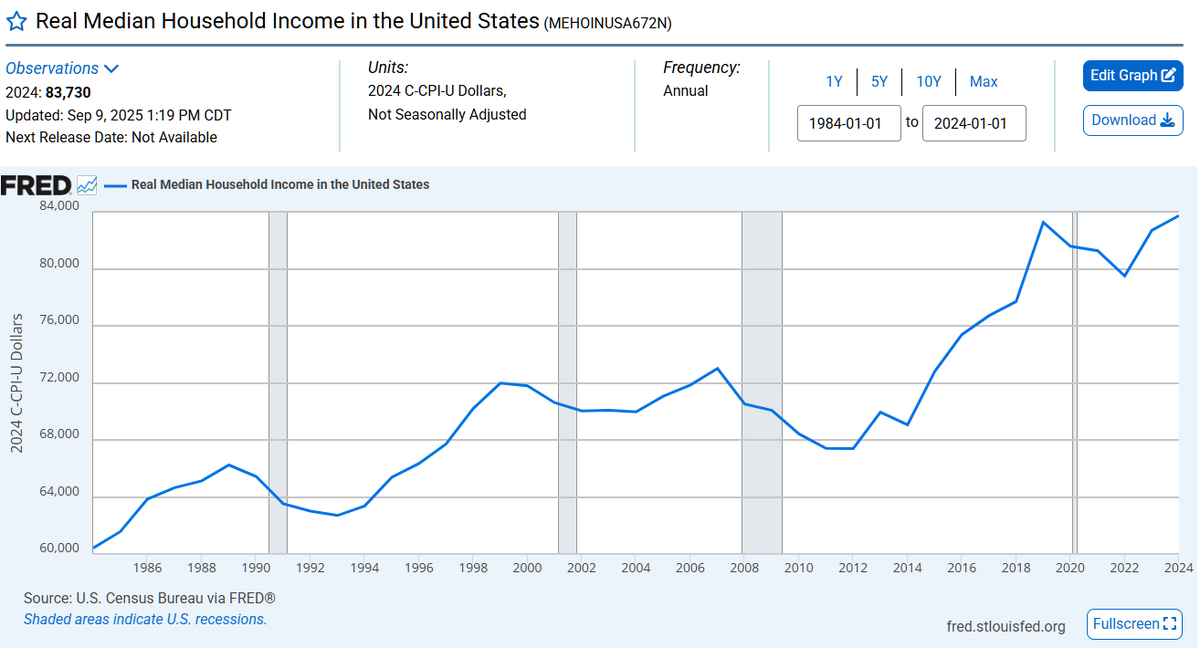
@thecostofwork@RiccardoTrezzi Except for a drop during the Biden administration, real median household income has risen quite a bit in the U.S. over the years.
Asset prices have grown dramatically faster than wages over the past generation — this chart is an understatement that doesn’t even include dividends or imputed rent.
https://t.co/Pgs4nlZW7E
@mattyglesias The divergence has a timing problem. If tax policy caused it, the timing would follow tax changes. If deregulation caused it, the timing would match deregulation. Neither does. The pattern holds across every administration, which suggests the cause sits beneath the policy debate.
@RossBinkley@RiccardoTrezzi Household income rose because households added a second earner. In 1970, one income covered a family. Today most families need two. That stat isn't measuring a gain in purchasing power per hour worked. It's measuring how many more hours families had to sell to keep up.
You're listing the products where the gains DID reach consumers. Phones, computers and TVs all got better and cheaper. That's the mechanism working. Now apply the same comparison to rent, a hospital visit, or a year of college. Those moved the opposite direction despite the same productivity growth. The gains reached your phone. They didn't reach your house.
Economists spend a lot of time debating whether real wages rose 10% or 35% since the 1970s. Both figures are defensible. Neither changes the fact that productivity rose 178% over the same period. The debate over which wage number to use distracts from the gap neither number explains.
A new piece at Human Progress argues opposition to free markets is misapplied evolutionary psychology — tribal instincts wired for chieftain economies.
It nails why the fixes are wrong. It skips why the problem exists at all.
@MillieMarconnni Ridley explains why progress happens. He doesn't explain why it stopped arriving. Productivity rose 178% since 1971.
The ideas kept combining. The gains stopped distributing. Something broke in the transmission.
This distribution pattern has held for decades regardless of which party holds Congress or which tax policy applies. It's getting worse because the mechanism that produces it compounds. The first 20 years looked manageable. The next 20 look catastrophic. Consistency of outcome across every political configuration points to something underneath the policy layer.