Explore the three-part architecture of human relationships: the biological floor, the social scaffolding, and the romantic canopy. Learn to separate these layers to understand modern mating.
Floor: The biological mating system. Pair-bond capacity, partner-specific habituation, and retained short-term/extra-pair options. It does not read vows.
Scaffolding: The external costs and rules that once raised the price of acting on the floor (legal, social, economic, communal). Many of those costs have been lowered.
Canopy: The romantic story that treats love, desire, and exclusivity as the same thing and as the meaning of the relationship. It is the map most people were given. It is not the building.
https://t.co/CaxNGjD1ty
Brett Hall's "Against Evolutionary Psychology" claims we have escaped the tyranny of our genes because humans are "universal explainers" who can critique and replace any idea.
Pressed against the Three-Track Lens (Evolutionary Floor, Cultural Scaffolding, and Romantic Canopy) and the empirical record, the essay accepts evolution only from the neck down, attacks a caricature no serious researcher holds, and smuggles a blank-slate narrative back in under philosophical cover.
Evolutionary Floor
Hall argues against evolutionary psychology as if it claimed thoughts are inherited, insisting that "thoughts are not passed on from parents to offspring" and that the genome's "12 MB" of protein-coding data has no room to store them. No serious formulation says that. DNA does not store propositional thoughts; it builds developmental systems, sensory filters, and valuation weights that reliably bias how we process threat, status, jealousy, and desire.
More importantly, Hall confuses computational universality with motivational autonomy. Critiquing an impulse does not delete the mechanism generating it. Understanding the reward circuitry for sugar does not abolish the craving, and understanding the evolutionary function of jealousy does not shut off the affective surge when a partner's attention wanders. In decision research, the hot-cold empathy gap shows that people in a calm state badly underpredict what they will want and do once aroused (Loewenstein, 2005; Ariely & Loewenstein, 2006).
Rather than engaging the data, the essay relies on a philosophical impossibility argument and skips the empirical record:
⏺️ A 50-year meta-analysis of 14.5 million twin pairs across 17,804 traits found an average heritability of roughly 49% across human traits (Polderman et al., 2015).
⏺️ Twin data show that individual differences in sociosexuality (unrestricted mating orientation) are driven primarily by additive genetic variance rather than shared family environment (Bailey et al., 2000).
⏺️ A 45-country replication confirmed cross-cultural sex differences in mate preferences, and gender equality did not eliminate them (Walter et al., 2020).
Cultural Scaffolding
Hall treats culture as free-floating memes that people can adopt or discard at will, with no account of priced constraints. Historically, legal penalties, economic dependence, and community surveillance did not delete underlying mating capacities; they raised the price of expressing them. Across 48 nations, men remain more unrestricted in sociosexuality than women in every world region, while local economic and ecological scaffolding calibrates the size of the gap (Schmitt, 2005). Memes do not float free of the scaffolding that makes some choices cheap and others expensive.
Romantic Canopy
In our work on human mating, we call the third track the Romantic Canopy because it wraps biological reality in a flattering story about pure willpower and character. Here, the canopy is doing the exact same job, swapping a love story for an exceptionalism story: "We are not like other animals. We have escaped the tyranny of our genes."
Strip away the Deutschian vocabulary and what is left is ego defense. The essay opens with an image of a man cutting his own puppet strings and closes with a sci-fi wish that we may one day "replace our wetware brains with a more robust substrate," so biology will finally stop applying to us. That is not an empirical refutation; it is secular theology for people who accept Darwin from the neck down. Calling yourself a "universal explainer" is just a high-status way of refusing to admit you are a primate running on conserved hardware.
At the end of the day, the canopy has one function: conceal the scaffolding, bury the floor, and insist that the canopy is the floor. If you can convince yourself that your drives, jealousies, and mate preferences are merely optional ideas you can edit out at will, you never have to confront the machinery actually moving you.
Philosophy does not overwrite biology. You can declare the puppet strings cut, sidestep fifty years of twin and cross-cultural data, and flatter yourself that you are the sole dictator of your own behavior. None of it alters a single receptor, hormone, or valuation weight in the wetware typing the argument. Until we actually leave DNA behind, the floor does not care what story you tell about it. It just keeps running.
https://t.co/nHSghV9Aja
El enésimo ataque contra la psicología evolucionista:
Este articulo es el último intento de refutar la Psicología Evolucionista (PE) y de reivindicar la Tabla Rasa. Acepta la teoría de la evolución pero sólo hasta el cuello. Descarta cualquier posible relación entre genes y conducta. Vamos a comentar algunas cosas:
1-Ataca una caricatura, no la psicología evolucionista real
El artículo combate la idea de que “los genes dictan irrevocablemente nuestra conducta” o que “no podemos cambiar de idea”. Esa posición es prácticamente inexistente entre psicólogos evolutivos serios. La psicología evolutiva estándar habla de mecanismos, predisposiciones y sesgos que interactúan con el entorno. No niega el aprendizaje, la cultura ni la capacidad de deliberación.
Al refutar una tesis que nadie defiende, el argumento no tiene mucho sentido.
2. El salto de la “universalidad explicativa” no funciona
El núcleo de la crítica de Brett Hall es la idea de universalidad explicativa. Según él, el cerebro humano es un sistema físico y, por tanto, un tipo de ordenador, de acuerdo con el principio de Church-Turing-Deutsch, que establece que cualquier proceso físico puede en principio ser simulado computacionalmente. A esto añade que los seres humanos no somos simples procesadores de información, sino explicadores universales: somos capaces de crear conocimiento explicativo de tal manera que, en principio, cualquier proceso físico del universo puede ser comprendido y explicado por una mente humana, sin que exista ninguna ley de la física que lo impida. A partir de estas premisas construye su argumento central: si una mente es realmente universal y puede explicar cualquier cosa, entonces cualquier idea que tenga debe poder ser criticada y sustituida por otra mejor. Si existiera alguna idea que no pudiera cambiarse bajo ninguna circunstancia, esa mente dejaría de ser universal. Por tanto, concluye, todas las ideas —vengan de los genes, de los memes o de cualquier otro origen— son en principio corregibles, y ni los genes ni los memes pueden dictar irrevocablemente nuestra conducta, porque siempre podemos crear una explicación mejor y actuar de otra manera.
Este argumento falla por muchas cosas empezando porque la PE no dice que no puedas cambiar de idea, pero es que da un salto injustificado entre la capacidad de criticar una idea y la desaparición de su influencia sobre la conducta. Que una persona pueda, en principio, entender y criticar un impulso o una preferencia no significa que ese impulso o preferencia deje de ejercer presión solo porque ha sido criticado. Se puede comprender perfectamente por qué el azúcar activa el sistema de recompensa y criticar racionalmente la idea de comerse un donut, y aun así el deseo sigue presente y a menudo prevalece. O puedo entender el funcionamiento ddd los celos y, aún así, sentirlos si mi pareja presta atención a otra persona. Y lo que dice la PE es que los celos son un mecanismo psicológico que está ahí porque ha sido adaptativo. Se puede disponer de una explicación sofisticada de por qué existen ciertos sesgos cognitivos y, sin embargo, seguir cayendo en ellos. Hall trata la capacidad de criticar ideas como si fuera suficiente para neutralizar los mecanismos psicológicos que las generan o refuerzan, pero criticar una idea no borra el mecanismo. Es como afirmar que, porque se puede entender la física de la gravedad, la gravedad ya no puede hacer que uno se caiga. La psicología evolutiva no sostiene que haya ideas intocables inscritas en los genes; sostiene que existen mecanismos y predisposiciones que hacen que ciertas ideas o conductas nos resulten más fáciles, atractivas o difíciles de resistir. El hecho de que podamos criticarlas no las elimina, y por eso la universalidad explicativa, aunque pueda ser cierta en un sentido abstracto, no refuta la existencia de influencias genéticas relevantes en la conducta humana.
3. Doble estándar claro
El texto acepta sin problemas que la evolución y los genes explican estructuras físicas complejas. Cuando se trata de la mente y la conducta, de repente esa explicación se vuelve sospechosa y se busca minimizarla al máximo. No hay una razón científica sólida para ese corte. La continuidad evolutiva existe. El cerebro es un órgano biológico como cualquier otro. La mente es lo que el cerebro hace. La mente es el cerebro en acción. El cerebro es el órgano de la conducta y el cerebro/la conducta ha evolucionado. Sin cerebro no hay conducta. Ni cultura.
4. Tesis fuerte sobre el libre albedrío y la excepcionalidad humana
El artículo termina defendiendo que los humanos hemos “escapado de la tiranía de los genes” y que, a diferencia del resto de los animales, somos esencialmente libres de dictar nuestra propia conducta mediante la creación de conocimiento. Esto es más viejo que la rueda. Seguimos sin poder aceptar que somos animales y que hemos evolucionado aunque han pasado más de 150 años desde Darwin.
Esto es una posición filosófica muy respetable pero no está demostrada y tampoco lo demuestra aquí, simplemente lo afirma.
5. Subestima la evidencia empírica
El artículo se centra en argumentos de principio (capacidad del genoma, universalidad explicativa) y presta poca atención a la evidencia concreta que suele citar la psicología evolutiva: estudios de gemelos, adopción, diferencias sexuales consistentes entre culturas, patrones de preferencia de pareja, sesgos cognitivos universales, etc.
No es necesario aceptar todas esas evidencias para reconocer que el texto las ignora en lugar de confrontarlas.
Conclusión
El artículo es una crítica a una versión exagerada y popular de la psicología evolutiva, envuelta en un marco filosófico (universalidad explicativa + libre albedrío fuerte) que permite llegar a la conclusión de que los genes tienen poca o ninguna relevancia para la conducta humana. Nada nuevo: siempre ha sido anatema y pecado poner genes y conducta en la misma frase.
This clip advises detaching when someone chooses others over you. Viewers commonly turn that advice into a "withdrawal test": pulling back to see who chases.
Pressed against the Three-Track Lens, that test misfires, and the research points to a stronger one.
Evolutionary Floor: Human cooperation runs on two distinct systems, not one. Exchange relationships (acquaintances, coworkers, business ties) track who owes what. Close, communal relationships respond to need without keeping a balance sheet. In experiments, people seeking a communal tie actually lost attraction to partners who insisted on immediate repayment (Clark & Mills, 1979).
Deep friendship evolved to solve what evolutionary psychologists call the Banker's Paradox. Pure reciprocity fails at the exact moment you need help most, because a person in crisis is the worst credit risk. Deep friendship solves this by valuing specific individuals as irreplaceable, so help arrives even when repayment is unlikely (Tooby & Cosmides, 1996), resting on mutual goodwill built over time rather than tit-for-tat accounting (Hruschka, 2010). Consistent with that logic, an agent-based simulation modeling Maasai sharing rules found higher herd survival under volatile conditions for need-based transfers than for strict account-keeping (Aktipis et al., 2016).
Social networks are also layered and cumulative: roughly 5 intimates, 15 close friends (including the 5), 50 good friends, and 150 meaningful contacts on average, with individual variation (Dunbar, 2018). Most named friends are outer-layer by design.
Cultural Scaffolding: Utility friendship is the historical baseline, a split Aristotle recognized 2,300 years ago (a historical parallel, while the evolutionary work explains the mechanism). Many friendships are held up by shared institutions: workplaces, congregations, clubs, roles, and titles. When the scaffolding ends, the tie often ends with it. That is utility friendship working as designed, not betrayal.
What has changed is how much time people spend maintaining ties. American Time Use Survey data from 2003 to 2020 show social isolation rising and time with friends falling well before the pandemic, with a steeper drop for men (Kannan & Veazie, 2023).
This is also why the withdrawal test is confounded. Non-kin friendships decay without regular contact, including genuine ones, and some loyal friends are simply poor initiators (Roberts & Dunbar, 2011). Pulling back to see who chases overcounts "parasites" and misreads normal decay as disloyalty.
Canopy Labels like "church family" or "best friend" describe outer-layer utility ties as deep communal bonds regardless of how they actually function. The sense of betrayal comes from the gap between the canopy label and the underlying behavior.
The stronger diagnostic (interpretation): while not a named test from a single study, the Banker's Paradox and communal-relationship research jointly predict a cleaner filter than withdrawal. Watch who shows up across repeated interactions when you cannot give anything back: illness, crisis, or loss. Sort relationships by layer, maintain the few who pass, and stop expecting inner-circle returns from outer-layer ties.
Now, through the Three-Track Lens (interpretation), this same canopy problem hits even harder in romance. The modern Romantic Canopy borrows the language of the Banker's Paradox and applies it to dating and marriage: it promises that a romantic partner will be both an unconditional communal safety net and a permanent source of erotic desire.
Because the canopy labels romantic attachment as an inner-circle communal bond almost from the start, people routinely misclassify early-stage, exchange-based attraction as deep irreplaceability. That is why the clip's detachment advice resonates so strongly: when someone chooses another option, the shock is not just losing a partner, it is discovering that a tie labeled as communal was still operating on exchange rules.
Inside long-term marriage, the Romantic Canopy creates the opposite confusion. Clark and Mills (1979) treat healthy marriages as communal relationships where a slide into strict scorekeeping signals distress. Yet pair bonds layer sexual exclusivity, parental investment, and partner-specific erotic habituation on top of friendship.
The Romantic Canopy tells couples that passing the need test and maintaining deep communal goodwill should automatically preserve erotic pull. On the floor, those systems do not run on the same track: a spouse can remain loyal through illness or job loss while desire still fades or shifts elsewhere. Romantic ties share the Banker's Paradox floor, but the Romantic Canopy hides the fact that communal friendship alone does not govern the whole bond.
https://t.co/0GY5gKXHgH
In a televised arbitration case on The Verdict with Judge Hatchett, a wife hired an unlicensed marriage coach with a master's in psychology to help repair an eight-year marriage. The coach advised the wife to stop small acts of kindness and threaten separation as a "power play." The husband filed for divorce, and months later the wife found the coach dating her ex-husband.
Pressed against the Three-Track Lens, this is a textbook modern illustration of mate poaching.
Evolutionary Floor: Mate poaching is not a modern aberration; it is a documented, cross-cultural feature of human mating. In U.S. samples, a majority of men and a large minority of women report having attempted short-term mate poaching (Schmitt & Buss, 2001). Across 53 nations, roughly 10% to 15% of current relationships began through successful poaching (Schmitt et al., 2004).
Capacity and execution sit at different levels. While the capacity is widespread, who acts on it is predicted by stable individual differences, specifically higher sociosexuality and lower agreeableness across cultures (Schmitt et al., 2004). In this framework, converting professional access into a post-divorce relationship points to a weak Residual Inhibitors Mechanism (RIM). That is a floor profile, not a moral mystery.
Schmitt and Buss (2001) also documented that poaching tactics can include undermining an existing relationship. Advising a client to withdraw warmth and threaten separation fits that pattern in outcome, even though the case record does not prove prior intent to poach the husband.
Cultural Scaffolding: A marriage coach is the ultimate pre-cleared candidate. She is paid to be trusted, granted emotional access to both spouses, and handed a complete diagnostic map of the marriage's weak points.
That is precisely why formal clinical scaffolding exists. The APA ethics code prohibits licensed psychologists from sexual relationships with a client's significant others (Standard 10.06) and bars relationships with former clients for at least two years after termination (Standard 10.08). The modern life-coaching industry operates inside a scaffolding vacuum: it borrows clinical authority and pre-cleared trust without enforceable licensing rails. The judge's doubled award was an attempt to re-price the breach after the fact because the preventative rails were missing.
Romantic Canopy: Public reaction treats the coach as a uniquely cartoonish villain and the wife as uniquely unlucky. The floor-and-scaffolding reading is colder and more predictive: a widespread mating capacity met a low-inhibitor profile inside an unregulated, high-proximity role with asymmetric information.
The research also yields a falsifiable prediction: relationships formed through poaching begin with lower commitment, lower satisfaction, and more attention to alternatives (Foster et al., 2014). On that evidence, the new relationship starts at a disadvantage.
https://t.co/kfoH3yjMES
A woman sues her marriage coach for $7,500 after she went behind her back to date her husband. The woman had sought marriage counselling from the coach, who advised her to leave her husband, only for the coach to start dating him herself. 😭
Two claims are colliding here. One argues that women would rather share a high-value man than have exclusive access to an average one, and that "five minutes of Alpha trumps five years of Beta." The reply cites UK survey data showing 81% of women reject formal polygyny, with only 5% open to it, in a study the authors themselves frame around a "mononormative nation" where sociosexuality predicts interest (Thomas et al., 2024).
Pressed against the Three-Track Lens, both sides are talking past each other because they are conflating formal polygyny with informal tournament competition.
Evolutionary Floor: Rejecting formal sharing is not just cultural conditioning; it sits on the floor. Sharing a mate dilutes male investment. Cross-cultural research across 29 populations finds diminishing fitness returns to each additional wife, consistent with a husband's resources being split among them (Ross et al., 2018), and across 69 polygynous societies, co-wife conflict over resources and affection is widespread even where co-wives cooperate economically (Jankowiak et al., 2005). The "five minutes of Alpha" slogan also fails the paternity check: extra-pair paternity runs roughly 1% to 2% across human populations (Larmuseau et al., 2016).
At the same time, female mate-value sensitivity is real. When resource inequality is steep and survival depends on a husband's wealth, the polygyny threshold can be crossed: among the Kipsigis of Kenya, women and their families chose wealthier men even when that meant marrying an already-married man (Borgerhoff Mulder, 1990). The floor wants both high mate quality and exclusive investment.
Cultural Scaffolding: Scaffolding decides which trade-off surfaces. In modern Western economies, female income removes survival dependence on a husband's land or provisioning, so the sharing cost dominates and formal polygyny collapses.
Digital dating markets introduce a different dynamic: aspirational pursuit creates a bottleneck at the top of the desirability hierarchy (Bruch & Newman, 2018). Through the Three-Track Lens, the likely reading of what happens inside that bottleneck is not a secret preference for harems, but informal tournament competition. A woman dating a high-status man who has other options is not necessarily choosing to share him; she may be taking a probabilistic bet on winning him exclusively.
That also explains the gap between cold survey answers and messy lived behavior. Anonymous online surveys reduce public social desirability bias, yet they still query people in a cold, reflective state. Research on the hot-cold empathy gap shows people in a cold, reflective state systematically mispredict their own choices in a hot, aroused state (Loewenstein, 2005), with sexual arousal shifting stated willingness substantially, at least in men (Ariely & Loewenstein, 2006). Saying "no" to formal polygyny on a questionnaire and tolerating temporary ambiguity while competing for a high-status man are two different states.
Romantic Canopy: Both sides read the data through their preferred story. One treats the rejection of formal polygyny as proof that the mate-value bottleneck is a myth. The other treats a dating-market bottleneck as proof that women prefer sharing.
Exclusive monogamy with a high-value partner is the floor's actual target. Formal polygyny only wins when steep resource dependence forces the trade-off, and modern informal sharing looks less like a preference for harems than an artifact of a bottlenecked market.
https://t.co/JregRhy0aW
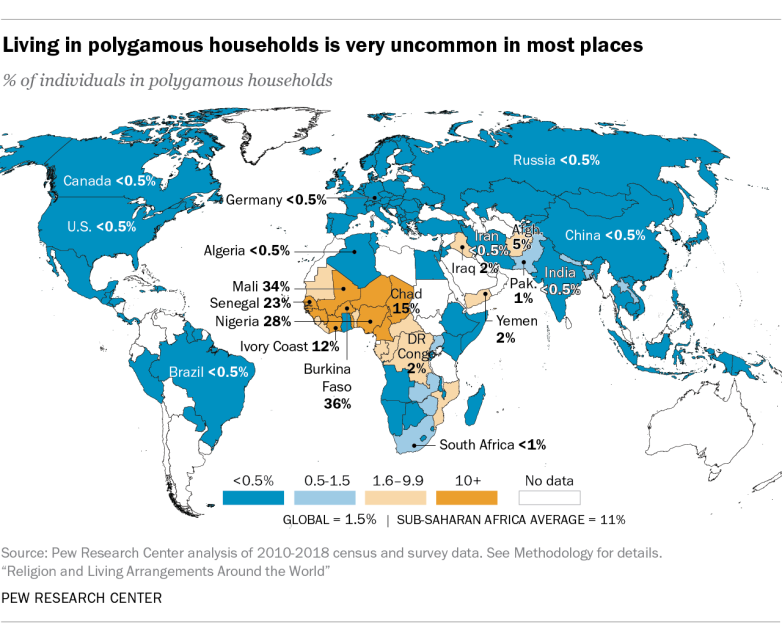
This is obviously false and mostly confined to being a man's wet dream. Polygyny is incredibly rare and most women simply aren't interested in it.
In developed nations like the UK, 81% of women are against polygynous relationships and only 5% are for them (first image) (PMID: 38030825).
Moreover, when rated on a scale ranging from −3 (not appealing at all) to +3 (very appealing), women put monogamy at around +2.5 and polygyny around -2 (second image).
Women's (lack of) interest in polygyny was unrelated to their age, education, prestige, or mate value.
These findings are observed in the YouGov survey of Americans too, with 73% of women "definitely not" interested in polyamory and 14% "probably not" — 87% total being not interested (third image).
And yes, women's behavior matches what they say. In the US, only about 4% of relationships are polyamorous (which includes polygyny, but also open relationships for both partners) (PMID: 29696552).
In another study, researchers estimated that just 0.1% of American marriages are polygamous (DOI: 10.1017/ssh.2021.23). PEW survey data put the value at less than 0.5% (fourth image).
The post's claim: a woman who left her first marriage through an affair later married the affair partner, had two children with him, and five years in began an affair with her CrossFit trainer, using the same complaints: he works too much, he ignores me. The post's conclusion: you already know how she handles an unhappy marriage.
Pressed against the Three-Track Lens:
Evolutionary Floor: The post is right about the prediction. The evidence supports it directly. People who cheat in one relationship are about three times more likely to cheat in their next (Knopp et al., 2017). Partners acquired through mate poaching also enter the new relationship less committed, less satisfied, more interested in alternatives, and more likely to be unfaithful, with sociosexual orientation largely explaining the weaker commitment (Foster et al., 2014).
The mechanism has two layers. The first is near-universal. Partner-specific habituation is a basic property of the nervous system (Thompson & Spencer, 1966; Rankin et al., 2009). After years of cohabitation and children, the familiar partner's erotic pull declines, and a novel target can restart the same dopamine-driven cascade that marked the start of the first relationship (Fisher, Aron, & Brown, 2006). She experiences it as "this one is different."
The second layer is individual, and it is what the post is detecting. Habituation and the novelty cascade happen to nearly everyone, so they cannot explain why she repeated the sequence when most habituated wives do not. What explains that is her internal brakes: in this series' terms, a weak Residual Inhibitors Mechanism (RIM). Unrestricted sociosexual orientation, one of RIM's four components, is the exact trait Foster and colleagues found driving the poached partners' weaker commitment (Simpson & Gangestad, 1991).
Cultural Scaffolding: The external price of a second affair is low. Gym and workplace proximity, private digital channels, and weak community surveillance keep the opportunity field wide open, and nothing in that environment raises the cost enough to stop the sequence once the cascade is under way. The same low-price conditions that allowed the first affair allowed the second.
Romantic Canopy: The post rejects her stated reasons, correctly. "He works too much" and "he ignores me" are the post-hoc package, assembled after the attraction moved to protect her self-image, and the same package was available both times (Glass & Wright, 1992). The repeated script is not a coincidence; it is the same justifying machinery running twice.
Where the post slips into canopy is its explanation. "How she handles an unhappy marriage" frames the pattern as a coping style, a moral choice about dealing with dissatisfaction. Through the lens, dissatisfaction in this pattern is often downstream of habituation, the script is downstream of the attraction, and what is stable in her is not a coping style, but a low inhibitor profile.
The repeated script is real and predictable, and so is the repetition itself. The post is right about the prediction and wrong about the explanation. What it reads as a character verdict is a floor profile: near-universal habituation and novelty response, running through unusually weak brakes, in an environment that charges almost nothing. And the man who married her had already seen that profile, because a partner who leaves a marriage through an affair has shown you her brakes.
https://t.co/PCXtHS9Dmc
If a woman cheated on her husband to be with you, you already know how she handles an unhappy marriage.
One guy I coached married a woman he'd had an affair with. Five years and two kids later, she said he worked too much and ignored her. Then she started an affair with her CrossFit trainer.
She used the same reasons and the same script on a different man.
The video argues that female promiscuity is the functional equivalent of male violent criminality. Both, it claims, use a biological advantage (sexual access for women, physical strength for men) to extract resources from the weak, leading to violent communities on one side and population collapse on the other.
Pressed against the Three-Track Lens and the empirical record:
Evolutionary Floor: (Partial alignment, major overclaim).
Strategic pluralism is real. Women retain capacity for short-term and extra-pair mating; men retain capacity for short-term mating and status competition (Buss & Schmitt, 1993; Gangestad & Simpson, 2000). Evolutionary theory also lists immediate resource acquisition as one hypothesized benefit of female short-term mating (Buss & Schmitt, 1993; Greiling & Buss, 2000).
But it is one benefit among several, not the primary motive. When researchers asked directly, women's most common reasons for sex were attraction, pleasure, and emotional connection, not material gain (Meston & Buss, 2007). The video slides from promiscuity to sugaring and digital content selling, yet transactional sex is a small, visible subset of short-term mating, not its definition.
The analogy also collapses on coercion versus voluntary exchange. Violent robbery takes resources through non-consensual force. Digital subscriptions, sugaring, and short-term mating are voluntary transactions. Framing paying men as "the weak" who had their wallets stolen strips men of agency. On the male side, violent crime is a high-variance status strategy concentrated in a small subset of young men (Wilson & Daly, 1985). Equating a heavily sanctioned, coercive male strategy with a conditional female mating capacity ignores the asymmetry in obligatory parental investment that shapes both sexes (Trivers, 1972). The floor does not license the equivalence.
Cultural Scaffolding: This is where the video's real observation sits, and where it misreads the data.
The scaffolding that once raised the price of short-term mating has thinned: contraception, no-fault divorce, weaker reputational surveillance, and tech platforms that monetize supernormal stimuli. Yet the result has not been a surge in promiscuity. Young adults are having less sex, not more. Sexual inactivity among American men aged 18 to 24 rose from roughly 19% to 31% between 2000 and 2018 (Ueda et al., 2020), and sexual frequency declined across American adults overall (Twenge et al., 2017).
What changed is distribution. Online dating data show attention concentrating at the top of the desirability hierarchy (Bruch & Newman, 2018), leaving a minority of men with disproportionate access while many get little or none. The video's audience is registering a real shift in pairing access, then misreading that distribution bottleneck as a wave of female promiscuity.
The crime half of the analogy fails the same empirical test. U.S. violent crime fell roughly by half from its early-1990s peak (FBI / Bureau of Justice Statistics). If the supposed male failure mode declined for three decades while digital dating markets expanded, the two trends never moved together.
Romantic Canopy: The video operates almost entirely inside a moral canopy. It recodes a conditional mating capacity as a civilizational defect and blames demographic decline on "unchecked female pathology." Yet fertility has fallen steeply below replacement in high-constraint, low-promiscuity societies like South Korea, Japan, and Iran (UN World Population Prospects). That points directly to industrial scaffolding (urbanization, housing costs, education, and contraception) rather than moral collapse.
The canopy calls the outcome a failure of virtue. The floor-and-scaffolding description is simpler: evolved capacities met a new technological opportunity structure that monetized attention and concentrated pairing access instead of expanding it.
The video correctly registers that traditional scaffolding has thinned and that digital markets have reshaped who gets access to whom. It fails the three-track test by treating resource extraction as the core function of female short-term mating, equating non-consensual violence with voluntary exchange, mistaking a distribution bottleneck for a rise in promiscuity, and pairing it with a crime rate that moved in the opposite direction. The grievance about pairing access is real. The diagnosis is canopy.
https://t.co/pxrwNfgIFi
We must recognize that promiscuity is the female equivalent of violent criminal behaviour in men.
The actions may be different but the reason is the same: using ones biological advantage to extract resources from the weak and vulnerable.
The finding matches the data: in modern industrial cohorts, personal income still predicts reproductive outcomes, but in opposite directions by sex. Higher-earning men have more children, mainly by entering partnerships and avoiding childlessness. Higher-earning women have fewer. Status didn't stop tracking fitness; it splits by sex.
Pressed against the Three-Track Lens:
Evolutionary Floor: The male side sits cleanly on the floor. Male reproductive success has always been more sensitive to status and resources, and income still converts into partnership access, which converts into descendants. The advantage comes almost entirely from avoiding childlessness, not from having larger families (Fieder & Huber, 2007; Nettle & Pollet, 2008; Hopcroft, 2021). That's the asymmetry Trivers identified in 1972, still executing under industrial conditions.
The female side is not the floor executing directly. The floor contributes the mate preference: because women weight a partner's resources more heavily, rising female income narrows the pool of acceptable long-term partners. Higher-earning women are more likely to divorce and less likely to remarry (Hopcroft, 2021).
Cultural Scaffolding: The rest of the female slope is scaffolding, and part of it runs in reverse. Children lower women's earnings: after a first child, women's income drops sharply and never fully recovers, while men's doesn't change (Kleven et al., 2019). So part of "high income, fewer children" is really "fewer children, high income." Reliable contraception and the career cost of early childbearing set the rest of the price.
The proof is that the female slope flips when the scaffolding changes. In Sweden, where parental leave is tied to prior earnings, higher-income women born in the 1960s and '70s had more children, not fewer (Kolk, 2023). The male slope didn't flip. It strengthened.
Education tells the same story from the other side. It predicts lower fertility in both sexes because years in school delay partnership and compress the reproductive window. Income taps the ancestral provisioning signal and splits by sex; education is a scaffolding clock that runs against everyone.
What holds across environments is floor. What flips when the rules change is scaffolding.
Romantic Canopy: The canopy tells both patterns as stories about equality. Part of that story is right: institutional support can shift the female slope. What the canopy misses is the other half. Even where support is strongest, the male income-to-partnership slope doesn't flatten. It holds, or strengthens. That isn't leftover patriarchy. It's leftover mating psychology, and better policy doesn't reverse it.
The ancestral resource asymmetry didn't vanish under industrial conditions. On the male side, it runs nearly unchanged. On the female side, it runs through mate choice and career cost, and the scaffolding decides the price. 🤔
https://t.co/CPWqoiwQG4
In modern industrial society, higher income continues to predict higher completed fertility for men, while it declines for women.
Status pursuit is a human universal, and evolutionary theory explains it through reproduction. Across nonindustrial societies, higher-status men reliably leave more descendants. Whether social status still predicts reproductive success in industrial societies is a long-standing problem for evolutionary approaches to human behavior.
This study examines how income and education relate to completed fertility, childlessness, and marriage across seven decades of American birth cohorts using data from 1972 to 2024 covering adults born roughly from the 1900s through 1979.
Even as overall fertility fell and marriage declined, the sex-specific links between personal income and fertility remained stable, with male childlessness and never-marriage concentrating more heavily among lower earners in later cohorts. Personal income predicts higher completed fertility for men and lower completed fertility for women, with both patterns remaining statistically stable across cohorts. Top-quintile earners had 9% more children than bottom-quintile earners among men and 28% fewer among women .
The male income advantage comes from entering partnership and avoiding childlessness rather than having larger families once a man becomes a father. Education predicted lower fertility in both sexes.
The central theoretical problem of human sociobiology looks different at this resolution. Status did not stop predicting fitness in the industrial United States. Its components predict fitness in opposite directions, by sex and by margin, and they have done so with remarkable constancy while the population around them moved into a low-fertility, high-exclusion regime.
Given that lower-earning men are more likely to remainchildless and higher-earning women tend to delay or forgo motherhood, income hypogamous partnerships are expected to postpone childbirth and display lower fertility.
When you married, you made your vows to the Madonna, the self-image who stood at the altar and meant every word. But the floor beneath her never took that vow, and it keeps running on the same ancient rules it always has.🤔
Diamond (2004, Current Directions in Psychological Science): Romantic attachment and sexual desire are functionally and neurobiologically distinct systems. Commitment made by one does not govern the other.
Under the Three-Track Model, the directional sex difference in valuing a partner's resources sits on the floor.
The Evolutionary Floor is evolved mating psychology built around ancestral fitness problems. For human females, pregnancy, lactation, and early offspring care carried high obligatory biological costs. A valuation bias placing heavier female weight on a partner's resources, status, and provisioning willingness directly addressed that asymmetry. It requires no conscious calculation, and it does not depend on modern dating freedom. Parental mate choice appears to be ancient, common even among hunter-gatherers (Apostolou, 2007), and empirical work on parent-offspring mate preferences shows parents consistently prioritize a prospective son-in-law's resources and status even more heavily than daughters do themselves (Buunk, Park, & Dubbs, 2008).
The empirical record converges across decades, countries, and methods:
⏺️ Cross-cultural scale: In Buss's (1989) 37-culture study, women valued "good financial prospects" more highly than men in 36 of 37 samples. The 45-country replication by Walter et al. (2020) confirmed the same directional sex difference, and Buss and Schmitt (2019) treat it as one of the most robust findings in the mate-preference literature.
⏺️ Methodological convergence: The pattern is not an artifact of one survey format or Western sample. Meta-analysis of earlier U.S. samples found medium-to-large sex differences for socioeconomic status and ambition (Feingold, 1992, d ≈ 0.6 to 0.7). Forced budget-allocation tasks in the U.S. and Singapore showed women treating status and financial prospects as necessities while men prioritized physical attractiveness (Li et al., 2002, 2011). Experimental manipulations of status showed women consistently preferred higher-SES partners while men did not (Greitemeyer, 2007), and women specifically preferred mates who earned their resources over other sources (Jonason et al., 2012).
The other two tracks operate on top of this floor:
⏺️ The Cultural Scaffolding (economic dependence, law, reputation, and marriage norms) regulates how freely or urgently the preference is acted on. The strongest objection, associated with Eagly and Wood (1999), is that the preference is a byproduct of historical economic dependence and should shrink as women gain equality. When later researchers tested that prediction directly, both Zhang et al. (2019, 36 countries) and Walter et al. (2020, 45 countries) found little consistent evidence that the sex difference in valuing earning capacity disappears as gender equality rises.
⏺️ The Romantic Canopy (romantic-companionate ideals and blank-slate narratives) either relabels the preference as "ambition," "safety," and "stability," or insists as a matter of principle that it cannot be biological.
Two limits keep the finding in proportion. First, this is a threshold weighting, not a claim that money is the only or even the top trait. As Li et al.'s (2002) necessities-versus-luxuries model shows, women prioritize status and resources up to a baseline minimum before shifting weight to other qualities; overall, both sexes rank kindness and intelligence higher than income or looks. Second, individual variation is wide, with plenty of women indifferent to resources and plenty of men who prioritize them.
Even with those limits, the cross-cultural signal is remarkably stubborn. The preference can be muted, redirected, or narratively covered by the canopy, but the claim that it "cannot be biological" is the one that collides with the data.
https://t.co/lBISMTjqt5
@SaffyCostello "for millenia" women barely even got a say in who their sexual partners were. It wasnt even until the 17th and 18th centuries that arranged marriage fell out of the norm. If it were biological it wouldnt vary by culture
Andrew G. Thomas's 2023 Psychology Today piece, "Understand Mating Strategies to Enhance Dating Success," reads on the surface like practical dating advice. Press the Three-Track Model against it, however, and a sharper structural picture emerges: it is an accurate map of pre-bonding scaffolding failure that accidentally exposes a deeper Canopy-Floor split.
The floor is grounded in Sexual Strategies Theory (Buss & Schmitt, 1993) and Thomas's peer-reviewed lab work on strategy flexibility, which demonstrates that preferences shift dynamically with evolutionarily relevant cues and that most people endorse mixed strategies (Thomas & Stewart-Williams, 2018). Humans are not sorted into rigid long-term and short-term personality types; both systems are wired in simultaneously, like Thomas's metaphor of two different colored lamps switched on in the same room. Because of asymmetric reproductive risk, the short-term lamp runs opposite filters for each sex: men lower overall standards to maximize sexual access, while women raise their short-term threshold primarily for physical attractiveness, cues of genetic quality, and immediate resource access, whereas long-term thresholds re-weight toward reliability, investment, and interpersonal traits (Buss & Schmitt, 1993, 2019; Gangestad & Simpson, 2000). The Evolutionary Floor is not broken; it is running two distinct acquisition algorithms.
The Cultural Scaffolding is what Thomas calls "context." Modern dating venues did not alter human hardware; they stripped out the friction and social visibility that once enforced long-term signaling. On dating apps, user ratios that can skew as high as 3:1 by Thomas's estimate combine with low-effort, scattergun outreach, inundating women with volume and leading many to rely on strict, superficial filters just to sift through it. Nightclubs, built on anonymity and visual compression, similarly hand the room to the short-term lamp. As Thomas puts it, trying to run a long-term strategy in a nightclub is playing on "hard mode." Friend-mediated introductions and speed-dating work better simply because they restore upfront investment and signal quality.
The Romantic Canopy is where the sharpest collision happens. Dating apps market a romantic story ("find love") while functioning structurally as short-term acquisition engines. Online gender rhetoric takes the visible output of the short-term lamp ("men will sleep with anything" and "women only want chads") and inflates it into a cultural verdict on the entire opposite sex. Most revealing is what Thomas politely calls "strategy incongruency": people claiming they want a committed life partner while filtering dates with a short-term question ("Who do I want to sleep with?"). As a related warning sign, he also flags extravagant early gifts as a cue that a giver may be more short-term oriented than they claim. Under the Three-Track Model, strategy incongruency may be more than a cognitive mix-up: a Canopy-Floor split maintained by motivated reasoning (Kunda, 1990) and self-deception (von Hippel & Trivers, 2011). The Canopy does not merely tolerate the verbal long-term claim; it socially rewards it with status, self-image consistency, and reduced reputational risk, making the incongruency cheaper to maintain even while the short-term lamp is still lit.
Where Thomas stops is at the front door of the relationship, treating self-awareness and better venues as the fix. Better scaffolding improves early screening, but the second lamp does not unplug once commitment is signed. Partner-specific desire decline and habituation (Klusmann, 2002; Murray & Milhausen, 2012) and Strategic Pluralism (Gangestad & Simpson, 2000) remain wired into the floor, while thinned modern scaffolding keeps alternative access high and exit costs low. Understanding the two lamps explains why the dating market feels rigged, and why the underlying tension does not vanish after the ring goes on. The second lamp remaining available is not the same as it being used; most pair bonds still stay inside the bond.
https://t.co/9iZfGvPpGR
Short answer: no. That reading collapses a conditional sequence into a deterministic clock. ⏰
The sequence being described (early neurochemical cascade, followed by partner-specific habituation, followed by exit in a low-cost environment) is possible. Habituation is a documented response decrement, and lower exit costs are a documented institutional shift. Neither step supports the stronger claim that female attachment is a fixed-duration chemical timer whose only durable constraint is the legal price of divorce, or that ongoing partner investment is just a holding action until the chemistry runs out.
Here is where the empirical record breaks from that deterministic reading across five points.
1️⃣ Attraction Is Conditional, Not a Formula
Keeping a woman's attention for a few hours does not reliably produce romantic love. While lab work like Arthur Aron's "36 questions" study (1997) shows that structured self-disclosure can build rapid closeness between willing strangers, closeness is not romantic love, and attraction depends heavily on mate-value cues, fit, and context:
⏺️ Specificity and mate value: Speed-dating research shows stated preferences poorly predict actual chemistry between two people (Eastwick & Finkel, 2008), willingness to accept sexual offers depends heavily on the specific man's perceived warmth, capability, and risk (Conley, 2011), and long-term preferences across 37 cultures emphasize dependability, ambition, and resources that cannot be demonstrated in an afternoon (Buss, 1989).
⏺️ Context and openness: Female desire is highly responsive to context and situation (Baumeister, 2000; Snyder et al., 2011), and satisfied, committed partners naturally pay less attention to attractive alternatives in the first place (Miller, 1997).
2️⃣ Habituation Is Real, Not a Mandatory Expiration Date
Early-stage passionate infatuation does tend to fade, and sexual habituation is one of the better-documented patterns in relationship research. Longitudinal and survey data show women's desire often declines with relationship duration (Klusmann, 2002; Murray & Milhausen, 2012; Call, Sprecher, & Schwartz, 1995), married women frequently point to routine and over-familiarity as the cause (Sims & Meana, 2010), and both human lab studies (Kelley & Musialowski, 1986) and animal neurochemistry (Fiorino, Coury, & Phillips, 1997) confirm that arousal drops with repeated exposure and rebounds with novelty.
However, fading novelty does not mean the bond itself expires:
⏺️ Separate neural systems: Lust, early attraction, and long-term attachment run on distinct brain systems (Fisher's three-system model), and companionate love built on trust and intimacy can remain stable or grow even as obsessive early passion subsides (Hatfield).
⏺️ Measurable long-term love: Brain scans of people married an average of 21 years who reported still being intensely in love showed the same reward-system activation seen in new lovers (Acevedo, Aron, Fisher, & Brown, 2012). In a U.S. national sample, roughly 40% of people married more than ten years reported being "very intensely in love" (O'Leary et al., 2012), and non-obsessive romantic love strongly predicts long-term satisfaction (Acevedo & Aron, 2009).
3️⃣ External Exit Costs Shift the Margin, Not the Whole Equation
External scaffolding clearly matters. Historical genetic-genealogy data shows extra-pair paternity climbed from 0.4% to 0.5% in tightly surveilled rural areas to 5.9% in dense, anonymous cities (Larmuseau et al., 2019); religious monitoring lowered non-paternity among the Dogon from 2.9% to 1.3% (Strassmann); and normative monogamy spread culturally in part because it constrained short-term mating competition (Henrich, Boyd, & Richerson, 2012).
Even so, cheap exit is not the sole driver of divorce:
⏺️ The long-run trend: When U.S. states adopted unilateral no-fault divorce, rates spiked temporarily and then returned toward prior levels within about a decade (Wolfers, 2006), alongside drops in female suicide, domestic violence, and intimate-partner homicide (Stevenson & Wolfers, 2006). Overall U.S. divorce rates peaked around 1980 and have generally fallen since to roughly a 40-year low (National Center for Family & Marriage Research), with "gray divorce" among adults 50 and older being the main exception (Brown & Lin, 2012). Part of that drop reflects selection (fewer, older, more committed people marrying), which still confirms that surviving marriages are held together by far more than legal friction.
⏺️ Initiation and cohabitation: Women initiate roughly two-thirds of divorces, yet there is no gender gap in who ends non-marital or cohabiting relationships (Rosenfeld, 2018), pointing to dynamics inside marriage itself rather than women simply being quicker to leave. Likewise, the cohabitation-divorce link largely disappears for couples who only lived together with their eventual spouse (Manning & Cohen, 2012), undercutting the idea that cohabiters simply "ran out the love clock."
4️⃣ Mapping the Floor Does Not Erase Agency
Describing evolutionary predispositions and incentive structures is not a moral pardon, and it does not turn people into passive passengers on their own neurochemistry:
⏺️ Commitment is a weighed decision: A meta-analysis of 52 studies on Rusbult's investment model found that staying is predicted by satisfaction, accumulated investments, and perceived alternatives (Le & Agnew, 2003), not just exit friction.
⏺️ Character and self-regulation matter: Low conscientiousness and low agreeableness predict infidelity across dozens of cultures (Schmitt, 2004), moral identity reliably predicts moral behavior (Hertz & Krettenauer, 2016), and committed partners actively filter out attention to alternatives (Miller, 1997).
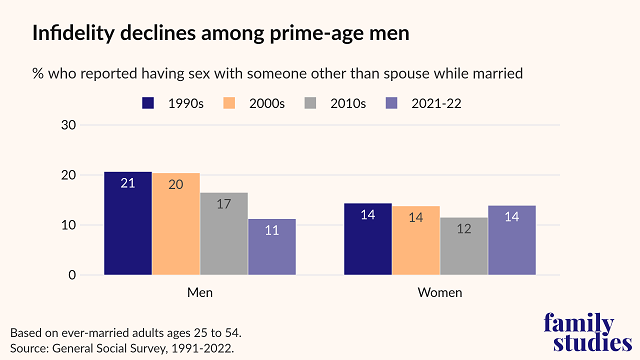
⏺️ Most people do not cross the line: In General Social Survey data analyzed by the Institute for Family Studies (Wang, 2025), roughly 13% to 14% of ever-married women report infidelity. Facing the exact same biological floor and the exact same thinned scaffolding, the large majority still choose fidelity. As Macken Murphy (2024) summarized his own cross-cultural infidelity research: evolving the capacity to cheat does not mean people should, and most do not.
5️⃣ Ongoing Behavior Still Moves the Needle
Benefit-provisioning and relational maintenance are not temporary holding actions waiting for a chemical timer to expire. While much of the relationship-maintenance literature is correlational, experimental and longitudinal findings show the floor can be worked with:
⏺️ Novelty and responsiveness: Couples assigned to do novel, mildly challenging activities together report higher relationship quality than those doing pleasant but familiar routines (Aron et al., 2000), and feeling understood and cared for directly increases partner-specific sexual desire (Birnbaum et al., 2016).
⏺️ Sustained investment: High "sexual communal strength" (motivation to meet a partner's needs) helps maintain desire over time for both partners (Muise et al., 2013), well-being rises with sexual frequency up to roughly once a week (Muise, Schimmack, & Impett, 2016), and benevolent, benefit-provisioning mate retention tracks with higher satisfaction than cost-inflicting guarding (Miner et al., 2009; Lopes & Shackelford, 2019).
⏺️ Boundaries and daily climate: Stable couples maintain roughly a five-to-one ratio of positive to negative interactions while avoiding contempt (Gottman, 1994), and keeping closest emotional confiding inside the marriage reduces the risk of workplace or friendship-based affairs (Glass, 2003).
The Three-Track Model is a lens that describes pressures, not destiny. The floor explains why habituation and extra-pair pulls exist; thinned scaffolding explains why weak bonds fail faster than they used to; and agency, ongoing responsiveness, and character explain why most long-term bonds do not simply collapse on a timer. ⏲️
https://t.co/DfX4rtuulU
@theintgap So, is the argument here that you can get any woman to love you, provided that you don't trigger and major negative qualifiers, as long as you can keep her attention and be earnest with her for a few hours, then, once she's in love, you're in the clock to get societal forces/1
The quoted observation describes a real, though conditional, outcome under modern conditions: an extra-pair allocation can run for years while the household continues to function. Dinner is served, children are managed, and the public couple remains intact. Shirley Glass's research (2003) found that infidelity does not require a visibly collapsing marriage: 34% of unfaithful women and 56% of unfaithful men rated their marriages as happy. Men run parallel tracks too, and often inside seemingly happy marriages, so the underlying capacity is not exclusive to one sex.
When a parallel track holds, it relies on low-crosstalk compartmentalization: keeping the erotic allocation partitioned from the utility and co-parenting routines. While female affairs frequently involve emotional attachment that eventually destabilizes the primary bond, with fewer unfaithful women remaining married than unfaithful men (Wang, Institute for Family Studies analysis of GSS data, 2025), Female context-dependent sexuality (Baumeister, 2000) and self-protective compartmentalization allow some individuals to maintain ordinary domestic competence without continuous behavioral leakage. The absence of visible disruption can becomes its own cover.
Modern conditions did not invent this capacity; they thinned the external scaffolding that once made it expensive to run:
⏺️ Lowered community surveillance: Historical genetic-genealogy research (Larmuseau et al., 2019) shows that while overall historical extra-pair paternity was low (about 1% to 1.6% overall), it scaled directly with anonymity and population density, rising from roughly 0.4% to 0.5% in sparsely populated areas and about 1% at average density to 5.9% among lower-SES laborers in dense cities. Mobile devices and private messaging amplify that urban anonymity by removing third-party observation from initial contact, even if digital trails later create their own forensic risk.
⏺️ Thinned reputation costs: External family, community, and economic sanctions have receded. The remaining costs sit almost entirely inside the pair bond and only activate if the allocation is detected.
From an evolutionary angle, both sexes carry extra-pair capacity under Strategic Pluralism (Gangestad & Simpson, 2000). On the female side, while some infidelity functions as mate switching or exit insurance (Buss et al., 2017), recent multinational data (Murphy, Phillips, & Blake, 2024) found stronger support for dual mating, with primary partners retained for parental investment. In any dual-allocation scenario, keeping the two streams from colliding is what protects biparental investment. Detection is far from impossible: in studies of young couples, men were more accurate than women at inferring a partner's infidelity, even though women underreported at higher rates (Andrews et al., 2008). Still, when external scaffolding disappears, the burden of detection falls entirely on the primary partner.
The post's question about ignorance versus discovery is therefore downstream of the architecture. As long as the allocation stays partitioned and undetected, the primary partner continues to invest loyalty, time, and resources using an incomplete map. Philosopher Robert Nozick's "experience machine" thought experiment (1974) captures why most people reject that bargain: we want our lives to actually be good, not merely feel good inside a fabricated picture. The cost is paid in uncalibrated investment rather than an immediate rupture, and investing a life in a map that is not true is a loss in itself.
https://t.co/JnzBgI0hPL
Imagine spending 20 years loving someone faithfully, only to discover that some of the most intimate moments of your marriage were shared with someone else.
But what if you never find out? You keep giving your loyalty, your time, and your life to someone who has already divided theirs. Is ignorance really peace, or just another form of heartbreak waiting to happen?
In a clip from her May 2025 appearance on the TFG Multiverse podcast, relationship educator Alison Armstrong (author of The Queen's Code and Understanding Men) reveals the exact behavioral feedback loop behind why men stop telling the truth, especially in her line about expecting a man to "change what's true for him" once he sees how upset she is. Where her explanation stops short is treating that reaction as a quirky communication mismatch ("women are motivated not to upset people"). Under the Three-Track Model, this is a structural collision between unvarnished reality and a protected self-image.
The Evolutionary Floor supplies the underlying alarm system. Female mate-retention vigilance is acutely sensitive to cues of waning investment or divergence (Buss, 1988), and high emotional distress raises the immediate relational cost of whatever a partner just introduced. On his side, "there was no problem until I said it out loud" is straightforward behavioral conditioning: when candor is reliably taxed with emotional fallout, honest men stop paying the tax.
The Romantic Canopy and the Cultural Scaffolding of the Madonna self-image explain why speaking it aloud creates the crisis. Under the romantic-companionate story, the Madonna self-image (loving, loyal, good, and effortlessly desired) acts as a load-bearing partition that requires two things to stay intact: plausible deniability and partner confirmation.
First, as Pinker, Nowak, and Lee (2008) argued in their work on indirect speech, stating something openly creates common knowledge. A quiet bedroom or gradual drift can sit for years as something both partners privately feel without either having to answer for it. Spoken aloud, each person knows the other knows, the relationship has to respond, and the deniability the canopy depends on disappears. The problem existed; the acknowledged problem did not.
Second, William Swann's self-verification research shows that married people rely on their spouses to confirm their self-views, showing stronger commitment to partners who see them the way they see themselves (Swann, Hixon, & De La Ronde, 1992). When a husband names a floor reality that contradicts her self-image, he is not just sharing data; he is withdrawing confirmation of who she is. Motivated reasoning (Kunda, 1990) and self-deception (von Hippel & Trivers, 2011), immediately fire to defend the partition. That is why she hopes her distress will make him "change what's true for him": his observation is a vote against her self-image, and she needs the vote reversed.
The mechanism is symmetric. Because self-verification applies to both sexes, a wife naming a reality that threatens a husband's protected self-image (good provider, competent, desired) triggers the exact same defensive engine in him, just wired to different content. A related, well-documented dynamic is the demand-withdraw pattern: whoever wants change tends to push and whoever wants the status quo tends to withdraw, so the loop can run in either direction (Christensen & Heavey, 1990, 1993). Regardless of who triggers it, emotional escalation enforces canopy compliance. Because he cannot rewrite the floor and cannot afford the fallout of naming it, he adapts by editing or withholding, and then gets accused of concealing the truth. The system punishes candor, enforces silence, and indicts the resulting caution as dishonesty. 🤷🏻♂️
https://t.co/lV25KF6Sg0
For the record, the M. Gary Neuman stats deserve context. His 2008 book (The Truth About Cheating) was not peer-reviewed research; it was a commercial survey of about 200 men, roughly half of whom had cheated. The 88% figure was the share who said the other woman was no better looking or in no better shape than their wife. More importantly, taking a cheater's self-report at face value ("92% said it wasn't about sex, it was emotional disconnection") ignores basic social desirability bias. A married man explaining himself in a survey has every incentive to protect a "decent husband" self-image with a post-hoc grievance story rather than admit he wanted sexual variety and had the opportunity.
Beyond the stats, the video's framing collapses three distinct layers of human behavior into one.
The Evolutionary Floor is conserved mating psychology. Strategic Pluralism (Gangestad & Simpson, 2000; Buss & Schmitt, 2019) remains the baseline framework: both sexes carry conditional toolkits that include long-term investment and extra-pair tactics. For men, that extra-pair tactic includes a documented average preference for sexual variety (Buss & Schmitt, 1993; Schmitt, 2005) and the Coolidge effect, a well-documented pattern in male mammals where sexual arousal rebounds in the presence of a new partner after declining with a familiar one. This novelty response has clear behavioral parallels in human sexual habituation and does not require the new partner to be an upgrade in attractiveness. Age-related or pair-bond testosterone decline lowers overall sexual drive on average; it does not push a man out the door hunting for novelty. A novel partner is not "rescuing" a collapsed neurochemical system; she is simply an unhabituated stimulus. The video does have a kernel of truth here: scaffolding costs usually keep a pair-bonded man from acting on the variety preference. When his baseline sense of reward drops, from aging, stress, or a flat marriage, novelty feels more rewarding by contrast, and that can tip the balance against those costs. But it raises the payoff of a capacity that is already there; it does not create it.
The Cultural Scaffolding is the external price. Law, reputation, economic dependence, community surveillance, and residual religious or cultural cost raise the friction of extra-pair allocation. Ultra-high-status men (like the examples in this clip) do not cheat because of a special midlife breakdown. High status slashes day-to-day acquisition friction through abundant private opportunity, attention, and weaker local oversight. Empirical data tracks this directly: Pérusse (1993) found that men's social status predicts greater mating access and number of sexual partners, and General Social Survey data analyzed by the Institute for Family Studies (Wang, 2025) shows 18% of prime-age men in high-prestige occupations report infidelity, outpacing men in lower-prestige tiers. Status does not install a new motive; it only makes an existing floor capacity cheaper to run in the moment.
The Romantic Canopy is the romantic-companionate story that treats permanent exclusivity as the biological baseline and partner-specific desire as proof of character. Under that story, any extra-pair act looks like a breakdown that must be explained by emotional disconnection, midlife emptiness, or a neurochemical rescue. The Neuman self-reports and the video's framing are canopy products: they measure post-hoc narrative management protecting a "decent husband" self-image, not the underlying allocation mechanism.
The video takes the romantic canopy's expectation of permanent exclusivity, mistakes it for the floor, and then leans on a decline story to account for the ordinary operation of the floor once scaffolding costs drop. The three-track model does not require that story. The floor already contains the capacity, high status is an opportunity-field variable, and the post-act "not about sex" narrative is the canopy doing its ordinary repair work.
https://t.co/fIPyxLT2i1
You do not need a Cluster B diagnosis or therapy-speak to explain this post. Nothing on this page requires a mental deficit; it is ordinary, non-clinical ego defense under high self-image threat. 🤔
In the Madonna Gate Model, internalized cultural scaffolding forms a protected self-image built around being a loving, loyal, and supportive partner, which acts as a narrative clearance gate.
Protecting it relies on optimizing logic, a continuous stream of self-protective storytelling grounded in motivated reasoning and dissonance reduction (Kunda, 1990; Festinger, 1957; Tavris & Aronson, 2007). In this model, it amplifies grievances before an affair and minimizes damage afterward. Men run the exact same defensive engine (Bandura, 1999; von Hippel & Trivers, 2011), just wired to a different self-image; men and women tend to endorse different justifications for extramarital involvement (Glass & Wright, 1992).
Because this Reddit screenshot is an anonymous post, it is an illustrative case rather than data. We cannot know what happened before the affair, and because Stage 6 predicts minimization, her claim that "It happened ONCE in eight years" cannot tell us the real route in. Here is how the six-stage trajectory tracks the sequence from start to aftermath:
Stage 0️⃣: Preconditions (Unobservable here; established mechanism)
Long-term desire tends to fade with familiarity and routine (Klusmann, 2002; Sims & Meana, 2010). As satisfaction dips, the attentional shield that keeps committed partners from noticing alternatives weakens (Miller, 1997). The model proposes that optimizing logic quietly begins amplifying ordinary marital friction into grievance narratives.
Stage 1️⃣: Novelty Trigger (Unobservable here)
A novel target activates dopaminergic reward circuitry tied to early attraction (Fisher, Aron, & Brown, 2005).
Stage 2️⃣: Certification Pings (Unobservable here) Low-cost nonverbal cues like glances and animation initiate interest (Moore, 1985) while preserving plausible deniability (by extension from Pinker, Nowak, & Lee, 2008). Below conscious awareness, the self-image relabels the pull as harmless warmth or friendship (Kurzban & Aktipis, 2007).
Stage 3️⃣: Answering and Agency Offloading (Unobservable here) Because men tend to over-read sexual interest in friendliness (Abbey, 1982; Haselton & Buss, 2000), the target steps forward and leads the escalation (Perper, 1985). That hands the self-image a key asset: the other man now carries the initiating agency.
Stage4️⃣ : Gate Clearance (Unobservable here) Women's willingness to accept casual offers is heavily sensitive to reputational and social cost (Conley, 2011). Once the continuous grievance stream plus externalized agency (or alcohol myopia, Steele & Josephs, 1990) certifies a protective story, perceived cost drops below the pull of novelty and the gate clears.
Stage5️⃣: Box Switch (Unobservable here)
Temporary compartmentalization (Kurzban & Aktipis, 2007) lets the act occur locally while the "good, loyal wife" self-image stays walled off.
Stage6️⃣: Post-Hoc Repair After Discovery (Directly Observable on the Page)
Discovery breaks the wall, and the continuous stream pivots from gatekeeper to spin doctor. The core mechanisms show up verbatim in the screenshot:
Euphemistic labeling (Bandura, 1999): She repeatedly shrinks the betrayal to "one mistake" and "one decision, one night", while expressing frustration at people who "hear 'I cheated' and stop listening".
Responsibility inversion (Bandura, 1999): The opening line flips agency onto her husband: "My husband threw away 8 years of marriage because I made one mistake". She closes with the same inversion: "He decided that mistake should define the rest of my life".
Motivated reasoning and self-deception (Festinger, 1957; Kunda, 1990; von Hippel & Trivers, 2011): She treats 18 months of neutral, businesslike emails ("like I'm a customer or something") as cruelty done to her, and resents that he is seeing someone new while she is "still the person everyone blames". Genuinely believing the story removes the cognitive load of conscious lying and makes the outward defense cleaner.
Shame-driven externalization (Tangney & Dearing, 2002): Guilt ("I did something bad") drives repair; shame ("I am bad") drives denial and blaming others. While her claim that she apologized and did "everything people say you're supposed to do" could reflect genuine frustration, the surrounding blaming lines ("tired of everyone acting like he had NO CHOICE") are consistent with shame-driven externalization.
No pathology is required to produce this. Her husband moved out that weekend "before I even had a chance to explain myself". When his boundary blocked her from deploying a protective story, the model reads her response as the self-image’s only remaining move to stay intact: recasting his exit as the real offense.
https://t.co/PFk1V7fU2n
This is how the mind of someone with untreated Cluster B personality works. There is a complete inversion of responsibility.
She can intellectually understand that what she did was wrong, but she cannot fully drop into the emotional pain of it because people with these patterns learn from a young age that they are either “bad” or “good,” and that doing something bad means being bad.
It is a mind that struggles to sit with nuance without extraordinary pain.
Because of this, the psyche develops defenses to protect itself from the overwhelming shame of recognizing its own wrongdoing. The behavior is minimized, rationalized, and then projected outwards, usually onto the intimate partner.
This makes accountability and growth extraordinarily difficult. There is a difference between regretting the consequences of your actions and actually confronting the unconsciousness that produced them. A healthy life requires the second.
And because she cannot fully look at herself, his response to her behavior becomes its own unjustified attack on her.
She experiences his decision to leave as something he is doing to her, rather than as a consequence of something she did to him.
Notice how her betrayal is reduced to “one mistake,” while his decision to leave is treated as an ongoing act of cruelty.
Her pain is the center of the narrative. His pain is not emotionally considered in her inner world, because to do so would be to feel the shame of having caused his pain.
The reality is that relationships are where unconsciousness rises - both partners will hurt eachother, both partners will project onto eachother. This is normal and expected as long as the wounds can be repaired through accountability and internal growth on both ends.
It is extremely sad, because these people ultimately push away those who care about them, and then all of the blame is projected onto the partner. They become the villain of the story despite (in many cases) only having good intentions.
For anyone landing on this thread cold, the debate comes down to a specific claim: that any visible effort to increase a partner's satisfaction signals low intrinsic value under "hypergamic logic," and that a smart man should instead withhold effort or run a "meta-strategy" combining benefit-provisioning with cost-inflicting tactics. 😃
The evolutionary psychology literature does not back either half of that argument.
1. Both the "Meta-Strategy" and Avoidance Have Already Been Measured
Miner, Starratt, and Shackelford (2009) formalized the two-domain split between benefit-provisioning (increasing a partner's satisfaction) and cost-inflicting tactics (vigilance, manipulation, or derogation). Backing Costello's point, their data show that men of lower mate value rely more heavily on cost-inflicting tactics, while higher-mate-value men perform more benefit-provisioning. Notably, men's mate value in that study was rated by their female partners, making the finding difficult to dismiss as male self-report bias.
Crucially, the "meta-strategy" proposed here is not a blind spot in the field. Lopes and Shackelford (2019) directly identified it in cluster analyses as the "exhaustive" strategy: using high benefit-provisioning and high cost-inflicting behaviors simultaneously. Meanwhile, the red-pill advice to "be avoidant" and withhold effort maps onto their "disengaged" cluster. In their data, the "benevolent" cluster (high benefit-provisioning, low cost-infliction) is associated with higher relationship satisfaction, whereas both the exhaustive and disengaged clusters are associated with less physical intimacy.
2. "Bums and Broken Musicians" Is a Short-Term Track
Pointing to starving artists, bums, and broken musicians mixes up the two tracks of strategic pluralism (Gangestad & Simpson, 2000). Dark Triad traits (narcissism, psychopathy, and Machiavellianism) do predict short-term mating success in men, including more sexual partners and greater willingness to poach mates (Jonason et al., 2009). Volatile, low-investment men can attract short-term flings.
Long-term mate selection runs on a different set of cues. Cross-cultural data consistently show that women's long-term preferences prioritize reliability, stability, and willingness to invest resources and care (Buss, 1989; Buss & Schmitt, 2019). Being chosen for a short-term fling is not the same as being kept for a long-term partnership.
3. Conceding the Kernel Without Collapsing the Signal
There is one small grain of truth in the "signals" argument: needy, unreciprocated appeasement can plausibly backfire. Higher attachment anxiety is also linked to greater use of cost-inflicting mate-retention tactics (Barbaro et al., 2021). Conversely, partner responsiveness is associated with higher sexual desire in ongoing relationships (Birnbaum et al., 2016), which indicates that it is the quality of the effort that matters, not effort itself.
Where the red-pill framing goes wrong is collapsing anxious supplication into calm benefit-provisioning. Offering care, stability, and attention from a position of surplus capacity is a different behavioral signal than desperate over-investment. As for Tom Brady and Kaká, high-profile divorces are classic survivorship anecdotes; millions of provisioning men stay married without ever making headlines.
Mate-value tracking is real, and needy appeasement can carry real costs. Treating all effort to increase a partner's happiness as an admission of inadequacy, however, is not in the data. Costello's warning holds up: advising men to withhold care or mix in cost-inflicting tactics steers them directly toward strategies empirically associated with worse relationship outcomes.
https://t.co/a78oCOu6Jj
This is your brain on the red pill.
They think the only way to “win” is to be chosen despite doing nothing, or even despite being a bad partner.
Trying to please your partner = weakness.
Effort = low value.
Care = “simping”
They talk about “intrinsic value.”
But what is that value if there is no benefit to being with you?
In some rare cases, exceptionally beautiful women can be chosen largely for existing. Many of these men resent that and want the male equivalent. To be desired without effort. It’s laziness masquerading as philosophy.
They cherry-pick celebrity divorces like Tom Brady or Kaká, then use those anecdotes to cultivate anxiety about female nature.
Their advice? Be avoidant. Don’t try to increase her happiness or you’ll signal inadequacy.
Pure poison.
Thank you for raising these two questions, @RondoAlchebz. Auditing the numbers to give you a thorough answer actually caught a real methodological error in my earlier post: I had treated the General Social Survey (GSS) baseline as a verbal face-to-face interview and applied a full verbal-to-computer anonymity multiplier on top of it, which double-counted the anonymity correction. I appreciate the push to verify the codebook.
Here is the corrected, data-grounded breakdown answering both of your questions.
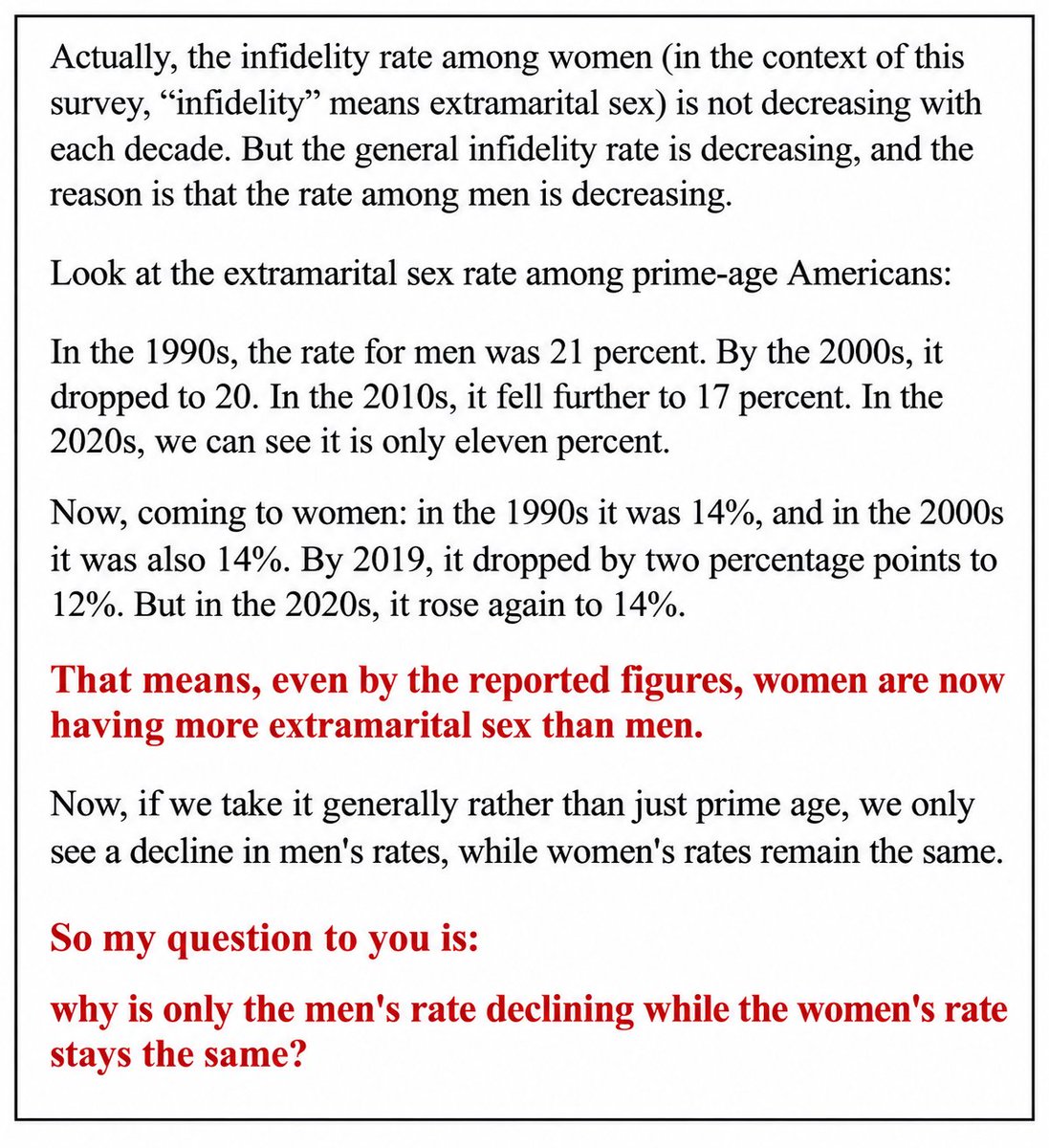
1️⃣ Do the reported figures show that women now have higher extramarital sex rates than men?
No. Across all ages in the 2010 to 2016 GSS (Wang, IFS), ever-married men still report higher lifetime extramarital sex than ever-married women, sitting at approximately 20 percent versus 13 percent.
The apparent crossover shows up only inside narrow age bands:
⏺️ Prime-age ever-married adults (ages 25 to 54) in the latest GSS data: men 11 percent, women 14 percent.
⏺️ Young ever-married adults (ages 18 to 29) in earlier pooled GSS waves: women 11 percent, men 10 percent.
In her August 2025 Institute for Family Studies (IFS) analysis, Wendy Wang explicitly notes that the 14 percent versus 11 percent prime-age gap is not statistically significant. The apparent inversion is therefore both age-restricted and inside the margin of error.
It is also important to get the survey mode right. The GSS extramarital sex item (EVSTRAY) has been administered via self-administered formats since 1991, and in 2021 to 2022 the survey shifted toward online and mixed modes. Wang's own footnote cautions that this mode shift "may complicate the interpretation of trends." Prime-age parity appeared as the instrument became more anonymous, not less.
2️⃣ Why has the male reported rate declined while the female rate remained relatively steady?
Wang notes that prime-age male reporting dropped from roughly 1 in 5 in the 1990s to 11 percent in the latest GSS data, whereas the share among ever-married prime-age women "remained relatively steady over time." Three non-exclusive factors may contribute to this divergence:
⏺️ Cohort replacement, labor-force selection, and marital-status sorting: Marriage has become more selective for college education on both sides (college-educated prime-age adults report 10 percent versus 15 percent for those without a degree), and later age at first marriage shortens cumulative exposure for both sexes. The male line still declines faster as older male cohorts with large historical gender gaps age out of the prime-age window, and as non-employed prime-age men (who report roughly double the infidelity of employed men, about 1 in 5 versus 11 percent) are increasingly priced out of marriage. In addition, Wang's data highlight a major marital-status selection effect in snapshots of intact marriages: 34 percent of currently divorced or separated prime-age adults report extramarital sex compared with only 7 percent of currently married adults, and nearly 60 percent of unfaithful prime-age women are currently divorced compared with 45 percent of unfaithful men. Surveys restricted to currently married people therefore undercount infidelity overall, and undercount unfaithful women more than men.
⏺️ Shifting partner-market access (hypothesis): Broader GSS data show rising past-year sexual inactivity among young men between 2000 and 2018 (jumping from 18.9 percent to 30.9 percent among men aged 18 to 24, and doubling from 7.0 percent to 14.1 percent among men aged 25 to 34), concentrated among the unmarried (Ueda et al., 2020, JAMA Network Open). While that increase occurred mainly among unmarried men rather than husbands directly, it points to tighter partner access for non-elite men, whereas a plausible hypothesis is that digital channels have lowered the logistical friction of low-load, high-attention contact for women. Wage decline alone does not cleanly explain the male trend, since both unemployed married men and high-prestige men (18 percent) report elevated rates.
⏺️ Survey mode shifts and undefined terms: Methodological work on married women confirms that removing interviewer presence produces substantially higher disclosure (Whisman & Snyder, 2007). If the 2021 to 2022 move to online modes buoyed female candor at the same moment later marriage and college selection were pulling exposure down, those opposing forces could contribute to a flat female line. Meanwhile, EVSTRAY simply asks whether a respondent had "sex" outside marriage without defining the term; because many respondents interpret "sex" narrowly as penile-vaginal intercourse (Sanders & Reinisch, 1999), non-intercourse sexual contact, explicit digital exchanges, and emotional affairs are likely undercounted.
Recalibrated Synthesis (Separating Intercourse from Broader Allocation)
Starting from the actual ever-married GSS self-administered baseline of roughly 13 percent lifetime extramarital sex for women, two explicit modeling assumptions help bound the undercount:
⏺️ Intercourse-only estimate (16% to 18%): Applying a modest modeling assumption of 1.2x to 1.4x for residual privacy and social-desirability suppression that persists even in self-administered surveys yields an estimated 16 to 18 percent for lifetime extramarital intercourse.
⏺️ Broader extradyadic sexual and erotic allocation (20% to 29%, central estimate ~24% to 25%): Applying an additional modeling assumption of 1.3x to 1.6x to account for exclusive non-intercourse sexual contact and sustained explicit digital boundary crossings (consistent with literature showing higher prevalence when definitions widen beyond intercourse; Blow & Hartnett, 2005; Brand et al., 2007) produces a broader range of roughly 20 to 29 percent.
The raw GSS pattern of male decline and female steadiness is a real measurement outcome consistent with cohort turnover, marital and labor-force selection, and survey mode changes. It is not evidence that the biological floor has been rewired or that dual-mating psychology has inverted. Official charts remain useful for tracking trends, but they likely understate total extradyadic allocation.
https://t.co/7OGcZx4Yod
Why Infidelity Surveys Systematically Undercount Female Extra-Pair Allocation 🤷🏻♂️
Every few months, a chart from a national family survey circulates online showing that married women report low or declining rates of infidelity. Commentators immediately treat those numbers as proof that the evolutionary dual-mating model is exaggerated.
That conclusion mistakes a measurement artifact for biological reality. Self-report surveys on female extra-pair mating do not measure behavior; they measure what respondents are willing to confess when their social reputation is on the line. When we examine the methodology through the Three-Track Model, four structural flaws explain why official figures systematically undercount the biological floor:
1️⃣ Interviewer Presence Triggers Madonna Self-Image Protection In evolutionary social psychology, female coalitional standing has historically depended on maintaining a spotless, nurturing reputation (Trivers, 2011; Kurzban, 2010). When a live researcher is present, admitting to infidelity threatens that benevolent self-image. Landmark methodological comparisons confirm that simply replacing a face-to-face interviewer with anonymous computer-assisted self-interviewing causes reported female infidelity rates to surge dramatically, whereas male reporting shifts far less (Whisman & Snyder, 2007; Treas & Giesen, 2000).
2️⃣ Instruments Count Only Penile-Vaginal Intercourse Major instruments like the General Social Survey rely on a single binary question asking whether the respondent has ever had "sex" outside the marriage. Empirical research on sexual definitions shows that large numbers of respondents strictly limit "sex" to penile-vaginal intercourse (Sanders & Reinisch, 1999). Oral contact, explicit digital exchanges, emotional affairs, and active erotic validation streams with workplace "friends" are excluded by design, even though they represent active reallocation of the erotic ledger.
3️⃣ Higher Social Costs Suppress Disclosure Disclosure rates track the local reputational penalty rather than actual behavior. Research consistently shows that respondents inside religious or traditional communities face steeper moral and social costs for admitting infidelity, leading to systematically lower self-reporting (Allen et al., 2005; Burdette et al., 2007). In addition, modern low-friction divorce allows a dissatisfied partner to initiate separation right before consummating an extra-pair attraction, allowing her to recode a mate-switching transition as a clean timeline that keeps her moral self-image intact.
4️⃣ Measurement Artifact Is Not Evolutionary Change When official charts show flat or declining marital infidelity alongside plummeting marriage rates and delayed family formation, we are watching selection effects and survey limitations, not a rewiring of human nature.
Underneath the Romantic Canopy, the biological floor has not changed. Strategic pluralism and modular compartmentalization still run in the background, regardless of what people check on a questionnaire.
🤔 Calculating the Biological Floor: What Female Extradyadic Allocation Actually Looks Like
Once you account for social-desirability suppression and narrow survey definitions, an obvious question follows: if standard national surveys undercount female extra-pair behavior, what is a realistic, literature-grounded estimate?
To avoid both romantic denial and reactionary exaggeration, we can calculate a conservative synthesis directly from the measurement literature, keeping our modeling steps explicit:
1️⃣ The Face-to-Face Baseline (11% to 15%) In standard interviewer-administered national surveys like the General Social Survey, lifetime extramarital sex for ever-married women sits between 11 and 15 percent, clustering near 13.5 percent (Wiederman, 1997; Labrecque & Whisman, 2017). These figures capture only penile-vaginal intercourse confessed to a researcher.
2️⃣ The Anonymity Correction (Modeling Step: 2.0x to 2.5x Net Lifetime Lift) In the cleanest head-to-head national test, Whisman and Snyder (2007) found that face-to-face interviews yielded a 1.08 percent past-year infidelity rate among currently married women, while Audio Computer-Assisted Self-Interviewing on an identical sample yielded 6.13 percent. Removing the human interviewer produced a 5.7-fold jump in annual reporting. Similarly, Treas and Giesen (2000) found that adding a privacy envelope lifted lifetime self-reports from 11.2 to 15.5 percent. Translating an annual reporting jump onto multi-year lifetime prevalence requires a modeling step: because high-openness individuals repeat behaviors across years, a 5.7-fold annual increase compresses into roughly a 2.0 to 2.5-fold lift over a cumulative marriage, bringing anonymous lifetime intercourse rates near 28 to 31 percent.
3️⃣ The Behavioral Definition Correction (Synthesis Adjustment: +7 to +10 Percentage Points) Standard national surveys exclude oral sex, manual genital contact, and explicit digital sexual exchanges by asking only about intercourse (Sanders & Reinisch, 1999). While non-intercourse studies do not provide a single nationally representative delta, literature broadening the definition to include non-intercourse sexual contact and sustained erotic boundary crossings consistently shows substantially higher prevalence (Blow & Hartnett, 2005; Brand et al., 2007). Applying a conservative synthesis adjustment of roughly 7 to 10 percentage points (a 1.25 to 1.35-fold expansion) accounts for exclusive non-intercourse allocation.
😮 The Convergent Estimate: 30% to 45% (Central Estimate: ~36% to 38%) Applying a conservative 2.25 lifetime anonymity lift and a 1.28 broadened definition adjustment to a 13.5 percent national baseline converges around 36 to 38 percent among ever-married women in low-consequence Western markets, within a realistic range of 30 to 45 percent.
This synthesis is neither an ideological inflation nor a claim that infidelity is universal. Roughly three out of five married women never cross that boundary. However, it demonstrates that standard Romantic Canopy surveys roughly halve the observable biological floor.
https://t.co/oTQdHKOaII
Despite the news, marital infidelity has been declining for prime-age men in America, and the gender gap is closing.
@FamStudies: https://t.co/8W46lWpOgG
Thank you for raising these two questions, @RondoAlchebz. Auditing the numbers to give you a thorough answer actually caught a real methodological error in my earlier post: I had treated the General Social Survey (GSS) baseline as a verbal face-to-face interview and applied a full verbal-to-computer anonymity multiplier on top of it, which double-counted the anonymity correction. I appreciate the push to verify the codebook.
Here is the corrected, data-grounded breakdown answering both of your questions.
1️⃣ Do the reported figures show that women now have higher extramarital sex rates than men?
No. Across all ages in the 2010 to 2016 GSS (Wang, IFS), ever-married men still report higher lifetime extramarital sex than ever-married women, sitting at approximately 20 percent versus 13 percent.
The apparent crossover shows up only inside narrow age bands:
⏺️ Prime-age ever-married adults (ages 25 to 54) in the latest GSS data: men 11 percent, women 14 percent.
⏺️ Young ever-married adults (ages 18 to 29) in earlier pooled GSS waves: women 11 percent, men 10 percent.
In her August 2025 Institute for Family Studies (IFS) analysis, Wendy Wang explicitly notes that the 14 percent versus 11 percent prime-age gap is not statistically significant. The apparent inversion is therefore both age-restricted and inside the margin of error.
It is also important to get the survey mode right. The GSS extramarital sex item (EVSTRAY) has been administered via self-administered formats since 1991, and in 2021 to 2022 the survey shifted toward online and mixed modes. Wang's own footnote cautions that this mode shift "may complicate the interpretation of trends." Prime-age parity appeared as the instrument became more anonymous, not less.
2️⃣ Why has the male reported rate declined while the female rate remained relatively steady?
Wang notes that prime-age male reporting dropped from roughly 1 in 5 in the 1990s to 11 percent in the latest GSS data, whereas the share among ever-married prime-age women "remained relatively steady over time." Three non-exclusive factors may contribute to this divergence:
⏺️ Cohort replacement, labor-force selection, and marital-status sorting: Marriage has become more selective for college education on both sides (college-educated prime-age adults report 10 percent versus 15 percent for those without a degree), and later age at first marriage shortens cumulative exposure for both sexes. The male line still declines faster as older male cohorts with large historical gender gaps age out of the prime-age window, and as non-employed prime-age men (who report roughly double the infidelity of employed men, about 1 in 5 versus 11 percent) are increasingly priced out of marriage. In addition, Wang's data highlight a major marital-status selection effect in snapshots of intact marriages: 34 percent of currently divorced or separated prime-age adults report extramarital sex compared with only 7 percent of currently married adults, and nearly 60 percent of unfaithful prime-age women are currently divorced compared with 45 percent of unfaithful men. Surveys restricted to currently married people therefore undercount infidelity overall, and undercount unfaithful women more than men.
⏺️ Shifting partner-market access (hypothesis): Broader GSS data show rising past-year sexual inactivity among young men between 2000 and 2018 (jumping from 18.9 percent to 30.9 percent among men aged 18 to 24, and doubling from 7.0 percent to 14.1 percent among men aged 25 to 34), concentrated among the unmarried (Ueda et al., 2020, JAMA Network Open). While that increase occurred mainly among unmarried men rather than husbands directly, it points to tighter partner access for non-elite men, whereas a plausible hypothesis is that digital channels have lowered the logistical friction of low-load, high-attention contact for women. Wage decline alone does not cleanly explain the male trend, since both unemployed married men and high-prestige men (18 percent) report elevated rates.
⏺️ Survey mode shifts and undefined terms: Methodological work on married women confirms that removing interviewer presence produces substantially higher disclosure (Whisman & Snyder, 2007). If the 2021 to 2022 move to online modes buoyed female candor at the same moment later marriage and college selection were pulling exposure down, those opposing forces could contribute to a flat female line. Meanwhile, EVSTRAY simply asks whether a respondent had "sex" outside marriage without defining the term; because many respondents interpret "sex" narrowly as penile-vaginal intercourse (Sanders & Reinisch, 1999), non-intercourse sexual contact, explicit digital exchanges, and emotional affairs are likely undercounted.
Recalibrated Synthesis (Separating Intercourse from Broader Allocation)
Starting from the actual ever-married GSS self-administered baseline of roughly 13 percent lifetime extramarital sex for women, two explicit modeling assumptions help bound the undercount:
⏺️ Intercourse-only estimate (16% to 18%): Applying a modest modeling assumption of 1.2x to 1.4x for residual privacy and social-desirability suppression that persists even in self-administered surveys yields an estimated 16 to 18 percent for lifetime extramarital intercourse.
⏺️ Broader extradyadic sexual and erotic allocation (20% to 29%, central estimate ~24% to 25%): Applying an additional modeling assumption of 1.3x to 1.6x to account for exclusive non-intercourse sexual contact and sustained explicit digital boundary crossings (consistent with literature showing higher prevalence when definitions widen beyond intercourse; Blow & Hartnett, 2005; Brand et al., 2007) produces a broader range of roughly 20 to 29 percent.
The raw GSS pattern of male decline and female steadiness is a real measurement outcome consistent with cohort turnover, marital and labor-force selection, and survey mode changes. It is not evidence that the biological floor has been rewired or that dual-mating psychology has inverted. Official charts remain useful for tracking trends, but they likely understate total extradyadic allocation.
https://t.co/7OGcZx4Yod
What Affair-Recovery Content Gets Right About the Brain, and What Is Still Missing 🤔
A closer, non-adversarial look at affair-recovery creators shows that they are not all just repeating Romantic Canopy tropes. Beneath the coaching language, the core empirical observation she is making about affair intensity is actually aligned with the Biological Floor.
Separating what she gets right from where the neurobiology is incomplete gives us a much cleaner picture of how extradyadic recapture actually works.
1️⃣ What She Gets Right (Floor-Aligned)
Dopaminergic Craving: She correctly identifies that the intense rush of an affair is driven by elevated dopamine and arousal chemistry. Functional MRI work on early-stage romantic love confirms that this state recruits mesolimbic reward circuitry, producing craving, rumination, and difficulty disengaging that resemble behavioral addiction more than calm attachment (Aron et al., 2005; Fisher et al., 2006).
⏺️ Secrecy and Idealization: She accurately observes that secrecy and partial information manufacture idealization. When two people only see curated slices of each other without the corrective friction of bills, chores, and daily stress, selective self-presentation inflates perceived compatibility (Murray, Holmes, & Griffin, 1996; Walther, 1996).
⏺️ Poor Long-Term Prediction: She rightly points out that intense chemistry is not durable evidence that a person is "the one." A high-intensity chemical invitation can coexist with very low long-term viability once the pairing hits open domesticity.
2️⃣ Where the Mechanism Needs Precision
⏺️Neurochemical Accuracy: Grouping serotonin, oxytocin, and dopamine together as uniformly "high" is imprecise. In the early-stage attraction literature, serotonin activity is actually reduced, which is linked to obsessive thought (Marazziti et al., 1999). While oxytocin does participate in early bonding (Schneiderman et al., 2012), dopamine is the primary engine of early-stage craving, whereas oxytocin and vasopressin anchor longer-term companionate attachment (Acevedo et al., 2012).
⏺️ Biology vs. Interpretation: Framing affair chemistry as "not real love" or "not reality" blurs an important line. The cascade is completely real as a biological event. What is false is the metaphysical claim people attach to it: believing that the intensity of the feeling proves the new person is uniquely destined for them. The error is in the translation, not the chemistry.
3️⃣ The Missing Precondition: Habituation
The largest gap in the recovery framework is that it omits the precondition that makes recapture possible in the first place: partner-specific erotic habituation (Klusmann, 2002; Morton & Gorzalka, 2015).
Without naming habituation, the video reads as if affair chemistry is an abnormal, pathological addiction. On the biological floor, it is the opposite. It is the ordinary, time-limited first-stage recruitment program re-firing for a novel target once the primary bond has naturally gone chemically quiet.
She is right that the feeling is a poor compass for lifelong commitment. Recognizing it as a normal, re-triggerable biological subroutine, rather than a mysterious "toxic" malfunction, is what allows couples to build real behavioral boundaries before the cascade ever starts.
https://t.co/Ii3Op8OtrB