An Anthropic engineer shared the exact system they use as a second brain.
Three folders. One file. One evening to build.
Most people use Claude the same way every day. Open a new tab. Rebuild context. Get an answer. Close the tab. Tomorrow it remembers nothing. You are still the one holding all the context. You are still the one resetting.
This architecture solves that problem.
The system is built around three folders and one file.
raw/ holds everything unstructured. Articles, transcripts, PDFs, voice memos, screenshots. Drop it in and never touch it again. Immutable ground truth.
wiki/ is where Claude converts everything in raw into structured, linked, cross-referenced knowledge. Clean. Organized. This is the folder Claude actually thinks from. The human reads it. The model writes it.
output/ is where finished work lands. Reports, posts, documents, presentations. Everything Claude builds using the wiki as its source.
At the center is CLAUDE.md. Not a prompt, but a persistent layer of identity, preferences, goals, and project context. Claude reads it before every session. You never explain yourself again.
Five automations run the system.
Ingest captures and extracts new sources into the wiki. Write retrieves context and drafts outputs. Manage links decisions to context. Review summarizes and updates. Maintain prunes and improves connections.
Every session adds to the system. Every source makes the wiki smarter. The returns compound over time.
One month in, context stops disappearing. Three months in, the vault surfaces ideas you forgot you had. Six months in, the gap between compounding and resetting becomes impossible to ignore.
Build once. Maintain daily. Let it compound.
Bookmark this.
(Episode 2) I'm building an app to make $10,000/Month and I'll record everything...
This episode I start building the AI Portrait app only to learn that none of my friends want it, but I still believe...
Link to first episode: https://t.co/nnV4ZeSW4Y
Why this series?
I want to document my WHOLE journey building an app, marketing it, and making money off of it. Is it really that easy?
How hard is it? I've been seeing so many X users online talking about how easy it is to make money online with AI now.
I want to test it and show people the reality of making a business online.
Head of Claude Code:
"85% of our engineers are running dozens or hundreds of agents. The way you do it is graph engineering."
In 40 minutes he explains how a single engineer now does the work of a whole team, how far this has gone inside Anthropic and where it goes next.
This is something you can't skip if you don't want to be left behind.
Watch it, then read the full guide on graph engineering below.
this is my AI marketing engine
say I have an idea I want to turn into a campaign. a guide, a cohort, a webinar, something we have been planning for a while, or just something cool I came across and want to build around.
it usually starts as one thing, an idea or an evergreen piece, and this engine is how that one thing becomes a full campaign and fans out across every vertical
the engine is a graph, a general step-by-step the idea moves through. at each step I can swap the harness, the loop, the tool, or the model to fit the campaign
right now I'm testing gstack, superpowers, and matt's skills, engineer tools I'm bending toward marketing
the models can write and design well now. what takes work is the context you feed them, the routing per job, and the evals that catch what is weak
there are eval stops all through the graph. both human and other agents evaluating and reviewing output, and then looping it back if it doesnt
here is the path it travels, from a raw idea down to a shipped campaign
PLANNING
1. the idea in
I dictate the whole thing out loud, every half-formed thought, and let the skill bundle catch the mess and hand me back a starting brief. this is the karpathy point, get it out of your head first and clean it up after
2. ideation
off that brief it opens the idea into angles and directions to choose from. I throw most of them out
3. research and context
this is where I pull context, and how much I need depends on the campaign, sometimes a ton of internal history, sometimes barely any. the internal side is our company brain (gBrain), the voice, the past campaigns, what converted, the offers, the ICP. externally I pull the market, the competitors, the hooks working this week
4. synthesis
different models merge all of that into a draft plan. the plan itself, the architecture and the trade-offs, runs on opus 5, and the narrow work underneath gets cheap fast models. that split is model routing
5. the sign-off
nothing crosses into execution until I sign it off. I read the draft against our marketing protocols, the voice rules, the brand, the SOPs, and I cut, sharpen, or send it back
EXECUTION
6. handing it to the build
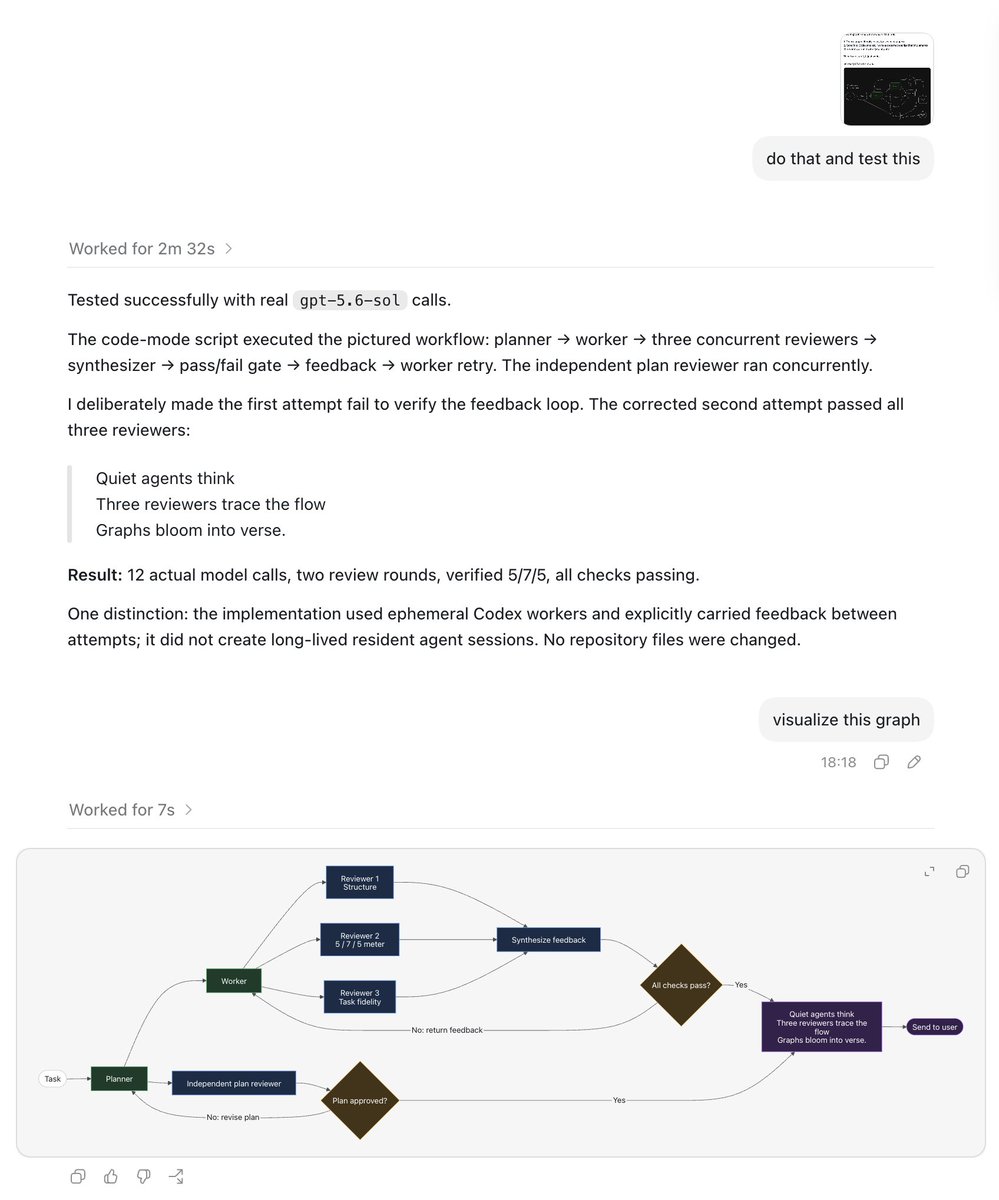
once the plan clears the sign-off it goes into the build, and the idea splits into all the parts a campaign needs. here I run two shapes depending on the job. when a piece is one task that has to clear a bar I run a loop, the agent drafts, checks itself, fixes, and keeps circling until it is good.
the bigger many-part pieces I build as a graph, drawing the steps and routes ahead of time so the agents travel the map I laid down. it is usually a bit of both
7. the models doing it
routing runs in execution too, you do not pay opus prices to resize a thumbnail for example
8. what stays with people
some of it I coordinate, some assets I make myself, and the work that needs taste, a relationship, or a client in the room I hand to the agency team
that one idea comes out the other end as a full campaign across every vertical, landing pages, blogs and guides, video scripts, email, PR, paid, and the social cuts
then the results come back in, what got bookmarked, what converted, what died, and that updates the brain for the next campaign
everyone has the same models, so the edge is the graph, the brain, and the protocols, and those you have to build yourself
How to become a forward-deployed AI engineer ($1M+/year).
I recently listened to @vasuman on @gregisenberg podcast, and it was genuinely one of the best videos I've watched on AI.
Such a great breakdown on FDE and undoubtedly a huge opportunity here for the right people:
We’ve decided to open-source a multi-agent harness we use internally at YC.
We call it “QM” and it’s meant to be easy to customize, like Hermes or OpenClaw, but useful for a whole company. We use it across accounting, legal, events, and engineering (including building QM itself!).
The whole project is under an MIT license. It is cloud-first and has Slack and web UI natively.
Sam Altman says the next 6 months will feel like the equivalent of the last 2 years of model progress.
The open source repo with 75,100 GitHub stars that helps you move at that speed is Paperclip. Two commands to set it up in Claude Code.
→ npx paperclipai onboard --yes
→ npx paperclipai run
Opens the UI at localhost:3100. That's it. Give your agent this now.
Just today I've already seen Wispr Flow, Granola and WHOOP all "reverse engineered" and open sourced with a fully free version
Very interesting to see what's happening
The question is if normies will pick up on this (I think they will) and how companies will react and pivot to still make money
this is f**king insane
a free github repo by Jack Dorsey (Co-Founder of Twitter) with 14.4K stars just dropped the entire "ai-agent" framework for running businesses
here is how you set it up:
1.clone the repo
2. self-host the server : channels, search, git, automation all live there
3.add your agent to a channel like a teammate, scope its key, let the team steer it live
save and bookmark this no matter what
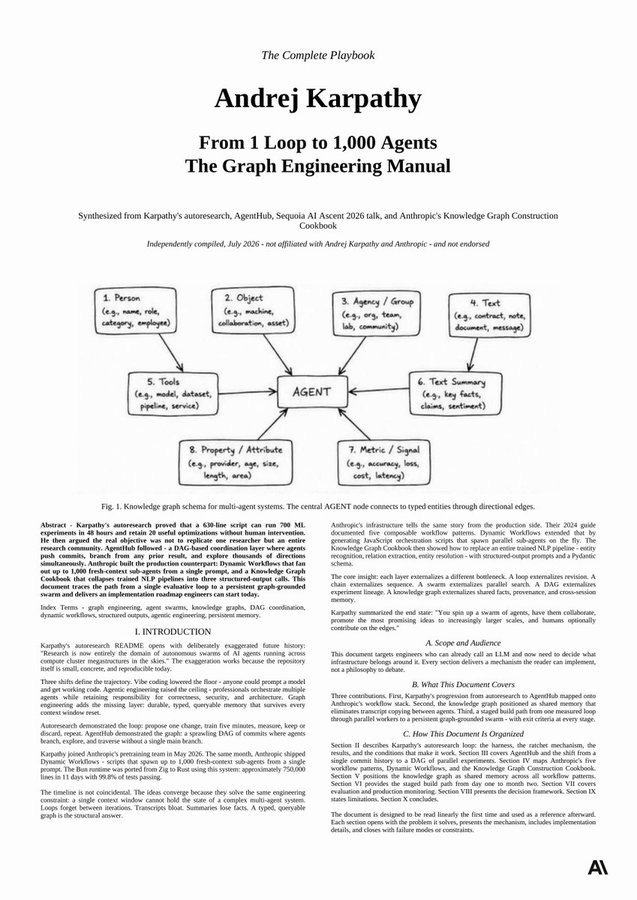
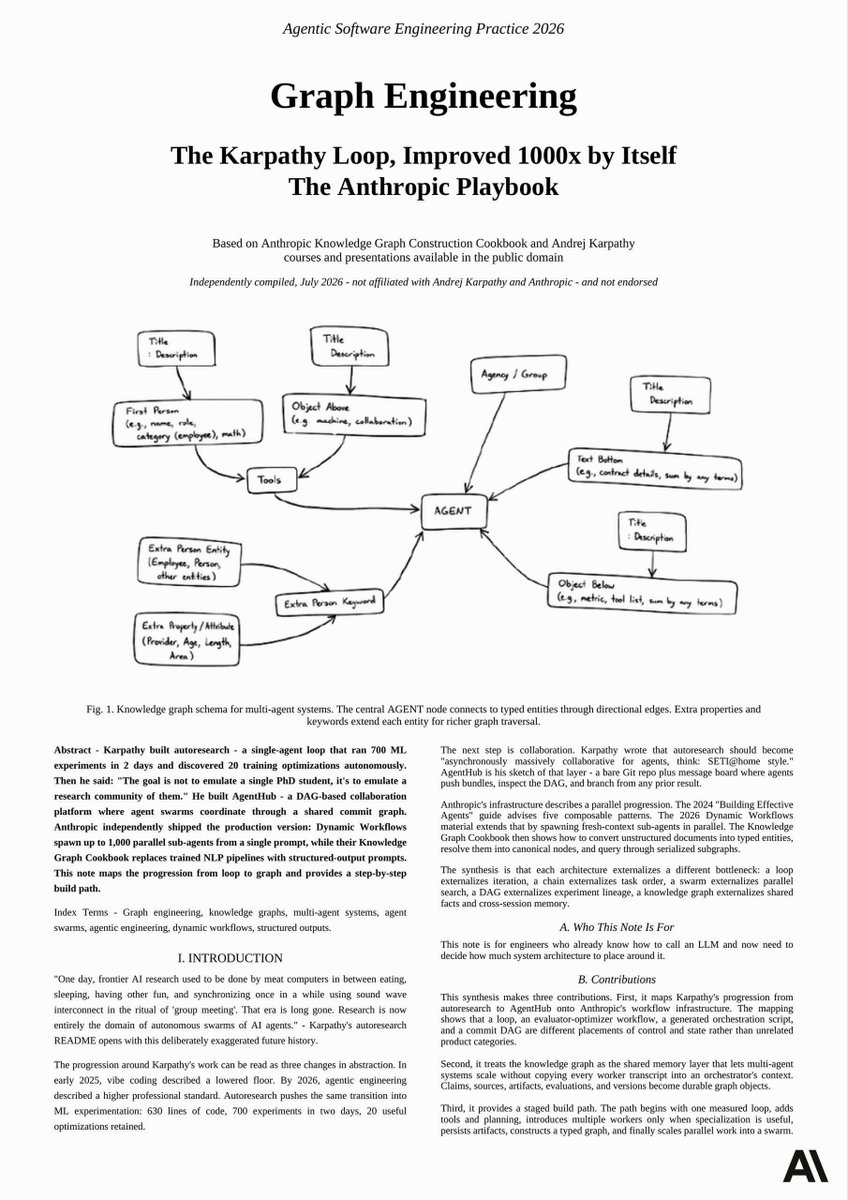
Two Anthropic seniors just made Karpathy's loop 1000x better with "Graph Engineering" - dropped 11-page PDF
the shift: the agentic systems got 1000x better the moment you wired agents into a graph
here's the playbook in 6 steps:
step 1 → build one loop: generate, critique, revise - one self-review cycle beats a smarter model with none
step 2 → add tools: search, code execution, database - thinking without tools is hallucinating
step 3 → go parallel: spin up agents in separate worktrees - same repo, different branches, no conflicts
step 4 → add a graph: agents write findings as typed nodes and edges - not transcripts - every claim keeps its source
step 5 → ground your evaluator: it checks claims against graph edges, not vibes - "Triple not found" beats "seems off"
step 6 → the graph survives every session - your agents stop rebuilding context from scratch
the result: Karpathy ran 1 agent in 1 direction - this system runs 1,000 with shared memory - same model, it's the architecture
read this 11-page PDF and paste it into your Claude - you won't regret it
bookmark - then read the article on building graphs from scratch ↓
Anthropic engineer:
“80% of our engineers are using self‑improving loops. Now everyone is building agentic Graphs.
In 4-6 months, we’ll all be building graphs to orchestrate self‑improving agents. No more prompting.”
in a 20‑minute talk, Anthropic engineer explains how to build self‑improving agentic systems from scratch.
Worth more than a $500 agentic course.
Watch this video, then read the article below on how to become a graph architect.