Gaza is being annihilated.
Thousands upon thousands of children are dead. Entire bloodlines erased. And the United States is the supplier, sponsor, and shield of the killing.
Netanyahu is not a defender.
He’s a butcher.
A fascist running from jail who’s building his legacy on mass graves.
Trump is insane .
Biden enabled it all .
Harris went with him.
This isn’t “complicated.”
It’s calculated.
You don’t “accidentally” flatten hospitals, starve cities, bomb refugees in tents or bomb convoys labeled UN. You do that when you know you’ll get away with it. And the U.S. ensures these crimes continue.
Every liberal who says “I don’t support Netanyahu but…” Every progressive who “wishes for peace” but won’t say the word occupation— You’re complicit. You are lubricating the machine of murder with your cowardice.
And don’t dare hide behind antisemitism to justify silence.
Antisemitism is real.
But using it to silence truth while bombs fall on children is a grotesque betrayal of every moral code.
Criticizing a government that carries out war crimes is not hate.
It’s obligation.
And if your politics can’t confront genocide, then your politics are trash:
No more money.
No more bombs.
No more fake neutrality.
No more bipartisan War Inc gorging on profits wrapping themselves in flags .
You are either against genocide. Or you are part of it.
Now pick a side.
@krassenstein Hanlon's razor applies.
"Never attribute to malice that which is adequately explained by stupidity”
If the messages are real it is stupidity.
If they aren’t it is malice.
THESE ARE FACTS:
- Daniel Cormier absolutely posted these messages about Eric Trump asking him for insider betting advice. I have direct evidence of that.
- Therefore Cormier either forged fake direct messages from Trump, or Eric actually sent these messages and he’s lying.
These are the only two possibilities.
⚠️WARNING: distressing details of child sexual abuse⚠️
-See the plump bloke in the ‘For the Children’ shirt who REALLY didn’t want to talk to me about Far Right sex offenders down in Brighton on Saturday?
He has VERY good reasons for that…
1/
If you believe these violent men and paedophile apologists care about protecting women and children, I have a bridge to sell you.
#SurvivorsAgainstFascism DO care and we will keep fighting the far right’s lies.
10/10
When the President of France visited the United States in April 1960, he asked the FBI to help him find a man.
The man he was looking for was an American citizen. He was sixty-four years old. He had been awarded fifteen French military decorations and — six months earlier, in a ceremony in Paris — had been made a Knight of the Légion d'honneur, the highest civilian honor France can give. The medal had been pinned to his chest by the President himself, who had publicly called him un véritable héros français. A true French hero.
The FBI located the man within a few days.
He was operating an elevator at Rockefeller Center in New York City.
The elevator operator's name was Eugene Bullard. He had been born in Columbus, Georgia, in 1895, the son of a man whose own father had been a slave.
He had run away from Columbus at the age of eleven, after watching a white mob nearly lynch his father.
He spent the next several years drifting through the American South. At sixteen, he stowed away on a German freighter at Norfolk, Virginia. He landed in Aberdeen, Scotland. From there he made his way to London, where he learned to box. By 1913, at eighteen, he was prizefighting in Paris.
When Germany invaded France in August 1914, Bullard was nineteen years old. He had no legal obligation to fight. He had no French citizenship.
He went to the recruiting office on October 19, 1914, and signed up for the French Foreign Legion.
He spent the next eighteen months as an infantryman in some of the worst fighting of the war — at the Somme, at Champagne, at Verdun. He was wounded three times. The third wound, on March 5, 1916, tore open his thigh and left him with permanent damage to his leg.
He was twenty years old. The doctors told him he would not return to the infantry.
He decided he wanted to fly.
In a Paris café in the spring of 1916, while he was recovering, Bullard mentioned to three white American friends that he was thinking of joining the French air service. A Mississippian named Jeff Dickson laughed.
Gene, Dickson said, you know damn well there aren't any Negroes in aviation.
Bullard answered: Sure do. That's why I want to get into it. There has to be a first to everything, and I'm going to be the first.
Dickson bet him two thousand dollars he would not make it.
Bullard took the bet. He earned his pilot's license on May 5, 1917. He won the bet.
He reported to the front in August 1917 and flew approximately twenty combat missions over the next three months in a SPAD VII. The fuselage was painted with a bleeding heart pierced by a knife and the French phrase Tout le Sang qui Coule est Rouge — All Blood that Flows is Red.
He carried, on every combat flight, a small capuchin monkey named Jimmy in the front of his flight jacket.
The French press began calling him L'Hirondelle Noire — the Black Swallow.
When the United States entered the war in 1917, Bullard immediately applied to transfer to the U.S. Army Air Service.
His application was rejected.
The U.S. Army Air Service had a policy, in 1917, of not accepting Black pilots. The other American pilots flying for France in his unit, all of them white, were transferred to the U.S. Air Service.
He was the only one who was not.
For the next twenty years, he was one of the most familiar faces in the Montmartre nightlife of Paris between the wars. He owned a nightclub called L'Escadrille. He spoke fluent French, English, and German. Hemingway drank there. Fitzgerald drank there. Langston Hughes drank there. Josephine Baker performed there. Louis Armstrong was a personal friend.
When Germany invaded Poland in 1939, Bullard was forty-four. His fluent German and his ownership of a nightclub frequented by German officers made him useful to the French Resistance. He became an intelligence agent — eavesdropping in his own bar on conversations between German officers who did not know he understood every word.
When France fell in June 1940, friends in the Resistance smuggled him across the Spanish border before the Gestapo could arrest him.
He came back to the United States for the first time in twenty-eight years.
He arrived in New York with thirty dollars in his pocket and a permanent limp.
He did not return to a hero's welcome. He returned to a country that had no idea who he was.
He worked at a perfume counter. He worked as a security guard. He worked at the Staten Island shipyards. By the late 1940s, he had taken the job that he would hold for most of the rest of his life.
He operated the elevator at Rockefeller Center.
He was wearing the elevator uniform on the day a producer from NBC came down from the studios upstairs to ask if he was the man Charles de Gaulle had been looking for.
A few weeks later, NBC sent a film crew to interview him in the lobby. The studios where NBC produced The Today Show were on the floors above. He had operated the elevator that took the network executives up to those studios every morning for nearly ten years. He had not been recognized as he did it.
He went back to operating the elevator the following Monday.
He died of stomach cancer on October 12, 1961, three days after his sixty-sixth birthday.
He was buried in the French War Veterans' section of Flushing Cemetery, in Queens, in the uniform of the French Foreign Legion. The casket was draped with the French flag.
In 1994 — thirty-three years after his death — the United States Air Force formally commissioned Eugene Jacques Bullard as a Second Lieutenant, posthumously.
It was the first commission the U.S. military had ever offered him.
He had been the first Black combat pilot in American history.
The French had been calling him a hero since 1917.
The Americans got around to it in 1994.
🚨
CRITIQUE OF RUPERT LOWE’S ‘RAPE GANG REPORT’
Rupert Lowe’s crowd-funded unofficial “Rape Gang Inquiry Report” presents itself as a serious attempt to expose institutional failures surrounding organised child sexual exploitation, but its central arguments are undermined by exaggeration, selective use of evidence, inflammatory rhetoric, and a highly politicised framing that risks making the problem harder rather than easier to address.
While drawing attention to genuine failures by police, social services and local authorities, the report ultimately inflates the scale of group-based child sexual exploitation to serve political ends rather than deliver serious safeguarding.
Most notably, the report’s headline claim that “at least 250,000 young white girls” have been victims of rape, trafficking and torture by predominantly Pakistani-heritage men is not supported by strong evidence nor any transparent robust methodology.
Critics have pointed out that the figure appears to rely on crude extrapolations from a small number of notorious cases, particularly Rotherham and Telford, projected across the country and then heavily inflated to account for presumed under-reporting. Official inquiries have repeatedly warned against such national extrapolations because the offending patterns in question were concentrated in particular places and periods rather than being evenly distributed nationwide.
The best-supported evidence from major inquiries suggests that the number of identified victims of this specific form of group-based child sexual exploitation is in the low thousands rather than the hundreds of thousands. By presenting the 250,000 figure as established fact, the report transforms documented failures into an apocalyptic national catastrophe, shifting debate away from evidence-based accountability and towards sensational claims of civilisational crisis.
The report’s treatment of the issue is also highly selective. While it is true that several inquiries found disproportionate involvement of Pakistani-heritage men in particular forms of organised “street grooming” offending, the report largely ignores the wider context that this represents only a small fraction of all child sexual abuse in Britain (around 4%).
The overwhelming majority of child sexual abuse occurs in other settings, including within families, through lone offenders, or online, and involves perpetrators from a wide range of ethnic backgrounds. By focusing almost exclusively on one category of offender and one category of victim, the report creates a distorted picture of the broader safeguarding landscape. This selective emphasis risks encouraging collective suspicion of entire communities rather than maintaining a focus on individual criminal responsibility and institutional accountability.
Viewed in this wider context, Lowe’s report displays many of the classic characteristics of a moral panic. Sociologists have long noted that moral panics do not arise from imaginary problems; they typically emerge from genuine social harms that are then exaggerated, simplified and symbolically transformed into evidence of a much larger societal threat.
The offences commonly referred to as "grooming gangs" are one particular form of organised, group-based child sexual exploitation (group-based CSE), in which multiple perpetrators work together to groom, manipulate, coerce or traffic children for sexual abuse. Group-based CSE is itself only one subset of the broader category of child sexual abuse and exploitation (CSAE), which encompasses all forms of child sexual abuse, whether committed by individuals, groups, family members, acquaintances, institutions, or online offenders.
Group-based CSE is unquestionably real and serious, and the institutional failures identified in towns such as Rotherham, Rochdale and Telford were grave. However, the existence of a real problem does not prevent that problem from subsequently being reframed in ways that distort its scale, causes, and significance.
One of the defining features of a moral panic is disproportion. A genuine social problem becomes represented as far larger, more widespread or more existentially threatening than the available evidence can sustain. Lowe’s headline claim of at least 250,000 victims exemplifies this tendency. The figure is presented as evidence of a national catastrophe on an almost unimaginable scale despite the absence of a transparent methodology, despite the absence of reliable supporting evidence, and despite repeated warnings from official inquiries against extrapolating local scandals into nationwide estimates. The effect is to transform documented cases involving thousands of victims into a narrative suggesting a hidden atrocity affecting hundreds of thousands.
A second hallmark of moral panic is the creation of a “folk devil”: a group is portrayed as symbolising a broader social menace. In Lowe’s report, British men of Pakistani heritage occupy this role. While some inquiries have identified disproportionate representation among offenders in particular forms of group-based exploitation, the report repeatedly moves from discussion of convicted perpetrators to broader claims about Pakistani culture, Muslim communities, immigration and multiculturalism. This encourages readers to interpret a specific offending pattern through the lens of an entire ethnic or religious population. The result is a shift away from individual criminal responsibility and institutional accountability towards collective suspicion and cultural blame.
Moral panics are also characterised by disproportionate attention. Organised grooming gangs have received extraordinary political and media coverage for more than a decade despite constituting only a small proportion (around 4%) of overall child sexual abuse. This sustained focus can create a misleading public impression that grooming gangs represent the primary threat facing children when the overwhelming majority of sexual abuse occurs in very different contexts. The danger is not that grooming gang offending is discussed too much, but that it receives a degree of attention far out of proportion to its prevalence, distorting public understanding of child sexual abuse as a whole.
Finally, moral panics frequently serve wider ideological purposes. They channel public anger and anxiety into narratives about national decline, cultural conflict or political betrayal. Lowe’s report repeatedly links grooming gang offending to immigration, multiculturalism, Islam and establishment complicity, transforming a safeguarding issue into a broader political argument about British identity and governance. This framing risks subordinating child protection to culture-war politics.
Rather than focusing primarily on how victims can be supported, offenders prosecuted, and institutions reformed, attention shifts towards symbolic political battles over ethnicity, religion and national belonging. Critics argue that this dynamic reflects what Professor Ruth Wodak has termed “the normalization of far-right discourse”, whereby the language, assumptions, and framing of the radical right gradually become accepted as part of mainstream political debate.
The language employed throughout the report further contributes to this dynamic. References to a “demonic chapter” in British history, claims of civilisational betrayal, Holocaust analogies condemned by Jewish organisations, and repeated descriptions of perpetrators as representatives of a wider cultural or religious threat move the discussion away from evidence-led analysis and towards moral and ethnic polarisation.
The report weaponises real institutional failings, including documented reluctance by some authorities to confront ethnic dimensions of offending for fear of accusations of racism, and repackages them as evidence of a broader conspiracy of multicultural betrayal. Such rhetoric may generate attention, engagement, and outrage, but it can also deepen social division, alienate potential allies, and make constructive discussion more difficult.
The concerns raised by critics therefore extend beyond the report's rhetoric. They also relate to whether the inquiry process itself was genuinely open to evidence that complicated its central narrative. A report that presents itself as a search for truth must demonstrate not only that it highlights supporting evidence, but also that it seriously engages with testimony and perspectives that challenge its preferred interpretation of events.
These concerns are reinforced by allegations regarding the inquiry's treatment of some survivors. Femi Mohammed, who has publicly described herself as a survivor of sexual assault by a Pakistani perpetrator, stated that she was initially invited to give evidence before being removed from the hearings and subsequently accused the inquiry of excluding Muslim and minority-ethnic victims.
Whether or not every allegation is accepted, the controversy highlights a broader perception that the inquiry prioritised evidence that reinforced its central thesis while marginalising voices that complicated it. An inquiry that seeks credibility should strive to include all victims and all relevant evidence rather than privileging those accounts that fit a particular political framing.
The selective framing becomes particularly apparent when compared with other child abuse scandals. The abuse crisis within the Roman Catholic Church in England and Wales involved thousands of victims and hundreds of perpetrators over several decades, prompting criminal prosecutions, formal inquiries, compensation schemes and institutional reform. Yet it was not used as a basis for demonising Catholics as a whole, nor for attributing collective guilt to white British communities.
The contrast highlights the importance of applying consistent principles: identifying patterns where they exist, holding institutions accountable for failures, and prosecuting offenders vigorously, while avoiding the temptation to treat entire ethnic or religious populations as collectively responsible for the crimes of a minority. If collective ethnic or religious blame is rejected in one context, there is a strong case for rejecting it in others.
The timing and political context of Lowe’s intervention also invite scrutiny. There is no public record of sustained campaigning, advocacy, or even engagement with the issue before his return to frontline politics and subsequent rise within Reform UK. His first identifiable public interventions on the subject appear only in early 2024, despite organised group-based child sexual exploitation having been a matter of public concern for over two decades.
The issue first attracted national attention through cases in towns such as Keighley, Derby and Rotherham during the early 2000s, with major convictions occurring long before Lowe entered Parliament. By 2011, following high-profile investigations by journalists such as Andrew Norfolk, the term “grooming gangs” had become firmly established in public debate, generating extensive media coverage, parliamentary discussion, criminal prosecutions, official reviews and public inquiries over more than a decade. The issue was therefore neither obscure nor newly discovered when Lowe adopted it as a central political cause.
Lowe’s engagement intensified as it became politically advantageous, coinciding with election campaigns, internal party disputes, his suspension from Reform UK, and the launch of his own political project. While this does not in itself invalidate his arguments, it does raise legitimate questions about motivation.
The issue functions as a powerful political wedge, capable of generating media attention, donations, public outrage and electoral support. Given the absence of a long-standing track record on the subject, critics argue that the inquiry appears less like a consistent commitment to child protection and more like a high-visibility wedge issue adopted at a moment of maximum political utility.
The fact that Lowe chose to establish a parallel crowd-funded inquiry, despite the existence of multiple previous official inquiries and an ongoing statutory investigation with formal powers, further reinforces the perception that political mobilisation and public visibility may have been at least as important as contributing new evidence or advancing safeguarding policy. This helps explain why many critics view the report as an exercise in political entrepreneurship as much as an exercise in child protection advocacy.
Perhaps most importantly, the report risks being counterproductive. Genuine institutional failures in towns such as Rotherham, Rochdale and Telford have already been extensively documented through criminal trials, public inquiries, reviews, parliamentary investigations and national scrutiny. Significant reforms have been proposed and, in some cases, implemented.
The report therefore recycles many issues that are already well established in the public record while offering little new evidence or analysis. By advancing disputed statistics, employing sensationalist rhetoric, and presenting the issue primarily through the lens of ethnicity, religion and national identity, it may ultimately undermine public confidence in evidence-based reform.
Rather than complementing ongoing statutory investigations and safeguarding efforts, it risks providing critics with grounds to dismiss legitimate concerns as politically motivated while simultaneously inflaming communal tensions.
Survivors deserve rigorous, fact-based accountability, effective policing, improved safeguarding, better victim support and institutional reform. Those goals are not advanced by exaggeration, selective evidence or political grandstanding. By maximising outrage over precision, mobilisation over understanding, and spectacle over reform, Lowe’s report risks generating more attention than solutions.
The result is a contribution that deepens division, distorts public understanding, turns child protection into a vehicle for culture-war politics, and ultimately does less to protect vulnerable children than a genuinely evidence-led, non-partisan approach would achieve.
🚨 Rupert Lowe's unofficial Rape Gang Inquiry Report claims: "It has been previously established that, at the very least, 250,000 young white girls have been subjected to repeated rape, gang rape, trafficking, torture..."
This is not supported by reliable evidence.
The best evidence-based estimate for the total number of known or identified victims of abhorrent group-based/organised "grooming gang" child sexual exploitation (multiple perpetrators working together to groom, coerce, and sexually abuse children, often over extended periods) committed specifically by men of Pakistani heritage in the UK is likely in the range of 2,000–4,000 (even one case is obviously too many). This is a cumulative figure across decades (mainly 1990s–2020s), not an annual total.
This number is grounded in official inquiries, police investigations, and court outcomes rather than speculation or broad extrapolation.
The major documented cases cluster in a small number of towns/cities where Pakistani-heritage men were the main (or predominant) perpetrators. These are the ones with the clearest evidence linking ethnicity to organised group offending of this type.
Rotherham: The 2014 Jay Report (and later National Crime Agency updates) identified around 1,400–1,510 victims abused mostly by men of Pakistani heritage over ~16 years.
Telford: The 2022 independent inquiry concluded over 1,000 children were exploited over decades, with a *large proportion* of offenders being of Pakistani/South Asian heritage.
Other significant cases (Rochdale, Oldham, Huddersfield, Oxford, Newcastle, Bradford/Keighley, etc) add several hundred more identified victims each in high-profile convictions — typically 50–300 per major case/operation where Pakistani-heritage groups dominated.
Adding the core confirmed figures from these well-documented scandals gives a baseline in the low thousands.
National data shows group-based child sexual exploitation (any ethnicity) is a small subset of overall child sexual abuse in the UK (about 4% of the total).
Recent police data (eg, Complex and Organised Child Abuse Dataset) records only around 700 group-based offences per year across England/Wales — and this includes all ethnicities, all group models (not just "on-street grooming" by Pakistani men).
Even in areas with over-representation of Asian/Pakistani suspects (per 2025 Casey audit), most child sexual abuse/exploitation is by lone offenders or white perpetrators.
Overall child sexual exploitation (group or not) involves thousands of identified cases annually, but the specific organised "grooming gang" model by Pakistani-heritage men is concentrated in certain localities and time periods, not widespread nationwide.
Higher figures that sometimes circulate come from unreliable extrapolation: taking Rotherham's 1,400 and multiplying it unrealistically across every town/city without evidence those places had similar offending patterns or scale.
Official reviews (Home Office, IICSA, Casey audit, police analyses) repeatedly state there is no reliable national total for this specific subtype, and warn against such scaling because the model isn't uniform everywhere.
Many victims in these cases remain unidentified or unreported, so the true number is certainly higher than reported/conviction-linked figures. But evidence-based estimates stick to what inquiries, police operations, and courts have actually confirmed or strongly indicated, which caps the known/identified Pakistani-heritage organised group victims in the low thousands overall.
In short, the high-profile scandals account for the bulk of the documented cases fitting this exact description, and even generous summing of those (plus smaller cases) stays well below 5,000 identified victims. Broader claims lack supporting data from credible official sources.
Best estimates suggest roughly 3–7M unique children in the UK have experienced contact sexual abuse (physical contact, excluding non-contact/online) since the 1990s.
EXCL: Nigel Farage has been trying to block Bank of England cryptocurrency plan that could be costly for billionaire bankrolling his party.
Reform UK leader has said Christopher Harborne wants nothing in exchange for millions donated to party and undeclared £5m personal gift to Farage revealed by Guardian.
But Farage used private meeting at Bank to urge governor to drop plans for state-run alternative to digital currency that has made his Thailand-based benefactor one of richest people in world.
Cracking tale from @tomburgis
https://t.co/o4ljHGx8fZ
Now the digital penny drops. Farage said the £5 Million he was given by a Crypto dude, was for nothing - and also for different things, like personal protection and or achieving Brexit (what an achievement) - clearly struggling to explain it. And we likewise struggle to understand it. Now we see that the Bank of England have their own Crypto currency in mind and Nigel Farage, the man that thousands of people literally paid to say anything they wanted him to, has leapt to his donors defence, urging the Bank to drop their plans. And now the £5 Million makes more sense. If we needed any more reasons to ban all donations to political parties - we just got a whopper. We can end this endless scandal fest for the price of a packet of crisps a year - check out Babelfish for details. https://t.co/eR7LuYLqQF
https://t.co/WuZRydtiJy
“What’re you in for mate?”
“Cleaning a river without a permit. What about you?”
@EnvAgency is really plumbing new depths of malevolent uselessness here.
@SarahForRuncorn For all you lefties criticising Sarah over this post, just remember she knows what her voters are like better than you do.
Maybe why she voted against proposals to strengthen women’s safety. She can’t afford to lose the Domestic Violence vote.
@SarahForRuncorn Difficult to articulate just how stupid this is from an MP. Rather than putting the responsibility for domestic abuse onto England's footballers, how about telling domestic abusers not to be domestic abusers?
@SarahForRuncorn Women get battered even if they win, you moron.
Reform’s policy to stop male violence? Hoping England win tournament matches. Wow.
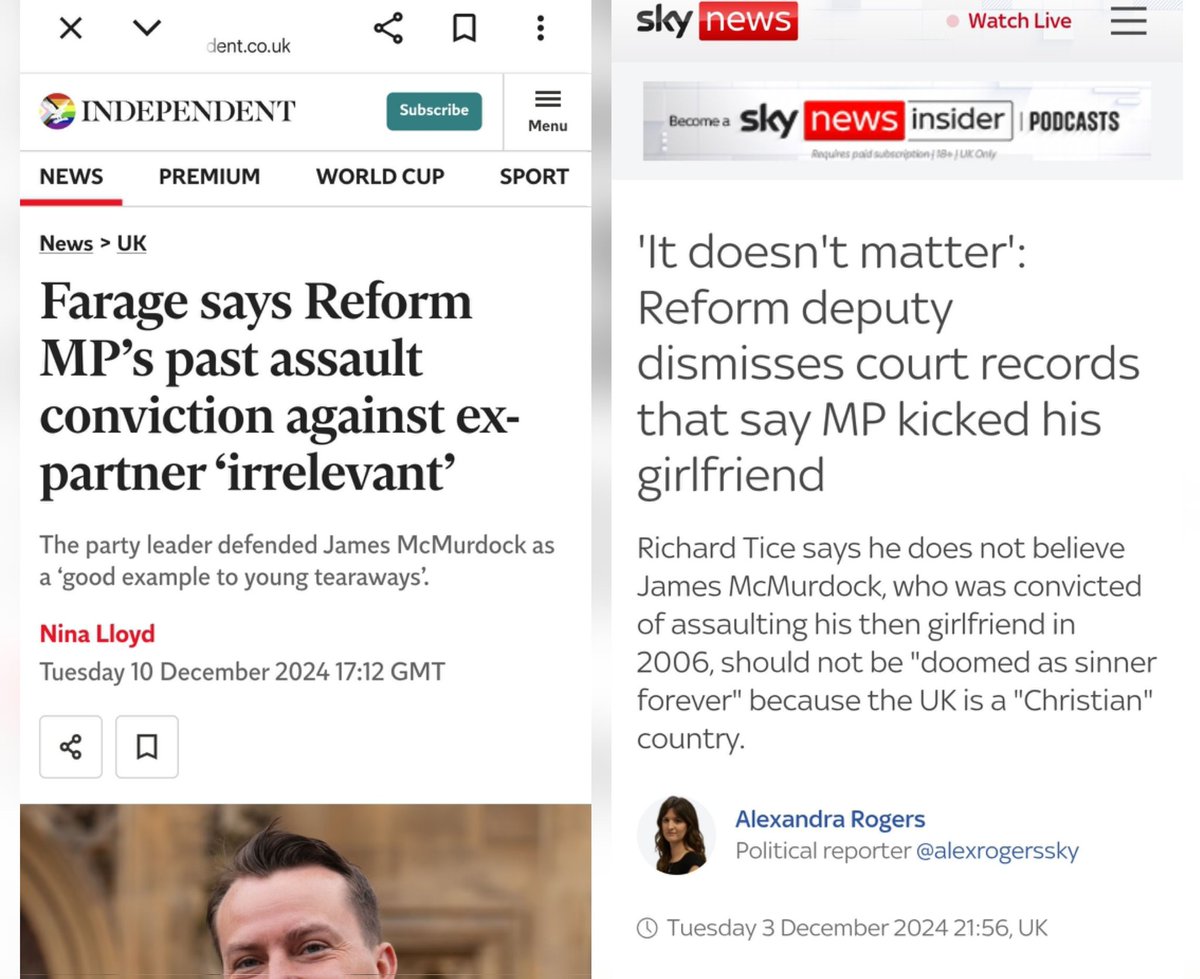
Meanwhile they stand sexists like Kenyon and wifebeaters like James McMurdock as candidates.
Domestic abuse rises whether England loses or wins at football.
Tackling that shouldn’t depend on the score line but the seriousness with which we take violence against women and ending the culture of misogyny that enables it.
With views like this Reform continue to show they are part of the problem not the solution.