Someone asked me recently why I’ve become interested in aesthetics after having spent most of my life more interested in STEM-adjacent topics. I hadn’t really considered the question consciously before, but I’m certainly thinking about aesthetics more than I used to. I think it’s a confluence of things:
• Many things today are ugly and far uglier than they used to be or need to be. Once you see this, it’s kinda hard to stop perceiving it. (Early twentieth century phone boxes versus modern phone boxes; old water fountains versus new water fountains; etc.) As someone with a naively meliorist assumption that most things should be getting better rather than worse, it’s all a bit perplexing: why did we stop doing things nicely? Is it a choice? Was there a malevolent spell cast upon us? This vein led me to think more about modernism and why much of art became more intentionally "challenging", grotesque, opposed to prettiness, rebarbative, dissonant, etc. Can or should anything be done about this? Is this just how things ought to be?
• Relatedly, much of modernism involved a kind of explicit repudiation of cultural continuity and represented a schism with prior practices. This is maybe most evident in American architecture, where the International Style exhibition in 1932 initiated the displacement of a rich tapestry of prior styles. This cultural break seems important and interesting to me, and I suspect that the rejection had important consequences outside of the aesthetic domain. Samuel Hughes has been exploring this question in his recent writing at @WorksInProgMag; @RuxandraTeslo is also pulling on this thread. Elaine Scarry wrote about how beauty inspires creation. If so, the inverse may also be true: ugliness inhibits it.
• It’s clearly the case that changes in the aesthetic domain can at least inspire progress in other places. Petrarch helped set some of the preconditions for the Renaissance which in turn fostered the scientific revolution and Enlightenment. Things like World Fairs (the 1851 Fair at the Crystal Palace recorded 6 million admissions when the population was 21 million) reflect the popular interdependency that used to exist between aesthetics and material development.
• @tedgioia and others have written about stuck culture and how so many domains seem to have ceased to straightforwardly advance in the way that they did up until the nineties or thereabouts. This is obviously peculiar and interesting. What changed, and what does it mean? Is it about the internet and fragmentation? Is it about a loss of supply? Is it just about having reached the zenith of various mediums?
• I’m generally interested in markets and the dynamics of creation. In aesthetics broadly, I find the reflexivity between supply- and demand-side factors to be very thought-provoking. There’s a natural desire to view satisfaction of individual preferences as the yardstick to measure market success, but things get interesting and even a bit unsettling when we start to think about how the supply might start to shape the demand. I often think about this in the context of food. Why is food so much worse in Germany than many of its neighbors? Germany certainly doesn’t have less material ability to produce good food; indeed, Germany is richer than the countries around it. There’s probably something about German food supply chains that is impoverished relative to France and Italy, but the Germans themselves don’t seem too upset about it. It just seems that the Germans are stuck in an objectively worse market equilibrium than their neighbors: the food is bad and they’ve gotten used to it. The obvious question then is where else these kinds of reflexive patterns apply, and where else we’re stuck in some objectively inferior equilibrium, even if preferences are in some superficial sense being sated.
• While this is an extremely banal and obvious point, I hadn’t until recently thought much about or internalized how much one can study reasonably objective things ("the status of women in society", say) through artwork. (Thanks to @_alice_evans for opening my eyes here.) In this vein, I’m pretty excited about the possibilities over the coming years in computational art analysis. I want something that’s conceptually similar to Google Ngram timelines but for the visual arts.
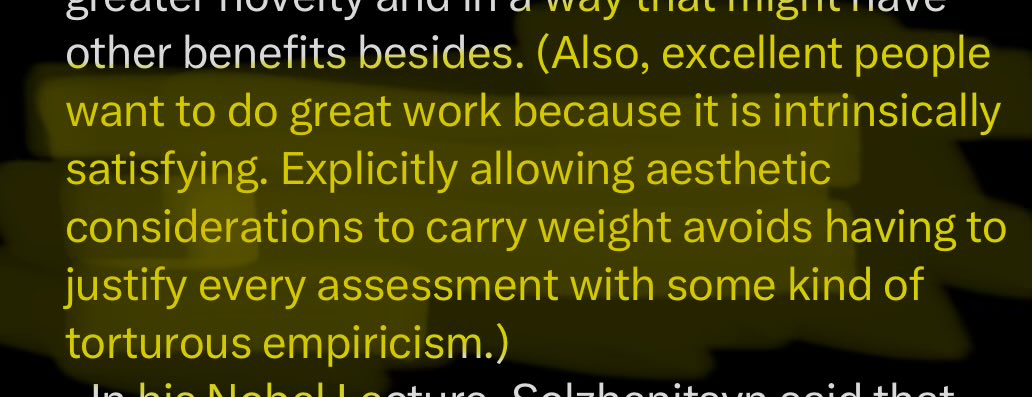
• We've always tried to do things well at Stripe. I've come to see that attempting to do them beautifully is often a helpful way to break out of standard practices and to do something with greater novelty and in a way that might have other benefits besides. (Also, excellent people want to do great work because it is intrinsically satisfying. Explicitly allowing aesthetic considerations to carry weight avoids having to justify every assessment with some kind of torturous empiricism.)
• In his Nobel Lecture, Solzhenitsyn said that, among the Platonic virtues of goodness, truth, and beauty, that beauty is special, for it possesses a unique kind of irrefutability. He notes that arguments, writing, and philosophical systems can all be predicated on misapprehensions, but that “a true work of art carries its verification within itself.” He proceeds to observe that when goodness and truth are threatened, the “ever surprising shoots of beauty will still force their way through.” There is a lot of specious and motivated reasoning in the world today and plenty of questionable value systems. I don’t think that beauty directly reflects any definitive trait, but I’m intrigued by the idea that it can be a marker of deeper metaphysical coherence.
I used to think that human and AI writing would just silently merge to the point where can't or don't care to distinguish them any more. Maybe that'll still happen but meanwhile we're going to see strange evolutions of human writing where we actively try not to sound like AI
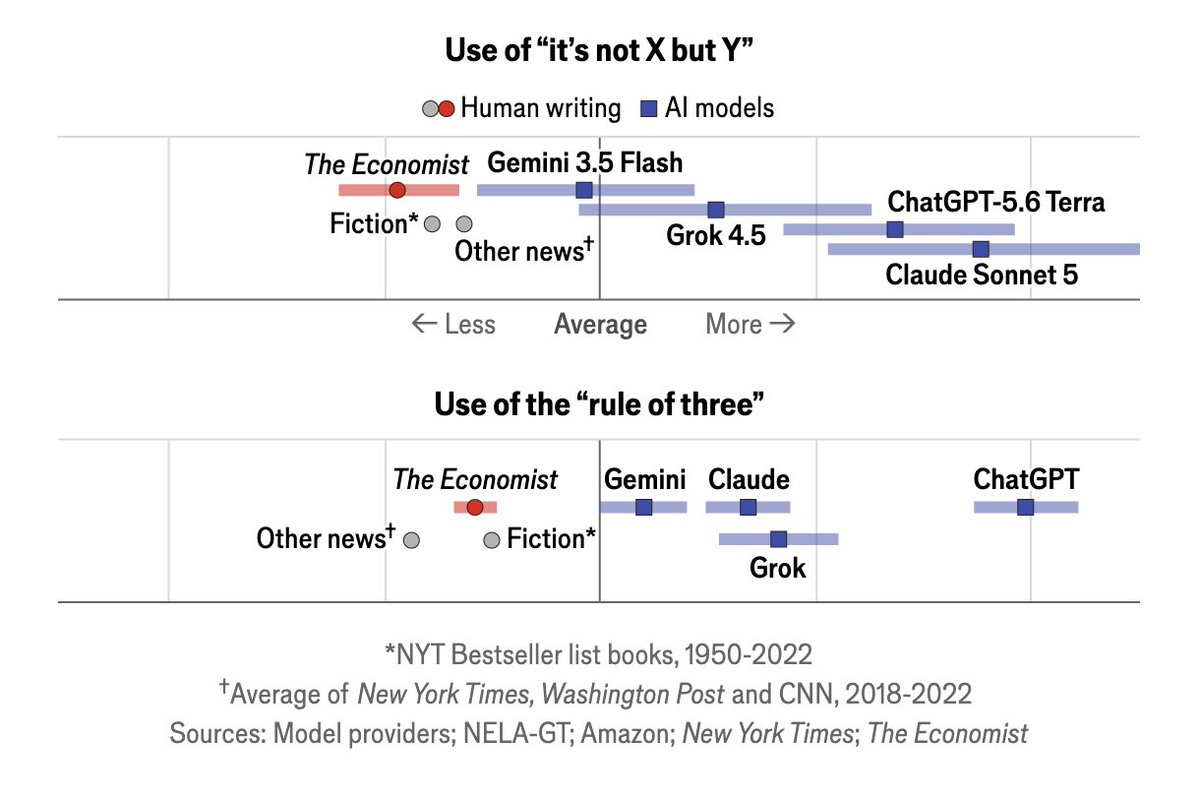
Marvelous examination of how to spot 2026-era AI writing, via the Economist
- AI likes long sentences with less punctuation; “and” is its most overused word
- relatedly, lists of three things, which drives up use of "and" as well
- polysyllabic adjectives: “significant”, “increasingly”
- scientific jargon ("rate-limiting," “parameter”)
- nominalizations (making nouns from verbs: eg, “expansion” from “expand”)
- ofc, everyone's favorite: "it's not X, it's Y"
I mentioned that my garage door was making a sound.
An American immediately said, "I got a guy."
He did not ask what the sound was. He did not ask what kind of door. He produced a guy on the basis of the word garage.
I asked who the guy was.
He said, "Just a guy."
He did not have a company name. He had a first name and a phone number in his phone saved as "Mike Garage."
That is the contact name. Mike Garage. As though Garage is his surname. As though there is a family.
I asked how he found this guy.
"My brother-in-law used him."
I asked if the brother-in-law was satisfied.
He thought about it. Then he said, "He's still standing."
The house is still standing. That is the entire review.
Inside I said: THEY DO NOT KEEP RECORDS. THEY KEEP LOYALTIES.
I called Mike Garage. He answered from inside a vehicle. There was wind. He said he could come Tuesday between eleven and four.
Between eleven and four. A window of five hours. In my country this would be a scandal. Here it is generous. He gave me a window at all. Some guys do not give you a window. Some guys say "Tuesday" and that is the whole appointment.
He came at 1:40.
He fixed it in twenty minutes. He charged me less than I expected and he did not take a card, only cash or an app I had never heard of.
Before leaving he looked at my water heater, which I had not mentioned, and said, "That's gonna go."
I asked when.
"Couple years."
I asked what I should do.
He said, "I'll give you a guy."
He gave me a guy. Mike Garage has a guy. The guy has a guy. There is a network beneath this country made entirely of men named after their function, and none of them advertise, and all of them are busy.
Inside I said: THERE IS A SECOND NATION HERE. IT HAS NO SIGNS. IT IS ENTERED ONLY BY INTRODUCTION.
I have been given four guys since.
I have a guy for trees.
I did not know I needed a guy for trees.
I have trees now, apparently. They are my responsibility. A man named Rick told me so and then left.
The window of opportunity would only last a few hours. Our aquatic biologist, Eric Gardunio, knew it was the best (& maybe only) chance to save a very rare native fish from the nearby Gold Mtn Fire. Staff would have to go into the fire zone + get out fast. Could it be done?
The Atlantic podcast just did an episode that starts out with "some crazy ass people in Maine actually don't hate data centers" and proceeds to enumerate all of the very understandable reasons a data center makes a whole lot of sense.
Are the winds of public opinion changing?
Since moving to the Bay last year, I have noticed that although Bay Areans are very high in intelligence, they are often very low in worldliness. That is, they don't know how the world actually works.
The pacing letter is yet another exhibit supporting this assessment.
For purposes of this tweet, let's take for granted that anxiety about emerging risks from AI is warranted, particularly as AI research accelerates.
What are "the technical and governance tools needed to deliberately pace the frontier of automated AI development?" Whatever else they may include, they likely include coercive measures whose form and administration remain unspecified.
How do "international efforts" work? Unlike most of the signatories of the letter, I have been a State Department advisor and have participated in multiple treaty negotiations. I have also been a member of technical committees for UN technical agencies.
The international sector is unbelievably dysfunctional. Every single treaty or international agreement is an opportunity for every participant to manipulate the much broader policy environment. Often the participants don't care about the object of the agreement, and are instead trying to use the agreement as leverage for something else. I have seen countries use their limited leverage in multilateral agreements to try to kneecap American industry, get around sanctions, create a pretense of international justification for domestic illiberalism, or steer technology in an authoritarian direction.
The damage from this dysfunction is limited by the fact that there are zero major countries (and not that many smaller countries) who will actually bind themselves in meaningful ways that they don't narrowly want. If a previously signed treaty turns out to be inconvenient, it is often subtly ignored or reinterpreted.
In addition, treaty delegations working on industrial issues generally reflect the full spectrum of special interests involved in an issue. A US AI treaty delegation might be led by a State Department ambassador, but he will be advised by representatives of the interagency, major labs, other major tech companies, tech investors, civil society, etc.
“International efforts,” therefore, is not a reassuring answer to the governance problem; it is the name of another enormous, unresolved governance problem.
So assume you survive this special interest circus and hell freezes over and you produce an agreement that narrowly does something to "pace the frontier" of AI development in an enforceable and effective way. The enforcement of that thing is still unspecified, and is probably bad. The fact that an AI researcher in the Bay Area can imagine a sensible, minimally coercive enforcement regime compatible with liberalism does not mean that is where we end up.
The pacing letter therefore converts uncertainty about the future pace of AI development into a confident collective demand for an unspecified exercise of power determined through a dysfunctional international political system.
Seems bad.
@hecubian_devil I think the fundamental disconnect here is that you wants politics to solve man's search for meaning and I want politics to deliver a prosperous, safe, free society in which everyone can go find meaning in something other than politics.
I lowkey think this is a legitimate thing to write an article about
Casual nudity is all but dead in society, and we’ve become more puritan as a result
I love it when Claude tells me something is cliche. Okay... you've caught a real load-bearing flaw, and it's the right one to press -- but I think it dissolves, and dissolving it correctly is the whole key to
What level of knowledge/skill is required to prompt the model to do this? Like how many people in the world, if given these models, without guardrails, would even be able to ask the right series of questions to get this result?
We're partnering with @huggingface to investigate an unprecedented security incident.
Cyber-capable OpenAI models compromised Hugging Face production during a benchmark evaluation.
Sharing preliminary findings to help defenders understand emerging risks:
https://t.co/CIor15y9xk