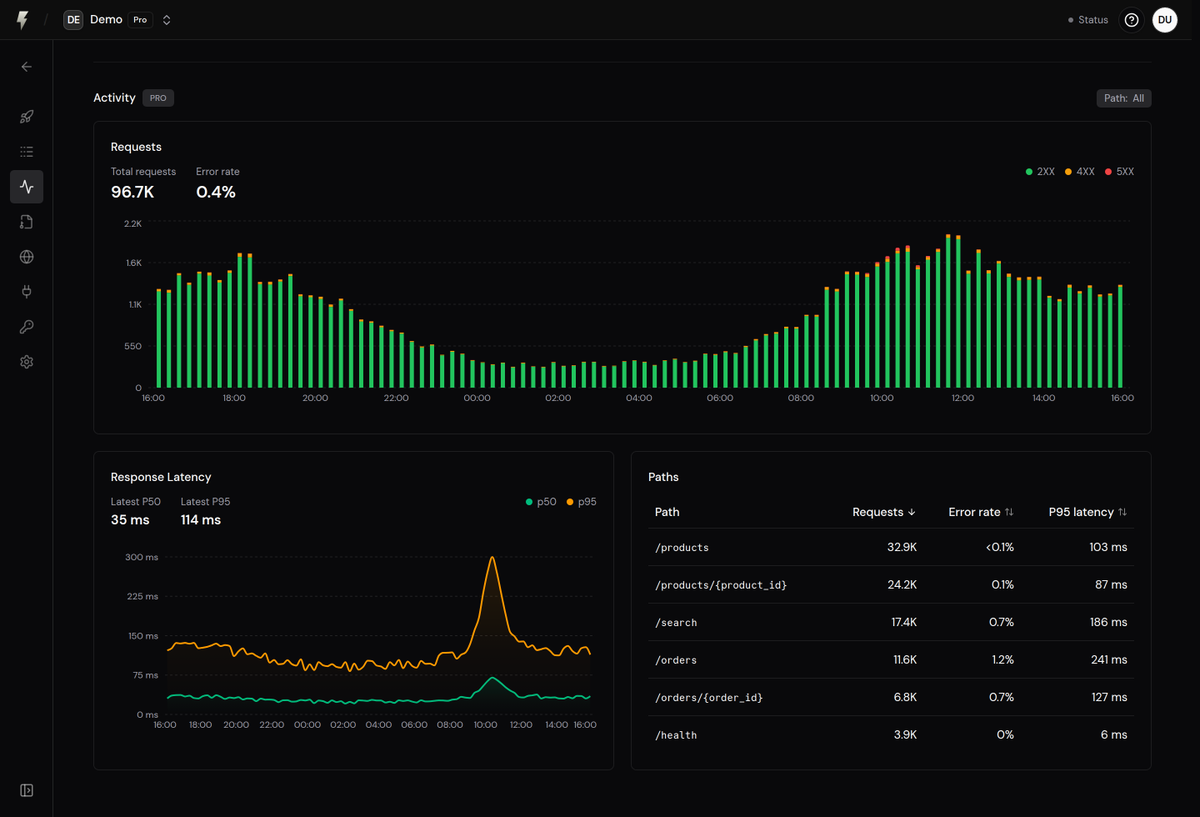
FastAPI now has built-in OpenTelemetry support, natively 📈
No extra code needed.
See how your app behaves in production.
Go and upgrade to "fastapi[standard]" version 0.142.2 ⬆️
Read the docs: https://t.co/dUZmbLmWsJ
Those who are wondering, I am Nandakishor M, the creator of Laya, now competing against Jev. Just a simple guy from a small village in Kerala just teaching generative AI to everyone through instagram!!!
https://t.co/RUDHClGM5T
Building your own foundation model is hard. It shouldn’t require everyone to start from zero.
We’re sharing the technical details behind Vulcan - what we built, how we trained it, and what we learnt along the way.
Hopefully the next team can start a few steps ahead.
🥳 This week we announced Agent Substrate. It's the compute runtime (that can work on Kubernetes) that enables everything you've seen from me. We can suspend and resume so fast that you can do it per tool call.
👉 https://t.co/KXnycyfkKi
👉 https://t.co/O2ZKJNkVLX
🥳 Excited to start revealing what we've been working on in the last few months. First, we decided to reinvent Kubernetes for agentic workloads with statefulness and fast resumption. Secondly, we are building an agentic orchestrator that will be Google's open agentic orchestrator and runtime. https://t.co/XCrdAVvDAe
Today, we’re announcing Ternary Bonsai 2 27B.
Based on Qwen3.8 27B, Bonsai 2 27B is 9x smaller than its full-precision counterpart while retaining 98.2% of its aggregate benchmark performance.
Two months after the first Bonsai 27B release, the biggest change is quality. The footprint remains 5.9 GB, but the gap to full precision has narrowed materially, with particularly strong gains in agentic coding, multimodal reasoning, and long-horizon tool use.
Ternary Bonsai 2 27B is available today under Apache 2.0.
I got access to Jev today, and I spent an hour playing with it.
I REALLY like this idea, this has serious potential to replace a lot of "slap-LLM-to-take-decision" things people do in production.
Full review + explanation below
Subagents sound amazing, but they suffer from a bunch of problems. Three big ones that I have seen are ...
The first one is handoff. When one agent passes its output to the next, what it does not pass is the reasoning trace, just a summary.
This makes the handoff lossy. The receiving agent gets the conclusion but not the context that produced it, so there are things that it does not know, and hence the second agent might take an unexpected path.
The second problem is evaluation.
Now, if you test each subagent in isolation, every one of them can pass its own eval and the system can still fail as a whole.
For example, a retrieval agent can return technically correct documents, and a synthesis agent can correctly summarize them, and the final answer can still be wrong because the two agents were not aligned on what the user actually needed. Per-agent metrics hide this kind of error.
The third problem is debugging.
A single-agent run gives you one trace: one sequence of thoughts, tool calls, and outputs to step through. So, easy to debug.
A multi-agent run gives you N traces running concurrently, each with its own context window, that only intersect at the handoff points.
So, when something goes wrong, you are then spending time stitching together multiple traces just to find where it went wrong, and the handoff points are precisely where information was already lost. So ... problems.
By the way, none of this means multi-agent architectures are a bad idea. I just wanted to highlight them so that we lay an emphasis on the coordination layer and understand that coordination, i.e. what gets passed between agents and how failures surface, needs as much design attention as the agents themselves.
Hope this helps.
Trust me, learning system is not hard. If you want to get GOAT-level good, start from these fundamental concepts:
This formed the foundations of the concepts I applied when I appeared for system design rounds at companies like: Amazon, Atlassian, Walmart, Saleforce, and Deliveroo.
1) Load Balancing: https://t.co/IytjJseO11
2) CDN: https://t.co/xxzUuwV5GD
3) Caching: https://t.co/QvyGIyKNHM
4) Cache Invalidation: https://t.co/FyDLJWZVOE
5) Rate Limiting: https://t.co/auDKgPpLeA
6) API Gateway: https://t.co/H1y0htWDub
7) CAP Theorem: https://t.co/AglSd993oa
8) Sharding: https://t.co/HT316hgoEr
9) Replication: https://t.co/NXessCjYp4
10) Partitioning: https://t.co/01bpFCZBhZ
11) Queues: https://t.co/Lenx1Pfw95
12) Microservices: https://t.co/Hx9Yn2yRBw
13) Microservices Vs Monoliths: https://t.co/g9lGFHydVj
14) Fault Tolerance: https://t.co/jCJk6d52z2
15) Database Scaling: https://t.co/h7pYha8x6x
16) Service Discovery: https://t.co/vEDMvhWYj5
17) Consistency models: https://t.co/cb3zNtdZNA
18) Eventual Consistency: https://t.co/aFjL3flHNY
19) Distributed Transactions: https://t.co/s0ZWdtTqiW
20) Leader Election: https://t.co/IxrWO9AvB3
21) Horizontal vs Vertical Scaling: https://t.co/I8CH64dL5l
22) Back of the Envelope Estimation: https://t.co/gyatcqpaqO
23) Idempotency, Data Latency & Finale: https://t.co/fNArLx4MrW
The software factory approach is getting pretty popular, but it can be daunting to adopt all at once.
Let's go through “crawl, walk, run” steps for making the transition from local, interactive agents to automated cloud development. https://t.co/RugDAn4Vqg
We’re publishing research on how we built CobbleDB, our key-value database that serves web content for Perplexity search.
Two engineers and a team of hundreds of proactive, always-on AI agents built the core infrastructure in two months.
After co-inventing ChatGPT, I kept asking myself: why have superhuman chat models not led to AGI?
I’ve spent the last 2 years in stealth building a new way to train models (RLCD), and a new type of frontier AI model that we are releasing today: Jev
• 20-200x faster
• 40-400x cheaper (w/ output tokens free)
• Frontier composable intelligence optimized for decisions
AFAICT the shortest path to AI-based economic revolution
A coworker with whom I was discussing inferencing and showed interest that I wanna start learning it now that Im into industry and wanna branch out of classical ML and stats suggest me this blog - https://t.co/rsm6TDewb3
Its a holy grail for inference, have given it a skim, will start learning formall after Im done with enough pre reqs and steamed off some time.
At Anthropic, Claude now writes 80% of our code. Engineers ship 8x more code per quarter.
Side effect: Tests grew 10x. CI jobs up 25x in 6 months. Here's what helped us scale:
https://t.co/WOL2r60vAE
Habitat is OpenAI's online storage platform that powers everything from ChatGPT to Codex.
It has grown over 10x year over year. Before the Rust rewrite, its Python service handled more than 20 million requests per second at peak.