Peace, but Victory
Quiet day slowly fading,
with lights playing the sea,
The gren slopes of Dnipro,
became dear to me,
Where the branches are swaying
of lovers delights,
How can I not love you,
Kyiv of mine!
Last May @U2’s Bono and The Edge visited Kyiv at @ZelenskyyUa invitation to show their support for Ukrainians. Today, on Kyiv Day, Bono reads from the lyrics of Kyiv’s anthem Yak tebe ne liubyty, Kyieve mii! in solidarity with the people of Kyiv and those who care about our city
Why does Japan’s 200 mph bullet train look like an elongated bird?
Because Japanese engineers refused to wake up sleeping babies in the mountains.
When the Shinkansen pushed past 180 mph, slamming into narrow mountain tunnels created a massive sonic boom—like a cannon firing through the valley.
Other countries might have built ugly concrete sound barriers.
Japan’s chief engineer, Eiji Nakatsu, went birdwatching instead.
He noticed the kingfisher bird:
It dives from air straight into dense water at high speed without making a single splash.
So the engineering team modeled the entire front nose of the bullet train after the beak of the kingfisher.
The result?
The train now slices into tunnels silently, reducing air resistance by 30% while residents sleep in complete peace.
Harmony with nature and quiet care for ordinary people, running on steel rails at 200 mph.
Why do governments wait until the fiscal crisis hits to act?
Alesina & Drazen (1991) argue that stabilization delays aren’t irrational. They’re a war of attrition as groups fight to avoid bearing the cost.
The Big Beautiful Bill is setting up the next round.
We’re sharing a solution to the Navier-Stokes Millennium Prize Problem, one of the deepest problems at the frontier of mathematics.
The proof was produced by a group of agents, using an OpenAI next-generation model significantly more capable than GPT-6 Astra.
The problem concerns whether the description of smooth three-dimensional fluid motion modeled by the Navier-Stokes equations can break down. It has remained unresolved for roughly 90 years.
What makes solving Navier-Stokes important?
Fluid dynamics affects more than you realize in your everyday life. This breakthrough — if it is true — gives you:
Cheaper, safer flying and driving. Air over a wing or around a car is a Navier-Stokes problem. Better control of that flow means less drag, so planes and trucks burn less fuel, stay quieter, and stall less often.
Weather you can actually plan around. Storms, jet streams, and ocean currents are giant fluid problems. Sharper turbulence physics is one of the remaining limits on hurricane tracks, heat waves, and flood forecasts. That is the difference between “maybe evacuate” and a clear warning.
Hearts, stents, and artificial valves. Blood is a fluid. Doctors already simulate flow through arteries and implants from CT/MRI scans. A more reliable theory of swirling, high-speed blood flow would help design stents, heart valves, and aneurysm treatments that work better.
Cleaner power from wind and turbines. Wind hitting a turbine blade, steam inside a power plant, and fuel mixing in an engine are all the same equations. Better models mean more electricity from the same wind farm and engines that waste less fuel
Ships, pipes, and dirty air. Oil in a pipeline, water in city mains, smoke over a city, and waves slamming a hull all follow Navier-Stokes. Better predictions cut leaks, pump energy, and help track pollution after a spill or wildfire.
Many other everyday effects: buildings, sports, and rain. The same math decides whether a skyscraper sways in a gale, why a dimpled golf ball flies farther, how air moves through a house’s vents, and even how raindrops form in clouds. Those are not abstract puzzles; they are why planes fly, forecasts exist, and a stadium roof doesn’t peel off.
None of this happens instantly because of a math problem solution by AI. But everything that does happen is going to help engineer a better life for all of us. This is big.
MAHIYA NAMAN KAYO | Secretary of National Defense Gilberto C. Teodoro, Jr. responded to a note from the Chinese side during the Seoul Defense Dialogue (SDD) 2026 in Seoul, Republic of Korea.
#DNDPHL#DiKaPasisiil#SDD2026
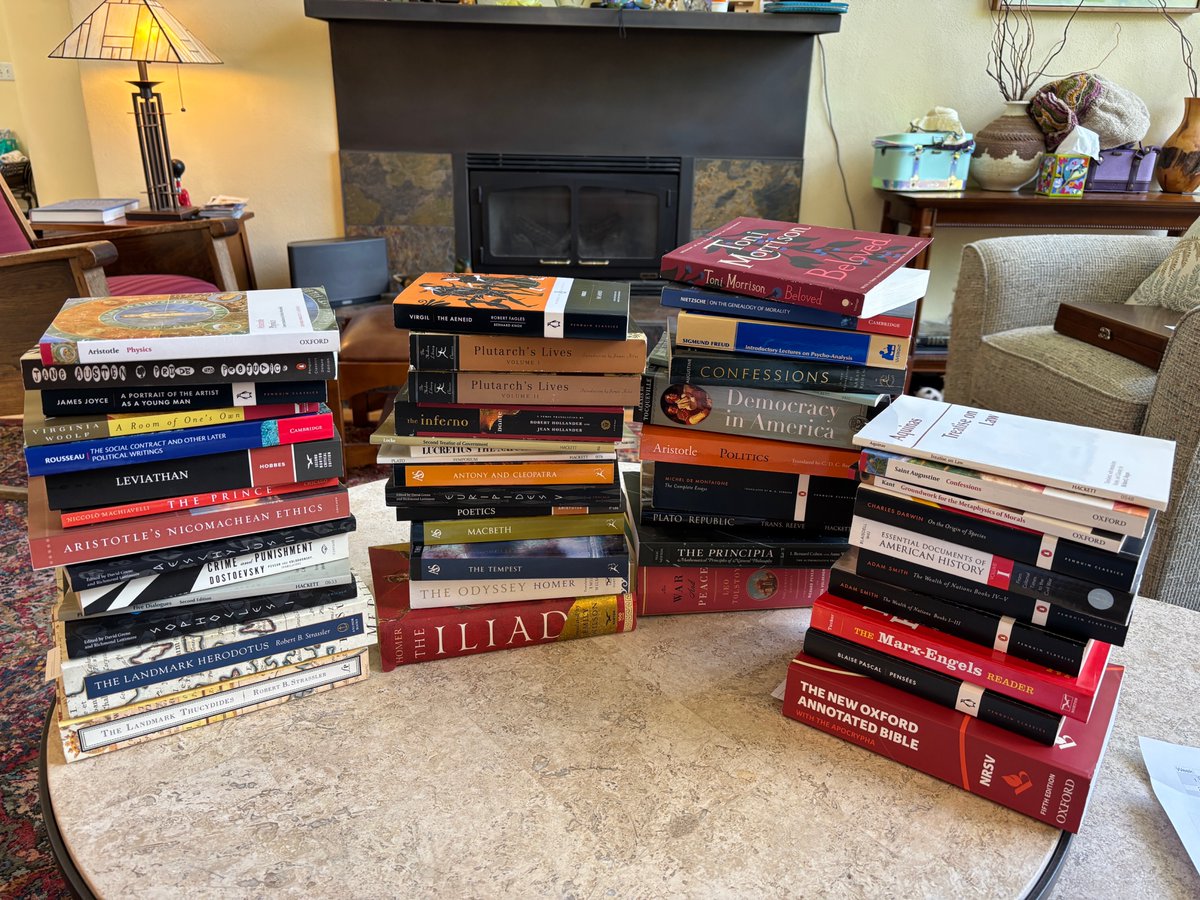
U Chicago offers a great four-year program studying the "Great Books of the Western World". Meets weekly online for 3hr discussion-based seminars with some wonderful facilitators and ~12 peers. Registration open for a few more weeks: https://t.co/Aq4f5ZSEQQ
I recently completed the program. Some reflections:
I can't tell you exactly why I signed up for this program. It sounded like a chance for ongoing encounters with beauty, I suppose. But also, some deep-down part of me harbored this delusion: "There are so many great classics I haven't read! So many great ideas I understand only shallowly. I can just sign up for this one program, and I'll end up checking so many metaphorical boxes!" In hindsight, I think I related to this mountain of books like a naive American tourist visiting Europe for the first time. I'll book a whirlwind guided tour to "check off" all the must-see sites! Then, in some sense, I'll be done with them!
That frame is obviously idiotic, both emotionally and practically. After about a thousand hours of reading and discussion, I don't feel I've truly understood or mostly metabolized almost any of these books. Rather, I got something like that naive tourist would: initial familiarity and connection with a wide range of cultural touchstones. The list of authors and works, once an abstract index, is now vivid and personal. Once I'd visited the Sagrada Familia, the idea of "checking it off" some kind of touristic bucket list became absurd. Instead, now that I'm introduced, I want to return again and again, noticing more and deepening my connection to it. Having finished my whirlwind tour, I now know where I'd like to return and linger on future trips. (Lucretius, Locke, Rousseau, Nietzsche...)
Programs like this call themselves "Great Books" programs, but I they're really more like "Great Ideas" programs. The selections and juxtapositions are designed to trace certain lines of Western thought: who should rule and how, the role of individuals in society, the shifting basis of morality, the meanings of virtue, knowledge, and justice, etc etc. I just loved following these arcs. They situate the texts in a web of humanity: rather than a grab-bag of independent texts, the selection was a series of unfolding conversations spread across centuries and continents. I found it plainly thrilling, for instance, to follow the beginnings of liberalism from abstract philosophical treatises up to the bloody stakes of the Declaration of Independence.
Part of the thrill is: individuals made these things! You can read their words. You can bear witness, centuries hence, to the birth of Plato's Forms, or deontology, or the novel as a literary form. Yes, I'm willing to give due credit to their intellectual contexts, and to hang appropriate asterisks on "Great Man" interpretations of history. But still—just imagine being Darwin, writing that book. I get very inspired in my design work thinking about Mendeleev and Playfair and Viete, individual humans who created new representations of thought for science and mathematics. This pile of books helped me appreciate the miracle of individual human invention behind so much in Western thought.
(photo from a classmate—alas, I mostly read digitally, which in hindsight deprived me of the physicality of this memory)
A paradox looms over the Brazilian economy:
unemployment has never been lower, income has never been higher. Yet household consumption is falling. Where did Brazilian families' money go? 🧵
Update: A lot of you have asked me to consolidate my book recommendations.
I’ve put them all in one place, categorized by topic, and will keep updating the list:
https://t.co/miyOaa5sMe
Qualquer pessoa que estude a década de 50 e 60 no Brasil sabe que isso aqui é meramente estética e nostalgia. A realidade é que nunca houve futuro nenhum, esse país sempre foi um motor de caos trabalhando contra si mesmo.
Basta abrir um orçamento da Novocap, ler as colunas do Eugênio Gudin (uma muito boa é de quando tentaram, em 1966, impedir a existência de café solúvel aqui) ou olhar que esse país tinha coisas como imposto sobre documentos, taxas de câmbio específicas para café e leis medievais contra usura em um país com hiperinflação.
Estudando nossa história de reformas e saltos de normalidade que retornam ao fundo do poço tenho cada vez mais certeza que o período de 1994 a 2010 foi um rasgo dimensional no espaço-tempo que nos jogou em uma linha paralela, mas já estamos de volta a dimensão normal.
Anteontem o FDA aprovou o daraxonrasib para câncer de pâncreas metastático. É o mesmo remédio cujo estudo, apresentado na sessão plenária da ASCO (principal congresso de oncologia do mundo) recebeu uma ovação de pé de quase um minuto. Vamos entender por quê
In Japan you will often see cafes and small shops with a small triangle shaped entrance cut into the front of the shop. The purpose is to soften the abrupt difference between shop interior and outside street and give customers a sheltered spot to sort out their umbrellas etc. It looks instantly welcoming and intimate. Here is a cozy cafe in Tokyo. The two chairs outside are for customers to wait their turn outside if the cafe is full. This is a tiny example of #GoodUrbanism on narrow streets and making the most of otherwise bland straight shop fronts.
Quem viaja de carro pelo Brasil sabe que se pode passar horas na estrada sem encontrar um banheiro limpo e uma refeição decente e confiável.
Isso ainda acontece em boa parte do país, mas em rodovias do Sul e Sudeste, uma família transformou essa incerteza em negócio: a rede Graal.