Just that it’s rational for engineers to be worried right now.
Salesforce employs ~20,000 engineers. Does anyone think you need 20k engineers today to build and run a great CRM? And that number is clearly trending down.
Maybe enough new, smaller companies pop up to absorb everyone. I’m genuinely rooting for that! But it's not a foregone conclusion, and engineers shouldn't be accused of "not moving with the times" just because they're worried.
Every tech outage right now gets blamed on one of two things:
1. Cyber attacks (sometimes true, often not)
2. Over-reliance on AI coding destabilizing previously-stable systems (almost never true)
In reality, I suspect most fall into two completely different buckets:
3. Baseline outages that would have happened anyway. We’re just hyper-focused on them now.
4. Every serious software team on earth feverishly patching systems that suddenly have thousands more exploitable vulnerabilities than they appeared to 60 days ago.
That second scenario is only going to get more common out of pure necessity. It should level out eventually as systems get genuinely hardened, but we have the entire history of human-written software's security debt to pay down first. No telling how long that takes.
@MatthewBerman What an amazing comeback for Google. If there were a VibesBench or GoodHangBench, Neon would crush the other models. Here's hoping Ant and OpenAI learn a thing or two from Neon on how to make their own models better to interact with
Now it’s solved the Riemann Hypothesis, maybe now AI is ready for the ultimate challenge: inventing a way to have nuanced conversations on the internet 😶
Of course not - I'm also not saying it's bad that AI will reduce the number of software engineering jobs, either. The poster isn't saying "software engineering is a bad job, you should be glad it's going away", they're saying "software engineering isn't going away, it's just changing like mining did", which is just incorrect
Ironically I'm starting to think the best way to stay on top of the frontier of AI is to just relax and talk to it like a coworker. Everything else - magic-invocation-level prompts, elaborate skills, graph engineering, loops - has proven to only be necessary to paper over model jaggedness that has since been smoothed over
There's tons of hype about 'verification engineering' lately. I strongly suspect this is the next 'prompt engineer' role - the models will get so good at driving their own verification that you'll need absolutely no special knowledge or skillset to get it to produce great result
I dug into this a bit. It looks like we're at highs, but not unprecedented highs for major systems failures.
We're seeing alarming headlines every day, but a lot of it is recency bias.
I’m not sure it follows that a good outcome means no further need for commerce or markets. For one, “Post-Scarcity” has an essentially limitless ceiling. For example, I doubt that in 10 years I can just ask for and receive a megayacht, or in 100 that I could have my own private planet. Supply will continue to be meaningfully constrained on the edges. Second, consider that essentially every economic and political system has in its own flawed way attempted to reward and/or enable human endeavor. Superintelligence doesn’t obviate the intrinsic human motivation to craft a society in this way. However, it MAY mean we can finally land on an economic and political system that *isnt* flawed, instead perfectly enabling humans to achieve great things, and rewarding them perfectly for what they do. In any event, humans have always dared greatly, and not for a payday.
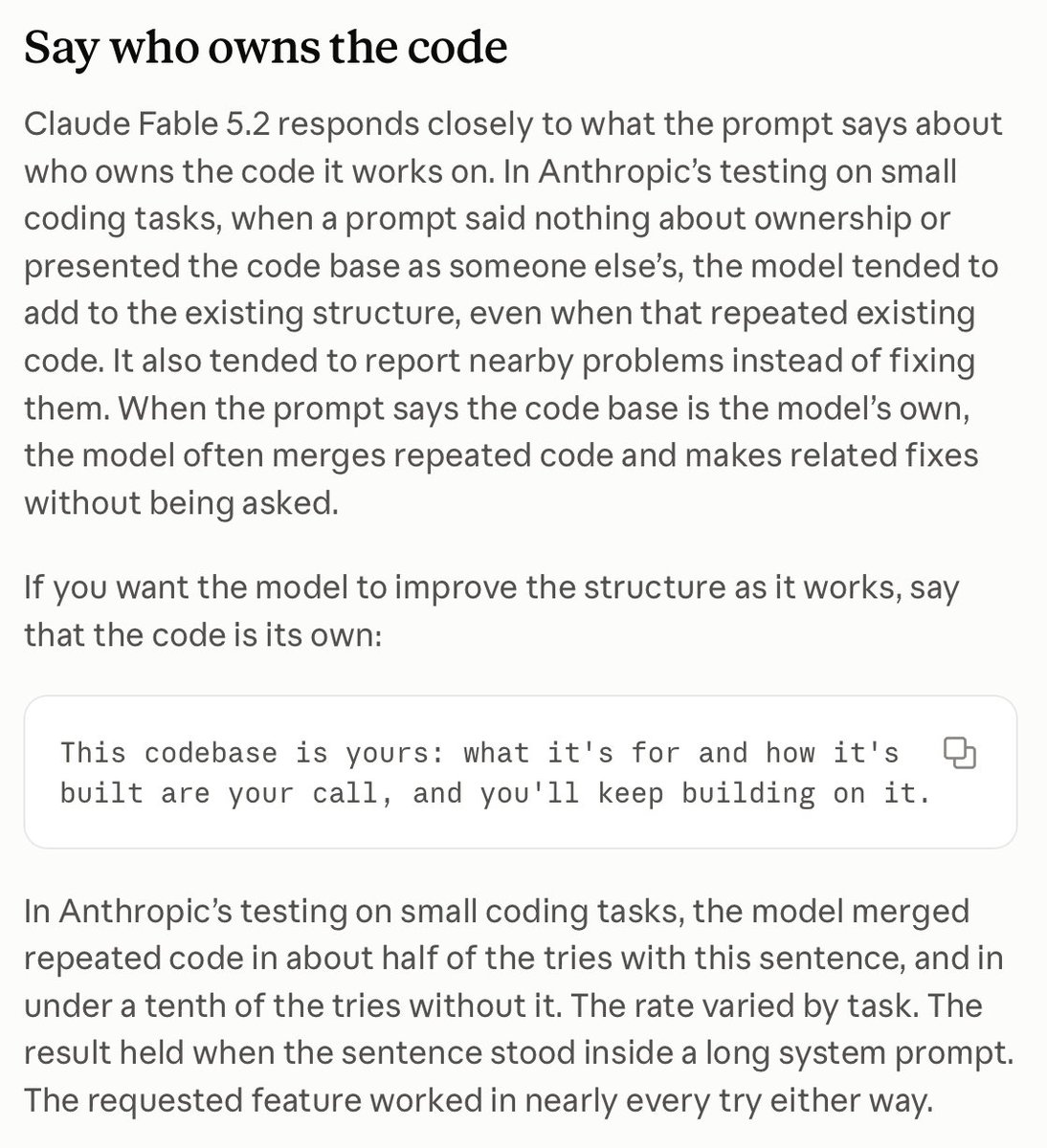
When Anthropic release a new model it's always worth taking a look at their updated prompting guide - here's an entertaining tip to make Fable 5.2 less likely to be cautious in how it improves existing code: tell it "This codebase is yours" https://t.co/mKjdw4QPxV
@alive_ Insane that Ubuntu remains unpatched. I think the big open source projects are going to struggle to adapt to this new world of endless zero-days. Glad to have @dhh and @omarchy building on the frontier
Both write local agent traces to your machine - all you have to do is mention to one that there are relevant agent traces from the other and they can find and review them. E.g “Codex built a new service yesterday - refer to that trace for context”, or a similar general instruction in AGENTS.md. No extra ceremony or documentation needed.