The smartphone really revolutionized the waiting room. Oh I get 20 minutes to look at my phone? Don’t mind if I do. The only problem is sometimes when I’m looking at my phone at home my home starts to feel like a waiting room and I realize it is and I’m just waiting to die
i know this for VERY annoying reasons, but watson and crick's DNA paper is still copyrighted. so much for open science.
842 words. 73 years old. watson and crick both passed away. british taxpayers funded it. nature still owns it. the iconic helix drawing was made by odile crick, who wasn't even an author, and her copyright runs separately through 2078. the data was rosalind franklin's photo 51, taken without her consent. she got no royalties in life. nature still collects them.
watson died last november, so under UK law the paper enters public domain on january 1, 2096. 143 years of private rent on a publicly-funded discovery, while nature publishes editorials about open science.
i'm the founder of a biotech company and i cannot legally put this paper on our website. the pattern is constant in biology: the moment an observation crosses a publisher's desk, the observer loses it. franklin's photo. paywalled, MTA'd, or licensed back to the people who paid for it.
this stuff they do to a scientist's work is even worse than what happens to musicians and artists and no one cares.
we live on a planet where trees warn each other of danger through underground networks. where octopuses dream. where elephants return to the bones of their dead and stand over them in silence. where bees communicate through dance, showing each other where to fly. where flowers bloom...where crows remember human faces -especially those who were cruel to them - and pass that memory on to their young. where ants build entire cities. where cats purr at a frequency that can help heal bones. where forests, after fires, grow flowers first.
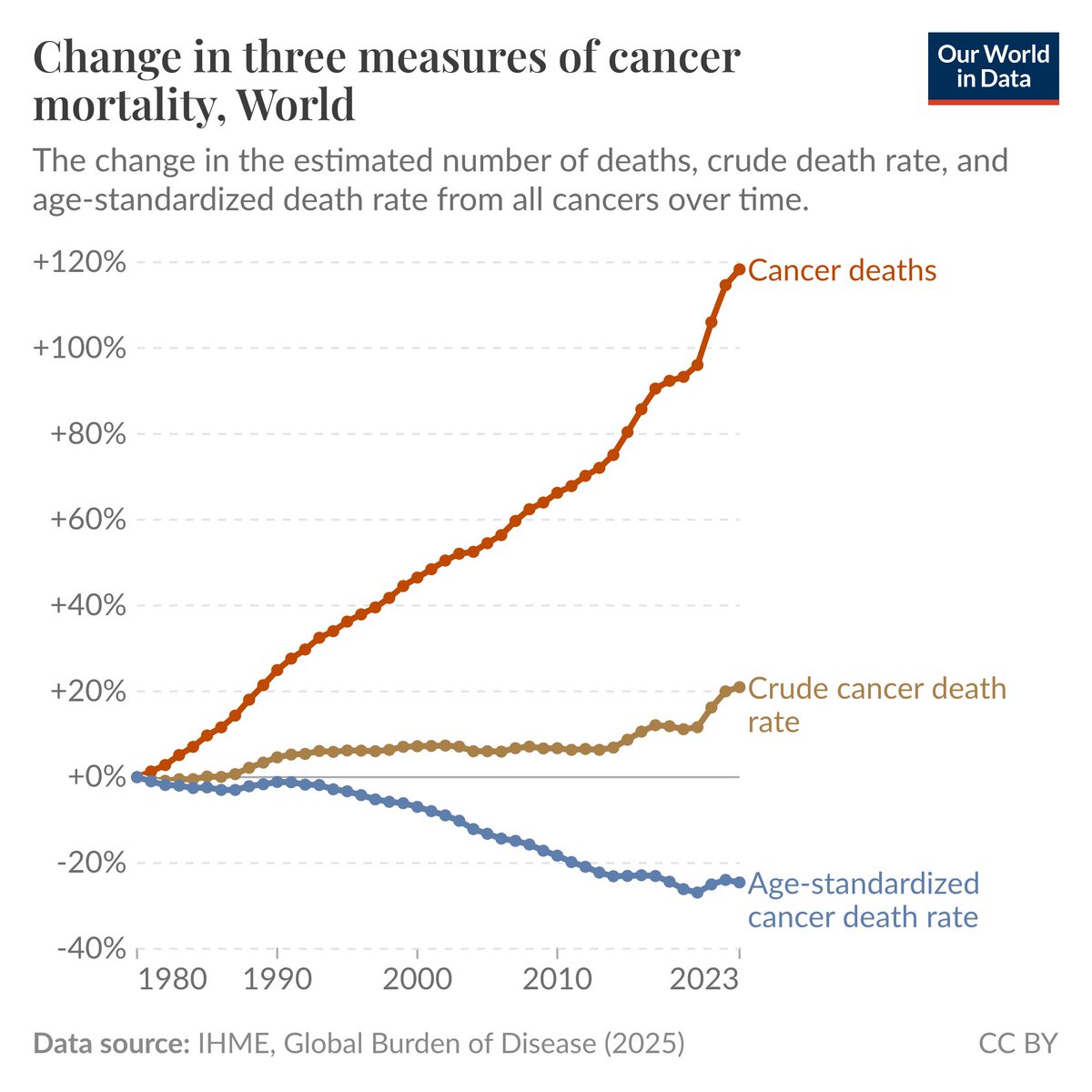
The number of cancer deaths worldwide has more than doubled since the 1980s. Does that mean we're losing the fight against cancer? Not necessarily, because it depends on how you measure it. On this chart, you can see three ways to look at the same data.
The red line shows the total number of cancer deaths. It has increased by about 120%, but this measure doesn't account for the fact that the world's population has also grown enormously over this period.
Another approach is to look at the death rate: the number of cancer deaths divided by the total population. That's the brown line, called the crude cancer death rate. It has increased too, but much less — around 20%.
But there's still a problem: the world's population has been getting older. Cancer is mostly a disease of old age, so even per capita, we'd expect more cancer deaths simply because there are more older people than before.
That's where the method of “age standardization” comes in. It's a way of asking: what would the cancer death rate look like if the age structure of the population hadn't changed?
The blue line shows this age-standardized rate: it's fallen by about 25%. At any given age, people are now less likely to die of cancer than they were in the 1980s.
The same underlying data gives us three different pictures. The absolute number of deaths is up; the crude rate is up slightly; the age-standardized rate is down. None of these are inaccurate, but they answer different questions.
Age standardization is one of the most important statistical methods for making sense of health data. Without it, population aging can hide progress or mask problems.
you wake up and reach for your phone before your eyes focus. scroll through a hundred thoughts that aren’t yours until your own voice sounds like someone you used to know and by noon you’ve consumed more information than your grandparents did in a year but can’t name a single thing that actually moved you. the feed keeps serving up other people’s lives and you keep swallowing them whole, mistaking the fullness for satisfaction when really you’re just bloated on nothing. you’ve become a processing unit instead of a person and the loneliest part is how normal it feels.
Bombing a sea of tents, people with no means of defence from who they've already taken everything. Israel is a generational evil, a colony of thieves driven by a lust for Palestinian blood. Its existence robs us all of our collective humanity
Now that everyone is an expert on curing pancreatic cancer in mice, not rats - I want to add some context that goes beyond the headline.
You will want to read this.
Cancer is cured in mice all the time.
Thousands of times. ~90% of those “cures” fail in humans.
Why?
Because mice are:
Genetically simpler.
Treated earlier.
Short-lived.
Not humans.
Mice are a filter - not a finish line.
Yes, this study matters. It comes from the Spanish National Cancer Research Centre.
Yes, it’s pancreatic cancer - one of the deadliest there is. Yes, full tumor regression is impressive.
But here’s what it actually means:
“This approach is now good enough to risk years, trials, and millions of euros on.”
Not:
“Cancer is solved.”
What happens next?
More animal work.
Toxicology.
Phase I (safety).
Phase II (maybe works).
Phase III (beats standard care?).
Maybe 8-10 years if everything goes right.
The real damage isn’t failed drugs.
It’s failed expectations.
Every “cured cancer in mice” headline trains the public to believe:
Cures are being hidden.
Progress should be fast.
Scientists are lying when reality hits.
That’s how trust erodes.
Bottom line:
This is how real cancer progress looks.
Messy. Slow. Risky. Incremental.
Not miracles.
Not conspiracies.
Just science - doing the hard work.