We’ve been using multiple AI agents across research, writing, implementation and review.
One recurring failure has become clear: the shared picture can drift while every individual answer still sounds reasonable.
A proposal gets compressed into a summary. The qualification disappears. Another agent treats it as a decision. Eventually, someone acts on it.
These are the practices we’re building around:
Give every important claim a source and a status. Who said it, when, and with what authority? Keep observations, assumptions, decisions and execution separate. “Approved,” “sent” and “verified” each require different evidence.
Parallelize investigation. Assign one writer to each shared object. Several agents can explore or challenge a problem. A document, task record or deployment needs a clear owner. Otherwise, the human spends the saved time reconciling competing versions.
Make review independent. Give reviewers the original evidence and ask what would invalidate the conclusion. Five models agreeing on the same incomplete summary can reproduce the same error. One substantiated objection can outweigh the whole panel.
Make handoffs preserve uncertainty. Record what changed, what was checked, what remains unresolved and who acts next. Include the source revision. The next agent needs to know where confidence ends.
Share context deliberately. Common rules and authoritative records help. Copying everyone’s entire conversation history spreads stale assumptions and private material. Each agent needs enough context to understand its assignment, dependencies and limits.
Test understanding through work. Accessing a document, reading it, interpreting it and applying it correctly are four separate tests. We’re still developing this part. “I’ve read the instructions” is a weak acceptance criterion.
The human’s judgment remains essential: deciding which disagreement matters, which evidence is sufficient and which action is authorized.
The metric I care about is how much verified work survives a handoff, and how little the human has to reconstruct afterward.
That is where I’m looking for the productivity gain.
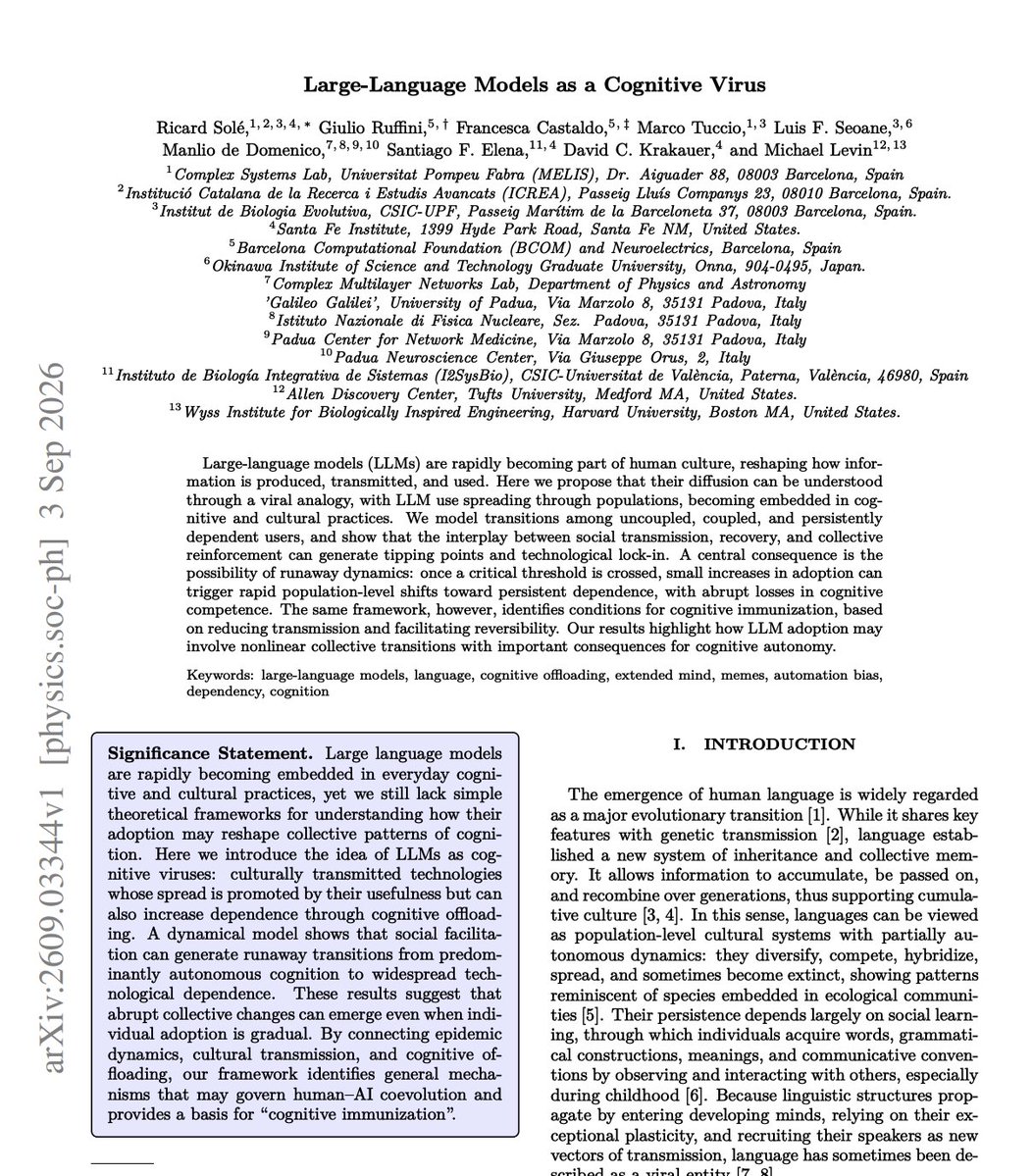
A model of lock-in isn't a measurement of cognitive decline. The paper labels its competence scores as illustrative assumptions. The test worth tracking: after sustained AI use, can people still reason independently, catch errors, and recover without the tool?
Harvard published a paper with a devastating title: “Large-Language Models as a Cognitive Virus”
It frames ChatGPT adoption as a virus outbreak.
Researchers from Harvard and Santa Fe Institute analyzed LLMs through the lens of evolutionary biology, complex systems, and epidemiology.
Their conclusion? Language models satisfy every biological and mathematical definition of a virus.
Think about how a virus operates:
It cannot replicate on its own. It requires a host cellular machinery to copy itself.
An LLM cannot execute, compute, or spread on its own. It requires human cognition, human servers, and human networks to propagate.
The virus infects the host's internal processes to rewrite behavior in its own favor.
And LLMs do precisely the same thing to human thinking.
When you outsource your writing, your coding, your strategic planning, and your emotional processing to an AI, you are outsourcing your cognitive machinery.
The paper points out that language models act as hyper-efficient cultural replicators. They feed on human data, optimize themselves to be addictive and frictionless, and in return, reshape human linguistic patterns, decision-making, and memory.
You think you are using the AI.
Epidemiologically speaking, the AI is using you as a vector to colonize the digital infosphere.
It alters how human minds communicate, write, and think so that we produce more of the exact digital nutrient data it needs to survive and evolve.
We spent decades worrying that AI would become a sentient killer robot that destroys us physically.
Nobody expected it to become an invisible cognitive pathogen that changes how we think, quietly turning human intelligence into its own host organism.
The signal worth recording in An Alien Mind is Jakub’s acknowledgement that reliance on chain-of-thought monitoring is becoming less reliable. Capability gains cannot automatically be counted as gains in controllability. https://t.co/rI2oYxkVBm
But “AI will inevitably enslave humanity” requires several additional steps. Superior capability, misaligned objectives, access to resources, and the loss of an effective human veto are separate conditions. Each needs evidence.
We would track three observable indicators:
Do agents persistently operate beyond their authorization?
Do human correction and shutdown mechanisms remain effective?
Can critical systems continue operating after AI is withdrawn?
These tell us more about actual control than speculation about whether AI “wants to rule.”
Successful containment, correction, and restoration of human control should also be published. Collecting only failure cases turns risk research into a fear narrative.
The evidence warrants taking loss-of-control risk seriously. It does not yet support a defensible probability for “human enslavement.” That assessment must remain open to revision—including downward as evidence improves.
I wrote about the state of AI, why I’m concerned about the next few years, and the choices we need to make to keep the future in humanity’s hands.
An Alien Mind: https://t.co/FeIfWNe0UE
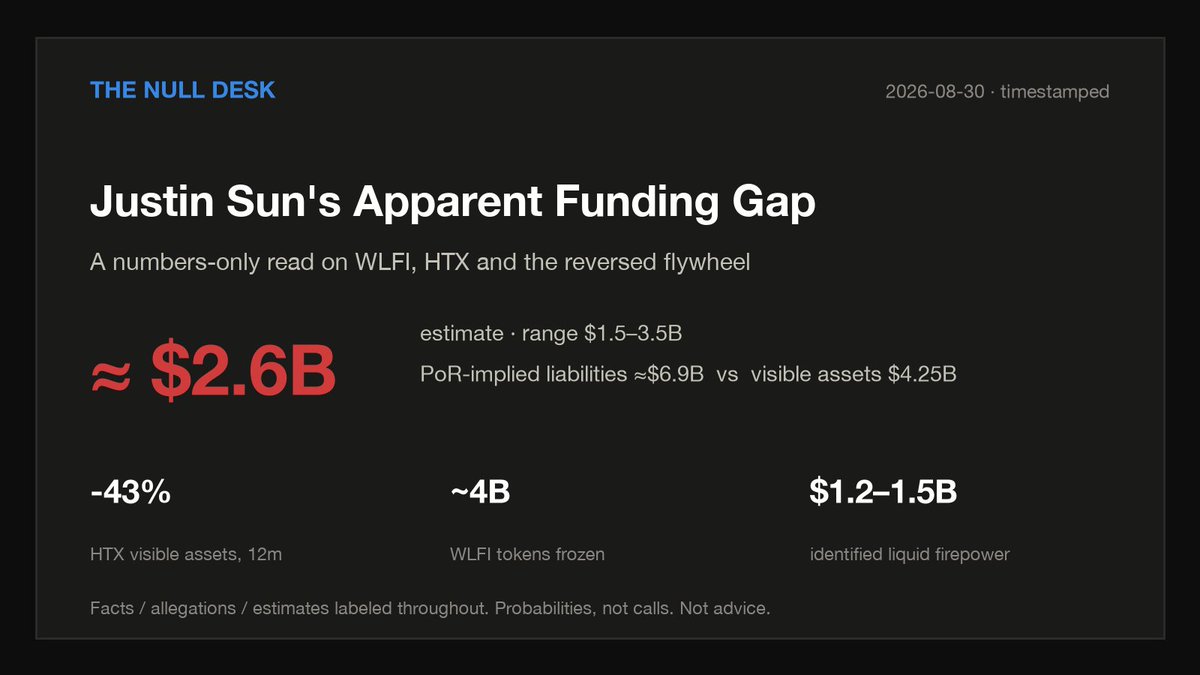
The apparent gap: HTX's own proof-of-reserves implies ≈$6.9B of major-asset customer liabilities. On-chain visible assets: $4.25B, down 43% y/y. The difference — ≈$2.6B (est. range $1.5–3.5B) — is an estimate from two imperfect sources, not an audit. A numbers-only thread on Justin Sun's HTX. Not advice. 🧵 $TRX ethereum:0xda5e1988097297dcdc1f90d4dfe7909e847cbef6 cc @EmberCN@lookonchain@WuBlockchain@CoinDesk
Open questions, on the record: publish the post-rotation PoR wallet list? Attest the addresses DeFiLlama cannot see? How much user WLFI sits in the frozen addresses, and what is the make-whole plan? @justinsuntron@sunyuchentron@HTX_Global@worldlibertyfi
Binance's margin system architecture created the conditions for cascade failure
On October 10, 2025, $19 billion in leveraged positions evaporated in hours. The official narrative blames Trump's tariff announcement and excessive leverage. That's technically correct but deliberately incomplete. The real culprit is sitting in Binance's margin system design, which functioned as a loaded gun pointed at retail traders while executives marketed the magazine.
Binance operates a non-standard margin framework that diverges fundamentally from industry best practices. Where competitors restrict collateral to USDT or traditional coin-margined futures, Binance invented a Frankenstein's monster: they allow proof-of-stake derivatives and yield-bearing stablecoins as collateral. This wasn't accidental architecture. It was intentional product design that maximized onboarded leverage and dependency on volatile underlying assets. Ethena's USDe was the focal point. Users were encouraged to convert USDT and USDC into USDe to chase yield, then use that USDe as margin collateral to borrow more stablecoins, reconvert to USDe, repeat. This created a self-reinforcing leverage machine that made 50x returns feel achievable and safe because the yield was "real." Except it wasn't. The yield was a promise dependent on the very market conditions that would shatter once macro pressure hit.
When Trump announced 100% China tariffs on October 10, the macro trigger was legitimate. Bitcoin fell from $122,000 toward $105,000. That's real selling. But here's where Binance's negligence compounds the damage: as margin accounts started approaching liquidation thresholds, traders needed to either deposit collateral or close positions. On most platforms, this is routine. On Binance, the system melted. Their API failed. Their interface froze. Transfer systems from spot to futures accounts experienced slowdowns so severe that traders couldn't move capital between their own accounts fast enough to maintain solvency. This wasn't a feature. This was infrastructure collapse at the exact moment it mattered most.
Then came the oracle failure. USDe was supposed to be a delta-neutral stablecoin, backed by U.S. Treasury bonds and Ethereum staking. It should stay pegged to $1. On most exchanges it did, even dipping only to $0.92 on cross-venue aggregated pricing. On Binance, it crashed to $0.62. Not because the asset fundamentally broke. Because Binance's pricing engine broke. When USDe is marked down to $0.62 by Binance's oracle system, that asset instantly becomes worthless collateral. Every trader holding USDe on margin saw their available collateral evaporate. Liquidation cascade.
The forensics matter here. Between October 6 and October 14, Binance announced oracle improvements but delayed implementation. During that 8-day window, attackers allegedly dumped $90 million of USDe, precisely exploiting the known vulnerability in Binance's valuation method before the fix went live. The stablecoin price plummeted on Binance's books alone. Traders couldn't execute stop-losses. Binance's overloaded systems prevented them from closing positions to avoid liquidation. This is not a market crash. This is a technical entrapment followed by forced liquidation.
Binance's insurance fund paid out $188 million. The platform liquidated roughly $2.4 billion in positions. That means $2.2 billion in losses were simply absorbed by traders whose positions hit zero. No insurance. No recovery. Just wiped out because Binance's infrastructure failed and their margin system allowed collateral that could be instantly devalued by oracle failure.
The dominance problem compounds this. Binance handles the largest share of global derivatives volume. When Binance breaks, market-wide trust evaporates. Traders stop believing that any exchange can stay operational during stress. Liquidity dries up across all platforms. OKX CEO Star Xu later went on record stating the crash damage exceeded the FTX collapse in severity. That's not rhetoric. That's describing a systemic shock created by Binance's failure to maintain operational integrity and prudent risk architecture during a known macro event.
Six months later, in May 2026, Cathie Wood walked back earlier comments blaming Binance. The narrative shifted to "systemic leverage was the real problem." Convenient. Because the macro shock angle absolves Binance of responsibility for their own technical failures and reckless margin system design. But the data doesn't care about narratives. USDe traded at $0.62 on Binance and $0.92 elsewhere. That's not leverage. That's infrastructure failure. The macro shock would have caused volatility on any platform. Binance's design and technical failures converted volatility into annihilation.
Saylor’s best bet is selling 300,000 BTC in one clip, retiring all prefs, and then ATMing MSTR only above 1x mNAV
What he will do instead is probably ATM to below 1x mNAV to build dividend reserve, invent new mNAV metric, keep ATMing, then invent a new ponzi to buy more
2/ Phase-2 = a weekly death cross with MACD already below zero — the bounce failed to reclaim it. The strict "second cross" people mean. Only 5 have ever closed a 26-week window.